Shih Tzu Colors: Common Shades, Patterns, and What Changes with Age
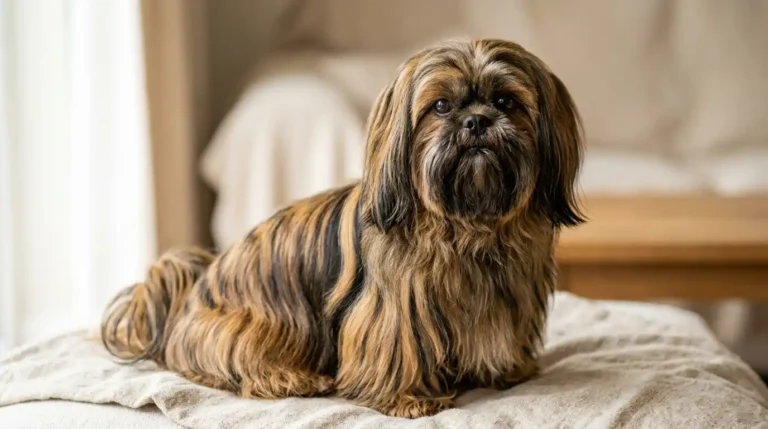
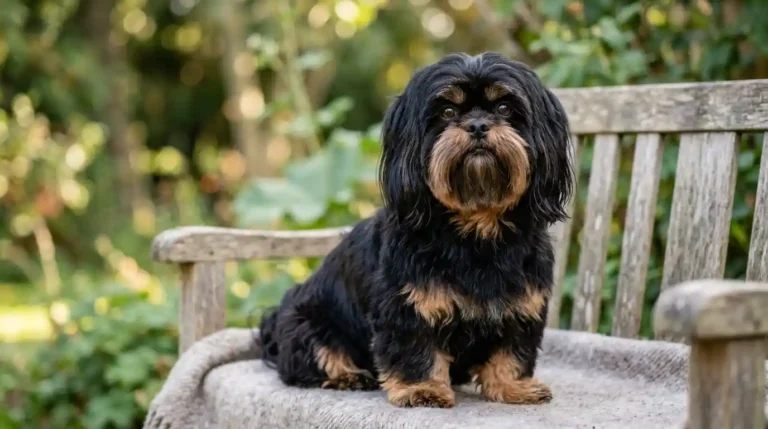
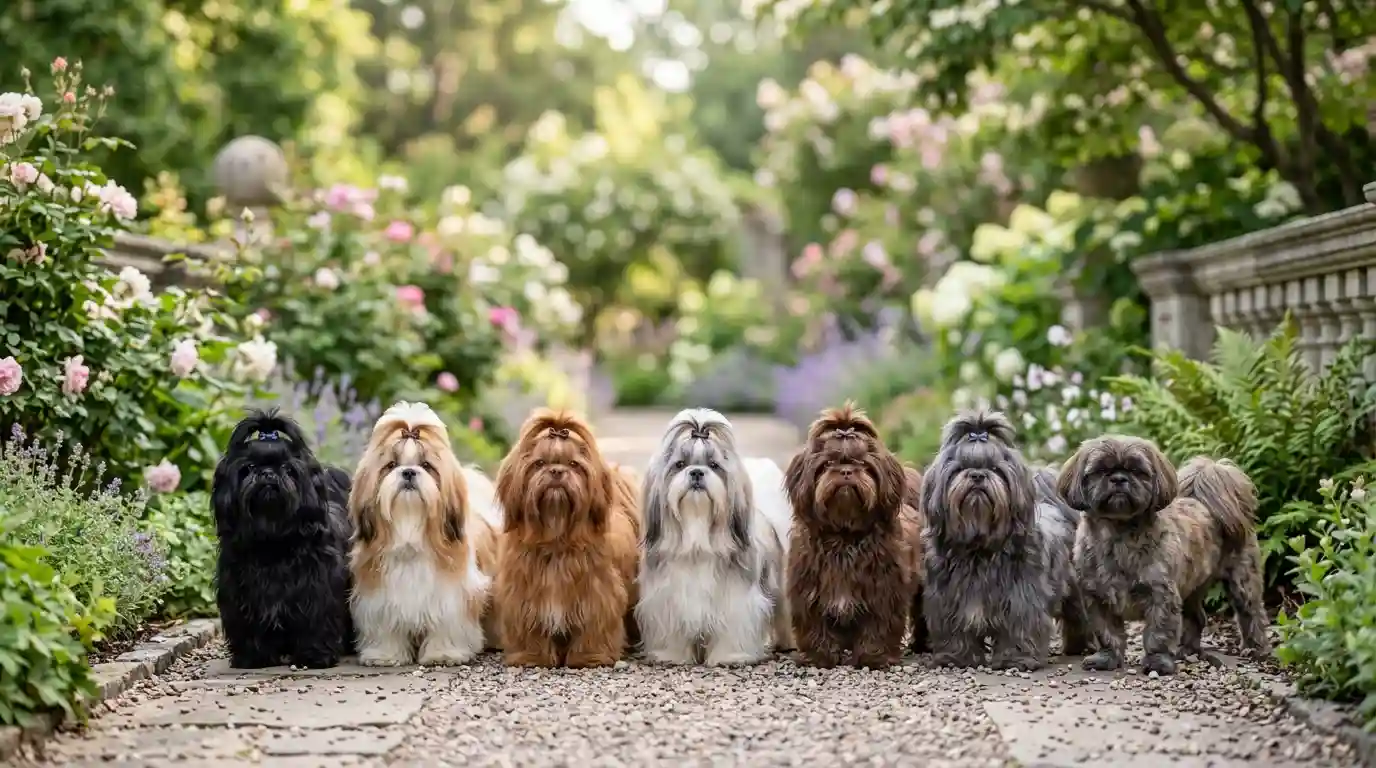
Shih Tzu colors range from solid black, white, gold, red, silver, blue, and liver to striking two-color and three-color combinations. The breed can also display brindle, black masks, white blazes, parti-color patterns, dark tips, and other markings that make two Shih Tzus with the same registered color look completely different. To identify a dog’s color accurately, however, you need to separate three things: coat color, coat pattern, and skin pigmentation. A brown-looking coat does not automatically mean liver, a gray coat does not automatically mean blue, and a puppy’s shade may look noticeably different once its adult coat grows in. This complete Shih Tzu color chart explains the major colors and combinations, how pigmentation of the nose and eye rims fits into identification, why Shih Tzu puppy colors can change with age, what AKC registration labels actually mean, and why claims about “rare Shih Tzu colors” should be treated cautiously.
Table of Contents
- What colors can Shih Tzus be?
- How to tell coat color, pattern, and pigment apart
- Why a Shih Tzu’s color may change as it grows
- What “recognized color” means in registration and breed standards
- Coat care and keeping light areas clean
- Do color claims predict health, temperament, or price?
- Frequently asked questions about Shih Tzu colors
- Final thoughts
What Colors Can Shih Tzus Be?
One reason Shih Tzu dog colors can seem confusing is that the breed has an unusually broad range of appearances.
A Shih Tzu may be:
- Completely black
- Predominantly white
- Gold
- Red
- Silver
- Blue-pigmented
- Liver-pigmented
- Brindle
- Black and white
- Gold and white
- Red and white
- Liver and white
- Blue and white
- Silver and white
- Brindle and white
- A three-color combination
- A warm brown-looking shade
- A lighter cream or blonde appearance
- Patterned with masks, blazes, saddles, or darker tips
Some of these are formal registration terms. Others are everyday descriptions used by owners and breeders.
That difference matters.
For example, liver has a specific relationship to brown pigmentation, while “chocolate” is often used more casually to describe how the coat looks.
Likewise, blue refers primarily to diluted pigmentation, not simply any gray-looking Shih Tzu.
Before comparing individual shades, it helps to understand that canine hair color comes primarily from two pigment families:
- Eumelanin, which normally produces black pigment and can be modified to brown or diluted shades.
- Phaeomelanin, which produces red and yellow shades ranging from deep red through gold and cream.
Genes at several locations—including the E, K, A, B, D, and white-spotting-related loci—can influence which pigment appears, where it appears, and how intense it looks.
You do not need to become a canine geneticist to identify your dog’s color, but this explains why a simple visual label sometimes fails to tell the whole story.
For broader breed information beyond color, see our shih tzu Breed Information section and collection of Shih Tzu facts.
Quick Shih Tzu Color Chart
| Color or Pattern | Typical Appearance | Important Identification Point |
| Black | Solid or predominantly black | Black pigment points |
| White | Predominantly white hair | Pigment points still matter |
| Gold | Yellow-gold, honey, warm golden | Usually black pigmentation |
| Red | Copper, orange-red, auburn | Usually black pigmentation unless liver |
| Silver | Pale gray or silver appearance | Can change noticeably with age |
| Blue | Diluted black pigmentation | Nose/skin may appear blue-gray |
| Liver | Brown pigmentation | Brown nose, lips, eye rims |
| Brindle | Intermixed darker and lighter bands | A pattern, not one simple shade |
| Black & white | Black patches with white | Black pigment |
| Gold & white | Golden areas with white | Warm but lighter than many reds |
| Red & white | Copper/red areas with white | Usually black points |
| Liver & white | Liver pigmentation plus white | Brown pigment points |
| Blue & white | Diluted pigmentation with white | Blue-gray pigment points |
| Silver & white | Silver areas combined with white | Shade may evolve |
| Brindle & white | Brindle areas plus white | Pattern may become less obvious |
| Tricolor | Three visible colors | Distribution varies widely |
Common Solid Colors
“Solid” usually means that one color dominates the visible coat, although tiny patches, lighter hairs, or shading may still occur.
Black Shih Tzu
A black Shih Tzu can have a striking deep black coat with black nose, lips, eye rims, and paw-pad pigmentation.
Some dogs described as solid black have small white areas on the chest or toes.
Sun exposure and normal hair wear can also make the tips of black hair look slightly brown or rusty without changing the dog’s underlying color.
Black should not be confused with very dark brindle.
A black brindle Shih Tzu contains patterned lighter or differently colored hairs within the darker coat.
White Shih Tzu
A white Shih Tzu may appear almost entirely white, but white hair does not mean the dog lacks pigmentation everywhere.
A normally pigmented white Shih Tzu should still have dark pigment around areas such as the nose and eye rims unless another pigmentation type is present.
A true albino Shih Tzu involves a completely different pigmentation issue and should not be confused with an ordinary white coat.
Gold Shih Tzu
Gold is one of the classic warm Shih Tzu coat appearances.
The shade may range from:
- Pale honey
- Wheat gold
- Rich gold
- Golden tan
- Orange-gold
Gold may become lighter as the dog matures.
When white areas are present, the dog may be described as a gold and white Shih Tzu.
Red Shih Tzu
A red Shih Tzu can range from deep orange and copper to auburn or reddish gold.
Red is produced by phaeomelanin rather than black eumelanin.
That distinction becomes particularly useful when comparing red dogs with liver pigmentation.
A red dog may have black points, while a red liver Shih Tzu has a red-looking coat combined with liver-brown pigmentation.
Silver Shih Tzu
A silver Shih Tzu may range from pale metallic gray to a much lighter silvery appearance.
Silver can be particularly difficult to identify in young puppies because dark puppy hair may lighten considerably.
This makes silver one of the colors for which Shih Tzu color change before-and-after photos can look especially dramatic.
Blue Shih Tzu
A blue Shih Tzu is identified primarily through diluted pigmentation.
Instead of normal black pigmentation, a blue-pigmented dog may have a slate, charcoal, or bluish-gray nose and related pigment points.
This is why simply having gray hair does not automatically make a dog blue.
Compare that with a blue gray Shih Tzu, where the overall coat can visually emphasize gray tones.
Liver Shih Tzu
A liver Shih Tzu has brown-based eumelanin pigmentation.
The clearest signs are usually:
- Brown or liver nose
- Brown lips
- Brown eye rims
- Brown-based paw-pad pigmentation
The visible coat does not have to be uniformly dark chocolate.
A liver-colored Shih Tzu may have a cream, red, gold, brown, or mixed-looking coat because liver primarily describes pigmentation rather than one required hair shade.
A rich dark-brown dog may also be described informally as a liver chocolate Shih Tzu.
Brown, Chocolate, and Golden Brown
Owners frequently search for chocolate color Shih Tzu, dark brown Shih Tzu colors, or caramel-looking coats.
These descriptions can be useful visually, but they do not automatically identify genotype.
A brown Shih Tzu may look chocolate, medium brown, or reddish brown.
A golden brown Shih Tzu sits visually closer to warm gold, caramel, tan, or light brown.
The informal term “caramelo” may similarly be used in some markets for a warm caramel-colored dog.
Always inspect nose and eye-rim pigmentation before assuming that brown-looking hair proves liver pigmentation.
Cream and Blonde
A cream color Shih Tzu may appear pale gold, ivory, warm off-white, or light beige.
Owners may also use “blonde” for this appearance.
Our blonde Shih Tzu guide explains why very pale gold and cream-like dogs can be difficult to label consistently from photographs.
These dogs should not automatically be classified as white simply because their coat is very light.
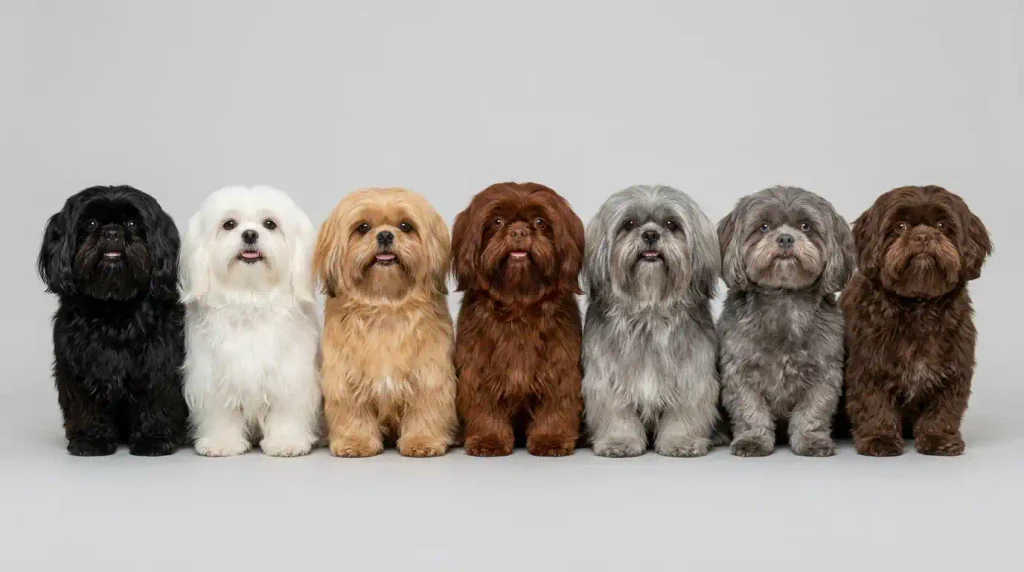
Two-Color and Three-Color Coats
Many of the most recognizable colors of Shih Tzu combine white with another color.
Black and White
A black and white Shih Tzu can range from nearly solid black with a white chest to predominantly white with black patches.
Common white areas include:
- Muzzle
- Forehead
- Neck
- Chest
- Legs
- Belly
- Tail tip
The exact pattern is not required to be symmetrical.
Gold and White
A gold and white Shih Tzu combines white spotting with warm golden areas.
A puppy may appear darker gold initially and lighten as it matures.
Red and White
A red and white Shih Tzu has copper, auburn, orange-red, or reddish-gold areas combined with white.
One dog may be predominantly red, while another may be mostly white with red ears and back patches.
Liver and White
A liver and white Shih Tzu combines white coat markings with liver pigmentation.
Remember that the liver identification comes primarily from brown pigment points rather than simply from the amount of brown-colored hair.
Blue and White
A blue and white Shih Tzu combines white areas with blue-associated diluted pigmentation.
A gray-and-white-looking coat should not automatically be called blue unless the pigmentation supports that identification.
Silver and White
A silver and white Shih Tzu may show pale gray or silver sections separated by white.
The contrast between the two colors can become more noticeable—or less obvious—as the adult coat develops.
Brown and White
A brown and white Shih Tzu describes a brown-looking coat combined with white.
Again, “brown” as a visual description is not necessarily identical to liver pigmentation.
Tan and White
A tan and white Shih Tzu usually appears lighter and less saturated than a red-and-white dog.
Gold, tan, cream, and light red can overlap visually, especially in photographs.
Gray and White
A grey and white Shih Tzu may have gray or charcoal areas combined with white.
Gray hair by itself does not establish blue pigmentation.
Brindle and White
A brindle and white Shih Tzu combines brindle-patterned areas with clearly white sections.
This is a useful example of why color and pattern are not the same thing.
The white is a spotting pattern, while brindle describes how darker and lighter pigment is arranged in the colored sections.
What Is a Tricolor Shih Tzu?
A tri color Shih Tzu, tricolor Shih Tzu, or Shih Tzu tri color has three visibly distinct colors in its coat.
Examples may include:
- Black, gold, and white
- Black, silver, and white
- Silver, gold, and white
- Black, brown/tan, and white
AKC registration terminology currently includes several three-color combinations, including Black Gold & Silver, Black White & Silver, Silver Gold & White, and Black Gold & White.
A tricolor Shih Tzu puppy may look especially dramatic because the three shades can create facial masks, eyebrow-like markings, chest patches, and saddle patterns.
However, the colors may change in intensity as the puppy grows.
For example, gold areas can lighten, silver can become more obvious, and black tipping may become less prominent.
A brown black and white Shih Tzu is another useful visual example of a dog that owners may informally describe as tricolor.
Similarly, a black and brown Shih Tzu may display multiple dark and warm shades even if white is minimal.

How to Tell Coat Color, Pattern, and Pigment Apart
One of the biggest mistakes people make when identifying Shih Tzu coat colors is treating every visible feature as “the color.”
In reality, at least three separate things are involved:
Coat color: The shade of individual pigmented hairs, such as black, red, gold, brown, or silver.
Pattern: How those colors are distributed, such as brindle, parti-color, merle, saddle, or mask.
Pigmentation: The color of the nose, lips, eye rims, paw pads, and other skin points.
A dog might therefore have:
Red coat + white spotting + black pigmentation
or:
Red coat + white spotting + liver pigmentation
or:
Brindle pattern + white spotting + black pigmentation
Those dogs can look superficially similar while representing different color characteristics.
What Parti-Color and Brindle Mean
Parti-Color
“Parti-color” generally describes a dog with areas of white combined with another color or pattern.
A parti-color Shih Tzu might be:
- Black and white
- Gold and white
- Red and white
- Liver and white
- Brindle and white
The amount of white can vary dramatically.
One dog might have a white chest and legs with a mostly colored body. Another could be almost entirely white with only colored ears and several body patches.
White spotting is genetically complex, and the exact distribution often varies even among related dogs.
Brindle
A brindle Shih Tzu has darker and lighter pigment arranged in a striped, banded, or intermingled pattern.
Shih Tzu brindle color can range from highly obvious striping to a pattern that looks almost uniformly dark from a distance.
Variants include:
- Black brindle Shih Tzu
- Red brindle Shih Tzu
- Silver brindle Shih Tzu
- Blue brindle Shih Tzu
- Brindle and white Shih Tzu
A brindle Shih Tzu color change can be particularly interesting because darker hair tips or stripes may become much less obvious once the adult coat grows.
This can make a strongly brindled puppy look comparatively gold, silver, or gray later.
Merle
A merle Shih Tzu has irregular areas in which eumelanin is diluted, creating mottled or marbled patches.
Merle is a pattern, not simply another solid shade.
A blue merle Shih Tzu typically describes a black-based merle appearance where solid black alternates with lighter gray areas.
This is different from ordinary blue dilution.
Merle deserves separate genetic consideration because two merle-associated variants can create greater risks for hearing and eye abnormalities.
What About Sable?
A sable color Shih Tzu may have warm red, gold, or tan hair with darker eumelanin tips.
The overall appearance can change significantly with hair growth because the amount of dark tipping visible in a young puppy may not remain equally obvious in the adult coat.
A sable-looking puppy can therefore be mistaken for brindle, black and tan, or a dark gold dog depending on the distribution of the darker hairs.
Where Nose, Lip, Eye-Rim, and Paw-Pad Pigment Fits
Pigmentation is especially important for distinguishing liver and blue from ordinary black-pigmented colors.
The U.S. breed standard says that the nose, lips, and eye rims should be black on all colors except liver-pigmented and blue-pigmented dogs.
That means:
Black nose + gold coat = ordinary black eumelanin pigmentation.
Brown nose + gold/red/cream coat = possible liver pigmentation.
Slate or blue-gray nose + grayish coat = possible blue pigmentation.
Paw pads can provide another clue, but they should not be used alone.
Liver Pigmentation
The B locus affects whether eumelanin appears black or brown.
A liver color Shih Tzu therefore has brown-based pigment on areas that would normally appear black.
This is why searches for Shih Tzu liver color, liver Shih Tzu colors, or a liver-colored Shih Tzu should focus first on the nose and eye rims.
Coat shade alone can mislead.
Blue Pigmentation
The D locus can dilute darker eumelanin, producing a blue or slate appearance.
A Shih Tzu blue color should therefore be identified partly through pigmentation rather than simply through gray hair.
This distinction separates a genetically blue Shih Tzu from an ordinary grey Shih Tzu.
Lavender and Isabella
The dilution gene can also modify brown eumelanin to a paler shade often called lilac or Isabella in dogs.
Owners may encounter terms such as lavender Shih Tzu or lavender blue Shih Tzu.
These terms are used inconsistently in the pet market, so appearance alone should not be treated as genetic proof.
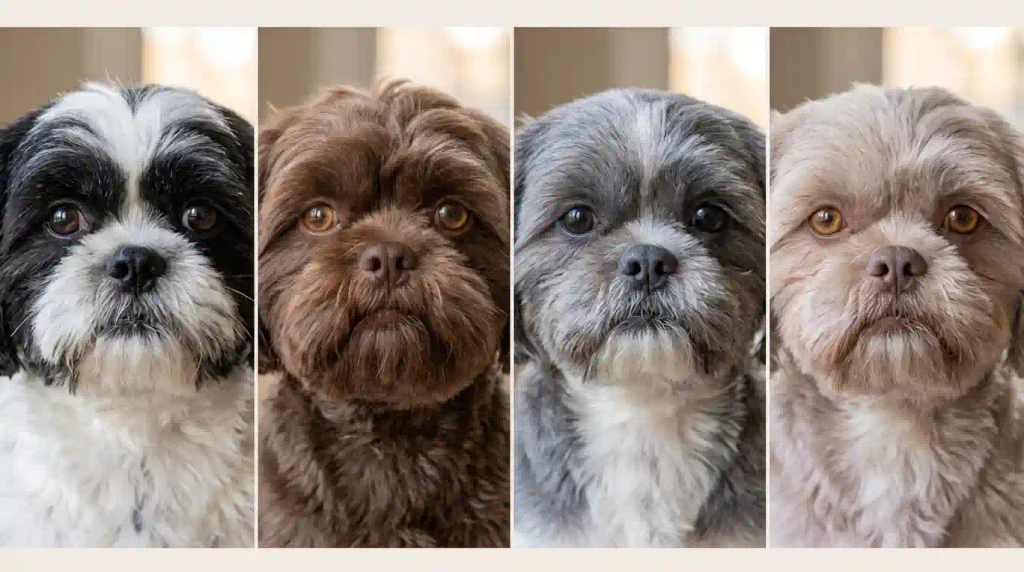
Shih Tzu Eye Color
Shih Tzu eye color also interacts with pigment identification, although the eyes should not be used alone to determine coat color.
The breed standard generally calls for very dark eyes, but liver- and blue-pigmented dogs may have lighter eyes.
Possible descriptions include:
- Very dark brown
- Brown
- Hazel-like
- Amber-toned
Lighting can alter how light-colored eyes appear in photographs.
A light eye does not automatically prove liver or blue pigmentation.
Evaluate the nose, lips, eye rims, coat, and genetic information together.
Common Markings, From Masks to Blazes
Markings can dramatically change how a Shih Tzu’s base color looks.
Black Mask
A black mask concentrates dark eumelanin around the muzzle and facial area.
A black mask gold Shih Tzu can look much darker around the face than an ordinary gold dog.
Do not confuse a black mask with staining or simply dark nose pigmentation.
Blaze
A blaze is a white stripe or wider white area running upward along the face, commonly between the eyes.
It may be narrow and symmetrical or broad and uneven.
Flare
Owners and breeders sometimes use “flare” for a larger white facial marking or expanded blaze.
The terminology is descriptive rather than a separate coat color.
Collar Marking
A white band around all or part of the neck can look like a collar.
Shawl Marking
A broad white area around the shoulders or upper body may be described informally as a shawl.
Tuxedo Marking
A dog with a darker body and white chest, belly, or paws may resemble a tuxedo.
This is an appearance description rather than a separate recognized Shih Tzu color.
Saddle Marking
A large colored area across the dog’s back can look like a saddle surrounded by lighter or white hair.
Dobie Markings
“Dobie” is an informal term used for dogs whose markings resemble the tan-point pattern commonly associated with Doberman-type markings.
These may include lighter points around the:
- Eyebrows
- Muzzle
- Chest
- Legs
A “liver Dobie” would combine that point-style pattern with liver pigmentation.
Again, the marketing term should not be confused with an official breed variety.
Black Tips
Some puppies have darker or black hair tips over a lighter gold, red, or tan base.
These tips may become less noticeable as the coat grows.
This is one reason Shih Tzu puppy colors can look substantially darker than adult colors.

Why a Shih Tzu’s Color May Change as It Grows
“Do Shih Tzu change color?” is one of the most common questions new owners ask.
Yes, many do.
A puppy born dark gold, red, brindle, black-tipped, or gray may look very different by adulthood.
However, color change does not mean that every puppy follows the same timeline or that you can accurately predict the final shade from one photograph.
Puppy Coat and Adult Coat
Shih Tzus commonly go through a significant coat transition around 10 to 12 months of age.
During this period, the puppy coat gives way to the developing adult coat.
The change can affect:
- Hair length
- Density
- Texture
- Apparent color
- Visibility of markings
- Amount of dark tipping
- Contrast between colored and white areas
A puppy with short dark-gold hair might grow a longer, much lighter adult coat.
A heavily brindled puppy may lose enough dark tipping that its adult coat appears predominantly gold or silver.
A dark gray puppy may develop a clearly silver adult appearance.
This is why a Shih Tzu color change before and after comparison can sometimes look like two different dogs.
Common Types of Shih Tzu Color Change
Possible visual changes include:
- Dark gold → lighter gold
- Red → copper or reddish gold
- Black-tipped gold → lighter gold
- Dark gray → silver
- Dark brindle → lighter brindle or gold-like appearance
- Brown-looking puppy → lighter caramel or gold-brown
- Strong facial shading → much lighter adult face
The amount of change varies.
Some dogs remain surprisingly close to their puppy color.
Others transform substantially.
Why Does the Coat Appear to Fade?
Several things can contribute to the visible change.
First, the adult coat contains much longer hair, which can show different pigment intensity along the shaft.
Second, darker puppy tips may be lost or become a smaller proportion of the total visible hair.
Third, genetically controlled pigment intensity can produce lighter hair as the adult coat develops.
Grooming and coat length also change how light reflects from the hair.
A short clip can make a coat look darker or more saturated because hair closer to the root becomes visible.
A long coat may appear lighter because faded or paler ends dominate the visual appearance.
Light Brown Shih Tzu Color Change
A light brown puppy may become:
- Golden brown
- Tan
- Light gold
- Creamy brown
- Gray-brown
However, the exact outcome cannot be predicted from “light brown” alone.
Remember that brown is often being used visually and may not indicate liver genetics.
Brindle Shih Tzu Color Change
Brindle can change particularly dramatically.
A dark brindle Shih Tzu puppy may have obvious striping at eight weeks, only for those stripes to become much less visible as the adult coat lengthens.
This does not mean the puppy was incorrectly identified.
Pattern visibility can change with coat growth.
Black Coat Changes
Black can sometimes develop rusty or brown-looking tips from environmental exposure, coat wear, or other factors.
That should not automatically be interpreted as the dog’s genetic color changing from black to brown.
The underlying pigmentation remains important.
Does Color Change Stop at One Year?
Not necessarily.
The most dramatic puppy-to-adult transition often occurs around late puppyhood, but visible shade can continue to shift later.
Age, hair length, clipping, sun exposure, and normal coat development can all alter appearance.
Older Shih Tzus can therefore look somewhat different from their one-year-old photographs.
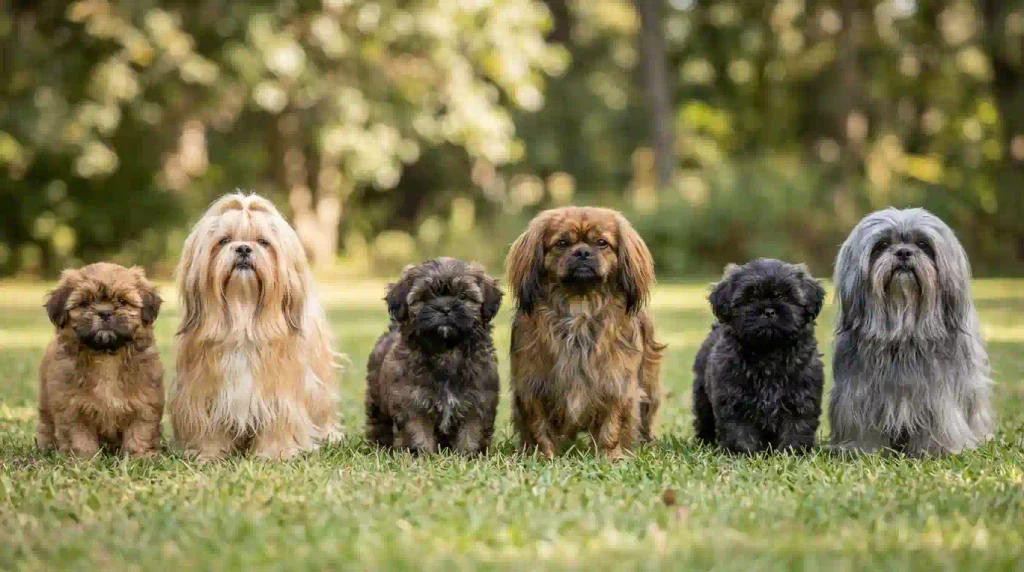
What Photos of Parents Can—and Cannot—Tell You
Looking at the parents is useful when evaluating a Shih Tzu puppy.
Parent photos may help you understand:
- Possible adult color range
- Whether strong fading occurs in the family
- Common patterns
- Pigmentation type
- White spotting tendencies
However, parent photos cannot guarantee an exact result.
A puppy receives genetic material from both parents, including traits that may not be visually obvious in either dog.
Grandparents and earlier generations can also contribute variants that affect coat appearance.
Therefore:
Parent color = useful context
but:
Parent color ≠ guarantee of puppy’s adult color
If a breeder promises that an eight-week-old puppy will remain exactly one shade for life, treat that claim cautiously.
What “Recognized Color” Means in Registration and Breed Standards
This topic causes considerable confusion because people use “recognized” to mean several different things.
There are at least two concepts:
- What the Shih Tzu breed standard permits
- What names appear as selectable registration colors
These are not identical questions.
The American Shih Tzu Club’s U.S. breed standard states that all colors and markings are permissible and are to be considered equally.
Separately, the current American Kennel Club Shih Tzu breed page provides specific registration color names and codes.
Current AKC Shih Tzu Color Registration List
| AKC Color | Registration Code |
| Black | 007 |
| Black & White | 019 |
| Brindle | 057 |
| Brindle & White | 059 |
| Gold | 091 |
| Gold & White | 092 |
| Red & White | 146 |
| Silver & White | 182 |
| Blue | 037 |
| Blue & White | 045 |
| Liver | 123 |
| Liver & White | 125 |
| Silver | 176 |
| Red | 140 |
| Black Gold & Silver | 235 |
| Black White & Silver | 033 |
| White | 199 |
| Silver Gold & White | 188 |
| Black Gold & White | 310 |
This distinction explains why an informal color label may describe a real appearance even when the exact phrase does not appear in the registration menu.
For example:
- “Chocolate” may be used informally for liver/brown coloration.
- “Lavender” or Isabella may describe diluted brown-type appearance.
- “Caramel” describes appearance but is not a separate AKC Shih Tzu registration color.
- “Tuxedo” describes distribution of markings.
- “Parti-color” describes colored areas plus white.
- “Sable” describes dark-tipped hairs over a lighter base.
- “Dobie” describes a point-style pattern.
- “Merle” is a genetically distinct pattern but is not listed as a current AKC Shih Tzu registration color.
Registration terminology also does not prove ancestry.
A dog displaying an accepted color is not automatically a purebred Shih Tzu.
Pedigree and parentage answer that question.
Likewise, color does not create a new recognized type of Shih Tzu.
Terms such as teacup Shih Tzu concern size marketing rather than coat color, while a prapso Shih Tzu involves coat-type development rather than merely being another color.
For readers interested in where the breed came from and why so many coat variations occur today, the Shih Tzu origin guide provides broader historical context.
Coat Genetics: A Simple Explanation
You do not need a genetic test to describe every Shih Tzu’s appearance, but genetics helps explain why there are so many Shih Tzu color variations.
Eumelanin and Phaeomelanin
Dog hair is primarily based on two pigments:
Eumelanin: Normally black, but it can be modified to brown or diluted colors.
Phaeomelanin: Red/yellow pigment that can range from deep red through gold to very pale cream.
Different genes determine which pigment is made, where it appears, and how intense it becomes.
E Locus
The E locus, involving MC1R, influences whether eumelanin or phaeomelanin can appear in particular ways.
Variants can contribute to:
- Red/yellow coats
- Dark facial masks
- Other pigment-distribution effects
K Locus
The K locus influences the switching between eumelanin and phaeomelanin and plays an important role in patterns including dominant dark coloration and brindle.
This helps explain why brindle should be considered a pattern rather than simply one fixed color.
B Locus
The B locus affects eumelanin.
When brown-associated variants are expressed appropriately, eumelanin changes from black to brown.
That produces liver pigmentation.
Importantly, this does not directly change red/yellow phaeomelanin.
This explains how a dog can have a red-looking coat with a brown liver nose.
D Locus
Dilution-associated variants at the D locus can lighten eumelanin.
Black eumelanin may become blue-gray.
Brown eumelanin may become a paler shade sometimes described as lilac or Isabella.
This helps explain the difference between blue, liver, and lavender-like appearances.
White Spotting and the S Locus
White spotting is more complex than a simple on/off gene in dogs.
White areas can range from tiny chest markings to a predominantly white body.
This creates many of the familiar parti-color appearances seen in Shih Tzus.
The exact borders are often asymmetrical.
That is why littermates can have dramatically different white patterns even when their basic colors are similar.

Coat Care and Keeping Light Areas Clean
Color does not fundamentally change a Shih Tzu’s grooming needs.
The breed has a luxurious double coat that can become tangled and matted if it is not maintained consistently.
Brushing a Long Coat
A Shih Tzu kept in a long coat generally needs frequent—and often daily—brushing.
Do not simply brush over the surface.
Work in layers so you reach the hair closer to the skin.
Areas particularly prone to tangles include:
- Behind the ears
- Neck
- Armpits
- Chest
- Belly
- Inner legs
- Tail base
- Areas under harnesses
A comb can help you find small knots that the brush missed.
Coat Change Can Increase Matting
The puppy-to-adult coat transition around 10–12 months can temporarily make grooming more difficult.
Loose puppy hair can become caught in the developing adult coat and form mats rapidly.
During this phase, brushing may need to become more frequent.
Bathing
Bathing frequency depends on the coat, environment, and lifestyle.
Long-coated dogs commonly benefit from routine bathing every few weeks, although individual needs differ.
Use products designed for dogs and rinse thoroughly.
Never assume that a product is appropriate merely because it claims to enhance white, black, red, or gold color.
Skin comfort and coat health come first.
Keeping White Hair Clean
Light coats show staining more easily.
Areas commonly affected include:
- Beneath the eyes
- Beard
- Mouth
- Chest
- Paws
- Lower legs
Food, saliva, tears, moisture, and environmental dirt can all contribute to discoloration.
Do not assume every reddish stain is caused by one specific food, allergy, or medical condition.
Persistent tearing, excessive licking, redness, odor, sores, swelling, or discomfort deserves veterinary evaluation rather than purely cosmetic treatment.
Does Coat Color Affect Allergies?
Color itself does not determine whether someone reacts to a dog.
If this is a concern, see our detailed guide on whether the Shih Tzu is hypoallergenic.
Do Color Claims Predict Health, Temperament, or Price?
A striking coat can make one Shih Tzu look very different from another, but color alone is a poor shortcut for judging the entire dog.
Does Color Predict Temperament?
No reliable rule says:
- Black Shih Tzus are calmer.
- Gold dogs are friendlier.
- Liver dogs are more affectionate.
- Red dogs are more energetic.
- White dogs are more sensitive.
Temperament depends on many factors including broader genetics, socialization, early experiences, training, and the individual dog.
Do not select a puppy mainly because someone claims a particular color has a better personality.
Does Color Predict Health?
Ordinary coat-color labels by themselves do not provide an overall health diagnosis.
A black, red, gold, liver, silver, or white dog should still be evaluated for the health issues relevant to Shih Tzus generally.
There are some specific genetic-pattern contexts where color genetics matter medically.
For example, double-merle breeding can increase risks of hearing and eye abnormalities, which is why our merle Shih Tzu article treats merle genetics separately.
That does not justify making broad claims that every unusual or light-colored Shih Tzu is unhealthy.
Likewise, an albino Shih Tzu involves a different biological issue than an ordinary white Shih Tzu.
What Is the Rarest Shih Tzu Color?
Searches such as rarest Shih Tzu color, rare Shih Tzu colors, and “what is the rarest color Shih Tzu” often produce confident rankings online.
Treat those rankings cautiously.
There is no universal, continuously updated population database showing the exact percentage of every Shih Tzu color worldwide.
Frequency can vary by:
- Country
- Bloodline
- Breeding program
- Registration population
- Time period
- How colors are labeled
A color that is uncommon in one breeding program may be much easier to find elsewhere.
The American Kennel Club has also noted in breed-history material that all colors occur in the breed and that no Shih Tzu color should simply be treated as rare in a universal sense.
For that reason, this guide does not create a “rarest to most common” ranking without reliable population data.
Should a Rare-Looking Color Cost More?
Demand can affect market price.
Breeders may charge different amounts for puppies based partly on appearance.
But a high price does not prove:
- Better health
- Better temperament
- Greater purity
- Superior breed quality
- Responsible breeding
- Exceptional rarity
A breeder advertising “rare chocolate,” “rare lavender,” “rare blue,” or “exclusive tricolor” should still be evaluated on the same fundamentals as any other breeder.
Ask about:
- Parent health
- Veterinary records
- Pedigree
- Registration where relevant
- Parent temperament
- Living conditions
- Puppy socialization
- Breeding practices
- Contracts
- Genetic testing when appropriate
Color should be a preference—not the main measure of quality.
Can Color Prove a Shih Tzu Is Purebred?
No.
Neither an unusual color nor a perfectly standard-looking color proves pedigree.
That question requires documentation or parentage evidence.
Even topics such as Shih Tzu wolf DNA concern breed ancestry at a very different level from day-to-day coat identification.
Frequently Asked Questions About Shih Tzu Colors
What are the main Shih Tzu colors?
Common registered colors include black, white, gold, red, silver, blue, liver, brindle, and several two- and three-color combinations.
What is the most common Shih Tzu color?
Frequency varies among populations and breeders, so a universal current ranking should not be assumed without population data.
What is the rarest Shih Tzu color?
There is no reliable worldwide dataset establishing one universal rarest Shih Tzu color.
Are there rare Shih Tzu colors?
Some appearances may be less frequently encountered within particular bloodlines or regions, but “rare” should not be treated as a universal classification.
Do Shih Tzu change color?
Yes; many Shih Tzus become lighter or otherwise look different as the puppy coat develops into the adult coat.
When do Shih Tzus change color?
Visible changes may occur throughout puppyhood, with an important coat transition often occurring around 10–12 months.
Can a dark Shih Tzu puppy become light?
Yes; gold, brindle, silver, and other puppies can look substantially lighter as adults.
Can a black Shih Tzu turn gray?
Some black dogs can develop lighter-looking hairs or aging-related graying, but this is different from automatically becoming a genetically silver or blue dog.
What does parti-color mean in a Shih Tzu?
Parti-color generally describes a coat with white areas combined with another color or pattern.
What is a tricolor Shih Tzu?
A tricolor Shih Tzu has three visibly distinct colors, such as black, gold, and white.
Are tricolor Shih Tzus recognized?
Several three-color combinations currently appear in AKC Shih Tzu registration terminology.
What is brindle Shih Tzu color?
Brindle is a patterned mixture of darker and lighter pigmentation rather than one uniform solid color.
Can brindle Shih Tzus change color?
Yes; the visibility and contrast of brindle markings can change significantly as the adult coat develops.
What does liver color mean in a Shih Tzu?
Liver primarily means brown eumelanin pigmentation, especially visible in the nose, lips, and eye rims.
Does every brown Shih Tzu have liver pigmentation?
No; a brown-looking coat alone does not prove liver pigmentation.
What does chocolate Shih Tzu mean?
Chocolate is commonly used informally for brown or liver-colored dogs, but the term may be applied inconsistently.
What is a blue Shih Tzu?
A blue Shih Tzu has diluted dark pigmentation that can appear slate or blue-gray.
Is every gray Shih Tzu blue?
No; gray coat hair by itself does not establish blue pigmentation.
What is a lavender Shih Tzu?
Lavender is an informal description often used for a pale diluted brown/lilac appearance, but terminology varies.
What is Isabella color in a Shih Tzu?
Isabella generally refers to diluted brown pigmentation in canine color terminology and may overlap with what some breeders call lavender.
What is a cream Shih Tzu?
Cream describes a very pale red/yellow or gold-like coat appearance, often ranging from ivory to light beige.
What is a sable Shih Tzu?
Sable generally describes lighter red, gold, or tan hair carrying darker tips.
What is a black mask?
A black mask is concentrated dark pigmentation in the facial hair, especially around the muzzle.
What is a blaze?
A blaze is a white stripe or larger white marking running up the dog’s face.
What are Dobie markings?
Dobie is an informal description for point-style markings resembling the tan-point pattern associated with Doberman-like markings.
What color should a Shih Tzu’s nose be?
The U.S. standard calls for black pigmentation except in liver-pigmented dogs, where it is liver, and blue-pigmented dogs, where it is blue.
Can a Shih Tzu have a brown nose?
Yes; a genuinely brown nose is a major clue for liver pigmentation.
Can a Shih Tzu have a blue-gray nose?
Yes; slate or blue-gray pigmentation can occur in blue-pigmented dogs.
What eye colors can Shih Tzus have?
Eyes are generally very dark, although liver- and blue-pigmented dogs may have lighter eyes.
Does eye color prove coat color?
No; nose, eye-rim, lip pigmentation, coat appearance, and genetics should be considered together.
Does grooming change a Shih Tzu’s genetic color?
No; trimming can change how the shade looks, but it does not alter the dog’s coat-color genes.
Why does my Shih Tzu look darker after a haircut?
Shorter hair may expose darker portions of the hair shafts closer to the skin.
Why is my Shih Tzu getting lighter?
Normal adult coat development, loss of dark puppy tipping, aging, hair length, and environmental effects can all change the visible shade.
Can two puppies from the same litter be different colors?
Yes; littermates can inherit different combinations of color and pattern genes.
Can parent photos predict puppy color?
They provide useful clues but cannot guarantee a puppy’s exact adult appearance.
Is merle a color or pattern?
Merle is a genetic coat pattern rather than a simple solid color.
Is white the same as albino?
No; ordinary white coat spotting is different from albinism.
Are blue, liver, and lavender the same?
No; liver involves brown eumelanin, blue involves dilution of darker pigment, and lavender/Isabella usually refers to diluted brown-type pigmentation.
Do different Shih Tzu colors need different grooming?
No; grooming requirements depend mainly on coat length, texture, and condition rather than pigment color.
Do white Shih Tzus need more grooming?
Not necessarily more grooming, although dirt and staining can be more visible on white hair.
Does color determine whether a Shih Tzu is hypoallergenic?
No; color does not determine allergy potential.
Does coat color determine temperament?
No reliable evidence supports assigning a specific personality to a Shih Tzu based solely on coat color.
Are unusual Shih Tzu colors unhealthy?
Not automatically; specific genetic situations should be evaluated individually rather than treating every unusual shade as unhealthy.
Are rare-colored Shih Tzus more expensive?
They may be marketed at higher prices, but price alone does not prove rarity, health, pedigree, or quality.
Does an AKC color prove a Shih Tzu is purebred?
No; a color label cannot establish ancestry by itself.
Is a Shih Tzu’s poop color related to coat color?
No; Shih Tzu poop color is a digestive-health topic and has nothing to do with inherited coat color.
How many Shih Tzu colors are there?
The answer depends on whether you are counting registration labels, genetic colors, patterns, markings, or informal appearance terms; the current AKC list contains 19 Shih Tzu color combinations.
Final Thoughts
Shih Tzu colors are much easier to understand when you separate coat shade, pattern, markings, and skin pigmentation. Black, gold, red, silver, white, blue, liver, brindle, and their many combinations can create dramatically different-looking dogs, while markings such as masks, blazes, saddles, and white spotting add even more variation.
Remember that Shih Tzu puppies can also change noticeably as the adult coat develops, so one early photograph cannot guarantee the final shade. Terms such as chocolate, lavender, sable, parti-color, and “rare color” should be interpreted carefully rather than treated as interchangeable official categories.
Use color as one enjoyable part of choosing or understanding your dog—not as a substitute for health, temperament, pedigree, or responsible breeding. For deeper identification, follow the individual color guides linked throughout this Shih Tzu color chart.