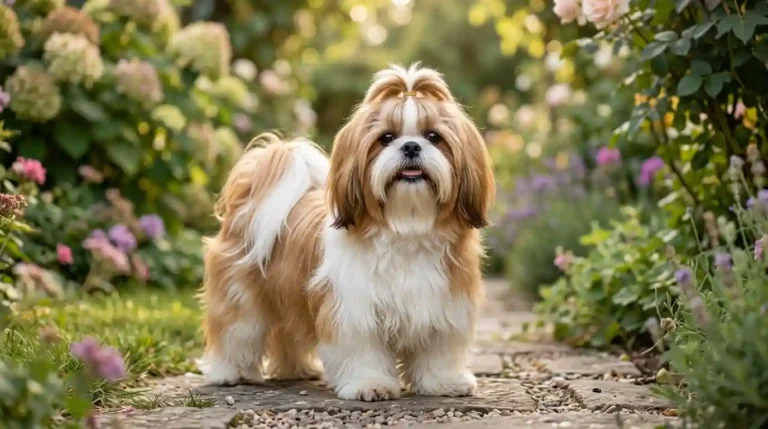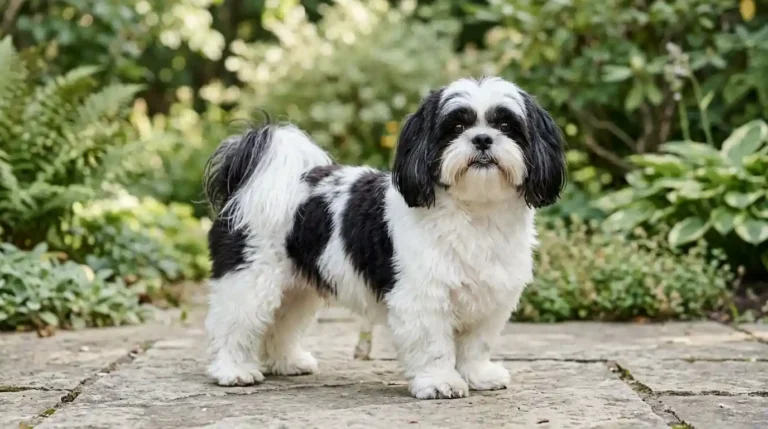

Shih Tzu Wolf DNA: What the Genetics Actually Show
Are Shih Tzus related to wolves? Yes. Like every domestic dog, a Shih Tzu shares ancestry with wolves. But the popular claim that the Shih Tzu is the dog breed closest to a wolf needs a closer look. “Closest” might refer to a breed’s position in a genetic family tree, similarities in DNA, or wolf ancestry introduced through later breeding. Those are different questions, and they do not produce one interchangeable shih tzu wolf DNA percentage.
The surprise is easy to understand: a small companion dog with a flowing coat looks nothing like a gray wolf. Yet appearance alone tells us little about how researchers group dog lineages. In this guide, you’ll learn what the frequently cited studies actually measured, why their findings are sometimes overstated, and what a dog DNA test can—and cannot—tell you about an individual pet. The answer is more useful than a sensational ranking: your Shih Tzu has a real place in the story of dog domestication, without needing to be a miniature wolf.
Table of Contents
- Does a Shih Tzu Have Wolf DNA?
- How Are Shih Tzus and Wolves Related?
- Is the Shih Tzu the Dog Breed Closest to Wolves?
- What Percentage of Wolf DNA Does a Shih Tzu Have?
- Shih Tzu vs Husky, Malamute, and Wolfdog
- Why Does a Shih Tzu Look and Act Unlike a Wolf?
- Can a Dog DNA Test Tell You Whether Your Shih Tzu Is Part Wolf?
- Frequently Asked Questions
- The Takeaway on Shih Tzu Wolf DNA
Does a Shih Tzu Have Wolf DNA?
The short answer
Yes, in the sense that Shih Tzus share the ancient ancestry of domestic dogs and wolves. That does not mean a typical Shih Tzu is a recent wolf hybrid or that every Shih Tzu has a measurable, breed-specific percentage of recent wolf ancestry.
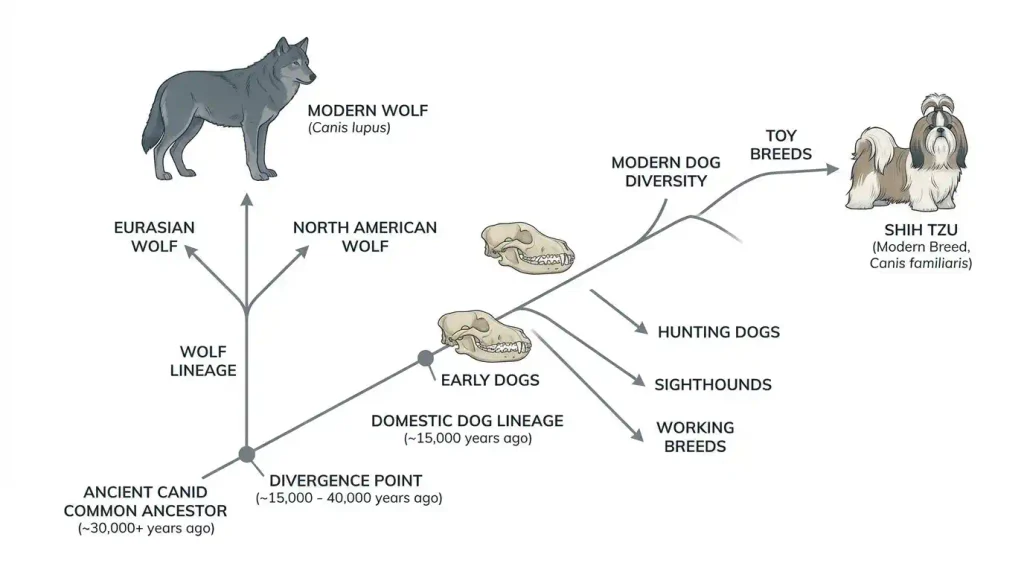
Domestic dogs belong to a lineage that arose from ancient wolf populations. The exact populations involved are still being studied; researchers have not identified a living wolf population that can simply be named the direct ancestor of today’s dogs. A large study of ancient wolf genomes found that dogs are more closely related overall to ancient eastern Eurasian wolves than to the western Eurasian wolves it examined, while also finding evidence of a more complicated ancestry.
So when someone asks, “Do Shih Tzus have wolf DNA?” the first step is to ask what kind of relationship they mean. Shared ancestry is certain. A claim about recent wolf ancestry in a particular dog requires different evidence.
Why “has wolf DNA” can mean different things
The phrase wolf DNA is used loosely online. It can describe at least three distinct ideas:
| What someone may mean | What the question actually asks |
| Shared ancestry | Do Shih Tzus and wolves have ancestors in common? |
| Genetic similarity or breed grouping | How does the Shih Tzu compare with other dog breeds in a particular study? |
| Later wolf admixture | Did wolves breed with dogs after domestication, leaving detectable ancestry in a dog or breed? |
All three involve genetics, but a result from one cannot be reported as a percentage for another. A breed appearing near an older lineage in a chart, for example, does not automatically mean a puppy is “30% wolf.”
This distinction matters because headlines often collapse a nuanced genetic finding into “Shih Tzu closest to wolf.” It is a memorable claim, but readers need to know which study, which measure, and which dogs produced it.
How Are Shih Tzus and Wolves Related?
Shared ancestry and dog domestication
Dogs and gray wolves are closely related canids. Over many generations, the ancestors of domestic dogs became associated with people, and the dog lineage developed traits that suited life alongside humans. Later, people bred dogs for particular purposes and appearances. Those processes help explain how today’s breeds can differ dramatically in size, coat, shape, and behavior while retaining a shared evolutionary background.
It would be misleading to picture a modern Shih Tzu descending directly from a modern gray wolf you could see in a wildlife photograph. Both living animals reflect long histories of change. Ancient-wolf genome research also indicates that the dog’s precise wolf progenitor populations have yet to be located.
The Shih Tzu belongs to a much more recent chapter of that history: the development of companion dogs. If you want the breed-history side of the story, read about shih tzu origin alongside this genetics guide. Breed history and the much older origins of all domestic dogs answer different questions.
Where the Shih Tzu fits among dog lineages
The Shih Tzu is a small companion breed associated with Asian toy-dog lineages. Genetic analyses have compared it with breeds including the Pekingese, as well as with wider groups of domestic dogs and wolves. One analysis described the Shih Tzu and Pekingese as grouping with modern toy dogs in a breed tree, while a separate clustering analysis found an ancient Asian component in those breeds. The apparent difference reflects what the analyses measure; it is not a simple “wolf versus no wolf” result.
That context is useful when reading claims that the Shih Tzu is an “ancient breed.” The label may refer to a genetic pattern found in sampled dogs. It should not be taken to prove that a present-day Shih Tzu is unchanged from dogs living thousands of years ago.
The Shih Tzu’s relationship with the Pekingese and Lhasa Apso also helps explain why breed discussions mention those names so often. If you are exploring how modern varieties and labels are used, our guide to types of shih tzu provides broader breed context. Neither a variety’s name nor its appearance can establish its wolf ancestry.
Is the Shih Tzu the Dog Breed Closest to Wolves?
What the often-cited breed studies measured
The “closest to wolves” story is often traced to early research comparing DNA markers across dog breeds. Researchers used genetic markers to examine how breeds clustered with one another and with wolves. That work was valuable for understanding relationships among sampled breeds, but it was not a contest designed to award one living breed the title of “most wolf DNA.”
The researchers’ own National Human Genome Research Institute explanation of the dog-breed study says that the analysis grouped 85 sampled breeds into broad populations. It explains why one cluster was called “ancient” and cautions that a breed’s placement does not, by itself, settle questions about an uninterrupted historical lineage. The researchers also say the study did not investigate genes for behaviors such as aggression.
This makes two popular shortcuts unreliable. First, results from a set of sampled breeds cannot establish a permanent ranking of every dog breed. Second, a genetic grouping cannot tell you that a friendly Shih Tzu is behaviorally more wolf-like than another dog.
Why “ancient breed” does not mean “most wolf DNA”
An ancient or basal lineage is not the same thing as a recent wolfdog. In breed research, the terms describe patterns inferred from genetic data. Which breeds appear together can vary with the dogs sampled, the markers examined, and the analytical method.
Later work illustrates the problem particularly well for the Shih Tzu. In a review of genomic analyses, researchers reported that Shih Tzus and Pekingese grouped with modern toy breeds on one genetic tree, yet showed an approximately 30% ancient-cluster component in a different analysis. That figure describes an inferred cluster assignment. It does not say a Shih Tzu is 30% wolf.
A dog’s long coat, short muzzle, or small body does not resolve the ranking either. Physical resemblance and genetic relationships can tell different stories. Still, the reverse claim—“the Shih Tzu looks unlike a wolf, therefore it cannot share important ancestry”—is just as weak. Appearance is one part of a breed’s history, not a direct measurement of its whole genome.
What newer ancestry research adds
More recent studies use much larger genomic datasets to investigate dog origins, breed relationships, and later mixing with wolves. They show that dog ancestry is more complex than a single neat line from one wolf population to every modern breed. A 2025 study, for example, reported detectable wolf ancestry in many modern dog breeds arising from admixture long after domestication. That finding concerns later gene flow; it does not make every breed a recent wolfdog, and it does not supply a universal Shih Tzu percentage.
Other genomic analyses place the Shih Tzu within an Asian toy-dog grouping. Taken together, the research supports a careful answer: Shih Tzus share the dog lineage’s wolf ancestry and have an interesting breed history, but the claim that they are unequivocally the single closest breed to wolves overstates the evidence.
The question “Are Shih Tzu genetically closest to wolves?” therefore needs a definition before it needs a ranking. Closest according to which genetic comparison? Without that detail, two articles can give opposite answers while talking about different measures.
What Percentage of Wolf DNA Does a Shih Tzu Have?
Shared DNA versus later wolf admixture
There is no single scientifically established shih tzu wolf DNA percentage that can be assigned to every member of the breed. A percentage needs a defined measure and a relevant dataset.
One possible measure is overall DNA similarity between dogs and wolves. That describes how closely related the lineages are across a chosen part of the genome. It is not the percentage of a Shih Tzu’s ancestry contributed by a recent wolf.
Another measure is inferred ancestry from wolf-to-dog breeding after domestication. Researchers can look for patterns consistent with this later genetic admixture. Its estimated level can differ by the population or individual studied, and a finding for “dogs” generally must not be transferred to all Shih Tzus.
A third number sometimes seen online comes from a breed-clustering model. As the earlier example shows, an “ancient-cluster component” is not interchangeable with wolf ancestry. If an article says a Shih Tzu is “30% wolf” on that basis, it has changed the meaning of the result.
Why popular percentages cannot simply be compared
Imagine three articles claiming that dogs share a very high percentage of their DNA with wolves, that a Shih Tzu has an ancient-cluster assignment, and that certain wolfdogs carry substantial wolf ancestry. All three percentages could describe different comparisons. Putting them in one ranking would be like comparing a family resemblance score, a neighborhood assignment, and the proportion of DNA inherited from a recent relative.
Before using any number, check:
- What is being measured? Sequence similarity, breed clustering, or ancestry from later admixture?
- Which dogs were sampled? Was the Shih Tzu included, and how many individuals represented the breed?
- What does the percentage’s denominator mean? Is it a portion of the genome, a modelled cluster assignment, or something else?
- Does the source make a breed-wide claim? An individual dog’s result need not describe every Shih Tzu.
This is why you should be skeptical of precise figures presented without a study and a definition. You can explore genuine inherited differences in shih tzu colors, but color genetics cannot serve as a shortcut to a wolf-ancestry percentage. A black shih tzu, a white shih tzu, and dogs with other coat colors remain members of the same domestic breed.
Shih Tzu vs Husky, Malamute, and Wolfdog
Three different meanings of “closest to a wolf”
Comparisons involving a Shih Tzu, Siberian Husky, Alaskan Malamute, and wolfdog tend to mix three ideas.
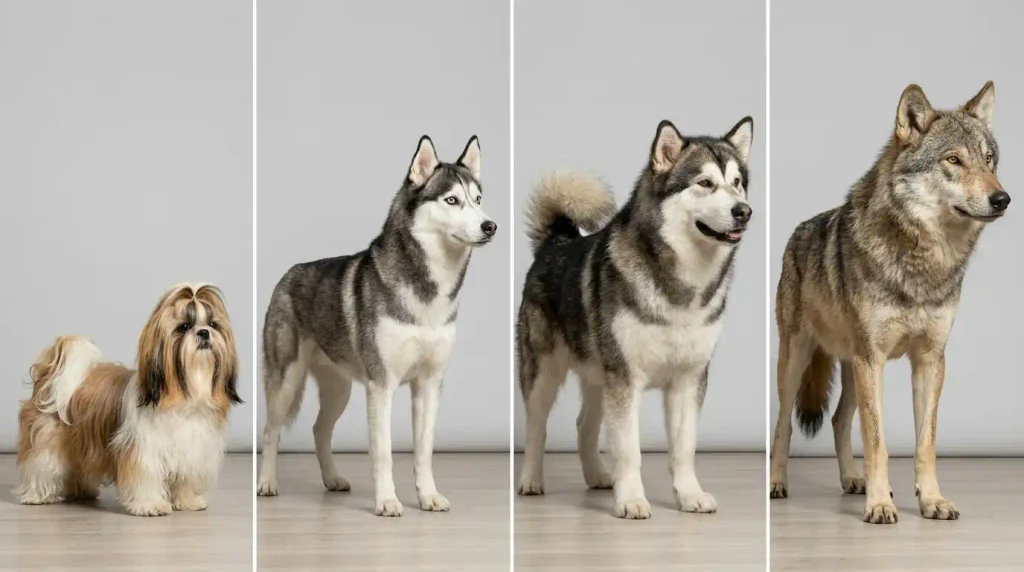
The first is appearance. Huskies and Malamutes can look more wolf-like than Shih Tzus because of features such as their body shape, ears, and coats. Looks alone cannot calculate genetic distance.
The second is breed-lineage analysis. Different studies place breeds within particular genetic groups using specific methods. A Shih Tzu’s position in one analysis cannot be directly compared with a Husky’s appearance or a wolfdog’s family history.
The third is recent wolf ancestry. A wolfdog is descended from dog–wolf crossings in a much more direct sense. Researchers studying later wolf admixture have identified particularly high levels in breeds deliberately developed using wolves, including Czechoslovakian and Saarloos wolfdogs. That is a different question from whether a Shih Tzu shares ancient ancestry with wolves.
A concise comparison table
| Dog or lineage | What a comparison can tell you | What it cannot establish on its own |
| Shih Tzu | A domestic companion breed that shares canine wolf ancestry and appears in breed-genetics analyses | A fixed, universal recent-wolf percentage |
| Siberian Husky | An Arctic dog whose appearance and lineage often prompt wolf comparisons | That wolf-like looks equal a particular ancestry percentage |
| Alaskan Malamute | Another Arctic breed included in studies of dog lineages | That every Malamute is a recent wolf hybrid |
| Wolfdog lineage | A history involving more direct dog–wolf breeding | That results from wolfdogs apply to ordinary Shih Tzus |
| Gray wolf | A close living relative used in genetic comparisons | A living, identifiable direct ancestor of every modern dog |
The practical answer to “dog breed closest to wolf: Shih Tzu or Husky?” is to specify the measure first. If the question is visual resemblance, the Shih Tzu is an unlikely choice. If it concerns breed clustering, cite the particular study. If it concerns later wolf admixture, compare ancestry estimates from the same method and dataset.
Why Does a Shih Tzu Look and Act Unlike a Wolf?
Size, face, and coat
Selective breeding has produced striking diversity among domestic dogs. The Shih Tzu’s compact body, short muzzle, and long coat reflect the development of a companion breed. A wolf’s anatomy reflects a different history and way of life. Looking at the two animals makes those differences obvious, but it does not erase their deeper relationship.
A Shih Tzu’s coat pattern is particularly easy to misread as a clue to ancestry. For example, the appearance of a black and white shih tzu or a brindle shih tzu tells you about visible dog-coat traits. It does not reveal whether that dog has detectable wolf admixture. Likewise, an albino shih tzu raises a different question about pigmentation; pale coloring is not evidence that a dog is genetically nearer to wolves.
Even within one breed, visible differences can attract labels that sound genetic but require care. The useful starting point is dependable shih tzu Breed Information, followed by evidence for any specific ancestry claim.
Companionship, behavior, and selective breeding
Shih Tzus were developed as companion dogs. Their everyday behavior is shaped by domestication, breeding, learning, environment, and the individual dog. A Shih Tzu may howl, guard a favorite spot, chase a moving object, or enjoy being close to its family. None of those actions works as a home test for “wolf DNA.”
The same caution applies to broad statements about temperament. Researchers behind the often-cited early breed study explicitly noted that their work did not locate genes for aggression. Breed position in that study cannot establish that a Shih Tzu has a wolf’s temperament, or that another breed does not.
If your interest began with your pet’s habits, shih tzu facts offers a more relevant next read than treating a howl as a genetics result. If you are checking whether a dog is a purebred shih tzu, that is another separate question: breed identity and recent wolf ancestry require different interpretations.
Can a Dog DNA Test Tell You Whether Your Shih Tzu Is Part Wolf?
Breed ancestry results versus wolf ancestry results
Some dog DNA tests report breed ancestry, and some can assess wolf ancestry. What a result means depends on the provider’s reference populations, methods, reporting rules, and ability to distinguish closely related groups. A breed result naming Shih Tzu does not itself tell you how much wolf ancestry the dog has.
It is especially important to separate a test’s wolfiness feature from a wolf-hybrid result. For example, Embark explains that its “wolfiness” score concerns certain ancient genetic variants; the company says the score does not represent recent wolf ancestry. It reports relevant recent ancestry through its breed results instead. A high score with a dramatic name is therefore not proof that a Shih Tzu had a wolf among its recent relatives.
If you are investigating a specific dog because of its reported parentage, start with what the test actually assesses. A commercial report may give useful information, but its categories should be read according to the provider’s definitions rather than a social-media interpretation.
Questions to ask about a test’s methods and limits
Before buying a test or sharing its results as a claim about shih tzu wolf DNA, ask:
- Does it test for recent wolf ancestry, or only provide breed identification and a separate trait score?
- What does its reported percentage describe? Check the label and the provider’s explanation.
- Which reference populations does it use? A result depends partly on what the test can compare.
- Does the report distinguish an individual result from a claim about the entire breed?
- How does the provider explain uncertain or very small estimates?
A cheek swab can collect DNA for analysis, but collecting DNA is only the first step. The interpretation comes from comparing genetic markers with reference data. If a result seems surprising, read the provider’s methodology and contact it for clarification before calling your dog a wolf hybrid.
The same principle applies to appearance-based labels elsewhere in the breed. A dog described as a teacup shih tzu is not assigned a different wolf ancestry by that label. Size is not a substitute for a relevant genetic test.
Frequently Asked Questions
Are Shih Tzus descended from wolves?
Yes—all domestic dogs share ancestry with ancient wolf populations, though a living gray wolf is not a Shih Tzu’s direct parent.
Can a purebred Shih Tzu be a recent wolf hybrid?
A claim of recent wolf ancestry needs evidence about the individual dog; being a Shih Tzu or having ancient shared ancestry does not establish it.
Does howling mean a Shih Tzu has more wolf ancestry?
No; howling is a behavior, not a reliable measure of an individual dog’s wolf ancestry.
Which dog breed has the most wolf ancestry?
It depends on the measure; breeds deliberately developed through dog–wolf crossing are different from breeds compared for ancient genetic relationships.
The Takeaway on Shih Tzu Wolf DNA
Shih Tzus and wolves are related through the broader history of domestic dogs. That connection is real, but it does not give every Shih Tzu a fixed “wolf DNA percentage” or prove the breed is uniquely closest to wolves. Early breed studies, later ancestry research, and DNA-test features ask different questions; their numbers should be read in their original context.
If a striking claim catches your eye, check what the source measured before repeating it. For a fuller picture of the dog beside you, explore the Shih Tzu’s breed history and everyday traits alongside the genetics. Your companion does not need a wolf ranking to have a fascinating ancestry.