Red Shih Tzu: Coat Color, Identification, and Care
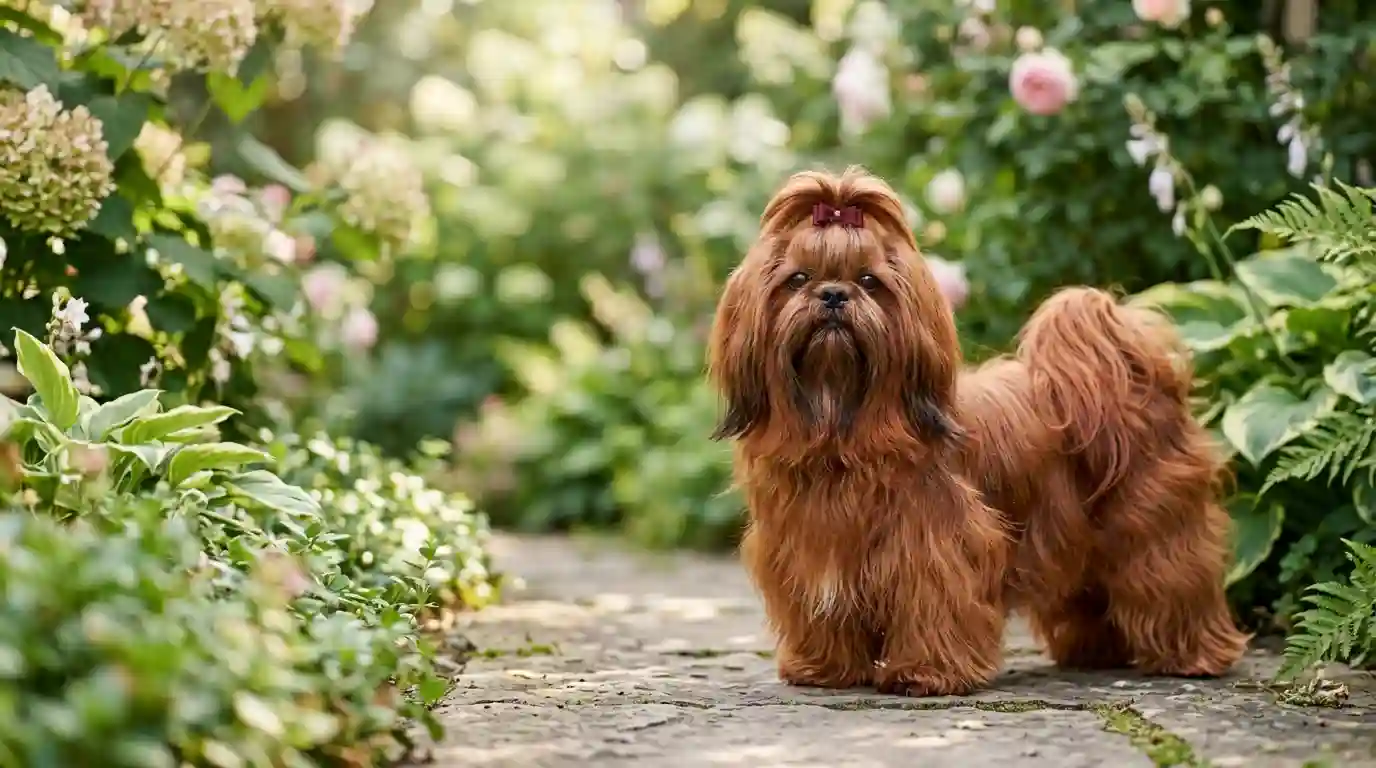
A red Shih Tzu has a warm coat that can range from deep orange and copper to rich auburn, mahogany-red, or reddish gold. The exact shade varies between individual dogs, and some puppies that look intensely red when young become lighter as their adult coat develops. Red may appear alone or alongside white, gold, darker shading, a black mask, or other markings. The easiest way to identify a red Shih Tzu correctly is to evaluate coat color and pigmentation separately. Most red Shih Tzus have a black nose, black lips, and black eye rims, while a reddish dog with a brown or liver nose has liver pigmentation instead. Red hair itself is primarily associated with pheomelanin, the red/yellow pigment in canine coats. This guide explains what a red coat looks like, how to distinguish red from gold and liver, what happens to the puppy coat with age, whether color affects health or temperament, how to handle reddish staining around the eyes or paws, and how to properly maintain the Shih Tzu’s long coat.
Table of Contents
- What does a red Shih Tzu look like?
- How can you distinguish red from gold or liver?
- Is red an accepted Shih Tzu color?
- Can a red Shih Tzu’s coat change with age?
- Does red coat color affect health or temperament?
- How should you care for a red Shih Tzu’s coat?
- How rare are red Shih Tzus, and should color affect price?
- Red Shih Tzu FAQs
- Final thoughts
What Does a Red Shih Tzu Look Like?
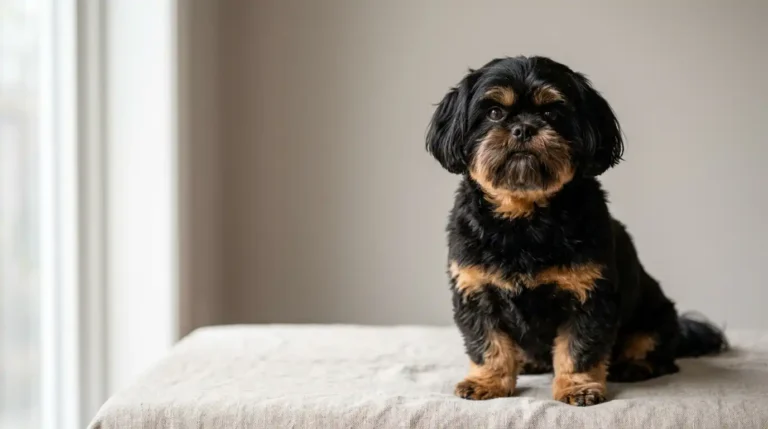
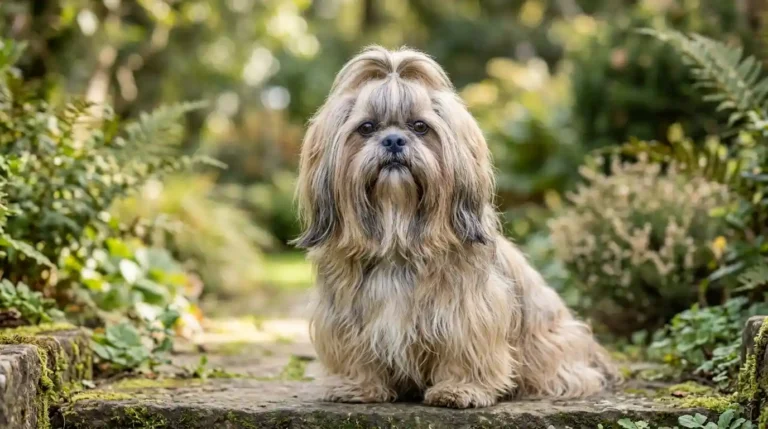
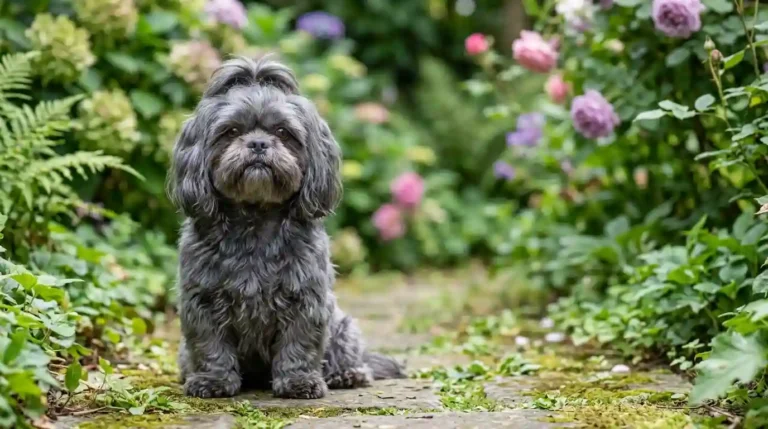
The term red Shih Tzu describes the visible color of the dog’s coat. Despite the name, the hair does not usually resemble a bright artificial red. Instead, it falls within a spectrum of warm canine coat colors that may resemble copper, burnt orange, dark apricot, auburn, reddish gold, or mahogany.
Some red dogs are immediately recognizable because their coat has a strong, rich orange-red tone. Others sit close to the visual boundary between red and gold and may be described differently depending on lighting, age, coat length, or the person evaluating the dog.
This variation is normal.
Dog coat color is produced primarily through two pigment families. Pheomelanin creates red and yellow shades, while eumelanin produces black or brown pigment. The interaction of several genes influences how those pigments appear and where they are expressed.
That means “red” should be understood as a range rather than one exact paint-chip color.
If you are comparing the full spectrum of Shih Tzu colors, it helps to look at multiple traits instead of judging one photograph.
How Red Shades Vary From Orange to Auburn
A red Shih Tzu may have a coat described as:
- Deep orange-red
- Copper
- Auburn
- Mahogany
- Rust
- Reddish gold
- Burnt orange
- Warm chestnut-red
- Dark apricot
- Light red
Two dogs registered or described as red may therefore look noticeably different.
One puppy might have a dark auburn body with even deeper coloring around the ears. Another might appear orange-red across the body and almost gold around the face.
Lighting changes the impression further.
Warm artificial bulbs can make gold hair appear more orange or red. Strong sunlight can wash out a dark red coat and make it look golden. Shadows may make reddish hair appear brown.
For color identification, indirect natural daylight is usually more useful than flash photography or indoor lighting.
The length of the hair also affects perception. A short puppy coat may look highly saturated because the colored hairs are compact. Once those hairs lengthen and mix with lighter undercoat or differently shaded tips, the adult dog can appear softer or lighter.
This explains why a red Shih Tzu puppy can look dramatically different from the same dog several months later.
The same principle applies to other warm coat descriptions. A golden brown Shih Tzu, tan Shih Tzu, or blonde Shih Tzu may overlap visually with lighter red shades.
Color identification is therefore most reliable when you combine overall coat appearance with pigment points and markings.
How White and Gold Markings Can Appear
A red coat does not have to cover the entire dog.
White markings can appear on the:
- Muzzle
- Forehead
- Chest
- Neck
- Belly
- Legs
- Paws
- Tail tip
- Shoulders
- Back
A dog with substantial white areas may be better described as a red and white Shih Tzu.
The white pattern can range from a small chest patch to a mostly white dog with red patches over the ears and body.
Some owners use the term parti-color for a Shih Tzu with clearly separated colored and white areas. The distribution does not need to be perfectly symmetrical.
Gold areas may also blend with red.
For example, a dog can have darker red ears and back while the face, legs, or sides of the body appear more golden.
A red puppy may also carry darker hair tips that create a shaded or sable-like appearance. The phrase red sable Shih Tzu may be used informally when dark-tipped hairs are layered over a warm red base, although color-genetic terminology can be more complicated than the marketing label suggests.
Dark facial hair can create another distinctive appearance.
A black mask is caused by dark eumelanin in the facial area and may occur with warm coat shades. The black mask gold Shih Tzu illustrates how strongly a dark muzzle can change the visual impression of an otherwise warm-colored dog.
Similarly, a red brindle Shih Tzu can have a warm red base combined with darker patterned hairs. That is different from a simple solid red coat because brindle is a pattern.

How Can You Distinguish Red From Gold or Liver?
Red, gold, and liver are among the most commonly confused descriptions in Shih Tzus because they can all create warm-looking dogs.
The important difference is that red and gold primarily describe visible coat shades, whereas liver describes brown-based pigmentation.
That distinction is essential.
A dog can have red hair and black pigmentation. It can also have red hair and liver pigmentation.
Likewise, a dog can look brown without necessarily being genetically liver-pigmented.
Here is a practical comparison:
| Description | Typical Coat Appearance | Nose/Lips/Eye Rims |
| Red | Orange-red, copper, auburn, reddish gold | Usually black |
| Gold | Honey, yellow-gold, warm gold | Usually black |
| Red with liver pigment | Red/copper coat | Brown/liver |
| Liver | Coat shade can vary | Brown/liver |
| Red and white | Red areas + white markings | Usually black unless liver/blue pigmented |
| Brindle | Patterned/intermixed darker hairs | Depends on underlying pigmentation |
What Nose, Lips, Eye Rims, and Paw Pads Can Tell You
When coat shade becomes confusing, inspect the dog’s pigment points.
For an ordinarily pigmented red Shih Tzu, the nose should be black. The lips and eye rims should also be black.
Paw pads normally carry dark pigmentation as well, although they are less useful as a standalone color-identification method.
This matters because people sometimes search for a red nose Shih Tzu or Shih Tzu red nose when they actually mean a reddish dog with a brown nose.
A genuinely brown or liver nose usually points toward liver pigmentation rather than simply a different shade of red hair.
The American Shih Tzu Club breed standard specifies black pigmentation on the nose, lips, and eye rims for normal colors, with liver pigmentation on liver-pigmented dogs and blue pigmentation on blue-pigmented dogs.
So if you have:
Red coat + black nose + black lips + black eye rims
you are looking at a typical red coat with black eumelanin pigmentation.
If you have:
Red coat + brown nose + brown lips + brown eye rims
the dog may be better described as a red liver Shih Tzu.
That dog can still have a genuinely red coat. The liver gene changes black eumelanin to brown but does not directly turn red/yellow pheomelanin brown.
This is why coat color and pigment points must be evaluated separately.
A liver Shih Tzu guide is useful if you are trying to determine whether a reddish or brown-looking puppy has liver pigmentation.
Why Coat Shade Alone Can Be Misleading
Imagine two Shih Tzus photographed under warm indoor lighting.
The first has a golden coat and black nose.
The second has a dark red coat and brown liver nose.
In a photograph, both may appear reddish-brown.
Yet they are not the same color-and-pigmentation combination.
Similarly, an intensely colored gold and white Shih Tzu might appear orange enough to be mistaken for red and white.
A brown Shih Tzu might look chocolate or reddish while retaining black pigment points.
A liver chocolate Shih Tzu may be darker and more obviously brown while showing liver pigmentation.
The safest visual identification method is therefore:
First: judge the body coat.
Second: check the nose, lips, and eye rims.
Third: inspect white, brindle, sable, or mask markings separately.
Fourth: use natural daylight.
This becomes even more important when evaluating puppies online.
Filters, saturation, camera white balance, flash, and shadows can change the appearance of warm colors dramatically.
Ask for unfiltered natural-light photographs if color matters to you.

Is Red an Accepted Shih Tzu Color?
Yes.
Red is an accepted and currently listed Shih Tzu registration color with the American Kennel Club.
AKC currently lists Red with registration code 140, while Red & White is listed separately with code 146.
The U.S. Shih Tzu breed standard also states that all colors and markings are permissible and should be considered equally.
You can review the current listings on the American Kennel Club Shih Tzu breed page.
This means a red coat is not automatically less correct than black, brindle, gold, liver, silver, white, or another accepted combination.
It also does not mean that color establishes pedigree.
A dog being red does not prove that it is a purebred Shih Tzu. Pedigree, parentage, and registration records address ancestry.
Likewise, a red coat does not create a separate breed variety.
When people talk about different types of Shih Tzu, color should not be confused with an independently recognized breed type.
For readers learning about the breed beyond color, our shih tzu Breed Information section, Shih Tzu facts, and guide to Shih Tzu origin provide broader context.
Can a Red Shih Tzu’s Coat Change With Age?
Yes.
A red Shih Tzu’s puppy coat and adult coat can differ noticeably in both shade and overall appearance.
Some puppies start with rich mahogany or dark copper coats and become lighter. Others remain comparatively red throughout adulthood.
There is no reliable way to guarantee the exact adult shade from a young puppy photograph.
Why the Puppy Coat Can Look Darker
Young puppies have shorter hair, which can make pigment look concentrated.
As the coat grows:
- Hair becomes longer
- Lighter hairs may become more noticeable
- Dark tips may disappear or become less dominant
- Underlying gold or cream tones may show more clearly
- Body proportions change
- Facial furnishings alter the appearance of markings
A puppy that initially looks dark auburn can therefore become copper or reddish gold.
A puppy with black-tipped hairs may lose much of that dark shading as the coat matures.
The opposite visual effect can occasionally occur in certain sections where longer colored hairs make a patch look more prominent.
Puppy Coat to Adult Coat
Shih Tzus commonly go through an obvious coat transition around late puppyhood.
During this period, the puppy coat is replaced by the developing adult coat, and grooming can temporarily become more demanding because loose puppy hair mixes with growing adult hair.
Color change and coat change are related visually but are not exactly the same process.
A red dog does not become genetically gold just because its adult hair looks lighter.
Rather, the expression and intensity of the warm-colored hair may produce a different visual result.
What Does Coat Fading Mean?
Owners often use the term coat fading when a puppy’s color becomes lighter with age.
Fading can mean:
- Deep red becoming copper
- Copper becoming red-gold
- Red-gold becoming gold
- Dark facial hair becoming lighter
- Strong puppy shading becoming less obvious
The degree varies enormously.
Some red dogs retain rich coloration for years, while others lighten substantially.
That unpredictability is one reason puppy buyers should be careful with claims such as:
“Guaranteed deep red adult.”
No breeder can determine every future shade from appearance alone with absolute certainty.
Do White Markings Change?
If a red puppy also has white markings, the distribution can look different as the dog matures.
A facial blaze may appear larger because facial hair becomes longer. White chest hair may become more prominent as it grows. Red patches can seem smaller when surrounded by a longer white coat.
A red and white Shih Tzu can therefore look substantially different in adult photographs even though the basic placement of the colored and white areas remains recognizable.
Can Grooming Change the Appearance of Red?
Yes, visually.
A short puppy cut exposes different parts of the hair shaft and changes how light reflects from the coat.
A long flowing coat may display several shades within the same section.
Sunlight and ordinary wear can also make the tips appear lighter than protected hair closer to the skin.
These changes do not mean grooming has altered the dog’s genetics.
Does Red Coat Color Affect Health or Temperament?
There is no good basis for assuming that a healthy red Shih Tzu has a particular temperament or overall health status simply because of its red coat.
Coat color is one physical trait.
It does not tell you whether a dog will automatically be:
- More affectionate
- More stubborn
- Calmer
- More active
- Easier to train
- Healthier
- Less healthy
- More intelligent
- Better with children
Temperament is influenced by genetics beyond coat color, early development, socialization, experiences, training, and the individual dog.
Health requires the same kind of broader evaluation.
When considering a red Shih Tzu puppy, focus on health screening, veterinary history, parent temperament, pedigree where relevant, living conditions, socialization, and responsible breeding practices—not just coat color.
Natural Coat Color Versus Reddish Staining
An especially important distinction is the difference between naturally red hair and hair that has developed red, rust, pink, or brown staining.
These are not the same thing.
A genetically red coat is naturally pigmented throughout appropriate areas of the hair.
Staining tends to occur in localized areas, particularly around:
- Eyes
- Mouth
- Beard
- Paws
- Genital region
- Areas repeatedly exposed to saliva or moisture
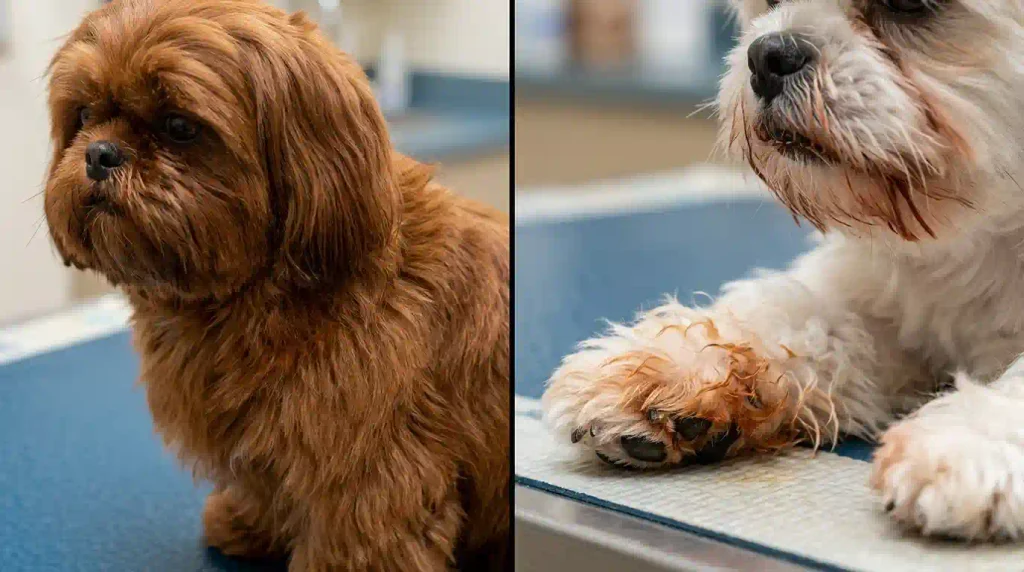
Naturally occurring compounds called porphyrins are present in tears and saliva. They can produce pink, reddish, orange, rust, or brown discoloration on hair, especially when the area stays wet.
This distinction is particularly useful for searches such as Shih Tzu paws turn red.
If a cream, white, or light-colored Shih Tzu suddenly develops rusty-red paws, that is not the dog genetically becoming a red Shih Tzu.
Repeated licking may be staining the hair.
Likewise, reddish-brown discoloration below the eyes is not equivalent to red coat pigmentation.
What If a Shih Tzu’s Paws Turn Red?
If the hair on the paws turns red or rusty but the underlying skin looks normal and the dog is otherwise comfortable, saliva staining may be contributing.
However, frequent paw licking deserves attention because dogs often lick when something is bothering them.
Possible reasons can include irritation, discomfort, environmental triggers, skin problems, or other causes that require proper evaluation.
If the dog is constantly licking, chewing, limping, or developing odor, swelling, sores, or hair loss, contact a veterinarian rather than treating the red color as merely cosmetic.
What About Red Skin?
A search such as Shih Tzu red skin describes a different issue entirely.
Healthy red coat pigment is located in the hair.
Actual reddening of the skin can indicate inflammation or irritation.
If you part the coat and see noticeably red, inflamed skin—especially with itching, bumps, odor, sores, hair loss, or discomfort—this is not simply a normal characteristic of a red Shih Tzu.
The same applies to Shih Tzu red skin around eyes.
Skin redness near the eyes should be distinguished from the natural black eye rims expected on ordinarily pigmented Shih Tzus.
Eye-area redness, swelling, discharge, squinting, or obvious discomfort deserves veterinary attention because Shih Tzus have prominent eyes and eye problems should not be ignored.
What Does “Shih Tzu Red Eye” Mean?
Searches for Shih Tzu red eye or Shih Tzu red eyes usually refer to eye health, not coat color.
A naturally red Shih Tzu should not have red eyeballs as a coat-color trait.
Redness of the eye can have many causes, ranging from minor irritation to conditions requiring prompt treatment.
Because the eye is sensitive, owners should not attempt to diagnose persistent redness based solely on photographs or online color information.
A red coat and a red eye are entirely separate issues.
Does a Red Nose Mean the Same Thing?
No.
A dog described as having a “red nose” may actually have a brown or liver-colored nose.
A true liver Shih Tzu has brown-based eumelanin pigmentation on the nose, lips, and eye rims.
Therefore, if a red-coated Shih Tzu has a clearly brown nose rather than a black nose, investigate liver pigmentation rather than treating “red nose” as a separate red-coat feature.
How Should You Care for a Red Shih Tzu’s Coat?
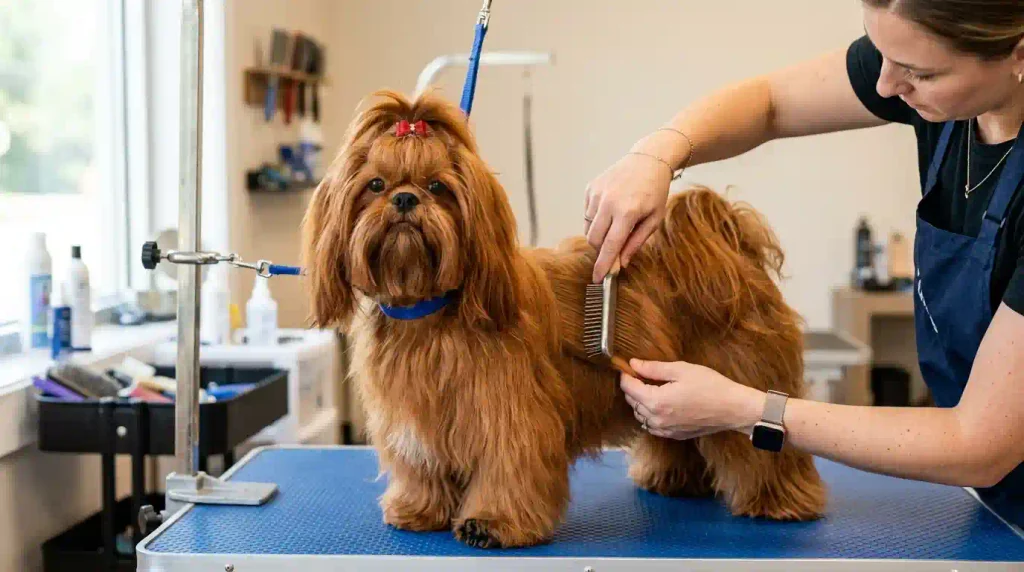
A red Shih Tzu does not need a special grooming method simply because its coat contains red pigment.
The primary grooming challenge is the Shih Tzu coat itself.
When allowed to grow long, the breed develops a dense double coat that can tangle and mat without regular maintenance.
Brush Often Enough to Prevent Mats
Brushing frequency should match the dog’s coat length and texture.
A full-length coat may require very frequent—and often daily—attention, while a shorter pet trim is typically easier to manage.
Areas that need particular attention include:
- Behind the ears
- Neck
- Armpits
- Chest
- Belly
- Inner legs
- Tail
- Feet
- Areas beneath harnesses
Work through the coat in sections instead of brushing only the surface.
A smooth-looking outer layer can hide knots closer to the skin.
After brushing, use an appropriate comb to check whether tangles remain.
Be Extra Careful During the Coat Change
The transition from puppy coat to adult coat can be particularly frustrating.
Loose puppy hair can become caught within the growing adult coat, causing tangles to form quickly.
Consistent brushing during this period is more useful than waiting for mats to become severe.
Never pull aggressively at a mat.
Forceful brushing can damage hair and hurt the dog.
Bathing a Red Shih Tzu
Bathing frequency depends on lifestyle, coat length, skin condition, and how quickly the coat becomes dirty.
Use a dog-appropriate shampoo rather than human products.
Rinse thoroughly.
Product residue can contribute to irritation and make the coat harder to manage.
Conditioning may help reduce friction and make long hair easier to comb.
Avoid bathing a severely matted dog before addressing the mats because water can tighten existing tangles.
Does a Red Coat Need a Color-Enhancing Shampoo?
Not necessarily.
Your goal should be a clean, healthy coat—not artificially maximizing the darkness of the red pigment.
Products marketed as “red enhancing” or “color intensifying” should not be used as a substitute for proper coat care.
The dog’s natural adult shade may be lighter than its puppy coat, and that is not inherently a grooming failure.
Healthy skin, suitable nutrition, veterinary care, regular brushing, and gentle bathing matter more than trying to force the coat to look dark red.
Protecting the Coat From Damage
Long hair is vulnerable to breakage.
Reduce unnecessary friction from poorly fitted harnesses, excessive matting, aggressive brushing, and prolonged dirt buildup.
If your dog spends significant time outdoors, routine coat checks can help identify:
- Twigs
- Seeds
- Burrs
- Dirt
- Knots
- Moist areas
- Skin irritation
A clean coat is generally easier to maintain than a dirty one.
Cleaning the Face
Shih Tzus have long facial hair and prominent eyes, so facial care deserves attention regardless of coat color.
Keep the area around the eyes clean and dry.
Food and water can also collect in the beard.
If your red dog has white facial markings, discoloration may be especially obvious against the pale hair.
Gentle routine cleaning is preferable to harsh bleaching products.
Persistent eye discharge, swelling, squinting, odor, or skin irritation should be evaluated rather than repeatedly covered with cosmetic products.
Short Coat Versus Full Coat
Owners do not need to maintain a show-length coat.
A short pet trim can make routine care considerably easier while preserving the dog’s natural red color.
The decision should be based on your lifestyle and ability to maintain the coat consistently.
Whether your dog is a red Shih Tzu, black Shih Tzu, silver Shih Tzu, grey Shih Tzu, or white Shih Tzu, preventing painful matting is more important than maintaining a particular hairstyle.
How Rare Are Red Shih Tzus, and Should Color Affect Price?
You may see breeders describe puppies as rare red Shih Tzu, “deep red,” “rare mahogany,” or “exclusive solid red.”
Treat these descriptions cautiously.
Red is an officially listed Shih Tzu color, so the existence of a red puppy does not by itself establish exceptional rarity.
How frequently you see a particular shade can vary depending on:
- Bloodline
- Breeding program
- Geographic region
- Current demand
- Local population
- How breeders label similar shades
A deep, relatively uniform red puppy may be less commonly encountered in one breeder’s program than gold or black-and-white puppies, but that does not establish a universal rarity ranking.
What About a Solid Red Shih Tzu?
The phrase solid red Shih Tzu usually refers to a dog whose visible coat is predominantly red without large white patches or obvious contrasting patterns.
Even a dog called solid red may have slight shading or small markings.
The label should not be interpreted as a guarantee that every hair is exactly the same shade.
Should a Red Puppy Cost More?
Color can influence demand, and individual breeders may price puppies differently.
However, coat color alone is not evidence of superior quality.
When evaluating price, look at:
- Responsible breeding practices
- Health screening
- Veterinary care
- Pedigree
- Parent temperament
- Puppy socialization
- Documentation
- Breeder support
- Contract terms
- Overall condition of the dogs
Be cautious if an unusually high price is justified almost entirely by phrases such as “rare red,” “exclusive bloodline,” or “special color.”
A red coat does not make one dog inherently healthier or more valuable than a responsibly bred dog of another accepted color.
Likewise, marketing terms such as teacup Shih Tzu should be evaluated separately rather than combined with color claims to imply superior quality.
The best puppy for your household should be selected for much more than hair color.
Red Shih Tzu FAQs
What is a red Shih Tzu?
A red Shih Tzu has a warm coat ranging from deep orange and copper to auburn or reddish gold.
Is red an official Shih Tzu color?
Yes, Red is currently an AKC-listed Shih Tzu registration color.
What is the AKC code for a red Shih Tzu?
Red is listed under registration code 140.
What color nose does a red Shih Tzu normally have?
An ordinarily pigmented red Shih Tzu should have a black nose.
Can a red Shih Tzu have a brown nose?
Yes, but a brown nose suggests liver pigmentation rather than ordinary black pigmentation.
Is a red nose Shih Tzu a separate color?
Not generally; a brown or “red” nose usually needs to be evaluated for liver pigmentation.
Is red the same as gold?
No, although they can overlap visually; red usually has stronger copper, orange, or auburn tones.
Is red the same as liver?
No; red describes coat shade, while liver primarily describes brown eumelanin pigmentation.
Can a liver Shih Tzu have a red coat?
Yes, which is why some dogs are described as red liver.
Can red Shih Tzus have white markings?
Yes; substantial red and white areas may be described as red and white.
Can a red Shih Tzu have a black mask?
Yes, dark eumelanin can create facial masking in genetically compatible dogs.
What is a red sable Shih Tzu?
The term is often used for a warm red dog with darker-tipped or shaded hairs, though informal color labels may not precisely describe genotype.
Can a red Shih Tzu be brindle?
A dog can have red-toned areas with brindle patterning; red brindle Shih Tzu describes that appearance more specifically.
Do red Shih Tzu puppies change color?
Yes, many puppies become lighter or develop a different visual shade as their adult coat grows.
Will my red Shih Tzu stay dark red?
Possibly, but no individual puppy’s exact adult shade can be guaranteed from a young photograph alone.
Why are my Shih Tzu’s paws turning red?
Rusty-red paw hair can result from saliva staining due to repeated licking and is different from inherited red coat pigment.
Why does my Shih Tzu have red skin?
Red skin suggests irritation or inflammation rather than a normal red coat trait and may need veterinary evaluation.
Why does my Shih Tzu have red skin around the eyes?
Red or irritated skin near the eyes is not a normal red-coat marking and should be evaluated if persistent or accompanied by discharge or discomfort.
Are red eyes normal in a red Shih Tzu?
No; eye redness is unrelated to red coat color and persistent redness should be assessed as an eye-health issue.
Are red Shih Tzus healthier than other colors?
Coat color alone does not establish that one Shih Tzu is healthier than another.
Do red Shih Tzus have a different temperament?
There is no sound reason to assign a particular temperament to a Shih Tzu solely because its coat is red.
Are red Shih Tzus rare?
Availability varies between bloodlines and breeding populations, so color alone does not support a universal rarity claim.
Are red Shih Tzus more expensive?
Individual breeders may charge different prices, but coat color alone is not proof of greater quality or value.
Do red Shih Tzus require special grooming?
No; their grooming needs come from the Shih Tzu coat rather than the red pigment.
Are red Shih Tzus hypoallergenic?
Coat color does not change allergy potential; read our guide to whether the Shih Tzu is hypoallergenic for details.
Final Thoughts
A red Shih Tzu can range from glowing orange-red and copper to deep auburn or reddish gold, and the shade you see in puppyhood may become lighter as the adult coat develops. For accurate identification, evaluate the coat separately from the nose, lips, and eye rims: ordinary red Shih Tzus have black pigment points, while a brown nose suggests liver pigmentation.
Red coat color itself does not determine health, temperament, quality, or value. It should also be distinguished from reddish staining caused by tears or saliva and from actual red, irritated skin.
If you are comparing puppies or trying to identify your dog’s shade, start with our complete Shih Tzu colors guide and compare the coat under natural daylight rather than relying only on breeder labels or edited photos.