Brindle Shih Tzu: How to Recognize the Pattern and Care for the Coat
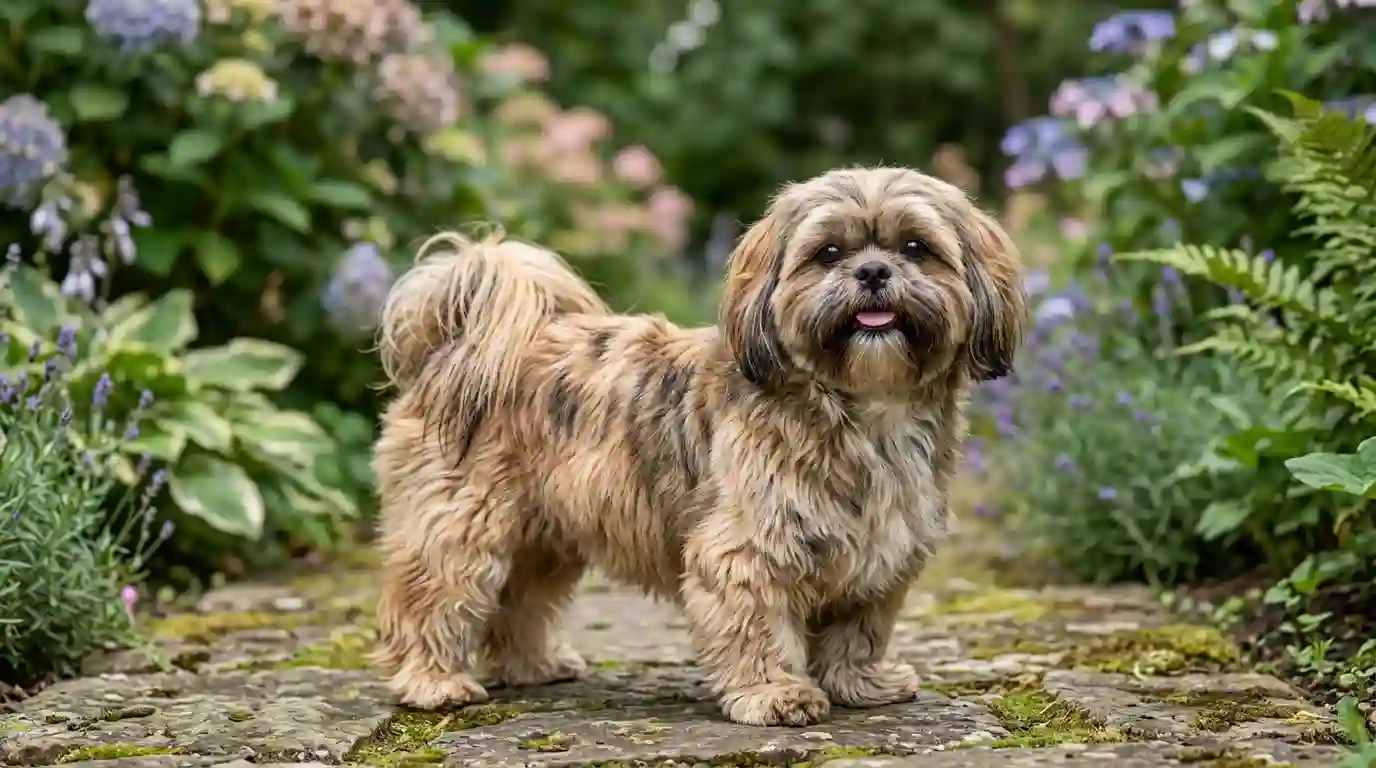
A brindle Shih Tzu has darker streaks running through lighter colored areas of its coat. The pattern may look like fine tiger stripes, broad dark bands, or a subtle mix of contrasting hairs. It can appear across the body or only in certain colored patches. The quickest way to identify it is to examine the back, shoulders, and sides in natural light: look for repeated streaking within the colored hair. A white patch, black facial mask, or dark tips on individual hairs can change a dog’s overall look without establishing brindle. Long hair may soften the pattern, and a haircut can reveal a different-looking layer, so a puppy’s photo cannot guarantee its adult appearance. This guide explains how to compare those similar coats, what pigment genetics and DNA tests can tell you, and how to maintain the Shih Tzu’s dense double coat. If you are looking at a puppy advertised as rare, you will also learn which photos, records, and questions matter more than the sales label.
Table of Contents
- What does brindle look like on a Shih Tzu?
- How can you distinguish brindle from similar coats?
- Why does a brindle pattern occur?
- Will a brindle puppy look the same as an adult?
- Is brindle accepted or particularly rare?
- Does brindle change health, temperament, or grooming needs?
- What should you check before choosing a brindle puppy?
- Frequently asked questions
- Final thoughts
What does brindle look like on a Shih Tzu?
Brindle describes a pattern, not one fixed shade. Imagine a lighter gold, tan, or reddish area crossed by darker streaks. On one dog, those streaks are obvious from across the room; on another, you need to part the long hair to see them. Some coats look grayish or predominantly dark, so their stripes are easy to miss in a small photograph.
Identify streaks across the colored hair
Begin with a large colored area on the back or flank. In daylight, gently lift a small section and compare neighboring strands from roots to ends. Do darker lines recur through the lighter background, or is the dark appearance confined to the ends of otherwise uniform hairs? Repeat this check in several places.
Long hair blends streaks, so examine dry, combed hair and take a close-up.
A red brindle Shih Tzu may have warm-looking background hair, while a silver brindle Shih Tzu may appear cooler and grayer. For the wider color vocabulary, see Shih Tzu colors.

Understand subtle, dense, and reverse-looking brindle
With loose brindle, streaks sit farther apart; with tight brindle, they crowd together. A dark brindle Shih Tzu may look almost black until lighter hair shows through.
Reverse brindle often describes a coat that looks predominantly dark because of dense streaking. It is an appearance label, not proof of a special gene. Check for streaks rather than assuming every dark coat is brindle. If the coat seems largely black, compare it with a black brindle Shih Tzu and a black Shih Tzu.
How can you distinguish brindle from similar coats?
Compare stripes with black hair tips, a facial mask, and solid patches
| What you see | What to check | What it suggests |
| Repeated dark streaks in a lighter colored section | Part the hair on the back or sides and compare neighboring sections | Consistent with brindle. |
| Dark ends on many individual hairs | Follow several hairs from root to tip | Black-tipped hair can create a dark overlay without clear body striping. |
| Dark hair concentrated around the muzzle or eyes | Compare the face with the shoulder and back | A black mask is a facial marking; body brindle is a separate question. |
| Large uniform blocks of color | Look within each block for repeated streaks | Multiple colors or patches alone do not prove brindle. |
| Irregular mottled patches rather than streaks | Inspect the size and shape of light and dark areas | A different pattern may fit; photos alone may be inconclusive. |
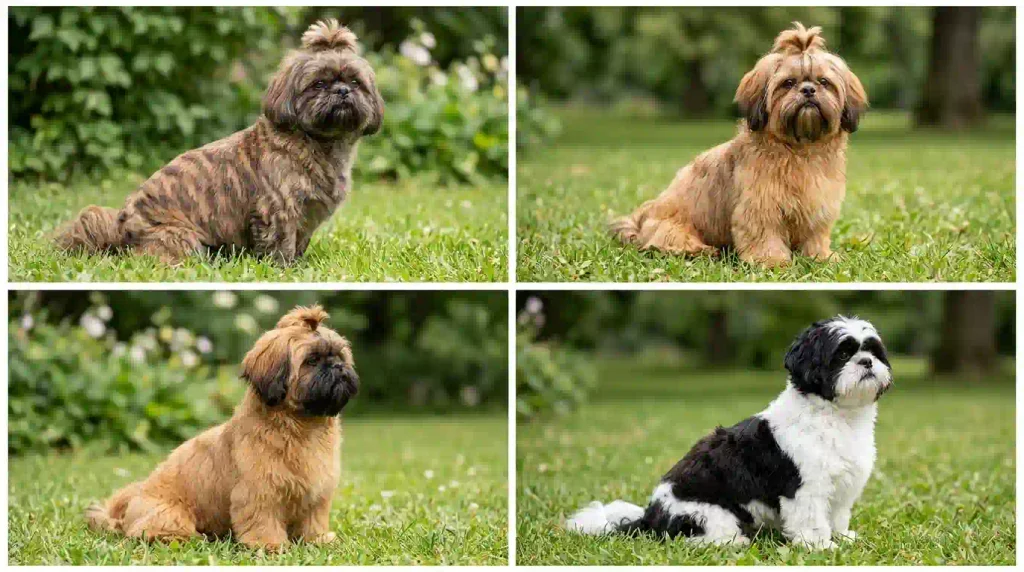
A black mask gold Shih Tzu may look strikingly dark in a headshot while its body remains evenly gold. A black and white Shih Tzu has two visible coat colors, but its black patches need not be striped.
Where white markings, gold, red, silver, blue, and liver fit
A brindle dog may have white paws, a white chest, or larger white areas. In a brindle and white Shih Tzu, inspect the colored patches for streaks; the white portions will not reveal whether the colored hair is brindled. Dogs with extensive white may be called parti-colored, but parti-color describes the distribution of white and does not by itself establish brindle.
A gold and white Shih Tzu or silver and white Shih Tzu can look multicolored without any striping. Blue and liver can also describe pigment in the nose, lips, and eye rims, so an owner may use one of those labels even when the hair looks different from what a beginner expects. Brindling and pigment labels answer different questions. A blue brindle Shih Tzu is a useful example: examine both the streaked hair and the skin points rather than deciding from a gray-looking photo alone.
Use even daylight; filters can distort subtle streaks.
Why does a brindle pattern occur?
Pigment switching and interacting coat-color genes
Two broad pigment types help describe the visible pattern. Eumelanin produces black or brown tones; pheomelanin produces red or yellow tones. Brindle is associated with darker pigment appearing in streaks across areas where lighter pigment is visible. The K locus participates in pigment switching, while the A locus and other genes influence where pigment patterns can be expressed. Variants at the B locus and D locus can affect the appearance of darker pigment. White spotting adds another layer to the finished coat.
A rule that every brindle must have a black nose oversimplifies these interactions.
What appearance and DNA testing can establish
A clear photograph can show visible streaks, patches, and skin points. A DNA report can show only the variants included in that laboratory’s test and how the laboratory interprets them.
If a breeder provides a report, read the tested loci and the result for that individual dog. Ask whether the test addresses coat-color variants, white spotting, inherited health conditions, or parentage. These are different questions. A D-locus result about dilution, for example, does not by itself establish the distribution of white markings. If the test and visible coat seem inconsistent, ask the laboratory or a veterinary genetics professional to explain the specific result rather than relying on a simplified internet inheritance chart.
Will a brindle puppy look the same as an adult?
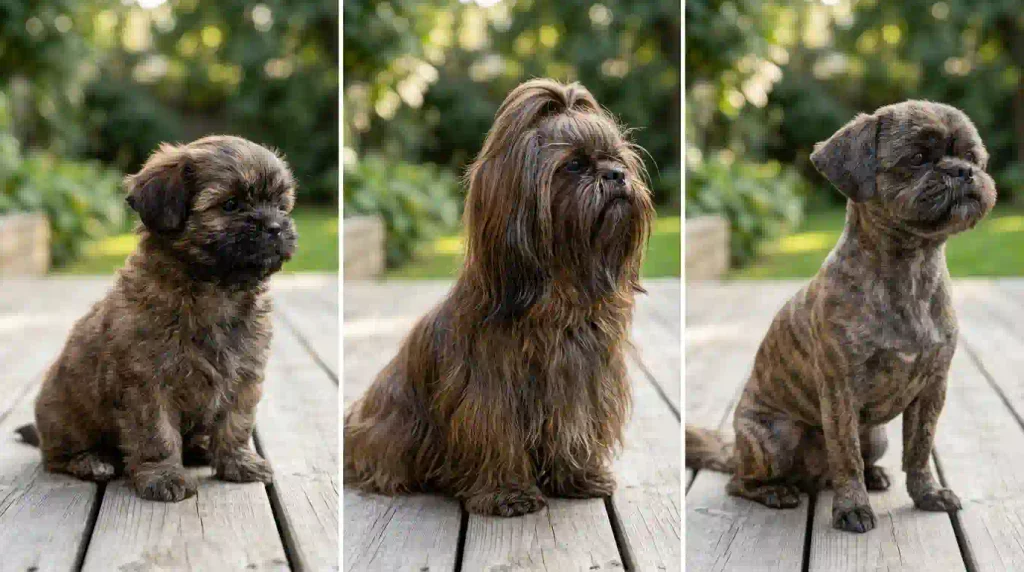
A brindle Shih Tzu puppy may look different as its adult coat grows in. Stripes can become less obvious, more obvious, or different in contrast. That possibility should inform expectations; it does not mean every brindle puppy will lose the pattern.
Coat growth, fading, graying, and haircuts
As adult hair grows, overlapping strands may soften stripe edges. Some dogs lighten; others keep strong contrast or develop gray hairs later. Puppy photos do not predict an exact adult shade.
A haircut adds another visual change. Clipping dark hair tips can reveal paler hair beneath, while trimming a long coat can make faint streaks easier to see. If the dog suddenly develops bald patches, irritation, or broken hair, treat that as a health question rather than ordinary color fading.
Use consistent photos to track the pattern
For an existing dog, build a small photo record:
- Take a full side view and close views of the back, shoulder, face, and any white patches.
- Use natural daylight, dry combed hair, and no color filters.
- Note the date, dog’s age, and how recently the coat was trimmed.
- Repeat from the same angles after substantial growth or grooming.
- Keep the originals so you can compare contrast without edited images.
Is brindle accepted or particularly rare?
The AKC breed standard, registration labels, and seller claims
The American Kennel Club’s official Shih Tzu breed standard says all colors and markings are permissible and considered equally. A brindle pattern is therefore compatible with the US standard’s color language. An AKC registration color is a recorded description, not proof that the dog’s streaks will remain unchanged or that its breeder’s rarity claim is true.
Be careful with statements such as “the rarest Shih Tzu color.” One seller may produce few brindle puppies, while another may produce them more often. Neither observation establishes how common brindle is across the breed. Without reliable breed-wide counts, a numeric ranking or automatic price premium is difficult to support. Ask a seller what evidence backs an unusual-color claim and weigh health records and care practices more heavily than marketing terms.
Does brindle change health, temperament, or grooming needs?
Brindle does not give a Shih Tzu a special personality or make its coat effortless to maintain. Assess the individual dog’s behavior, skin, hair, and everyday care needs separately from its stripe pattern.
Separate coat-color claims from symptoms that need veterinary care
Some discussions of coat color mention color dilution alopecia, a hair-loss condition associated with certain dilute coats in dogs. That is not a diagnosis for every brindle dog, nor evidence that an ordinary brindle pattern causes baldness. Similarly, a dog with a dark or light coat is not automatically healthier than one with the opposite shade.
Look for a change in the dog, not merely a change in a color label. New hair thinning or loss, persistent itching, flaky or inflamed skin, sores, and an unusual odor warrant a veterinary examination. Eye cloudiness, redness, pain, or squinting also deserve prompt veterinary attention; do not confuse a newly cloudy eye with a coat-color trait. Your veterinarian can examine the dog and investigate causes that a photograph cannot distinguish.
Assess temperament from the puppy’s behavior and upbringing, not its stripes or registration color.
Brush and maintain the Shih Tzu’s double coat
The Shih Tzu has a dense double coat, and a dark brindle pattern can conceal dirt or tangles. Brush a long coat daily in small sections, then pass a comb through to check close to the skin. Work gently around the ears, armpits, chest, belly, collar area, and tail, where friction can create mats. Never pull hard at a tight mat or cut blindly near the skin; a groomer can help when a knot is beyond gentle home care.
A shorter trim reduces work but still needs combing. Bathe as needed with dog-appropriate shampoo, rinse and dry thoroughly, and use conditioner if suitable. Choose products for the dog’s skin, not to intensify stripes.
Part the coat during brushing to check the skin. For wider ownership guidance, see Shih Tzu Breed Information.

What should you check before choosing a brindle puppy?
Assess the actual puppy and its care, even if its shade may change.
Examine current photos and clarify the color description
Request dated, unfiltered photographs of the puppy in daylight: one from each side, a view from above, the face, and a close-up of the area claimed to be brindle. A short, current video can help you see how longer hair moves across the pattern. Ask the seller to point out the streaks, any black mask or white markings, and the reason for an added label such as blue or liver. Compare pictures taken before and after a haircut if available.
Ask where the streaks appear. If you want white markings, confirm their size; not every brindle puppy is parti-colored.
Review health records, breeder practices, and grooming costs
Use this short checklist before committing:
- Identify the puppy: Meet it in person where practical, or request a live video showing the same puppy as the photos.
- Review parent information: Ask for the parents’ identities and available health-screening documentation, including which conditions were screened.
- Read veterinary records: Check examinations, vaccinations, parasite-care history, and the documents provided at handover.
- Examine test claims: Request the complete report if the seller advertises DNA or health testing; note which dog was tested and what each result covers.
- Observe care: Look for a clean setting and a puppy comfortable with age-appropriate gentle handling.
- Plan the routine: Budget time for brushing and money for professional trims if you cannot maintain the coat entirely at home.
- Question pressure: A time-limited “rare brindle” offer does not replace a review of the puppy or its records.
Choose a dog whose needs you can meet even if its adult coat looks lighter or darker than expected. Broader Shih Tzu facts can help with the ownership decision, but evaluate each seller’s evidence on its own merits.
Frequently asked questions
What is a brindle Shih Tzu?
A Shih Tzu with repeated darker streaks through lighter colored coat areas.
Can a brindle Shih Tzu have white patches?
Yes; white markings can occur alongside brindled colored areas.
Is a dark brindle Shih Tzu the same as a black dog?
No; look for visible streaks rather than deciding from the overall darkness.
Do brindle Shih Tzu puppies keep their stripes?
The visible pattern can change as hair grows or is trimmed, so an exact adult look is not guaranteed.
Does brindle change a Shih Tzu’s temperament?
A coat pattern does not establish an individual dog’s personality.
Is brindle accepted by the AKC?
The AKC Shih Tzu standard permits all colors and markings equally.
Does brindle require special shampoo?
No; select products for the dog’s coat and skin needs.
Can a DNA test predict the exact adult coat?
No; it reports the variants tested, with limits on predicting the finished appearance.
Final Thoughts
A brindle Shih Tzu is easiest to recognize by repeated darker streaks within colored coat areas. Check those areas in natural light and compare several sections before relying on an overall shade, a face mask, or a seller’s label. Remember that a growing puppy coat or a haircut can change how obvious the pattern looks. Give a long double coat regular brushing, examine the skin beneath it, and ask a veterinarian about hair loss or irritation. If you are choosing a puppy, request clear current photos and documented health information, then decide whether the dog’s grooming and other needs fit your life. Start with the visible pattern, but let the individual dog guide the decision.