What Is a Prapso Shih Tzu? Signs, Coat, Genetics, and Care
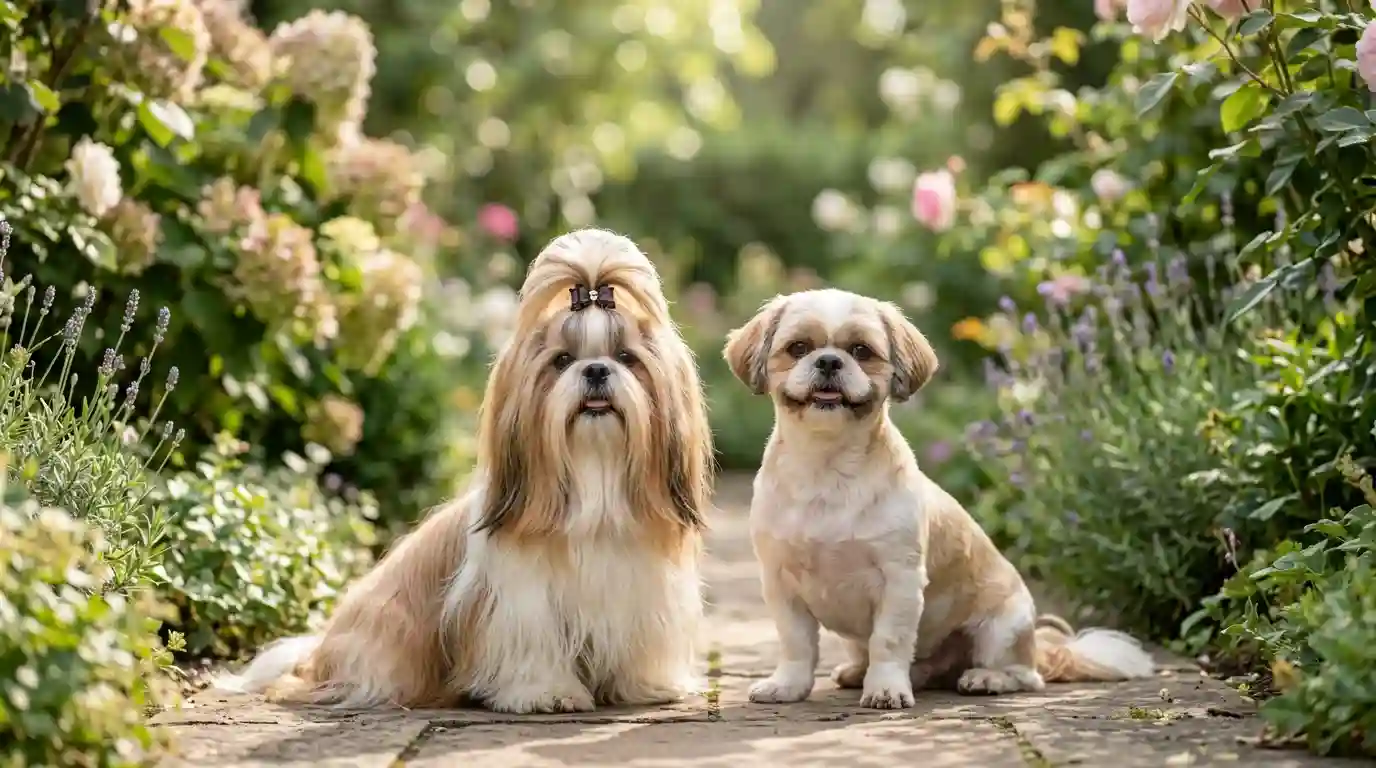
A Prapso Shih Tzu is a term used by some breeders and owners for a Shih Tzu whose coat develops much shorter, smoother, or less profusely than the breed’s typical long, flowing double coat. The difference may become noticeable during puppyhood, especially when littermates begin developing fuller facial hair, leg furnishings, and longer body coats while one puppy remains comparatively smooth. Breeders sometimes describe these dogs as full Prapso or partial Prapso, but those are informal terms rather than official kennel-club varieties. A short or unusual coat also does not by itself prove that a dog is mixed with Lhasa Apso, Tibetan Spaniel, or another breed; pedigree and verified parentage are separate questions. Canine coat length is influenced by known genes, including FGF5 variants, but there is currently no validated Prapso-specific genetic test proving a single mutation or inheritance pattern. This guide explains how the coat may look, what can change with age, what the breed standard says, which popular Prapso claims remain anecdotal, and how to care for an individual dog safely.
Table of Contents
- The short answer: what “Prapso” means
- How a Prapso coat can look different
- Does a short coat mean the dog is not purebred?
- What is known—and unknown—about the genetics
- Health, development, and temperament claims
- Grooming and everyday care
- Questions to ask a breeder or rescue
- Prapso Shih Tzu FAQs
- Final thoughts
The Short Answer: What “Prapso” Means
The term Prapso Shih Tzu generally refers to a Shih Tzu that develops an atypically short, smooth, sparse, or less profuse coat compared with the classic Shih Tzu coat.
The word itself is often explained in breeder circles as coming from the phrase:
“perhaps an Apso”
The idea is that an unusually short-coated puppy may look sufficiently different from its littermates that someone unfamiliar with the trait wonders whether a Lhasa Apso or another breed is involved.
That explanation of the name is part of breeder tradition rather than an official kennel-club definition.
Importantly, Prapso is not a recognized separate Shih Tzu breed or size variety.
It should not be grouped with different types of Shih Tzu as though it were equivalent to a formal breed classification.
Instead, think of it as a label for an unusual coat phenotype—what the dog’s hair visibly looks and grows like.
A puppy may still otherwise resemble a Shih Tzu in:
- Body size
- Head
- Tail carriage
- Expression
- Color
- Temperament
- Overall structure
while having noticeably different hair growth.
Prapso Does Not Mean “Shaved Shih Tzu”
A Prapso coat is also different from an ordinary Shih Tzu that has received a short haircut.
A normally coated dog clipped into a puppy cut still has the biological capacity to regrow its typical longer coat.
A dog described as Prapso is said to naturally grow a shorter or less profuse coat.
That distinction becomes clearer over time.
How a Prapso Coat Can Look Different
The standard Shih Tzu is famous for a long, dense, flowing double coat.
A Prapso-type puppy may instead develop:
- Shorter body hair
- Smooth-looking facial hair
- Limited beard or mustache
- Short hair around the muzzle
- Less feathering on the legs
- Less hair around the feet
- Reduced topknot growth
- Less profuse coat around the head
- A coat that does not reach the floor
- Different coat texture from littermates
Not every dog described as Prapso looks identical.
That is why the labels full Prapso and partial Prapso are sometimes used.
Full and Partial Coat Differences
These are breeder descriptions rather than standardized veterinary diagnoses.
Full Prapso
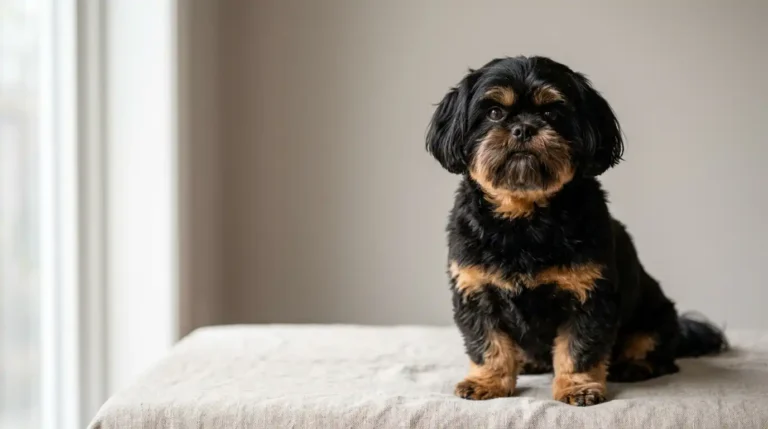
A dog described as a full Prapso is usually said to have shorter hair across most of the body.
The coat may appear:
- Smooth
- Relatively short
- Close to the body
- Sparse compared with ordinary Shih Tzu coat
- Short around the face
- Shorter on the legs and feet
The face can look especially different because normal Shih Tzu facial furnishings contribute strongly to the breed’s familiar “chrysanthemum” appearance.
Without long hair around the muzzle and cheeks, a Prapso puppy may appear to have:
- A more visible muzzle
- Larger-looking eyes
- A different head outline
- More prominent ears
That visual difference can lead owners to wonder whether the puppy is part Tibetan Spaniel, Lhasa Apso, or another Asian companion breed.
Appearance alone cannot answer that question.
Partial Prapso
A partial Prapso is generally described as intermediate.
The body coat may grow longer than in a full Prapso but remain noticeably shorter or less profuse than the typical Shih Tzu show coat.
Some partial dogs may have:
- Moderate-length body hair
- Longer hair on ears or tail
- Enough head hair for a small topknot
- Shorter muzzle hair
- Reduced leg furnishings
- Uneven coat length across different body areas
The coat can therefore look like a combination of normal and short-coat characteristics.
Typical Coat vs. Informal Prapso Description
| Feature | Typical Shih Tzu Coat | Prapso-Type Description |
| Body hair | Long and flowing | Shorter or less profuse |
| Double coat | Expected in standard | May look thinner or single-coated |
| Facial hair | Long furnishings | Often shorter around muzzle |
| Topknot | Usually possible when coat grows | May be reduced or absent |
| Leg furnishings | Long | Often shorter |
| Floor-length potential | Possible | Often limited |
| Grooming demand | High when kept long | May be lower, but not zero |
| Official variety? | Standard breed coat | No |
What May Change as a Puppy Grows
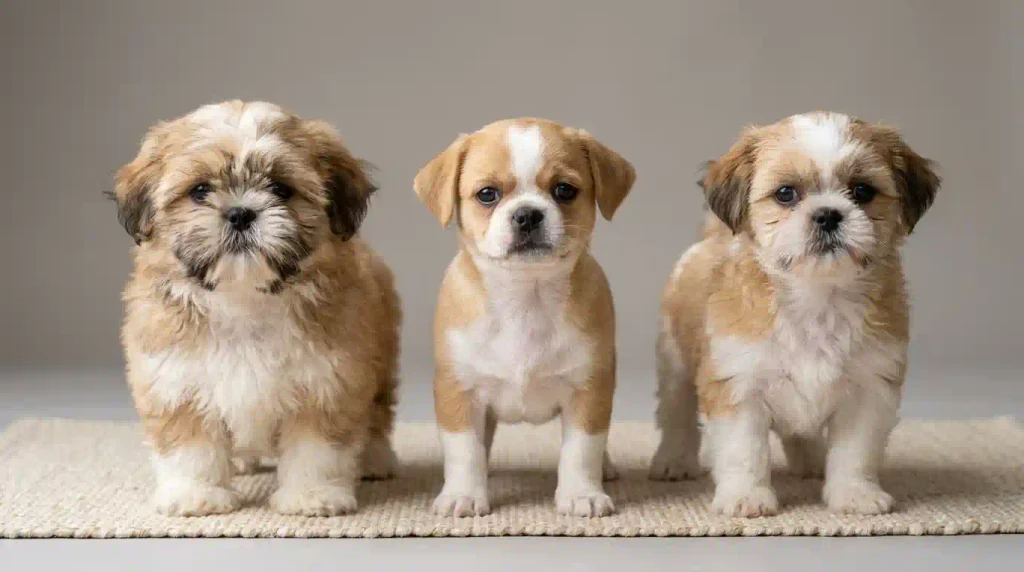
Breeders commonly report that coat differences become easier to notice around the time normal-coated littermates begin “fluffing out.”
A puppy may initially look ordinary at only a few weeks old.
Later, the contrast becomes clearer because its siblings develop:
- Longer facial hair
- More leg feathering
- Denser body hair
- Fuller head furnishings
while the Prapso-type puppy remains comparatively smooth.
However, one early puppy photo is not enough to predict the mature coat perfectly.
Shih Tzu coats normally change as dogs grow, and the usual puppy-to-adult coat transition can itself alter texture, density, and appearance.
A puppy that simply develops coat at a different rate should not immediately receive a permanent label.
If you are unsure, compare photographs over several weeks rather than relying on one image.
Does a Short Coat Mean the Dog Is Not Purebred?
No.
A short or atypical coat does not by itself prove mixed ancestry.
This is one of the most important points for people searching “what is a Prapso Shih Tzu?”
Breed identity and coat appearance are different questions.
Coat Appearance Versus Pedigree
Suppose two registered Shih Tzu parents produce a puppy whose hair remains unexpectedly short.
The puppy’s unusual coat does not automatically change the identity of its parents.
Conversely, a dog that looks exactly like a textbook Shih Tzu cannot prove its ancestry from appearance alone either.
If you want to establish whether a dog is a purebred Shih Tzu, stronger evidence includes:
- Verified parents
- Pedigree documents
- Registration records where applicable
- Breeder records
- Parentage testing when necessary
A commercial breed-ancestry DNA estimate can provide additional information in some situations, but it should not be confused with a diagnostic test for “Prapso.”
There currently is no recognized DNA result that simply says:
Prapso: positive
Does a Prapso Mean Lhasa Apso Ancestry?
Not automatically.
The term’s traditional “perhaps an Apso” explanation reflects how the puppy may look, not proof of a recent Lhasa Apso cross.
The Shih Tzu and Lhasa Apso do share historical connections among Tibetan and Chinese companion dogs.
Our Shih Tzu origin guide explains that background.
But historical relatedness between breeds does not prove that an individual short-coated puppy has a recent Lhasa Apso parent.
How the Breed Standard Describes the Show Coat
The official Shih Tzu standard describes the ideal dog as having a long, flowing double coat.
The current American Kennel Club Shih Tzu standard describes the coat as luxurious, double-coated, dense, long, and flowing.
This means a naturally very short or sparse coat departs from the ideal described for conformation showing.
That matters if the goal is the show ring.
It does not mean the dog cannot make a suitable companion.
A breed-standard deviation and proof of mixed ancestry are not the same thing.
A dog can also have completely normal Shih Tzu colors while having unusual coat length.
For example, a Prapso-type dog might visually be:
Color and coat length are separate traits.
What Is Known—and Unknown—About the Genetics
This is where Prapso information online becomes especially unreliable.
You may see confident claims such as:
- “Prapso is caused by one recessive gene.”
- “Prapso is dominant.”
- “Two carriers always produce a predictable percentage.”
- “It is a throwback to the Tibetan Spaniel.”
- “It comes directly from Lhasa Apso genes.”
- “DNA testing can prove Prapso.”
These statements should not be repeated as established facts without appropriate evidence.
What We Do Know About Dog Coat Length
Dog coat traits are influenced by known genes.
For example, variants in FGF5 are associated with long-hair phenotypes in many dog breeds.
Other genes can influence:
- Furnishings
- Curl
- Shedding
- Texture
So the general idea that genetics influences Shih Tzu coat length is completely reasonable.
What We Do Not Yet Know About “Prapso”
What has not been established in reliable veterinary-genetics literature is a specific mutation officially identified as:
the Prapso gene
There is no widely validated Prapso DNA test showing that all dogs carrying the appearance have the same molecular cause.
That means the inheritance could potentially involve:
- A known coat-length variant
- Furnishing-related variants
- Multiple genes acting together
- Other unidentified factors
but assigning one explanation without testing is speculation.
Recessive Gene or Multigene Trait?
Breeder sources disagree.
Some describe the trait as recessive.
Others propose more complicated or multigene inheritance.
Those observations may eventually prove useful to researchers, but breeder experience is not the same as a controlled genetic study.
Until Prapso-specific research establishes the mechanism, the accurate wording is:
The unusual coat likely has a genetic basis, but the precise inheritance of the breeder-defined Prapso phenotype has not been scientifically established.
Is There a Prapso DNA Test?
Not currently as a recognized Prapso-specific diagnostic test.
A dog can be tested for general canine coat genes such as FGF5 variants, but obtaining a coat-length result does not automatically prove or disprove the entire breeder-defined Prapso phenotype.
This distinction protects owners from spending money on a test that cannot answer the specific question they think they are asking.

Health, Development, and Temperament Claims
Online Prapso descriptions often go beyond coat appearance.
Breeder anecdotes sometimes claim that Prapso puppies:
- Open their eyes earlier
- Walk earlier
- Develop teeth earlier
- Mature faster
- Are more intelligent
- Are more dominant
- Are more playful
- Are healthier
- Have different cognitive development
These claims deserve caution.
Which Breeder Observations Lack Strong Evidence?
Multiple breeder websites describe early eye opening and tooth eruption.
That repetition tells us the observation exists within breeder communities.
It does not automatically establish that every Prapso puppy develops faster or that Prapso genetics cause the difference.
Factors affecting puppy development can include:
- Individual variation
- Litter size
- Birth weight
- Nutrition
- Maternal health
- Environment
- Genetics unrelated to coat
Similarly, statements such as “Prapsos are smarter” or “they are always the alpha puppy” are subjective behavioral impressions.
There is no accepted veterinary test demonstrating superior Prapso intelligence.
It is therefore better to evaluate an individual puppy’s temperament rather than predict behavior from coat type.
Are Prapso Shih Tzus Healthier?
There is not enough reliable evidence to claim that they are universally healthier.
A Prapso-type dog can still experience health conditions seen in Shih Tzus generally.
Its shorter coat does not protect it automatically from:
- Dental disease
- Eye problems
- Patellar luxation
- Brachycephalic airway concerns
- Other individual health issues
Likewise, an unusual coat alone does not mean the dog is sick.
The coat difference may simply be developmental or genetic.
Does Prapso Change Shih Tzu Temperament?
There is no established Prapso temperament category.
Typical Shih Tzu facts about the breed—such as its companion-dog background—remain more useful than claims that the short coat creates a specific personality.
Socialization, training, health, environment, and individual genetics all affect behavior.
When a Coat Change Calls for a Veterinarian
A puppy that has always had shorter hair is different from a dog that suddenly begins losing a previously normal coat.
Contact a veterinarian if you notice:
- Sudden hair loss
- Bald patches
- Severe thinning
- Persistent scratching
- Red skin
- Scaling
- Crusting
- Sores
- Unusual odor
- Broken hairs
- Skin infection
- Significant coat loss accompanied by illness
- Symmetrical hair loss appearing later in life
Hair loss, or alopecia, can have many causes.
These include:
- Parasites
- Infection
- Allergic skin disease
- Hormonal disorders
- Nutritional problems
- Inherited follicle disorders
- Trauma or excessive scratching
Do not assume that a new bald patch is “just Prapso.”
A Prapso label describes an overall developmental coat appearance; it should not be used to dismiss acquired skin disease.

Grooming and Everyday Care
A shorter coat can make grooming easier, but Prapso does not mean no grooming.
The actual routine depends on the individual dog’s:
- Coat length
- Texture
- Density
- Shedding
- Skin
- Lifestyle
Brushing
A short, smooth coat may require less brushing than a floor-length Shih Tzu coat.
However, brush regularly enough to:
- Remove loose hair
- Check the skin
- Prevent tangles in longer sections
- Keep ears, tail, and chest tidy
Partial Prapso dogs may still mat in areas where hair grows longer.
Bathing
Bathe according to coat condition and lifestyle rather than an arbitrary Prapso schedule.
Use dog-appropriate shampoo and rinse thoroughly.
Dogs with sensitive, dry, itchy, or abnormal skin should receive product recommendations from a veterinarian.
Facial Care
A typical Shih Tzu can grow substantial facial furnishings that require combing and topknot management.
A Prapso-type dog may have much shorter facial hair.
That can reduce some grooming around the muzzle but does not eliminate:
- Eye checks
- Facial cleaning
- Dental care
- Ear care
Nail Trimming
Keep nails short enough that they do not interfere with normal movement.
The coat type does not change nail-care needs.
Dental Care
Regular tooth brushing remains important because dental health is unrelated to whether the coat is Prapso-like.
Does a Prapso Shed?
Some owners report more noticeable loose hair because the coat behaves differently from the typical profuse Shih Tzu coat.
However, “Prapso” is not a scientifically standardized coat category with a defined shedding rate.
Do not assume every Prapso sheds heavily—or does not shed.
Likewise, a short coat does not guarantee a dog will be suitable for someone with allergies.
Our guide on whether the Shih Tzu is hypoallergenic explains why allergens are more complicated than visible coat length.
Questions to Ask a Breeder or Rescue
If a puppy is being advertised as a Prapso Shih Tzu, ask exactly what the seller means.
1. When Did You First Notice the Coat Difference?
Ask whether the puppy looked different from littermates and at what age the difference became obvious.
2. Is It Being Described as Full or Partial Prapso?
Remember that these are informal breeder labels.
Ask the breeder to describe the actual coat, not merely provide the label.
3. Can I See Littermate Photos?
Comparing littermates of the same age can be especially useful.
Look at:
- Face
- Muzzle hair
- Legs
- Body coat
- Ears
- Tail
4. Can I See Both Parents?
If purebred status matters, ask for information about:
- Dam
- Sire
- Registration
- Pedigrees
- Parentage documentation
Do not accept “Prapso looks like Tibetan Spaniel” as proof of a recent cross.
5. Have These Parents Produced Prapso-Type Puppies Before?
This can provide useful breeder history even though it does not establish a formal inheritance model.
6. What Will the Adult Coat Look Like?
A responsible breeder should explain uncertainty.
Avoid promises that a young puppy will have one exact adult coat length or texture.
7. Has a Veterinarian Examined the Puppy?
A veterinary exam can help distinguish a healthy unusual coat from signs of skin or developmental disease.
8. Is the Puppy Being Sold for Breeding or as a Companion?
Because the coat departs from the long-flowing show ideal, many responsible breeders may place an affected puppy primarily as a companion.
9. Is There a Prapso Genetic Test?
If someone claims to have one, ask for:
- Laboratory name
- Gene tested
- Published validation
- Explanation of what the result actually proves
A standard coat-length test is not automatically a Prapso diagnostic test.
10. Are Health or Intelligence Guarantees Being Made?
Be cautious with claims such as:
- “Prapsos never get sick.”
- “Prapsos are smarter.”
- “Prapsos always live longer.”
- “Prapsos mature faster.”
- “Prapsos never mat.”
- “Prapsos are completely hypoallergenic.”
These go beyond what current evidence supports.
A breeder should describe the actual puppy rather than turn an unusual coat into a package of unverified advantages.
Prapso Shih Tzu FAQs
What is a Prapso Shih Tzu?
A Prapso Shih Tzu is an informal breeder term for a Shih Tzu with an atypically short, smooth, or less profuse natural coat.
What does “Prapso” mean?
The name is commonly explained in breeder circles as a shortened form of “perhaps an Apso.”
Is Prapso an official Shih Tzu variety?
No, it is not a separate kennel-club-recognized Shih Tzu variety.
What is a full Prapso?
Full Prapso is an informal term for a dog showing short coat characteristics over much of its body and face.
What is a partial Prapso?
Partial Prapso generally describes a dog with some longer coat areas but shorter-than-typical hair on areas such as the muzzle or legs.
Does a Prapso Shih Tzu have short hair?
Usually yes; shorter or less profuse natural hair is the main characteristic associated with the term.
Does a Prapso have a single coat?
Some are described as appearing single-coated or less densely double-coated, but the term is not standardized enough to guarantee one identical coat structure.
Can a Prapso grow a topknot?
Some partial Prapso dogs may grow enough head hair for one, while fuller short-coated dogs may not.
Can a Prapso be purebred?
Yes, an unusual coat does not by itself disprove purebred ancestry.
Does Prapso mean the puppy is part Lhasa Apso?
No; the appearance alone cannot demonstrate a recent Lhasa Apso cross.
Is a Prapso part Tibetan Spaniel?
Not necessarily; resemblance to a Tibetan Spaniel is visual and does not establish parentage.
How can I know whether my Prapso is purebred?
Pedigree, parent information, registration records, and parentage evidence are more useful than coat appearance.
Is there a Prapso gene?
No single validated gene has been established specifically as the cause of the breeder-defined Prapso phenotype.
Is Prapso recessive?
Some breeders describe it that way, but reliable Prapso-specific research has not established a definitive simple inheritance model.
Can DNA testing diagnose Prapso?
There is no widely validated Prapso-specific DNA test currently established.
Do Prapso puppies open their eyes earlier?
Some breeders report this, but it has not been established as a universal scientifically verified Prapso trait.
Do Prapso puppies get teeth earlier?
Early tooth eruption is also reported anecdotally by breeders but should not be treated as a proven defining feature.
Are Prapso Shih Tzus smarter?
There is no reliable evidence showing that the coat phenotype causes greater intelligence.
Do Prapso Shih Tzus have different temperaments?
No established Prapso-specific temperament has been demonstrated.
Are Prapso Shih Tzus healthier?
There is insufficient evidence to say they are universally healthier than normally coated Shih Tzus.
Are Prapso Shih Tzus rare?
The frequency is not well documented in a reliable population database, so universal rarity claims are difficult to verify.
When can you recognize a Prapso puppy?
Breeders often report recognizing coat differences as littermates begin developing fuller coats, sometimes around six weeks or later.
Does the Prapso coat change with age?
Yes, coat length and texture can continue developing, so an early puppy appearance does not perfectly predict adulthood.
Does a Prapso need grooming?
Yes, although a naturally shorter coat may require less brushing than a full-length Shih Tzu coat.
Do Prapso Shih Tzus get mats?
They may develop fewer mats if the coat remains short, but longer areas on partial Prapsos can still tangle.
Do Prapso Shih Tzus shed?
Shedding may vary between individuals, and there is no standardized Prapso shedding rate.
Is a Prapso hypoallergenic?
A short or unusual coat does not guarantee that an allergic person will not react.
Can a Prapso compete in conformation shows?
A naturally short coat departs from the long, flowing double coat described by the Shih Tzu conformation standard.
Should sudden hair loss be called Prapso?
No; sudden thinning, baldness, itching, or skin inflammation should be evaluated for medical causes.
Final Thoughts
A Prapso Shih Tzu is best understood as a breeder and owner term for an unusual coat phenotype—not a separate breed, guaranteed health advantage, or proven genetic syndrome. These dogs may naturally have shorter body hair, limited facial furnishings, reduced leg feathering, or a coat that never develops the classic floor-length Shih Tzu appearance.
The coat alone also cannot determine whether a dog is purebred. Use pedigree and parentage information for ancestry, and remember that no validated Prapso-specific DNA test currently establishes one simple genetic cause.
If your puppy has always developed a shorter but healthy coat, the main adjustment may simply be a different grooming routine. If hair is suddenly falling out, skin becomes inflamed, or bald patches develop, involve a veterinarian rather than assuming Prapso explains the change. For broader context, continue with our Shih Tzu facts and shih tzu Breed Information guides.