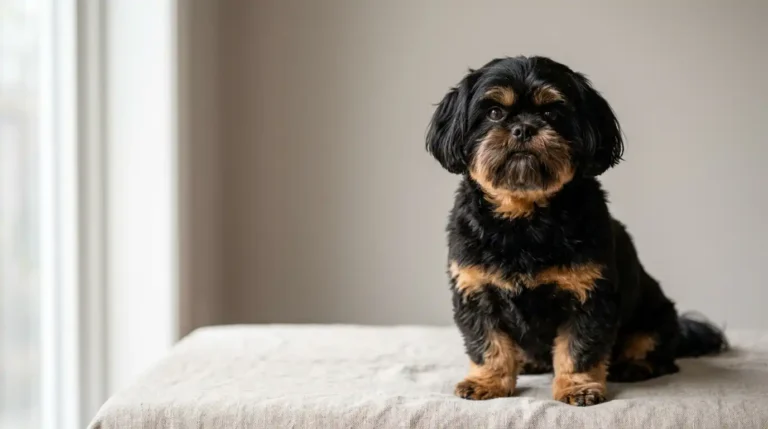

Liver and White Shih Tzu: Color, Identification, and Care
A liver and white Shih Tzu combines distinctive liver pigmentation with white coat markings, but understanding the name requires separating pigmentation from coat color. In a true liver-pigmented Shih Tzu, areas that would normally contain black eumelanin—especially the nose, lips, and eye rims—appear brown or liver instead. The white portion refers to areas of unpigmented hair that may form patches, a blaze, collar, chest marking, saddle-like pattern, or other arrangements across the coat. This means a brown-looking and white dog with a black nose is not automatically liver and white.
If you are trying to identify a puppy, compare the coat with the dog’s skin points in natural daylight rather than relying on a breeder label or photograph alone. This guide explains exactly what liver and white Shih Tzu means, how it differs from similar Shih Tzu colors, what breed standards say, how the coat may change with age, and how to keep the long double coat healthy and attractive.
Table of Contents
- What does “liver and white” mean?
- How can you identify a liver and white Shih Tzu?
- How is liver and white different from similar colors?
- What do the AKC and breed standards say about this color?
- Can the coat’s appearance change as a Shih Tzu grows?
- How do you care for a liver and white Shih Tzu’s coat?
- What should you ask a breeder about color and registration?
- Liver and white Shih Tzu identification checklist
- Frequently asked questions
- Final thoughts
What Does “Liver and White” Mean?
The phrase liver and white Shih Tzu describes two different aspects of the dog’s appearance.
“Liver” primarily refers to the dog’s brown-based eumelanin pigmentation. “White” describes areas of the coat where pigment is absent from the hair.
Understanding this distinction is important because everyday terms such as brown, chocolate, liver, gold, and red are sometimes used inconsistently in puppy advertisements.
A general liver Shih Tzu guide can help you understand liver pigmentation itself, while this article focuses specifically on dogs that combine liver pigmentation with substantial white markings.
Liver Describes Pigmentation; White Describes the Coat
A useful way to understand the combination is to examine the dog’s features separately.
| Feature | What to Look For |
| Nose | Brown or liver rather than black |
| Lips | Brown/liver pigmentation |
| Eye rims | Brown/liver rather than black |
| Paw pads | Often brown-based pigmentation |
| Coat | Liver-associated colored areas mixed with white |
| White markings | May appear on face, chest, legs, neck, body, or tail |
In dogs, eumelanin normally appears black unless genetic variants modify it. Liver pigmentation is associated with brown eumelanin. Variants involving the B locus and TYRP1 gene can change black eumelanin to brown.
The trait is generally recessive, meaning the relevant brown variants must be inherited in a combination that allows the liver phenotype to be expressed.
White markings are another part of the dog’s appearance and should be evaluated separately. A dog can have extensive white hair yet still show clearly liver-colored pigmentation on its nose and eye rims.
This is also why a white Shih Tzu and a liver-and-white dog should not be classified purely by the amount of white visible in the coat.
How the Liver-Colored Areas Can Vary in Shade
“Liver” does not mean every dog’s colored hair must look like the same shade of dark chocolate.
The visible areas may appear:
- Medium brown
- Chocolate brown
- Reddish brown
- Warm caramel-brown
- Light brown
- Dark liver
- Brown with golden or reddish undertones
Lighting, coat length, age, and surrounding white hair can make these shades appear different.
A liver chocolate Shih Tzu may have particularly rich brown coloration, while a dog described as a golden brown Shih Tzu may look warmer or lighter. Those visual descriptions should not replace inspection of the dog’s actual pigmentation.
The nose, lips, and eye rims provide more useful information about liver pigmentation than simply deciding whether the coat “looks brown.”

How Can You Identify a Liver and White Shih Tzu?
Identification becomes easier when you stop looking at the dog as one color and inspect individual characteristics.
The strongest visual clues come from the dog’s skin pigmentation, particularly around the face.
Check the Nose, Lips, Eye Rims, and Paw Pads
Start with the nose.
On a liver-pigmented Shih Tzu, the nose should be liver or brown rather than solid black. The lips and eye rims should show corresponding brown-based pigmentation.
Paw pads can provide another useful clue, although they should not be used alone for identification.
Whenever possible, inspect the dog in indirect natural daylight. Strong artificial lighting can make deep brown pigmentation appear almost black, while warm lighting can make black pigmentation look brownish.
The Shih Tzu breed standard also recognizes this pigment distinction. The official American Kennel Club Shih Tzu breed information lists Liver & White among the breed’s registration colors, and the standard distinguishes liver pigmentation from ordinary black pigmentation.
Eye color may also be lighter in a liver-pigmented Shih Tzu, but eye color alone should never be treated as proof.
Separate the Skin Points From the Coat Markings
Next, ignore the nose for a moment and examine the coat itself.
The white areas may take many forms.
A white blaze may run between the eyes or up the forehead. White on the neck can appear as a partial or complete collar. Larger white areas around the shoulders may resemble a shawl, while colored areas across the back may create a saddle effect.
Some dogs have a pattern that resembles a tuxedo, with more concentrated color across the back and head and white on the chest, belly, or legs.
These descriptive terms can help explain appearance, but they do not create separate genetic color categories by themselves.
A liver-and-white dog might therefore have:
Liver ears + white blaze + white chest
or
Liver head + white collar + liver saddle + white legs
or
Mostly white coat + several liver patches
The distribution can vary considerably.
This is one reason a Shih Tzu color chart should be used as a visual guide rather than an absolute diagnostic tool.
What Photos Can—and Cannot—Confirm
Photos are useful for comparing markings, but they have important limitations.
Camera exposure, white balance, sunlight, filters, indoor bulbs, and editing can dramatically alter brown pigmentation.
A dark liver nose photographed in shadow can look black. A black nose photographed under warm indoor lighting may appear brown.
If you are evaluating a puppy remotely, ask the breeder for:
- A clear photograph of the face in natural daylight.
- A close-up showing the nose and lips.
- A photograph showing both eye rims.
- Full-body photographs showing the white markings.
- Similar photographs of the parents when available.
Photos can help establish whether a puppy appears consistent with liver and white coloration, but they cannot reliably confirm every aspect of color genetics.
If genotype matters for breeding or another specific reason, appropriate DNA testing provides information that appearance alone cannot.

How Is Liver and White Different From Similar Colors?
Many Shih Tzu coat combinations can overlap visually, particularly in photographs.
The most useful distinction is often not whether the hair looks brown but whether the dog has black or liver pigmentation.
| Color Description | Typical Coat Appearance | Pigment Clue |
| Liver and white | Brown/liver-associated areas + white | Liver/brown points |
| Red and white | Red/copper areas + white | Must inspect points separately |
| Brown and white | Brown-looking coat + white | May or may not indicate liver |
| Gold and white | Gold coat + white | Often visually warmer/lighter |
| Brindle and white | Patterned colored areas + white | Pattern must be evaluated separately |
| Black and white | Black areas + white | Black pigmentation |
Liver and White Versus Red and White
A red and white Shih Tzu can sometimes appear surprisingly similar to a lighter liver-and-white dog, especially when the red coat has strong brown or copper undertones.
The difference cannot be established simply by deciding whether the colored patches look “red” or “brown.”
Look at the skin points.
A red-coated dog may retain a black nose, black lips, and black eye rims. A liver-pigmented dog has brown/liver eumelanin instead.
A red liver Shih Tzu demonstrates why this distinction matters: a dog can have a visibly red coat while also having liver pigmentation.
Similarly, a plain red Shih Tzu should not automatically be classified as liver just because the red coat appears dark.
Liver and White Versus Brown-Looking Coats With Black Points
This is one of the most common sources of confusion.
A dog can have hair that looks brown while retaining completely black pigmentation.
For example, a brown Shih Tzu may be described according to visual coat appearance, but the word “brown” by itself does not prove liver pigmentation.
The same caution applies when looking at a brown and white Shih Tzu.
If the dog has a clearly black nose and black eye rims, that is significant information and should not be ignored simply because its coat appears chocolate, tan, or brown.
Other combinations such as a black and brown Shih Tzu or brown black and white Shih Tzu can contain several visually dark coat colors while retaining obvious black pigment.
This is why skin pigmentation and coat color should always be evaluated separately.
When Brindle or Other Markings Affect the Appearance
Brindle can make color identification more complicated because the coat contains a pattern of lighter and darker hairs.
A brindle Shih Tzu may show dark striping or intermingled hairs that create a brownish appearance from a distance.
A brindle and white Shih Tzu combines that patterned coat with white spotting, while a red brindle Shih Tzu may include strong red or warm-toned areas.
Likewise, a black brindle Shih Tzu can appear very dark, while a silver brindle Shih Tzu may become lighter or grayer in appearance.
A facial mask can also change how the dog looks. For example, a black mask gold Shih Tzu has dark facial hair that should not be confused with liver pigmentation.
A true black mask provides visible black eumelanin. That is different from brown liver pigmentation.
What Do the AKC and Breed Standards Say About This Color?
Liver & White is an AKC-listed Shih Tzu registration color.
The American Kennel Club currently lists both Liver and Liver & White among Shih Tzu colors.
The official breed standard also says that all colors and markings are permissible and are to be considered equally.
Pigmentation receives specific attention in the standard. Nose, lips, and eye rims are normally black, except that liver-pigmented dogs have liver pigmentation and blue-pigmented dogs have blue pigmentation.
This supports an important practical principle: liver identification is not based solely on brown coat hair.
The Royal Kennel Club in the United Kingdom likewise includes Liver and Liver & White among its Shih Tzu breed-standard color listings. Its current breed standard allows all colors except merle.
That UK distinction is worth knowing because older or inaccurate online articles sometimes claim that liver is excluded from the British standard.
Registration terminology also should not be confused with genetic testing.
A registration color describes how the dog is recorded, while DNA testing examines specific genetic variants. Neither should be substituted for the other.
If you are studying the breed more broadly, our shih tzu Breed Information section, Shih Tzu facts, and guide to Shih Tzu origin provide additional background.
Can the Coat’s Appearance Change as a Shih Tzu Grows?
Yes. Shih Tzu coat appearance can change considerably between puppyhood and adulthood.
A puppy with deep brown areas may develop lighter, warmer, or more muted shades as the adult coat grows. Other dogs maintain strong pigmentation and relatively rich coat color.
The exact adult shade cannot be predicted simply from a young puppy photograph.
Changes can occur because of:
- Development of the adult coat
- Hair length
- Changes in color intensity
- Different proportions of lighter and darker hairs
- Grooming and clipping
- Sun exposure
- Normal aging
White markings themselves may also look different as body proportions change and the coat becomes longer.
For example, a narrow white facial flare on a puppy may look broader once the surrounding hair grows. A colored saddle can appear smaller relative to the dog’s longer white coat.
The underlying liver pigmentation of the skin points is a different characteristic from gradual changes in coat shade.
This is another reason not to reject or confirm liver pigmentation purely because a puppy’s brown coat becomes lighter with age.
A gold and white Shih Tzu, blonde Shih Tzu, or tan and white Shih Tzu may also shift noticeably in visual appearance over time.

How Do You Care for a Liver and White Shih Tzu’s Coat?
Liver-and-white coloring does not require a special grooming routine.
The grooming needs come from the Shih Tzu’s long double coat, not from liver pigmentation.
Whether your dog is liver and white, black and white Shih Tzu, grey and white Shih Tzu, silver and white Shih Tzu, or another color, consistent coat maintenance is important.
Brush and Comb Thoroughly
Long Shih Tzu coats can develop tangles and matting, especially in areas where friction occurs.
Pay particular attention to the hair:
- Behind the ears
- Around the collar or harness
- Under the legs
- On the chest
- Around the belly
- Around the tail
- On the legs and feet
Brushing should remove loose hair and separate tangles, while a comb can help confirm that you have worked through the coat down toward the skin.
Simply brushing the surface may leave hidden knots underneath.
Keep the White Markings Clean
White coat areas can make staining more visible.
Hair around the mouth may discolor from food and moisture. Facial hair beneath the eyes can also become stained, particularly when it remains damp.
Regular gentle cleaning and keeping the face dry can improve appearance.
Do not assume persistent staining is only a cosmetic issue, however.
Eye irritation, persistent discharge, redness, odor, itching, or inflamed skin should be discussed with a veterinarian.
This is particularly important around the Shih Tzu’s prominent eyes.
Bathe Without Over-Drying the Coat
Bathing frequency should depend on the dog’s coat length, lifestyle, skin condition, and how quickly the coat becomes dirty.
Use products formulated for dogs rather than human shampoo.
Rinse carefully so shampoo or conditioner does not remain against the skin.
A conditioning product suitable for the individual dog can help make a long coat easier to brush and reduce friction during detangling.
Dogs kept in a short pet trim are usually easier to maintain than dogs in a full flowing coat.
Protect Coat Health Rather Than Chasing Color
Owners sometimes worry that a liver coat is becoming too light or that the white areas are not bright enough.
Healthy skin and coat should take priority over attempting to artificially intensify color.
Good nutrition, regular grooming, appropriate veterinary care, and protection from excessive coat damage are more important than maintaining a particular shade.
A silver Shih Tzu, grey Shih Tzu, tan Shih Tzu, and liver-and-white dog all need coat care based on hair condition—not on marketing labels.
What Should You Ask a Breeder About Color and Registration?
If you are considering buying a liver white Shih Tzu puppy, color should be only one part of the conversation with the breeder.
Ask exactly what the breeder means by “liver.”
A responsible breeder should be able to show you the puppy’s nose, lips, and eye rims clearly and explain how the color is recorded in registration documents.
Useful questions include:
- What color is the puppy registered as?
- Are the nose, lips, and eye rims liver-pigmented?
- What colors are the parents?
- Are natural-light photos of both parents available?
- Has any coat-color DNA testing been performed, and what exactly was tested?
- What health screening has been completed on the parents?
- Can I review veterinary and registration records?
- Is the higher price, if any, based mainly on a “rare color” claim?
Be careful with advertisements that place more emphasis on terms such as “exclusive chocolate,” “rare liver,” “exotic,” or “designer color” than on health, temperament, responsible breeding, and documentation.
Color does not establish whether a dog is a purebred Shih Tzu.
Similarly, labels such as teacup Shih Tzu refer to a different topic and should not be treated as additional evidence of color, quality, or pedigree.
If appearance seems unusual, compare several characteristics rather than assuming a dog belongs to a different type of Shih Tzu simply because of color.
Liver and White Shih Tzu Identification Checklist
Use this checklist when examining a puppy or adult:
- Examine the nose in daylight: A liver-pigmented dog should have a brown/liver nose rather than a true black one.
- Check the lips: They should be consistent with liver pigmentation.
- Inspect the eye rims: Look for brown-based rather than black pigmentation.
- Check the paw pads: Brown pigmentation can provide supporting visual evidence.
- Evaluate the white markings separately: Determine where the blaze, chest, collar, legs, saddle, or other white areas appear.
- Do not identify liver from coat color alone: Brown-looking hair can occur alongside black skin points.
- Compare photographs carefully: Lighting and filters can distort color.
- Look at the parents when possible: Their appearance may provide useful context.
- Check registration documents: Verify how the puppy is officially recorded.
- Consider DNA testing if genotype matters: Visual identification cannot answer every genetic question.
The simplest rule is:
Look at pigment first, coat markings second.
If the Shih Tzu has liver-colored pigmentation together with clearly defined white coat areas, “liver and white” is a reasonable description.

Frequently Asked Questions
Is liver and white an accepted Shih Tzu color?
Yes. Liver & White is listed among the AKC’s Shih Tzu registration colors.
Does a brown nose alone confirm liver pigmentation?
A brown nose is an important clue, but the lips, eye rims, coat, documentation, and other pigmentation should also be considered.
Is special grooming needed for this color?
No. Liver-and-white Shih Tzus need normal Shih Tzu coat care rather than a color-specific grooming routine.
Is a liver and white Shih Tzu the same as a brown and white Shih Tzu?
Not necessarily; “brown” may describe coat appearance, while liver specifically refers to brown-based pigmentation.
Can a liver and white Shih Tzu have light eyes?
Liver-pigmented Shih Tzus can have lighter eyes, but eye color alone should not be used to identify liver pigmentation.
Can liver and white Shih Tzus become lighter with age?
Yes. The visible coat shade can change as a puppy matures even though its underlying liver pigmentation remains a separate characteristic.
Is liver and white the same as chocolate and white?
“Chocolate” is often used informally for brown/liver-colored dogs, but breeder terminology can vary, so check the pigmentation rather than relying on the label.
Can a liver and white Shih Tzu have brindle markings?
Coat patterns can complicate appearance, so evaluate the pigmentation and pattern separately rather than assuming every brown-striped area is liver.
Is liver and white related to blue pigmentation?
No. Liver involves brown-based eumelanin, while blue is associated with dilution of black pigment; compare with a blue Shih Tzu or blue and white Shih Tzu for the visual distinction.
Is liver the same as lavender?
No. The terms describe different pigmentation appearances; our lavender Shih Tzu and lavender blue Shih Tzu guides explain those distinctions in more detail.
Is merle the same as liver and white?
No. Merle is a coat pattern rather than another name for liver-and-white coloring; see the merle Shih Tzu guide for details.
Final Thoughts
A liver and white Shih Tzu is easiest to identify when you separate pigmentation from coat markings. Liver refers primarily to brown-based pigment visible on features such as the nose, lips, and eye rims, while white describes unpigmented areas of the coat. Those white areas can form anything from a small blaze or chest marking to extensive white sections across the body.
Do not rely solely on a puppy’s brown-looking hair, a seller’s color description, or a heavily edited photograph. Examine the skin points in natural light, review registration information, and consider genetic testing when precise color genetics matter.
For more comparisons, explore our complete Shih Tzu colors guide and dedicated liver Shih Tzu article to understand where liver and white fits within the breed’s wide range of coat colors.