
Types of Shih Tzu: Official Breed, Common Labels, and What They Mean
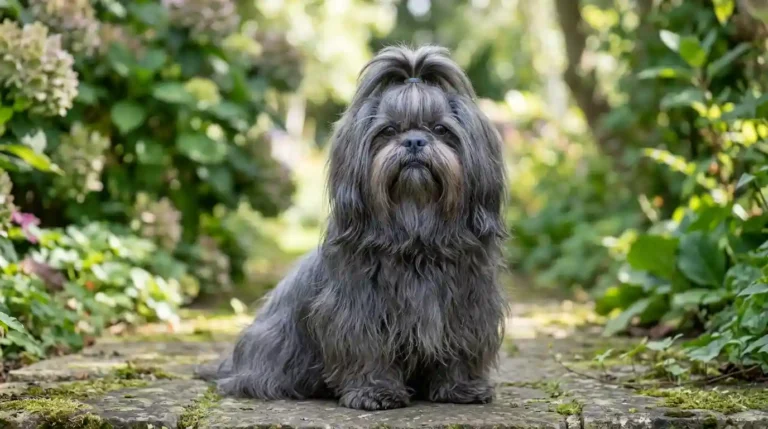
Search for types of Shih Tzu, and you may find lists claiming there are 8, 10, or even 14 separate Shih Tzu breeds. These lists often combine completely different categories—American Shih Tzu, European Shih Tzu, Imperial, teacup, blue-eyed dogs, brindle dogs, Japanese Shih Tzu, and Shih Tzu mixes—as though each were an officially recognized breed type. That is misleading. The important fact is that major kennel-club standards recognize one Shih Tzu breed. Individual Shih Tzus can differ in size, proportions, coat color, markings, pigmentation, grooming style, and breeding-line appearance, but those differences do not automatically create separate breeds. Labels such as “American” and “European” are generally informal descriptions, while Imperial, mini, and teacup refer to undersized dogs rather than officially recognized varieties. Crosses such as a Jatzu are mixed-breed dogs. This guide sorts the common labels into clear categories so you can understand what a breeder, rescue, or online listing actually means before choosing a dog.
Table of Contents
- How many Shih Tzu breeds are officially recognized?
- What do people mean by “American” and “European” Shih Tzu?
- Are Imperial, mini, and teacup Shih Tzus separate types?
- Are coat colors and patterns different Shih Tzu types?
- How are Shih Tzu mixes different from Shih Tzus?
- A quick comparison of the labels buyers encounter
- What to ask a breeder or rescue before choosing a dog
- Frequently asked questions about Shih Tzu types
- Final thoughts
How Many Shih Tzu Breeds Are Officially Recognized?
The simplest answer is:
There is one officially recognized Shih Tzu breed.
The American Kennel Club places the Shih Tzu in the Toy Group and describes one breed standard rather than separate American, European, Imperial, miniature, or teacup varieties.
The current standard calls for a sturdy, compact dog with an ideal mature weight of approximately 9 to 16 pounds. The ideal height is about 9 to 10½ inches, although 8 to 11 inches is permitted.
You can review the current measurements and breed information on the American Kennel Club Shih Tzu page.
So when someone asks, “How many types of Shih Tzu are there?”, it helps to separate official breed classification from everyday labels.
You may encounter many descriptions, but they generally fall into five categories:
| Label Category | Examples | Separate Official Shih Tzu Breed? |
| Geographic/style labels | American, European, Chinese, traditional | No |
| Size marketing labels | Imperial, mini, teacup | No |
| Coat appearance | Black, liver, brindle, blue, red | No |
| Grooming descriptions | Puppy cut, lion cut | No |
| Crossbreed names | Jatzu and other Shih Tzu mixes | No—they are mixed-breed dogs |
This distinction is especially important for prospective buyers because a creative marketing name can make an ordinary physical variation sound like a separate or rare breed.
For the basic characteristics shared by the breed, visit our shih tzu Breed Information hub or read these Shih Tzu facts.
One Breed, With Differences in Appearance and Labeling
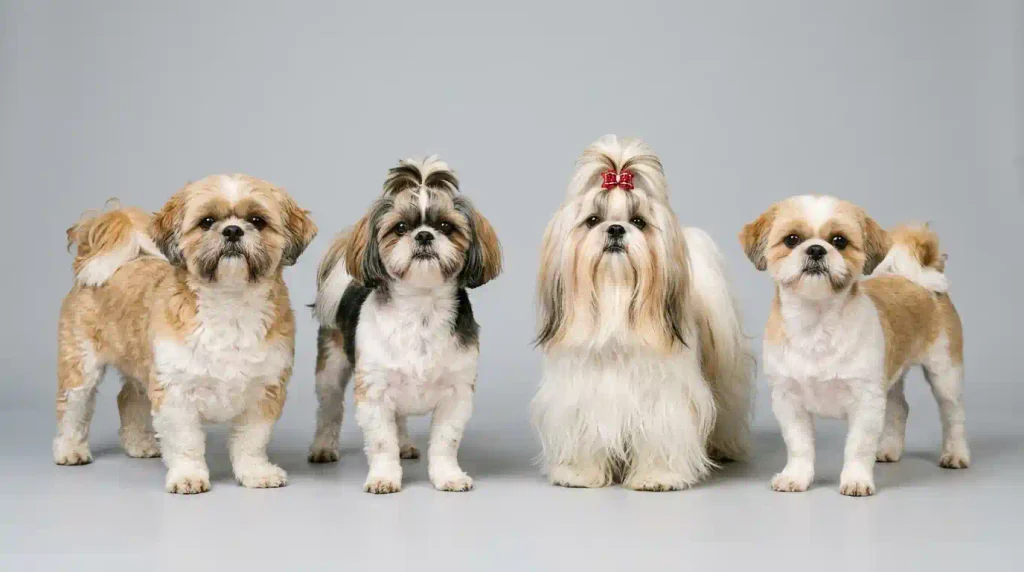
Recognizing one breed does not mean every Shih Tzu looks identical.
Individual dogs naturally differ in:
- Head shape
- Muzzle length
- Body proportions
- Leg length
- Overall size
- Coat density
- Coat texture
- Color
- Markings
- Nose pigmentation
- Eye shade
- Facial expression
Breeding lines can also emphasize slightly different appearances while remaining within the same breed.
This is normal in purebred dogs.
Imagine two adult Shih Tzus. One has a very broad head, substantial body, and long floor-length coat. The other is somewhat lighter in build, has slightly longer legs, and wears a puppy cut.
They can still both be Shih Tzus.
The variation does not mean they belong to two separate breeds.
The same principle applies to the historical differences among early European breeding lines. Dogs imported from China varied in size and structure, and breeders in England and Scandinavia worked to stabilize the breed. Later American breeders combined those bloodlines rather than maintaining permanent “English,” “Scandinavian,” or “American” subspecies.
Our guide to Shih Tzu origin explains how this small founder population developed into today’s international breed.
What Do People Mean by “American” and “European” Shih Tzu?
Searches for American Shih Tzu and European Shih Tzu often lead to confident comparison charts describing two supposedly distinct versions of the breed.
You may see claims such as:
- American Shih Tzus have longer legs.
- European Shih Tzus are shorter and heavier.
- American dogs have smaller heads.
- European dogs have wider chests.
- One type has rounder eyes.
- One has a different temperament.
These descriptions should be treated as informal style comparisons, not official breed categories.
There is no separate AKC-recognized “American Shih Tzu breed” and no separately recognized “European Shih Tzu breed.”
Historically, some differences between lines did exist.
Early Shih Tzus exported from China reached both England and Scandinavia, and the imported dogs were not identical. Breeders developed their lines independently for a time.
The American Shih Tzu Club’s historical material notes that American breeders later imported from both English and continental European lines and mixed them extensively.
As a result, the club states that it would now be difficult to find a genuinely distinct modern “English” or “Scandinavian” style in the strict historical sense.
What people call European or American today often reflects:
- Particular breeder preferences
- Bloodline characteristics
- Differences between individual dogs
- Regional show fashions
- Grooming
- Marketing terminology
rather than a formal division of the breed.
American Shih Tzu
“American Shih Tzu” usually just means a Shih Tzu bred in the United States or from American breeding lines.
It does not mean there is a separate American Shih Tzu breed standard independent of the Shih Tzu.
The AKC breed remains simply Shih Tzu.
An “American Shih Tzu price” can likewise vary based on breeder, pedigree, location, health screening, age, and demand—not because “American Shih Tzu” represents another breed.
European Shih Tzu
“European Shih Tzu” similarly tends to describe a dog from European lines or a particular appearance associated with breeders in Europe.
Some breeders may favor a heavier head, more substance, shorter-looking legs, or another stylistic preference, but variation within a breed does not automatically create a separate type.
What About “Traditional Shih Tzu”?
“Traditional Shih Tzu” or “old-fashioned Shih Tzu” is another informal term.
The American Shih Tzu Club notes that dogs with characteristics such as being lower on the leg, slightly longer through the body, or having a larger head may sometimes be called old-fashioned.
Again, it is a description, not another breed.
Chinese Shih Tzu
The Shih Tzu was historically developed in China from dogs with deeper Tibetan roots.
Calling one modern puppy a “Chinese Shih Tzu” does not establish that it represents a unique Chinese variety.
If ancestry matters, look at actual pedigree information instead of relying on the geographic label.
Are Imperial, Mini, and Teacup Shih Tzus Separate Types?
No.
Imperial Shih Tzu, mini Shih Tzu, and teacup Shih Tzu are not separate AKC-recognized Shih Tzu breeds or varieties.
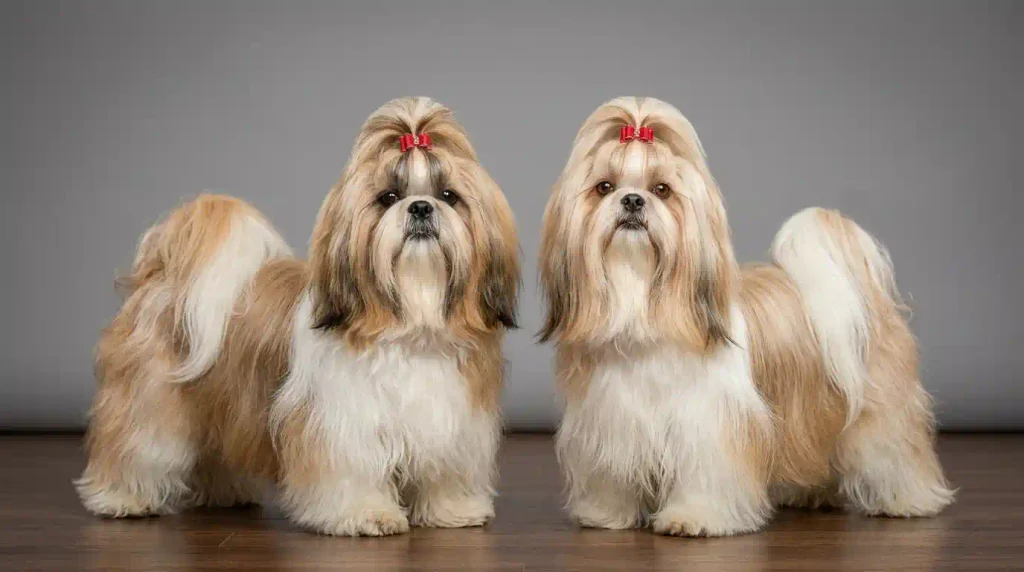
These terms are typically used for dogs expected to mature below the standard size.
This is an important point because sellers may use labels such as:
- Imperial Shih Tzu
- Tiny Imperial
- Teacup Shih Tzu
- Mini Shih Tzu
- Micro Shih Tzu
- Toy Shih Tzu
to make an unusually small puppy sound like a special recognized variety.
The Shih Tzu is already classified as a Toy breed.
There is no smaller official AKC division beneath it.
Our dedicated teacup Shih Tzu guide explores this terminology in more detail.
What the Breed Standard Says About Size
The U.S. breed standard calls for an ideal mature weight of:
9 to 16 pounds
and describes the Shih Tzu as:
- Compact
- Solid
- Sturdy
- Well-balanced
This last point matters.
The goal is not simply to make the dog as tiny as possible.
A Shih Tzu is intended to have substance despite being small.
The American Shih Tzu Club specifically advises that “Imperial” and “tiny teacup” are not recognized varieties and warns buyers about deliberately breeding dramatically below the standard solely to create a marketable miniature dog.
That does not mean every small Shih Tzu is automatically unhealthy.
Some healthy individuals simply mature smaller than expected.
The concern is different: deliberately selecting repeatedly for extreme smallness can prioritize size over structure, genetic health, and overall soundness.
Are Small Shih Tzus More Fragile?
Extremely small dogs can require additional care.
Potential concerns in undersized puppies can include vulnerability to injury and, in very young tiny puppies, issues such as difficulty maintaining stable blood glucose.
But it is inaccurate to say that every dog marketed as “teacup” will inevitably become sick.
Health depends on the individual dog, its genetics, breeding practices, development, and veterinary care.
A more useful question is not:
“Is teacup good or bad?”
It is:
“Why is this puppy unusually small, what size are its healthy adult relatives, and what objective health information can the seller provide?”
How to Assess a Seller’s Size Claims
If someone advertises an Imperial or teacup puppy, ask:
- What are the adult weights of both parents?
- How old is the puppy?
- What does the puppy currently weigh?
- How was the predicted adult weight calculated?
- Are littermates similar in size?
- Has the puppy had a veterinary examination?
- What health screening was performed on the parents?
- Is the puppy registered simply as a Shih Tzu?
- Is the seller charging a large premium solely because of the size label?
- Does the contract guarantee an exact adult weight?
Be cautious of claims such as:
“Guaranteed 4-pound adult.”
Puppy growth can be estimated, but precise adult weight cannot always be guaranteed.

Are Coat Colors and Patterns Different Shih Tzu Types?
No.
Black, blue, liver, brindle, red, silver, and other colors describe appearance—not separate Shih Tzu breeds.
The breed standard permits all colors and markings and considers them equally.
If you are trying to understand coat appearance, use our complete Shih Tzu colors guide rather than treating colors as different breed types.
For example:
A black Shih Tzu is not a separate black variety of the breed.
A brindle Shih Tzu has a coat pattern.
A blue Shih Tzu has diluted pigmentation.
A liver Shih Tzu has brown-based pigmentation.
A red Shih Tzu has a red-to-auburn coat.
A white Shih Tzu simply has extensive white coat hair.
They are still Shih Tzus.
Coat Color, Markings, and Eye Color Are Appearance Traits
A dog’s appearance can be described at several levels:
| Trait | Example | Separate Breed Type? |
| Coat color | Black, red, gold, silver | No |
| Pigmentation | Black, liver, blue | No |
| Pattern | Brindle, merle | No |
| White spotting | Black and white, red and white | No |
| Facial marking | Black mask, blaze | No |
| Eye color | Dark brown, lighter in some pigment types | No |
| Haircut | Puppy cut, lion cut | No |
This distinction prevents several common mistakes.
Black and Multi-Color Dogs
A black and white Shih Tzu and a black and brown Shih Tzu are color descriptions.
A brown black and white Shih Tzu may be described informally as tricolor.
None constitutes another breed.
Brindle Variations
A black brindle Shih Tzu, red brindle Shih Tzu, or silver brindle Shih Tzu simply reflects different expressions of color and pattern.
A brindle and white Shih Tzu adds white spotting.
These are appearance variations within the breed.
Liver and Chocolate Labels
A liver chocolate Shih Tzu may have particularly rich brown coloration, while a liver and white Shih Tzu combines liver pigmentation and white coat markings.
“Chocolate” is often used casually, while liver has a more specific pigmentation meaning.
Blue, Lavender, and Gray
A blue gray Shih Tzu, lavender Shih Tzu, and lavender blue Shih Tzu can look unusual enough that sellers sometimes present them as special “types.”
They are still appearance labels.
Merle
A merle Shih Tzu involves a genetic coat pattern and deserves separate attention because merle genetics can be relevant to breeding decisions.
Likewise, a blue merle Shih Tzu describes a patterned appearance rather than another Shih Tzu breed.
What About Blue-Eyed Shih Tzus?
“Blue-eyed Shih Tzu” is another appearance description.
Eye shade can be influenced by pigmentation and other genetic factors.
Blue eyes do not create a separate Shih Tzu variety.
Are Nose Types Different Shih Tzu Types?
Searches for Shih Tzu nose types sometimes make normal pigmentation differences sound like separate dogs.
The nose can help identify pigmentation, but it does not define a separate breed type.
Most Shih Tzus have a black nose.
Liver-pigmented dogs have a brown or liver nose.
Blue-pigmented dogs may have slate or blue-gray pigmentation.
The lips and eye rims generally correspond with the dog’s pigmentation.
A brown-nosed Shih Tzu is therefore not a “brown-nose breed.” It is a Shih Tzu expressing liver pigmentation.
Similarly, muzzle length can vary somewhat between dogs, but an exaggeratedly long or short nose does not constitute an officially recognized subtype.
Are There Different Shih Tzu Hair Types?
Shih Tzus can show some variation in coat texture and density, but there are not multiple officially recognized breeds based on hair.
The standard calls for a luxurious double coat that is dense, long, and flowing, with a slight wave permitted.
A different coat-development pattern can occasionally occur, commonly discussed as a prapso Shih Tzu.
Prapso describes an unusual coat characteristic, not a separate Shih Tzu breed.
What About Shih Tzu Cuts?
Searches for “types of Shih Tzu cuts” refer to grooming, not genetics.
Popular grooming styles include:
- Puppy cut
- Teddy-bear style trim
- Topknot
- Long show coat
- Lion-style trim
- Short summer-style pet trim
A Shih Tzu can look dramatically different after grooming, which may be why owners sometimes assume they are seeing different types of dogs.
Haircuts do not alter breed identity.
What Is a “Japanese Shih Tzu”?
“Japanese Shih Tzu” is not a recognized Shih Tzu variety.
The term can cause confusion because the Japanese Chin is a completely separate breed.
A seller advertising a “Japanese Shih Tzu” might mean:
- A Shih Tzu bred in Japan
- A particular informal appearance
- A Japanese Chin × Shih Tzu cross
- Simply a marketing label
Do not assume which meaning applies.
Ask directly.
If the parents are a Japanese Chin and a Shih Tzu, the puppy is a crossbreed commonly called a Jatzu or Chin-Tzu—not a special Japanese variety of purebred Shih Tzu.
How Are Shih Tzu Mixes Different From Shih Tzus?
A mixed-breed dog with one Shih Tzu parent may resemble a Shih Tzu closely, but genetically it is not simply another Shih Tzu “type.”
Crossbreeds can inherit characteristics from either parent.
Their:
- Adult size
- Coat texture
- Coat length
- Face shape
- Temperament
- Shedding
- Exercise requirements
can all be less predictable than people assume from the mix’s nickname.
Jatzu and Other Crossbreed Labels
A Jatzu is generally a Shih Tzu crossed with a Japanese Chin.
It is not the same as a purebred Shih Tzu and is not an official Shih Tzu variety.
Other Shih Tzu crosses may receive similarly creative names.
These names can be convenient shorthand, but they do not turn the cross into a new Shih Tzu breed.
For example:
Shih Tzu × Japanese Chin = Jatzu
The Japanese Chin remains one parent breed and the Shih Tzu the other.
The resulting puppy may inherit more visible traits from either side.
This is important when buyers see terms such as “rare type of Shih Tzu” attached to mixed dogs.
A crossbreed is better described transparently by its parent breeds.
A Quick Comparison of the Labels Buyers Encounter
| Label | What It Usually Means | Official Shih Tzu Type? |
| Standard Shih Tzu | Ordinary Shih Tzu conforming reasonably to breed size/type | The recognized breed |
| American Shih Tzu | Shih Tzu from American lines or an informal style | No separate type |
| European Shih Tzu | Shih Tzu from European lines or an informal style | No separate type |
| Traditional/old-fashioned | Informal body-style description | No |
| Chinese Shih Tzu | Geographic/historical or marketing description | No |
| Japanese Shih Tzu | Ambiguous informal term | No |
| Imperial Shih Tzu | Usually undersized Shih Tzu | No |
| Mini Shih Tzu | Marketing term for small dog | No |
| Teacup Shih Tzu | Marketing term for very small dog | No |
| Black Shih Tzu | Coat color | No |
| Brindle Shih Tzu | Coat pattern | No |
| Blue Shih Tzu | Pigmentation/color description | No |
| Liver Shih Tzu | Liver pigmentation | No |
| Blue-eyed Shih Tzu | Eye-color description | No |
| Prapso Shih Tzu | Unusual coat expression | No separate breed |
| Jatzu | Shih Tzu × Japanese Chin mix | Mixed breed |
| Rescue Shih Tzu | Shih Tzu available through rescue | Not a different type |
If an online article promises “8 types of Shih Tzu” or “14 types of Shih Tzu,” look closely at what is being counted.
Often the list mixes:
- Sizes
- Colors
- Countries
- Coat patterns
- Mixes
- Haircuts
into one artificial classification.
That may be convenient for a slideshow, but it is not how the breed is officially organized.

What to Ask a Breeder or Rescue Before Choosing a Dog
Once you understand what the labels mean, choosing a Shih Tzu becomes much easier.
You do not need to find the most unusual “type.”
You need to understand the actual dog.
Ask What the Label Means
If a seller advertises:
European Shih Tzu
ask which European lines appear in the pedigree.
If they advertise:
Imperial Shih Tzu
ask for the parents’ mature weights and why the term is being used.
If they advertise:
Japanese Shih Tzu
ask whether the dog is a purebred Shih Tzu or a Japanese Chin cross.
If they advertise:
Rare blue-eyed lavender teacup Shih Tzu
separate each claim individually rather than accepting the phrase as one recognized category.
Ask About the Parents
Useful questions include:
- Can I see the mother?
- What is her adult weight?
- What is the father’s adult weight?
- What are their temperaments?
- Can I see pedigree or registration documentation where applicable?
- What health screening was performed?
- Have the parents produced previous litters?
- How large did previous puppies become?
Parent size is more meaningful than a creative size name.
Ask About Health Rather Than Just Appearance
A responsible puppy search should prioritize:
- Veterinary examination
- Parent health information
- Appropriate health screening
- Sound movement
- Clear eyes
- Healthy skin and coat
- Comfortable breathing
- Normal development
- Temperament
- Socialization
Color and size can remain personal preferences, but they should not replace health considerations.
Ask About Registration Correctly
Registration itself is not a guarantee that every breeder is responsible.
However, when someone claims a dog is an unusually valuable purebred subtype, ask what registry recognizes that subtype.
You may discover that the registration certificate simply says Shih Tzu.
That is expected because Imperial, teacup, American, and European are not separate AKC breed varieties.
If Adopting From a Rescue
Rescue dogs may not have complete pedigree information.
That is fine.
Ask what the organization actually knows rather than expecting guesses to be presented as facts.
Useful information includes:
- Estimated age
- Current weight
- Veterinary findings
- Behavior around people
- Behavior around dogs
- Known history
- Grooming tolerance
- House-training
- Medication
- Special needs
A rescue Shih Tzu does not need a perfect pedigree label to become an excellent companion.
Do Not Choose Mainly by “Rarity”
A rare-sounding label can increase perceived value without improving the dog.
Terms such as:
- Imperial
- Micro
- Exotic
- Rare color
- Exclusive bloodline
- Japanese type
should lead to more questions—not automatic assumptions about quality.
The American Shih Tzu Club specifically cautions buyers about size-based marketing terminology, and AKC material notes that all colors occur within the breed.
If appearance matters to you, that is reasonable. Just separate preference from evidence.
Frequently Asked Questions About Shih Tzu Types
How many types of Shih Tzu are there?
There is one officially recognized Shih Tzu breed, although many informal labels describe size, color, bloodline, grooming, or mixed ancestry.
Are there 8 types of Shih Tzu?
No official system recognizes eight Shih Tzu breeds; such lists usually combine unrelated appearance and marketing labels.
What are the 14 types of Shih Tzu?
There is no official 14-type classification of Shih Tzus.
Is an American Shih Tzu a separate breed?
No, American Shih Tzu is an informal geographic or breeding-line description.
Is a European Shih Tzu different from an American Shih Tzu?
Individual lines can differ in appearance, but they remain the same Shih Tzu breed.
Is there a Chinese Shih Tzu type?
China is central to the breed’s historical development, but “Chinese Shih Tzu” is not a separate modern recognized variety.
Is there a Japanese Shih Tzu breed?
No; Japanese Shih Tzu is not a recognized separate variety and should not be confused with the Japanese Chin.
What is a Jatzu?
A Jatzu is generally a Shih Tzu × Japanese Chin crossbreed.
Is an Imperial Shih Tzu a separate breed?
No, Imperial is an informal term generally applied to undersized Shih Tzus.
Is a teacup Shih Tzu officially recognized?
No, teacup is not an AKC-recognized Shih Tzu size or variety.
Is a mini Shih Tzu real?
Small Shih Tzus certainly exist, but “mini Shih Tzu” is not an official breed classification.
What is the standard Shih Tzu weight?
The U.S. breed standard specifies an ideal mature weight of approximately 9–16 pounds.
Can a healthy Shih Tzu weigh under nine pounds?
Yes, individual dogs can fall outside the ideal range; being smaller does not automatically create a new breed type.
Are teacup Shih Tzus unhealthy?
Not every unusually small Shih Tzu is unhealthy, but intentionally selecting for extreme smallness can introduce additional concerns, so buyers should investigate breeding and veterinary history carefully.
Are black Shih Tzus a different type?
No, black describes coat color.
Is a brindle Shih Tzu a separate type?
No, brindle describes a coat pattern.
Is a liver Shih Tzu a different breed?
No, liver describes brown-based pigmentation within the Shih Tzu breed.
Is a blue Shih Tzu a different type?
No, blue refers to diluted pigmentation rather than another breed.
Are blue-eyed Shih Tzus another type?
No, eye color is an appearance characteristic.
Is a merle Shih Tzu another breed type?
No, merle describes a genetic coat pattern, although it raises specific breeding and genetic considerations.
Is a prapso Shih Tzu a separate breed?
No, prapso describes an unusual coat expression in Shih Tzus rather than a recognized separate breed.
Are Shih Tzu haircuts considered different types?
No, puppy cuts, lion cuts, and other trims are grooming styles.
What are the different Shih Tzu nose types?
Most have black pigmentation, while liver-pigmented dogs have brown noses and blue-pigmented dogs can have slate or blue-gray noses; these are pigmentation differences, not breed types.
Which type of Shih Tzu is best?
Rather than choosing by an informal type label, compare individual health, temperament, size, grooming needs, breeder or rescue practices, and suitability for your household.
What type of Shih Tzu is rarest?
There is no recognized system ranking official Shih Tzu “types” by rarity because these supposed types are largely informal labels.
How can I tell whether my Shih Tzu is purebred?
Appearance alone cannot prove ancestry; pedigree, registration records, and parentage information provide stronger evidence, as explained in our purebred Shih Tzu guide.
Final Thoughts
When people discuss types of Shih Tzu, they are usually mixing several different ideas. There is one recognized Shih Tzu breed, while American and European describe informal lines or styles; Imperial, mini, and teacup describe unusually small dogs; black, blue, liver, red, and brindle describe appearance; puppy and lion cuts describe grooming; and names such as Jatzu identify crossbreeds.
Understanding those differences makes breeder and adoption listings much easier to evaluate.
Instead of searching for the “rarest” or most impressive-sounding Shih Tzu type, focus on the individual dog’s health, temperament, background, adult-size expectations, and suitability for your home. For more breed guidance, continue with our Shih Tzu facts, Shih Tzu origin, and Shih Tzu colors guides.