Red Brindle Shih Tzu: How to Recognize the Coat and Care for It
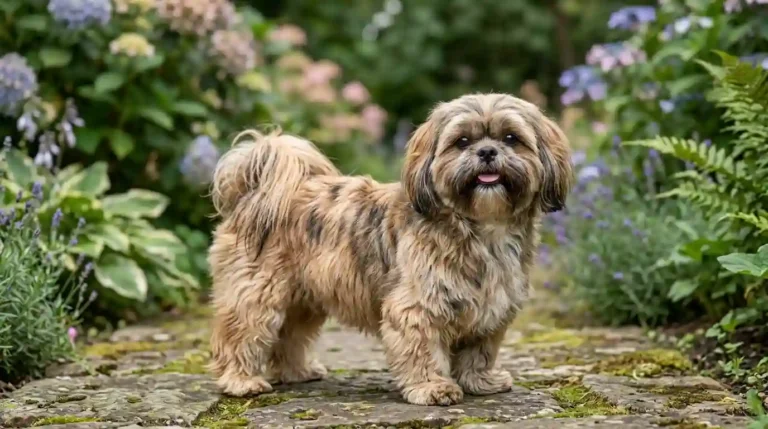
A red brindle Shih Tzu has warm red, reddish-gold, or copper-looking areas interrupted by darker streaks in the colored parts of the coat. The key is the pattern: brindle describes striping, while red describes the warmer color seen beneath or between those streaks. A puppy with a dark face, a few black-tipped hairs, or red hair beside white patches is not automatically brindle. Look across the body and legs in natural light for repeated darker bands within the red areas. The pattern can be obvious on a short trim and surprisingly hard to see in long hair or a photograph. It can also look different as a puppy’s coat grows and is cut. This guide shows exactly what to check, how to compare look-alike coats, and what to ask if someone is selling a puppy as a “rare red brindle.” You will also learn which coat changes are ordinary, how to keep a dense Shih Tzu coat comfortable, and why the dog’s health and temperament deserve more attention than a color label.
Table of Contents
- What does “red brindle” look like on a Shih Tzu?
- How can you tell red brindle from similar coats?
- Why does the brindle pattern occur?
- Will a red brindle puppy keep the same appearance?
- Is red brindle accepted or especially rare?
- Does the pattern change grooming or health needs?
- What should you ask before choosing a red brindle puppy?
- Frequently asked questions
- Final thoughts
What does “red brindle” look like on a Shih Tzu?
Red base color and darker streaks
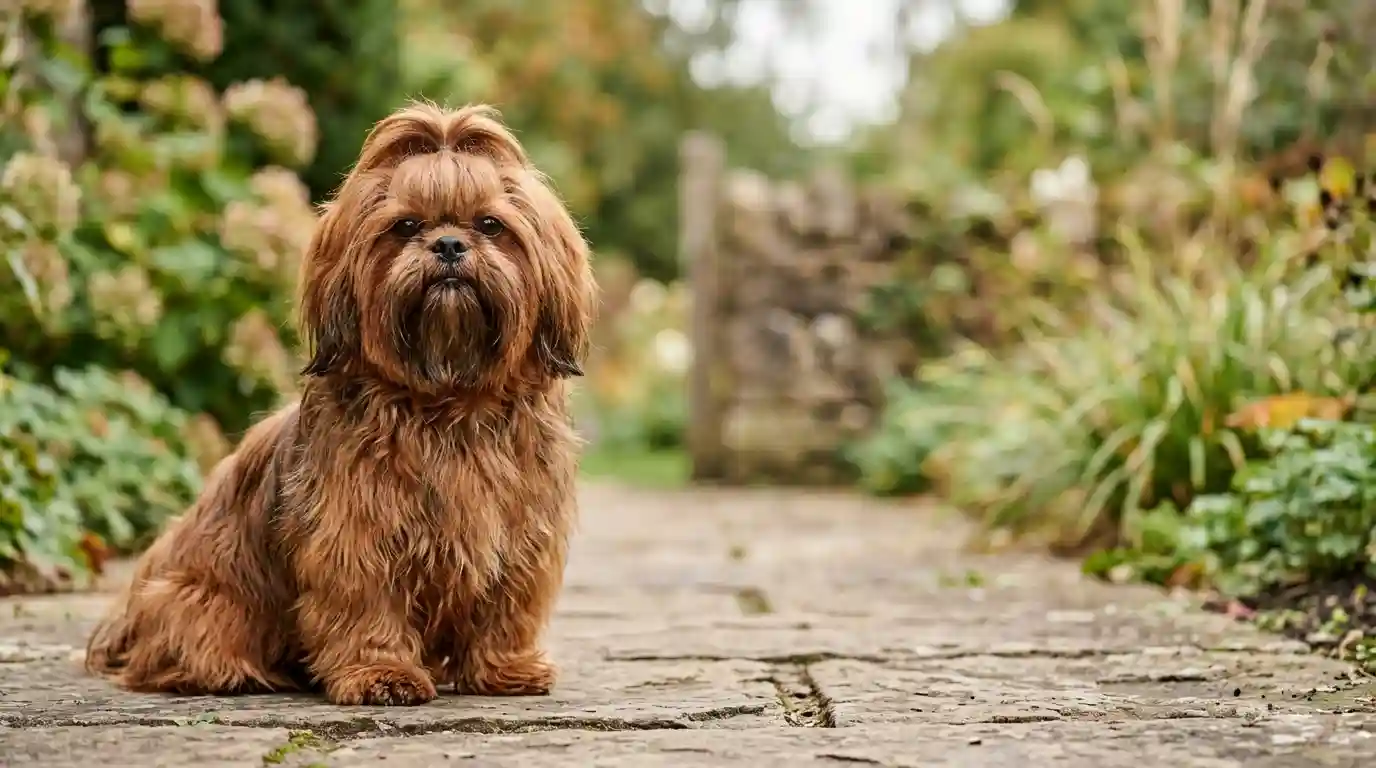
Start by separating two descriptions that are often rolled into one label. Red refers to the warm appearance of parts of the coat. Some people use the word for a saturated copper or rusty tone; others use it for reddish gold. Brindle describes a pattern in which darker markings run through colored areas. Put together, red brindle means that the dog’s warm-colored hair has a visible streaked or striped effect. The red need not be exactly the shade of another red brindle dog’s coat.
Look at the torso first. Part the hair gently and compare several areas across the shoulder, side, back, and upper legs. Do you see repeated darker markings within areas that otherwise look red or gold? Are the markings distributed through the coat rather than confined to the face or the ends of a few hairs? Those observations are more helpful than trying to decide whether an entire dog looks “red enough.” On a small Shih Tzu, the pattern may be easiest to spot along the sides, where hair lies differently from the face and chest.
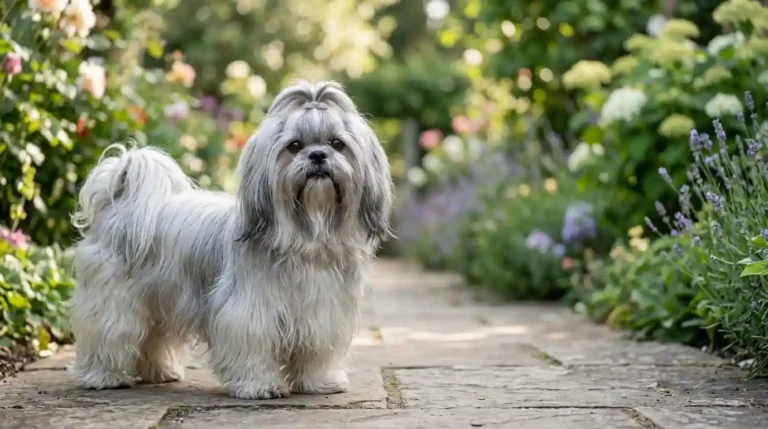
Brindle does not require bold, perfectly parallel tiger stripes. On a long, flowing coat, individual hairs overlap, so a pattern that is clear close up can blend into the overall color at a distance. Some areas may have fine, closely packed dark streaks; others may show broad areas of warm color. Sunlight, indoor bulbs, camera processing, and a wet coat can change the contrast. None of these effects changes the underlying pattern, but each changes what you can see on a given day.
The practical identification question is therefore: Can you find darker striping within a red-looking part of the coat? A uniformly warm coat is better described simply as red or gold. If you want the wider context for how coat terms overlap, see the Shih Tzu colors guide and the general brindle Shih Tzu guide. They give the broader vocabulary; this article focuses on the red-and-brindle combination.
Why brindle can look subtle, heavy, or patchy
Owners often describe loose brindle when the darker streaks are spaced far enough apart for the warm background to stand out. Tight brindle describes markings set close together; from a distance, the coat may seem mostly dark. These are visual descriptions, not measurements with an official threshold. The degree of contrast depends on the colors of the individual dog, the length and direction of the hair, and where the pattern is expressed.
On a heavily brindled dog, step back before settling on “black” or “dark brown.” Check the sides and legs for warmer strands breaking through the darker impression. On a lightly brindled dog, move closer before settling on “solid red.” The repeated dark effect may become apparent only when the hair is separated. The words light and heavy describe how much pattern you see; they do not indicate the dog’s quality or health.
You may also see the term reverse brindle. People use it for a coat that appears predominantly dark with narrower, more visible light areas. The appearance can be striking, but the phrase is used inconsistently in casual descriptions. If it matters for a puppy listing, ask for well-lit photographs of the whole dog instead of relying on the term. Similarly, a dog may have brindle in some colored areas while other areas are white. White does not form darker brindle stripes; the pattern is assessed in the pigmented parts of the coat.
Placement matters. A few streaks on the shoulder can coexist with a quieter-looking back, while another dog’s pattern may run across much of the body. That makes a single close crop unreliable. Ask for a full-body photo from each side and a clear picture of the shoulder and upper leg. If the dog has white on the chest or feet, note where the colored hair starts again. Then judge the pattern within that colored hair.

How can you tell red brindle from similar coats?
Compare solid red, black-tipped red, and red brindle
The best comparison asks where the dark color appears. A red Shih Tzu can be warm and richly colored without having darker stripes. Some red- or gold-looking puppies have black-tipped hair that creates a shaded appearance, especially when their puppy coat is fluffy. That shading may look streaky in a photograph, but the dark portion can be concentrated at the hair tips rather than forming an alternating pattern across a colored area. A red brindle coat shows darker streaking distributed within the warmer areas.
Use the table as an observation guide, not a guarantee that every dog fits a neat category:
| Appearance | What to inspect | What can cause confusion |
| Solid red or reddish gold | Look across both sides for repeated darker streaks. | Changes in shadow can resemble striping. |
| Red with black-tipped hair | Part hair in several places and see whether darkness is mainly at the ends. | A short haircut may remove dark tips and change the overall appearance. |
| Red brindle | Look for recurring dark markings within the warm-colored areas of the torso or legs. | Long hair can blur the streaks. |
| Red with a black mask | Check whether dark hair is concentrated on the face. | A prominent face can dominate a puppy photo. |
| Red and white | Identify the boundaries of white patches and inspect the red areas separately. | White patches describe a different feature from brindling. |
A darker black brindle Shih Tzu may have so much dark hair that the warm base seems hidden. That broader comparison can be useful if someone calls the same dog black in one photo and red brindle in another. But avoid treating those casual labels as competing diagnoses. Ask what the person actually sees in daylight, where the markings are, and whether photographs were taken at different ages. Different owners may emphasize the dominant impression or the underlying pattern.
If you are evaluating a puppy from online images, enlarge the photographs carefully but resist interpreting pixel noise as hair pattern. Phone cameras can boost contrast, warm up the reds, and sharpen individual clumps. A short video with the puppy walking in even daylight may reveal more than a heavily edited portrait. A close view of the sides plus a full-body view usually provides a better description than a single picture of the head.
Distinguish a black mask and white markings from body striping
A black mask is dark facial coloring. It may appear around the muzzle, across parts of the face, or near the eyes. A masked red or gold Shih Tzu can look dramatic without being brindle at all. Conversely, a red brindle dog may also have a darker face. To tell which term fits, move your attention away from the face: inspect the shoulders, ribs, and legs for streaking. A close facial portrait alone is inadequate.
Compare with a black mask gold Shih Tzu if the facial coloring is driving the confusion. The purpose of that comparison is to identify where the dark pigment sits. Do not assume that every dark-faced dog carries one particular pattern throughout the body. Similarly, dark ears can appear on dogs with otherwise relatively even body color. Markings in one small area do not tell the whole story.
White patches answer a separate question. A red and white Shih Tzu has warm-colored and white areas, but the colored areas may be solid or patterned. A dog with white paws, white chest, and streaked red sides can reasonably be described as red brindle with white markings. Some owners would describe the same overall effect as a brindle and white Shih Tzu. These phrases emphasize different parts of the same visible coat; they do not create a new type of Shih Tzu.
Be precise about location in an image caption: “white chest and feet; brindle streaking in the red side coat” is clearer than “red, white, and black puppy.” If the white is extensive, inspect a colored patch large enough to show a repeated pattern. A tiny colored spot with one dark edge will not demonstrate brindle reliably. You can still describe what is certain, such as the white markings and red-looking coat, while leaving the pattern uncertain.
Do not confuse ordinary white markings with albinism. Those are separate topics with different implications, and a white patch is not evidence of an albino Shih Tzu. Likewise, brindle stripes are not the irregular, mottled patches people describe as merle. If a listing uses both terms loosely, compare the pattern itself with the separate merle Shih Tzu discussion rather than accepting the combined sales label at face value.

Why does the brindle pattern occur?
Pigment switching in plain language
The visual explanation is straightforward: different areas of hair show different amounts and placements of darker and warmer pigment. The genetics behind that appearance are less straightforward. Dog coats involve eumelanin, which produces black or brown-related dark pigment, and phaeomelanin, associated with red or yellow color. Genes influencing where and how these pigments appear interact. A brindle pattern is associated with pigment switching in areas that would otherwise show warm color, creating darker markings against that warmer background.
The K locus is part of that story, as are the A locus and other coat-color genes. The University of California, Davis Veterinary Genetics Laboratory explains that its K-locus test concerns interactions with other pigment genes and that one of the reported results can sometimes be seen in a brindle dog. Its description does not justify a simple claim that every brindle Shih Tzu has the same visible markings or that a single result determines exactly how wide, dark, or red the streaks will look. The lab also explains that genes affecting the red/yellow and dark pigments work together. Those interacting effects are why a neat one-gene sales story is a poor substitute for examining the actual coat.
For an owner, the useful lesson is that red brindle is a description of appearance, not a separate breed. A dog’s stripe pattern, its white areas, and the depth of its reddish color are related but distinct questions. A dog can have white markings while also being brindled in the remaining colored areas. Another can be brindled with a cooler-looking background; compare that appearance with a blue brindle Shih Tzu or a silver brindle Shih Tzu only when those are genuine visual alternatives. The names are descriptive shorthand, not a complete genetic report.
If you want a simple mental model, think of three layers: what the hair looks like today, which coat-color variants a test detects, and how the dog’s coat may look after its hair grows or is trimmed. The first can be documented with clear photographs. The second requires a report from a suitable laboratory and careful interpretation. The third remains an estimate, especially in a very young puppy. Keeping those layers separate prevents confident-sounding labels from outrunning the evidence.
What a coat-color DNA result can and cannot establish
A coat-color test can report the specific variants the laboratory examines. A broader panel may assess several pigment-related locations, making it more informative than an isolated test when multiple colors or patterns are in question. Results can be helpful when parents have complicated coloration, when the puppy’s appearance is ambiguous, or when a breeder is making a specific inheritance claim. Ask for the actual report, the dog’s identifying details, and the name of the laboratory if a result is offered as proof.
Yet a test report is not an artist’s preview of the adult coat. It cannot reliably promise a particular depth of red, a fixed number of dark streaks, or that the stripe contrast will remain identical after coat changes and haircuts. A report describing coat-color variants also is not a complete assessment of health. A seller who says “DNA tested” should explain which tests were performed and what the results mean for that dog. The phrase by itself is too vague to establish either color or health.
Color and parentage are also separate claims. Registration paperwork may document a dog’s recorded identity or color description, while a color test addresses specific genetic variants; neither replaces a full evaluation of breeding practices. For a wider discussion of breed identification, see purebred Shih Tzu. It is especially useful when a seller uses coat terminology to imply a breed category or special lineage.
Will a red brindle puppy keep the same appearance?
Puppy coat changes, fading, and haircuts
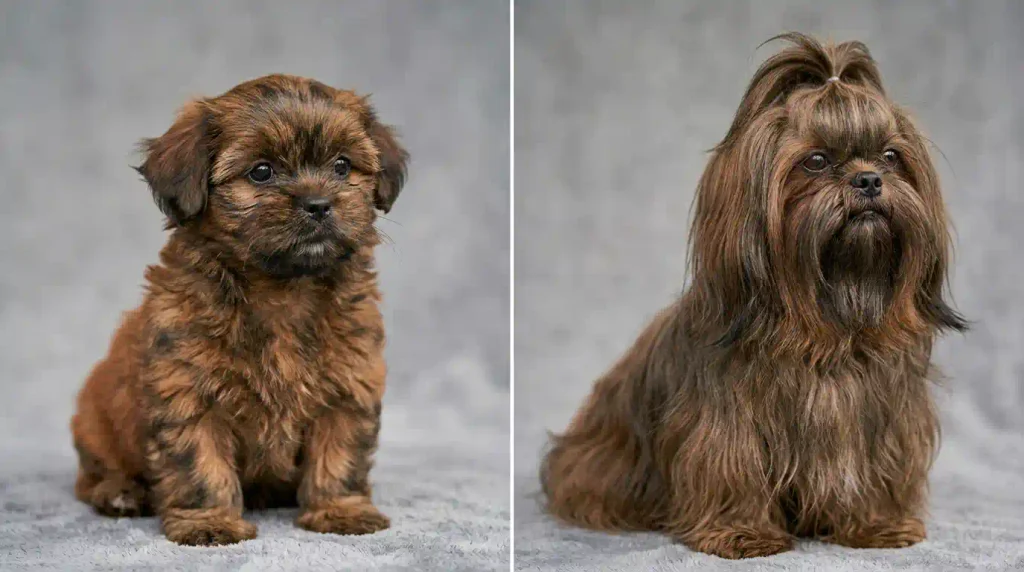
Do not plan an adult dog’s appearance from a single eight-week photograph. Shih Tzu puppies develop longer coats, and a puppy’s color or the contrast between light and dark areas may appear different as that coat matures. Some darker markings become less obvious, while in other dogs they remain visible. The direction and extent of change vary among individuals. An example of one dog whose red brindle appeared less prominent years later does not establish a schedule for every red brindle puppy.
Hair length alone changes what the eye sees. Long strands overlap and mix colors at a distance; a short cut may expose the distribution of colors more clearly. Cutting off hair with dark tips can make the coat look lighter even though the underlying inheritance has not changed. A fresh haircut may also reveal a red area that had been hidden by the way longer hair fell over it. This is one reason two accurate photographs of the same dog can look as if they show different colors.
A puppy coat can be soft and visually busy. When the adult coat grows, hair texture, length, and arrangement affect the visible pattern. The term coat fading is often used broadly for any apparent lightening, but it can hide several distinct observations: warmer hair becoming lighter, dark tips being cut, streaks blending into long hair, or additional gray hairs appearing with age. Describe what changed before trying to explain why. A series of dated pictures is much more informative than the statement “this color always fades.”
Observe whether change is gradual and evenly distributed or accompanied by a problem with the hair or skin. Gradual differences in shade and pattern visibility deserve good documentation, especially if you enjoy tracking your dog’s appearance. Sudden bald patches, inflamed skin, significant itch, or an abrupt change in hair quality deserve veterinary attention. Color labels should never distract from a physical symptom.
If you hope to keep the stripes easy to see, choose a trim for comfort and maintenance first. A shorter style may make the coat pattern easier to photograph, but it does not preserve pigment or prevent ordinary age-related changes. Talk with a groomer about what length you can manage and whether the dog has tangles hidden under the top layer. A neat photograph has limited value if achieving it leaves the dog matted or stressed.
Photographs that make comparisons more reliable
Photographs help when they are taken consistently. To document a red brindle Shih Tzu, photograph the dog in indirect daylight, away from strongly colored walls or bright artificial lighting. Take a standing side view on both sides, a close view of the shoulder and flank, and a front view that shows any mask and white markings. If possible, include a photograph taken before a haircut and one afterward, both labeled with dates.
Keep editing to a minimum. Filters that intensify oranges and reds can make a gold coat look coppery; heavy contrast can make a lightly brindled coat look almost black. A flash can flatten some dark details or create glossy highlights. A photo taken through tinted glass is particularly poor evidence. A neutral background and even lighting make your comparison much easier, though they still cannot reveal every genetic detail.
For a puppy listing, ask whether the photos show the same dog and when they were taken. Request a short, current, unfiltered video from the side, ideally including a few steps of normal movement. Compare it with the dated still photographs. A breeder should be able to explain whether a picture depicts the puppy now, a parent, or an older puppy from a previous litter. That distinction matters more than a polished gallery of similar-looking dogs.
Use the following simple photo log if your own dog’s pattern interests you:
| Record | Why it helps |
| Age and date | Establishes when an apparent change occurred. |
| Coat length and last grooming date | Helps explain why stripes are more or less visible. |
| Lighting and camera | Makes color comparisons more meaningful. |
| Left and right side views | Shows pattern across the body, not just the face. |
| Notes on skin and coat condition | Separates appearance changes from possible health concerns. |
Is red brindle accepted or especially rare?
The breed standard and registration labels
The American Kennel Club Shih Tzu breed standard states that all colors and markings are permissible and considered equally. That is the authoritative starting point for a US reader asking whether red brindle is “allowed.” The standard describes the desired Shih Tzu as a whole dog, including its structure, coat, and temperament. It does not say that a dramatic stripe pattern makes one dog a better example of the breed than another.
Keep the breed standard separate from a registration color. Paperwork uses color choices and descriptions for records. A seller may use “red brindle” in an ad because it conveys the dog’s appearance more vividly than a particular form’s available categories. Conversely, a registration label is not a detailed promise about how a puppy will look as an adult. Ask which words appear on the papers, which words describe the current coat, and whether the seller is treating them as the same thing.
The standard also describes a dense, long, flowing double coat. A pet Shih Tzu can have a practical shorter trim; the appearance expected for a dog shown in full coat is a different conversation from everyday pet grooming. If a seller uses “show quality” casually, request a concrete explanation of the dog’s pedigree, structure, and intended purpose. Red brindle by itself does not establish any of those qualities.
You may encounter the term “rare red brindle Shih Tzu.” The AKC breed standard’s acceptance of all colors does not supply a population count for a particular red-and-brindle combination. Neither do a few listings or a social-media trend. It is fair to say that an individual dog’s coat is distinctive. It is not sound to attach a numerical rarity claim without breed-level data. A dog’s appearance can be unusual within a household or breeder’s litters without being demonstrably rare across the breed.
How to assess an unsupported rarity claim
If a listing charges more for a “rare” puppy, ask what the premium buys. Does it reflect documented health screening, excellent husbandry, veterinary care, and careful placement? Or is the surcharge based only on an adjective? The first group involves things you can examine; the last is marketing until supported. There is no need to argue about how pretty a particular puppy is. Simply request the evidence behind the seller’s factual claims.
Listen for categorical promises: “This puppy cannot fade,” “this color means the dog is healthier,” or “only our line has true red brindle.” A present-day photograph cannot guarantee an adult coat, and a color name does not establish health. Ask for dated images of the puppy and, where available, the parents at different ages. Look at the pattern rather than the promotional wording. If the seller cannot show a current side view, treat the exact color as uncertain.
Some listings bundle terms such as imperial, teacup, exclusive, and rare brindle. These extra labels do not resolve whether the coat is genuinely brindled. Compare any size-related claims separately, using the information in types of Shih Tzu and teacup Shih Tzu if those claims are relevant to your decision. Keep the puppy’s welfare and suitability in view instead of allowing several marketing labels to reinforce one another.
Ask the breeder how they identify brindle in their own dogs. Someone who can point to the streaking on a current image and acknowledge that coats may change gives you more useful information than someone who promises an exact shade for life. A candid answer might be, “The puppy has warm red hair and some darker streaks now; we cannot promise precisely how prominent they will be in adulthood.” That is a stronger basis for a decision than a dramatic but unverifiable guarantee.
Does the pattern change grooming or health needs?
Brush and check the coat beneath the stripes
Red brindle does not call for a special stripe-enhancing shampoo or a different breed-specific haircut. The primary grooming job is the same as for other Shih Tzus: keep the long, dense double coat free of painful tangles, inspect the skin, and choose a length the household can maintain. The outer coat may look smooth while knots form closer to the skin or in the undercoat. The AKC describes daily brushing for a Shih Tzu kept in a long coat; shorter trims can reduce the workload but still need regular checking.
Work in small sections and brush through the coat gently, then use a suitable comb to check whether you can reach the skin without pulling. Give extra attention to friction points: behind the ears, under the collar or harness, in the armpits, and around the legs. A dog that objects when you touch one spot may have a concealed mat or sore skin. Do not tug hard or cut close to the skin to remove a tight mat; ask a professional groomer or veterinarian for help when removal is unsafe or painful.
Bathing frequency depends on coat length, activity, skin condition, and the products your veterinarian or groomer recommends. Use dog-appropriate shampoo, rinse thoroughly, and dry and detangle the coat carefully so damp knots do not tighten. A suitable conditioner may help manage a long coat, but products do not change the inherited stripe pattern. Skip supposed pigment treatments, harsh home rinses, or unproven claims that an ingredient will “bring back” red coloring. Focus on the dog’s comfort and skin health.
Dark streaks can make bits of debris less obvious. During brushing, use your fingers to check for burrs, knots, or dirt regardless of how clean the coat appears from above. Examine white patches, if present, without assuming they need aggressive cleaning to look bright. Likewise, a red area does not require a product marketed for red coats. Simple consistent care generally tells you more about the coat’s condition than its color category does.
A shorter puppy cut can be a sensible option for an owner who cannot keep a long coat thoroughly detangled. Discuss the length and maintenance schedule with a groomer who handles Shih Tzus. Explain if you want photographs of the brindle pattern before clipping changes the way it appears. A trim should prioritize easy movement, clear vision, clean hygiene areas, and manageable daily care; seeing the stripes is a welcome bonus.
| Grooming check | What to do |
| Hair near the skin | Separate sections and check for hidden mats. |
| Ears, harness area, legs | Inspect places where rubbing creates knots. |
| Face | Keep hair and debris from irritating the eyes; use gentle handling. |
| After a bath | Rinse and dry adequately, then check for tangles. |
| After a haircut | Record how the pattern looks without assuming the genes changed. |

Skin and hair changes that merit veterinary advice
The stripe pattern itself does not diagnose a disease or predict a dog’s personality. A healthy red brindle Shih Tzu still needs the ordinary attention given to any individual dog. During grooming, watch for persistent scratching, redness, new sores, crusting, unusual odor, sudden thinning, or bare areas. If you find them, consult your veterinarian rather than attributing them to “normal color change.” The veterinarian can examine the skin and ask about grooming, parasites, irritation, and other possible causes.
Distinguish gray hairs or gradual changes in shade from hair loss. Gray hair may alter the visible contrast of a brindle pattern; a patch where hair has disappeared calls for a different question. Likewise, a coat that feels temporarily different after bathing is not the same as ongoing flaking, broken hairs, or inflamed skin. Take dated photographs of a problem spot and note when you first noticed it. This gives the veterinarian information more useful than a color label alone.
No evidence from the breed standard suggests that red brindle dogs need a separate medical routine merely because of their pattern. Do not assume that the black streaks are inherently rougher than surrounding hairs or that a coat supplement can prevent normal changes in color. If a dog has a specific skin diagnosis, follow its veterinarian’s plan, which may change bathing products or frequency for that dog. The visible pattern should remain a description, not a shortcut to treatment.
Temperament follows the same principle. Two puppies with visually similar coats may respond differently to handling, new environments, grooming, and people. A thoughtful choice includes meeting the puppy, learning about its daily care and socialization, and considering whether its needs fit your home. If you are new to the breed, the broader Shih Tzu breed information and Shih Tzu facts provide context beyond coat appearance.
What should you ask before choosing a red brindle puppy?
Compare current photos, parent records, and health information
A sensible buyer begins with the dog in front of them—or with current evidence of that particular dog. Ask for dated side photographs and a short natural-light video. Confirm that these show the puppy offered, not a parent or a different littermate. Request a picture that includes the body and upper legs; a close portrait of the face cannot demonstrate body brindling. If possible, meet the puppy and observe its coat in person, knowing that its adult appearance may differ.
Ask to see photos of both parents and discuss any history of coat change. Parent images can show what related dogs looked like at particular ages, but they cannot guarantee a puppy will copy one parent’s shade or stripe distribution. A breeder should be comfortable discussing uncertainty. If there is a coat-color DNA result, request the report rather than a screenshot cropped to a promotional claim. Check which dog was tested, which variants were examined, and whether the seller can explain the result without promising a precise final color.
Separately, ask about health screening for the parents, the puppy’s veterinary visits, vaccinations, and any written health information relevant to the purchase or adoption. Genetic testing for coat color is not a substitute for health screening. Health-tested parents are meaningful only when you know which screens were performed, who performed them, and what the actual results say. Ask for records you can review. A reputable seller should discuss concerns directly, even if the puppy’s markings are an important attraction.
Notice how the puppy lives and behaves. Is its coat kept free of substantial mats? Does the environment look clean? Can the person caring for it describe feeding, handling, grooming, and socialization? How does the puppy respond to normal interaction? None of these observations predicts every future outcome, but together they give a far better picture than a “rare red brindle” tag. A beautiful coat should be part of the appeal, not the whole evaluation.
If an offer pressures you to send a deposit before you can verify the puppy or review records, slow down. Ask what the deposit covers, what happens if the puppy develops a health concern before transfer, and what the written agreement says. Keep communications and dated photos. If a seller’s story about the puppy’s age, identity, or parents changes, resolve that inconsistency before making a commitment. Color uncertainty alone is manageable; uncertainty about the dog’s identity and welfare is more serious.
A concise puppy-evaluation checklist
Use this checklist to keep the conversation focused on verifiable details:
- Identify the actual puppy. Request current dated photographs of both sides, the face, and a close view of colored body hair.
- Describe the coat you can see. Ask where the darker streaks occur within the red-looking areas and whether white patches or a black mask are also present.
- Ask about change. Request older and newer photos of the same puppy, if available, and age-labeled parent photos; avoid accepting a guarantee of adult shade.
- Read any test report. Check the dog’s identification, laboratory, tested variants, and the seller’s explanation of what the result does and does not prove.
- Review health information. Request parent screening details, the puppy’s veterinary record, and a clear explanation of any concern or follow-up.
- Evaluate care and fit. Discuss grooming habits, handling, daily routine, socialization, and how the puppy responds to you.
- Read the agreement. Check what is promised in writing, including transfer details and any health-related terms, before committing.
If all you have is one online photograph, you cannot complete this checklist yet. That is a reason to gather more information, not a reason to guess. A short, polite request for side-view video and records often reveals whether the seller is prepared to answer practical questions. It also shifts the discussion from “How rare is this?” to “What do we know about this particular dog?”
For a puppy you already own, the list becomes a record-keeping guide. Save the first photographs, record grooming dates, retain any test reports, and track meaningful skin or coat changes. You do not need to prove a color label to enjoy a distinctive dog. A clear description and good care are enough.
Frequently asked questions
Is red brindle a Shih Tzu breed or type?
No; it describes warm-looking coat color combined with visible brindle streaking.
Can a red brindle Shih Tzu have white paws?
Yes; white markings can occur alongside brindle in the colored areas.
Does a black mask make a red Shih Tzu brindle?
No; check the body for repeated darker streaks rather than judging the face alone.
Can a red brindle puppy become lighter?
Its visible color and stripe contrast can change with coat growth, grooming, and age; the amount varies.
Will a DNA test show the exact adult shade?
No; a test reports examined variants, not an exact portrait of the adult coat.
Is red brindle disallowed in US Shih Tzu shows?
No; the AKC breed standard permits all colors and markings equally.
Does brindle mean the dog needs different shampoo?
No; choose products for the individual’s coat and skin needs, not for the stripe label.
Can one photo prove a puppy is red brindle?
Usually not; current side views in natural light are much more useful.
Final Thoughts
A red brindle Shih Tzu is best recognized by darker streaks within warm red-looking areas of the coat. Check the body, not just a black mask or a few dark hair tips. White patches can accompany the pattern, and a puppy may look different as its coat grows or is trimmed. The AKC accepts all Shih Tzu colors and markings equally, so a seller’s “rare” label should lead to questions, not an automatic premium. For everyday care, brush and inspect the coat thoroughly, choose a manageable trim, and ask a veterinarian about new skin irritation or hair loss. If you are considering a puppy, request dated natural-light photos, health information, and a clear written agreement. Start with what you can see and verify; then choose the dog whose care and personality fit your home.