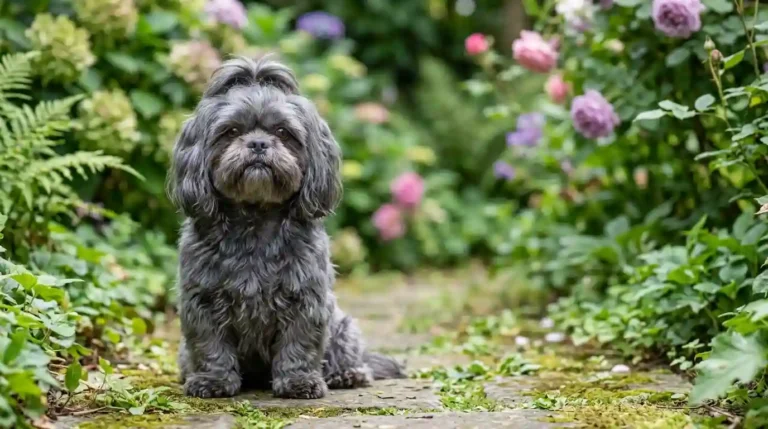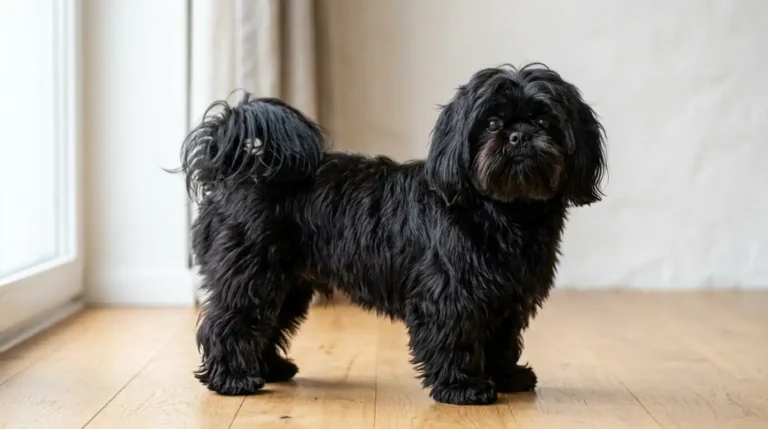

Merle Shih Tzu: Appearance, Genetics, and What to Know
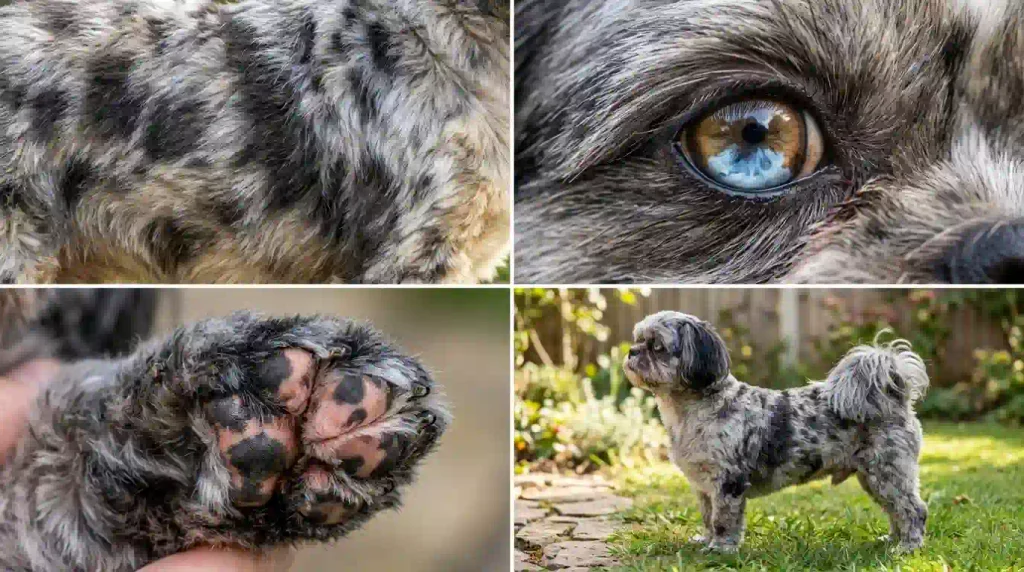
A merle Shih Tzu is described as having a mottled coat pattern in which areas of normal pigment appear beside irregular patches where the pigment is lighter or diluted. Depending on the dog’s underlying colors, the pattern may look gray and black, brown and tan, reddish-brown, cream, or mixed with white markings. Merle can also be associated with blue or partially blue eyes, although eye color does not confirm the pattern by itself.
The important point is that merle is a pattern, not simply another solid Shih Tzu color. It also raises questions that go beyond appearance. The U.S. Shih Tzu standard permits all colors and markings, although merle is not separately listed among current AKC Shih Tzu registration colors; the U.K. Royal Kennel Club standard explicitly excludes merle. Neither a coat pattern nor a show standard alone establishes a dog’s ancestry. DNA testing, pedigree documentation, responsible breeding practices, and appropriate health evaluation matter much more when considering a Shih Tzu described as merle.
Table of Contents
- What “merle” means
- Can a Shih Tzu have a merle coat?
- How to recognize a merle pattern
- Genetics and testing
- Health and responsible breeding
- How should you care for a merle Shih Tzu’s coat?
- Merle Shih Tzu FAQs
- Final thoughts
What “Merle” Means
Merle is a coat pattern created by irregular dilution of eumelanin, the pigment responsible for black and brown coloration in dogs.
Rather than changing every pigmented hair evenly, merle produces a patchwork. Some areas retain their normal solid pigment while others appear significantly lighter.
This can create a dramatic marbled, mottled, or splashed appearance.
Depending on the underlying pigment, a merle dog may show combinations such as:
- Black patches over gray
- Brown patches over lighter tan or brown
- Gray, black, and white
- Brown, cream, and white
- Irregularly diluted facial markings
- Small isolated merle areas
- Extensive mottling across most of the body
If you are comparing the pattern with ordinary Shih Tzu colors, the key distinction is that merle changes the distribution and intensity of pigment rather than simply creating one uniform coat shade.
How the Coat Pattern Differs From a Solid Color
A black Shih Tzu may have relatively uniform black pigmentation across its colored areas.
A merle-patterned dog, in contrast, can have sections where that dark pigment is broken into lighter patches while other areas remain fully pigmented.
The result may look something like:
Solid black + irregular gray patches = black-based or commonly called blue merle appearance
or:
Solid brown/liver + lighter brown or tan patches = brown/liver-based merle appearance
Merle is sometimes casually described as a “partial dilution” pattern. That description can help readers visualize the effect, but genetically it is different from ordinary whole-body color dilution.
It is also important not to confuse merle with brindle.
A brindle Shih Tzu usually shows patterned bands or streaks of differently colored hairs, while merle creates irregular diluted patches within eumelanin.
Similarly, a black brindle Shih Tzu or red brindle Shih Tzu may look patterned without being genetically merle.
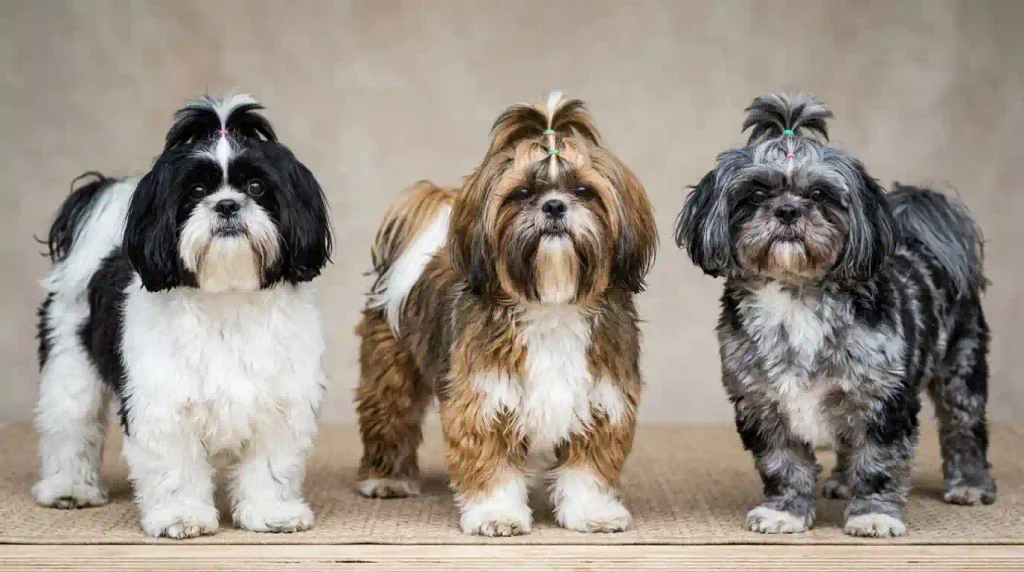
Can a Shih Tzu Have a Merle Coat?
Dogs described as merle Shih Tzus do exist, and merle-pattern DNA can be detected genetically in dogs.
However, there are several different questions that should not be combined:
- Does the dog visually look merle?
- Does genetic testing detect a merle-associated variant?
- How is its color recorded by a registry?
- Does it meet a particular kennel club’s show standard?
- What does its documented pedigree establish about ancestry?
Those questions are related, but they do not have identical answers.
What U.S. and U.K. Breed Standards Say
The U.S. and U.K. standards handle the issue differently.
The American Shih Tzu Club standard used by the American Kennel Club states that all colors and markings are permissible and should be considered equally.
At the same time, the current AKC Shih Tzu color-registration list includes colors such as black, brindle, gold, red, blue, liver, silver, white, and various combinations—but it does not separately list Merle as a Shih Tzu registration color.
That distinction matters.
Saying that a breed standard permits all colors and markings is not exactly the same as saying that “Merle” appears as a named registration color.
The U.K. Royal Kennel Club standard is more explicit. Its current Shih Tzu standard states that all colors are permissible except merle, which it calls unacceptable.
Therefore, statements such as “merle is universally accepted” or “merle is universally prohibited in Shih Tzus” oversimplify the issue.
Standards differ by organization and country.
For general information about how coat color fits into the breed, see our shih tzu Breed Information section and complete Shih Tzu facts guide.
Why Coat Color Alone Cannot Confirm Pedigree
A merle-looking coat cannot prove whether a dog is purebred or mixed.
Appearance is not a pedigree test.
Likewise, a breed standard cannot establish the ancestry of one individual dog.
If ancestry matters, stronger evidence comes from:
- Verified pedigree records
- Registration records
- Parentage information
- Genetic parentage testing where appropriate
- Documentation for both parents
- Breeding records
A merle pattern therefore should not automatically be used to claim that a dog must be mixed, nor should a seller’s statement that a dog is purebred be considered proof simply because registration paperwork is mentioned.
Our guide to the purebred Shih Tzu explains why breed identity involves more than appearance.
Likewise, unusual coat appearance does not create a new type of Shih Tzu by itself.
How to Recognize a Merle Pattern
Merle can range from dramatic to extremely subtle.
The classic pattern consists of irregularly shaped areas of diluted eumelanin mixed with areas where eumelanin retains its normal intensity.
Imagine a black section of coat.
Instead of being completely black, a merle pattern might break it into:
Black → gray → black → pale gray → black
The patches are usually irregular rather than symmetrical.
Red and Blue Appearances, Markings, and Pigmentation
Two common descriptive labels are blue merle and red merle, but these names can confuse Shih Tzu owners.
Blue Merle Appearance
A black-based merle dog may have:
- Black patches
- Gray or silver-gray diluted sections
- White markings
- Blue or partially blue eyes in some individuals
This is commonly called blue merle even though the dog does not necessarily have the genetic dilution associated with a true blue Shih Tzu.
That distinction is important.
A blue merle Shih Tzu describes a merle pattern, whereas “blue” pigmentation involves a different color mechanism.
A blue gray Shih Tzu can therefore look gray without being merle at all.
Red Merle Appearance
In dog color terminology, “red merle” commonly refers to merle acting on brown/liver eumelanin, creating solid brown patches mixed with lighter tan or brown areas.
That should not automatically be confused with a genetically red coat.
A red Shih Tzu may have red, copper, or reddish-gold hair but no merle pattern whatsoever.
Likewise, a liver Shih Tzu has brown-based pigmentation but is not automatically merle.
A liver-based merle may also have a liver nose rather than a black nose because the dog’s underlying eumelanin is brown.
This illustrates why several separate color genes may interact in the appearance of one dog.
White Markings
Merle and white spotting are also separate characteristics.
A merle-patterned dog can have:
- White chest
- White legs
- White face
- Facial blaze
- White collar
- White tail tip
- Extensive white sections
A black and white Shih Tzu, grey and white Shih Tzu, or brindle and white Shih Tzu can also contain strong white markings without being merle.

Blue Eyes, Heterochromia, and the Butterfly Nose
Merle can sometimes be associated with striking eye pigmentation.
Possible appearances include:
- Two brown eyes
- Two blue eyes
- One blue and one brown eye
- Partially blue eye
- Brown eye containing a blue segment
Having two differently colored eyes is called heterochromia.
However, blue eyes or heterochromia do not prove a dog is merle. Other genetic mechanisms can affect eye color.
Likewise, a partially pigmented or so-called butterfly nose should not be treated as proof of merle.
Nose pigmentation should be evaluated alongside coat pattern, genetics, age, and the dog’s underlying pigment type.
Why Some Merle Patterns Are Hard to See
Not every merle dog has dramatic marbling.
Two particularly important concepts are cryptic merle and hidden merle.
Cryptic merle generally describes merle-associated variants that may produce little or no clearly visible merle pattern. A dog can consequently look non-merle or show only a tiny area of mottling.
Hidden merle refers to situations where another genetic mechanism prevents the merle pattern from being visible.
For example, merle acts primarily on eumelanin. If a dog’s coat does not visibly express eumelanin in the relevant area, the pattern may be hidden.
This becomes particularly important with cream or red-looking dogs.

A dog may appear to have a relatively uniform cream base coat while still carrying a merle-associated variant that cannot be reliably identified by appearance alone.
This is one reason breeders should not depend entirely on visual inspection when merle inheritance is possible.
Genetics and Testing
Merle is associated with a DNA insertion affecting the PMEL gene, historically also called SILV or PMEL17.
The genetic mechanism is more complicated than the old simple description of “M versus m.”
Modern testing can evaluate the presence and size of merle-associated insertions because different insertion lengths can influence how strongly the pattern is expressed.
According to the UC Davis Veterinary Genetics Laboratory merle test, merle is an incompletely dominant pattern characterized by irregularly shaped areas of diluted pigment alongside fully pigmented areas.
Only one merle-associated variant may be sufficient for a visible pattern, although phenotype can vary substantially.
What a Merle DNA Test Can Establish
A properly performed genetic test can help determine whether a dog has:
- No detected merle-associated insertion
- One merle-associated variant
- Two merle-associated variants
- More complex allele patterns reported by some laboratories
Testing is especially useful when the coat pattern is subtle or invisible.
A DNA test may therefore help answer:
Does this dog carry a detectable merle-associated PMEL variant?
It cannot, however, answer every question owners may have.
A merle test does not automatically establish:
- Purebred ancestry
- Breed quality
- Temperament
- Overall health
- Whether every physical marking is caused by merle
- Complete pedigree history
A genetic color test and a parentage test answer different questions.
This distinction is particularly important when evaluating unusual advertisements for a Shih Tzu merle puppy.
Cryptic Merle Makes Testing Especially Important
Merle-associated DNA can vary in length, which helps explain why some dogs have extensive mottling while others display almost none.
A visually solid-looking dog can therefore be risky to classify solely from photographs if merle occurs in its family.
This becomes especially significant before breeding.
If one apparently non-merle dog actually carries a merle-associated variant and is bred to another merle, offspring could inherit two merle variants.
Health and Responsible Breeding
The health discussion around merle needs careful wording.
A dog carrying one merle-associated variant should not automatically be assumed to be unhealthy.
At the same time, merle genetics matter greatly when breeding because dogs inheriting two merle variants, commonly called double merles, have a substantially greater concern for abnormalities affecting hearing and vision.
Single-Merle and Double-Merle Risks
In a typical merle-to-non-merle pairing, some puppies may inherit one merle-associated allele and others may not.
A double merle results when a puppy inherits merle-associated variants from both parents.
Double-merle dogs often have considerably more white in their coat than typical merles.
They can have increased risks involving:
- Congenital hearing impairment
- Deafness in one or both ears
- Abnormal eye development
- Microphthalmia, or unusually small eyes
- Abnormal pupils
- Vision impairment
- Other ophthalmologic abnormalities
Not every double-merle dog has identical problems, and the frequency and severity can vary.
However, the elevated risk is serious enough that merle-to-merle breeding is generally discouraged.
This is where hidden or cryptic merle becomes particularly important.
Two dogs do not need to look dramatically merle for a risky pairing to occur if genetic testing shows that both carry relevant merle variants.
Is a Single-Merle Shih Tzu Unhealthy?
You should not conclude that a merle-patterned Shih Tzu is unhealthy solely because of its coat.
An individual dog’s health should be assessed through appropriate veterinary evaluation, family history, health screening, and any relevant genetic tests.
The strongest evidence for severe merle-associated risks concerns dogs inheriting merle variants from both parents.
Because published health data can differ among breeds, it is also inappropriate to take a percentage reported in another breed and claim that the same percentage applies specifically to Shih Tzus.
Questions to Ask a Breeder
If you are considering a merle Shih Tzu puppy, ask questions that go beyond appearance.
A responsible conversation should include:
- Have both parents been tested for merle?
- Can I see the actual laboratory reports?
- Is either parent merle, cryptic merle, or genetically merle despite a subtle coat?
- Were two merle-positive dogs bred together?
- Can I see pedigree and registration records for both parents?
- What health screening was performed on the parents?
- Has the puppy’s hearing been evaluated if there is a concern?
- Has a veterinary eye examination been recommended or completed?
- Can I see the puppy in natural light rather than only edited photographs?
- What does the breeder mean when using labels such as blue merle, red merle, or rare merle?
Ask for documentation rather than accepting verbal claims.
A high price is not proof of careful breeding.
Similarly, labels such as “rare,” “exotic,” or “premium color” say nothing by themselves about health, pedigree, or breeding quality.
The same caution should be used when unusual colors are marketed as automatically more valuable, whether they are merle, lavender Shih Tzu, or liver chocolate Shih Tzu.
How Should You Care for a Merle Shih Tzu’s Coat?
Merle pigmentation itself does not require a special grooming routine.
The dog’s grooming needs come primarily from the Shih Tzu’s dense double coat, hair length, lifestyle, skin condition, and chosen haircut.
Brush and Comb Consistently
Long-coated Shih Tzus can develop tangles and mats, particularly:
- Behind the ears
- Around the neck
- Under the front legs
- Across the chest
- Around the belly
- On the legs
- Near the tail
- Beneath collars and harnesses
Brush the coat in sections and check with an appropriate comb afterward.
Surface brushing alone may leave tangles close to the skin.
Keep the Face Clean
Long facial hair can trap:
- Food
- Water
- Saliva
- Eye discharge
- Outdoor debris
Keep the face gently cleaned and dry.
Persistent redness, irritation, unusual eye discharge, odor, or discomfort should be evaluated by a veterinarian rather than assumed to be normal staining.
Do Not Confuse Grooming Changes With Merle
Clipping the coat can temporarily change how the pattern looks because different hairs and undercoat become more visible.
Long hair can also soften the visual boundaries between merle patches.
This does not mean grooming has changed the dog’s merle genetics.
Likewise, sun exposure or normal coat maturation may alter color intensity without creating or removing the underlying merle-associated DNA variant.
Choose Coat Health Over Color Enhancement
A healthy coat should matter more than making the merle contrast appear stronger.
Use suitable canine grooming products, maintain a consistent brushing routine, feed an appropriate complete diet, and seek veterinary care when skin or coat problems develop.
The same basic care principles apply to a merle dog as they do to a silver Shih Tzu, grey Shih Tzu, gold and white Shih Tzu, or another normally coated Shih Tzu.
Merle Shih Tzu FAQs
Is merle a Shih Tzu color?
Merle is a coat pattern rather than a single solid color, and it is not separately listed among current AKC Shih Tzu registration colors.
Does the U.S. Shih Tzu standard allow merle?
The U.S. standard says all colors and markings are permissible, although Merle is not a separately named AKC Shih Tzu registration color.
Does the U.K. Shih Tzu standard allow merle?
No; the current Royal Kennel Club Shih Tzu standard explicitly states that merle is unacceptable.
Does a merle coat prove a Shih Tzu is mixed?
No; coat appearance alone cannot establish ancestry, so pedigree and parentage evidence must be considered separately.
Can a purebred Shih Tzu be merle?
A dog’s merle appearance alone cannot prove or disprove purebred ancestry; documented pedigree and appropriate parentage evidence address that question.
What is a blue merle Shih Tzu?
It generally describes a black-based merle pattern producing irregular black and gray areas rather than a uniformly blue coat.
What is a red merle Shih Tzu?
The term commonly describes merle affecting brown/liver eumelanin, producing darker brown patches over lighter brown or tan areas.
Is blue merle the same as a blue Shih Tzu?
No; merle patterning and genetic blue dilution involve different mechanisms.
Can merle Shih Tzus have blue eyes?
Yes, merle can be associated with blue or partially blue eyes, but blue eyes alone do not prove merle.
Can a merle Shih Tzu have heterochromia?
Yes, one blue eye and one differently colored eye can occur, but heterochromia is not exclusive to merle.
What is cryptic merle?
Cryptic merle refers to certain merle-associated variants that may produce little or no obvious visible merle pattern.
Can a cream Shih Tzu carry merle without obvious patches?
Potentially; because merle acts on eumelanin, other color genetics can make the pattern difficult or impossible to recognize visually.
What is a double merle?
A double merle inherits merle-associated variants from both parents and has an increased risk of hearing and eye abnormalities.
Should two merle dogs be bred together?
Merle-to-merle breeding is generally discouraged because it can produce double-merle puppies with increased health risks.
Does a butterfly nose prove merle?
No; partial nose pigmentation is not sufficient to diagnose a merle genotype.
Can DNA testing confirm merle?
Yes, an appropriate PMEL merle test can identify merle-associated variants and provide more information than visual inspection alone.
Does merle require special coat care?
No; grooming requirements are based on the Shih Tzu coat, not the merle pattern itself.
Final Thoughts
A merle Shih Tzu can have a striking mottled coat, but understanding the pattern requires more than identifying gray, brown, red, or white patches. Merle is a genetic pattern affecting eumelanin, and its appearance can range from obvious marbling to cryptic or completely hidden expression.
Breed-standard rules also differ: the U.S. standard broadly permits colors and markings, while the current U.K. standard specifically excludes merle. Neither standard determines an individual dog’s ancestry.
If you are considering a merle puppy, prioritize documented pedigree, genetic testing of the parents, responsible breeding practices, and appropriate health evaluation over claims about rarity or appearance. For broader comparisons, explore the complete Shih Tzu colors guide.