Grey Shih Tzu: Coat Color, Identification, and Care
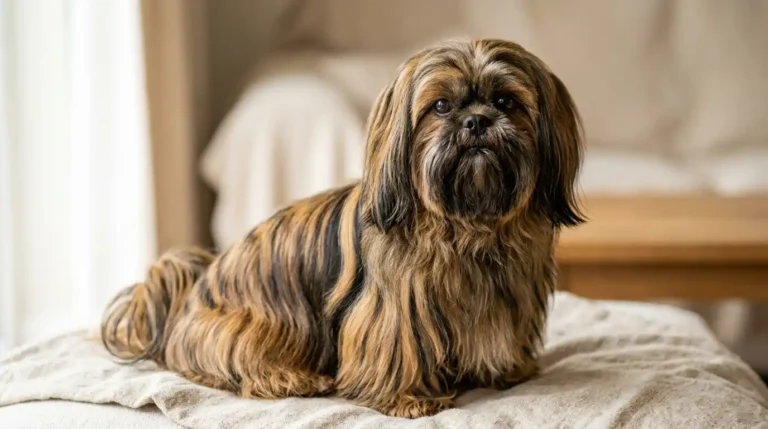
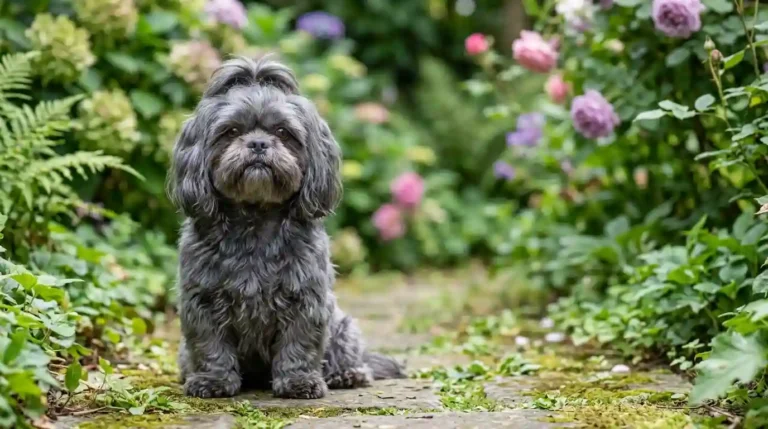
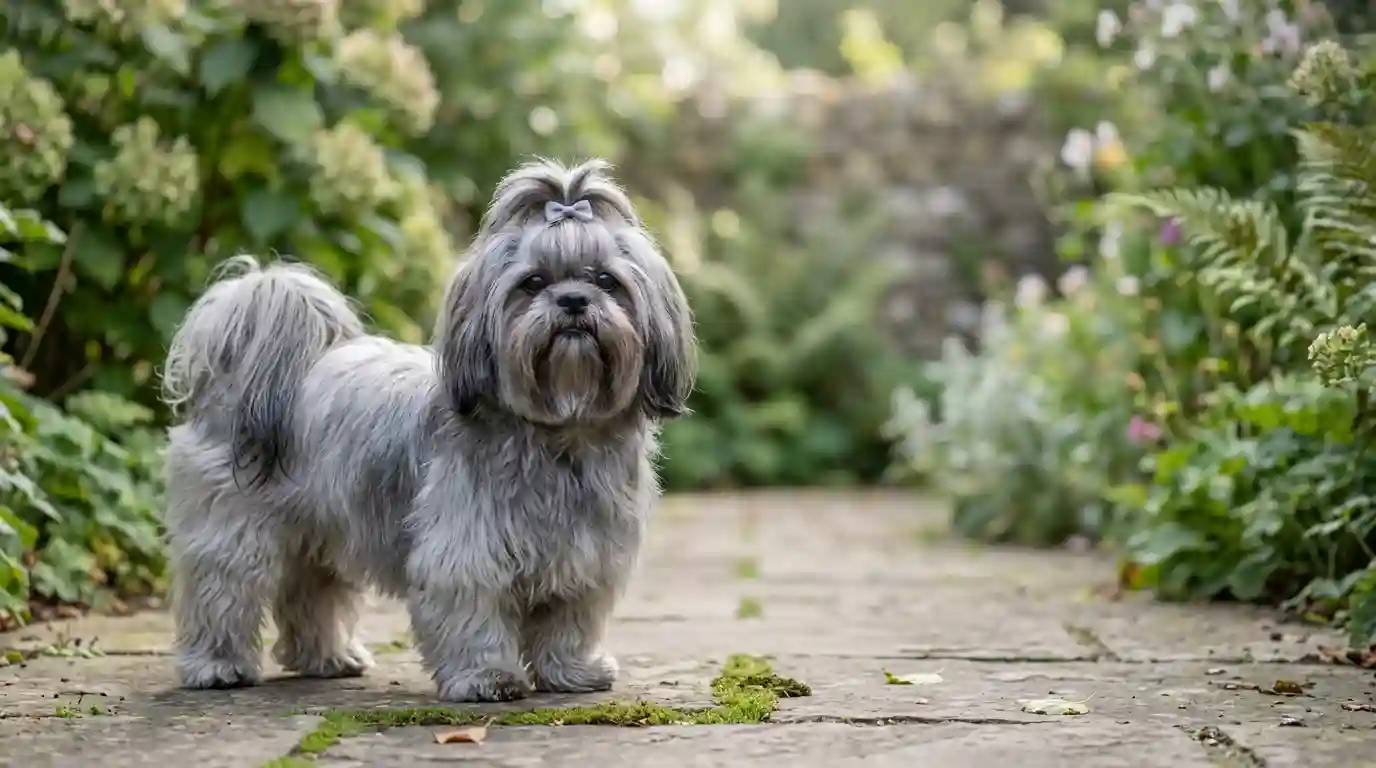
A grey Shih Tzu may look smoky, charcoal, steel-gray, or almost silver, but the visible shade of the hair does not tell the whole color story. Some gray-looking Shih Tzus still have deep black pigment on the nose, lips, and eye rims, while genuinely blue-pigmented dogs show diluted-looking pigment at those points. Age can change the picture too: a very dark puppy may become much lighter as the adult coat grows in, sometimes shifting from nearly black to charcoal, gray, or silver. Even photographs can be deceptive because warm bulbs, cool LEDs, sunlight, camera processing, and filters can alter the apparent shade. If you are trying to identify a gray Shih Tzu, compare breeder photos, or understand whether a puppy advertised as “rare gray” is likely to stay that color, the most useful approach is to examine coat shade, pigment, markings, age, and earlier photos together. This guide explains how to do that and how to maintain the breed’s distinctive double coat.
Table of Contents
- What does “grey Shih Tzu” mean?
- How can you identify a gray-looking coat?
- Can a Shih Tzu’s gray coat change with age?
- Is gray an accepted Shih Tzu color?
- How do you care for a gray Shih Tzu’s coat?
- Grey Shih Tzu quick answers
- Final Thoughts
What Does “Grey Shih Tzu” Mean?
In everyday use, grey Shih Tzu generally means a Shih Tzu whose coat appears gray, smoke-colored, charcoal, steel-gray, or silver-gray. American owners are more likely to write gray Shih Tzu, while “grey” is common in British English; the two spellings refer to the same general color.
What matters more is why the dog looks gray.
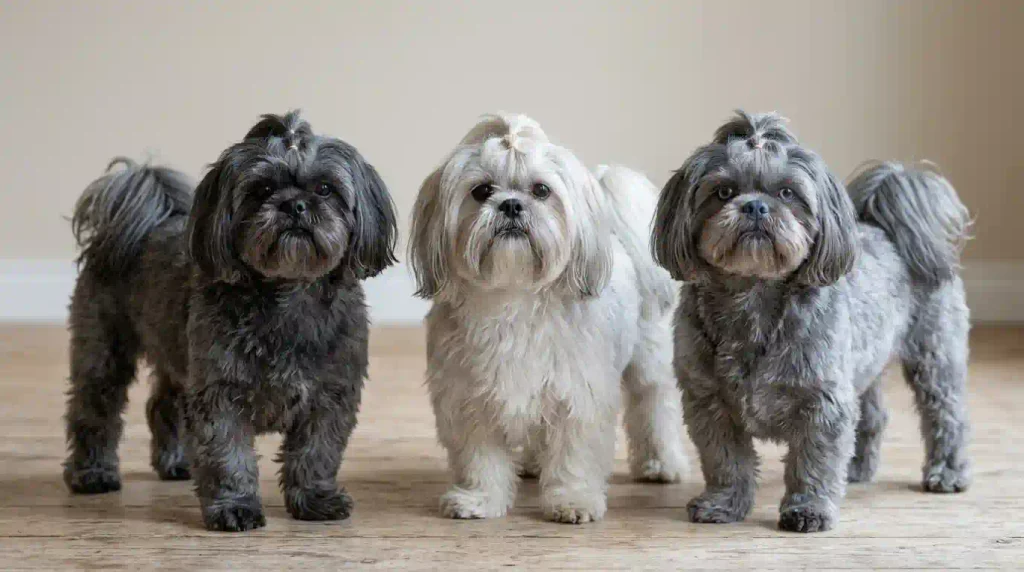
A Shih Tzu can appear gray because a dark puppy coat has lightened, because black hairs have faded as the adult coat developed, because darker and lighter hairs blend visually, because the coat is silver, or because the dog has diluted-looking pigmentation associated with blue coloring. Lighting and camera processing can add even more confusion.
That is why it helps to compare a gray-looking dog with the wider range of shih tzu colors instead of relying on one label.
Grey, Silver, and Blue: How the Labels Compare
The words gray, silver, and blue are often used around similar-looking Shih Tzus, yet they do not always describe the same thing.
Grey usually describes visible appearance
A Shih Tzu grey coat may be very dark charcoal, medium smoke-gray, pale gray, steel-gray, gray mixed with black, or gray accompanied by white markings.
The important point is that visible gray hair does not, by itself, prove that the dog carries diluted blue pigment.
A young black shih tzu may begin life with a very dark coat and later become much lighter. If the adult still has clearly black nose and eye-rim pigment, it would be too simplistic to call that dog blue merely because the hair became gray.
This is particularly relevant with a dark grey Shih Tzu because charcoal hair may appear almost black indoors but noticeably gray in daylight.
Silver usually describes a paler gray effect
A silver shih tzu commonly appears lighter, brighter, or more reflective than a darker gray dog.
That difference can become more obvious as the coat grows. Long Shih Tzu hair catches light in a way that can make a smoky coat appear significantly more silver outdoors than it does indoors.
There is no perfectly sharp visual line separating every gray dog from every silver one. One owner may describe a coat as silver while another calls the same dog light gray.
For identification, describing what you actually see is more useful than treating the word “silver” as proof of a specific genetic result.
Blue is not simply another word for every gray coat
The term “blue” can also refer to gray coloration in dogs. The AKC glossary notes that blue can mean gray in canine color terminology while cautioning that definitions differ between breeds.
For Shih Tzus, the pigment points are especially useful.
The official breed standard states that the nose, lips, and eye rims are black on most colors, liver on liver-pigmented dogs, and blue on blue-pigmented dogs.
So a gray coat does not automatically make a dog a blue shih tzu.
A blue-pigmented Shih Tzu may show a slate, smoky, or diluted gray quality at the nose, lips, and eye rims rather than the strong black pigment seen on many gray-looking dogs.
If the visual overlap is difficult to interpret, the blue gray shih tzu guide covers that distinction in greater detail.
What about the dilution gene?
Inherited dilution variants can affect canine pigmentation and are often discussed in terms of a dilution gene and recessive inheritance. That does not mean you can identify a particular variant by looking at gray hair alone.
The shortcut:
Gray hair = dilution gene = blue dog.
is too simplistic.
A Shih Tzu can develop a gray or silver-looking adult coat while retaining black pigment on the nose, lips, and eye rims.
If a breeder or owner needs certainty about a particular recessive gene, pedigree information or suitable DNA testing is more informative than coat shade alone.
Solid Gray Coats and Gray-and-White Patterns
Gray Shih Tzus do not all have the same coat pattern.
A dog that appears nearly solid gray may still have slightly darker ears, subtle silver areas, black-tipped hairs, or small white markings. Because coat shade can vary along the hair shaft, the dog may even appear darker after a short haircut and lighter when the hair is grown long.
A dog with much more white presents a different pattern entirely.
A grey and white shih tzu might have a white forehead blaze, muzzle, chest, neck, belly, feet, legs, or tail markings combined with gray patches elsewhere.
When white covers a substantial area, the coat may be described as parti-color.
Silver can also occur with white, which is why some pale dogs are better compared with a silver and white shih tzu. A blue-pigmented dog with extensive white may resemble a blue and white shih tzu.
It helps to separate two questions:
Color asks: What shade is the hair?
Pattern asks: Where are the different colors distributed?
Once those are considered separately, a gray coat becomes easier to describe accurately.
How Can You Identify a Gray-Looking Coat?
A useful way to identify a gray-looking Shih Tzu is to avoid choosing a color label too early.
Begin with the coat itself. Is it almost black, charcoal, medium gray, pale gray, silver, blue-gray, or a mixture of gray and white? Next, look at the nose, lips, and eye rims. Then consider the dog’s age and compare current photos with puppy images. If exact color genetics matter, pedigree records or genetic information can add evidence that appearance cannot provide.
Check the Coat and Pigment Points Together
The coat should never be evaluated in isolation from the dog’s pigment.
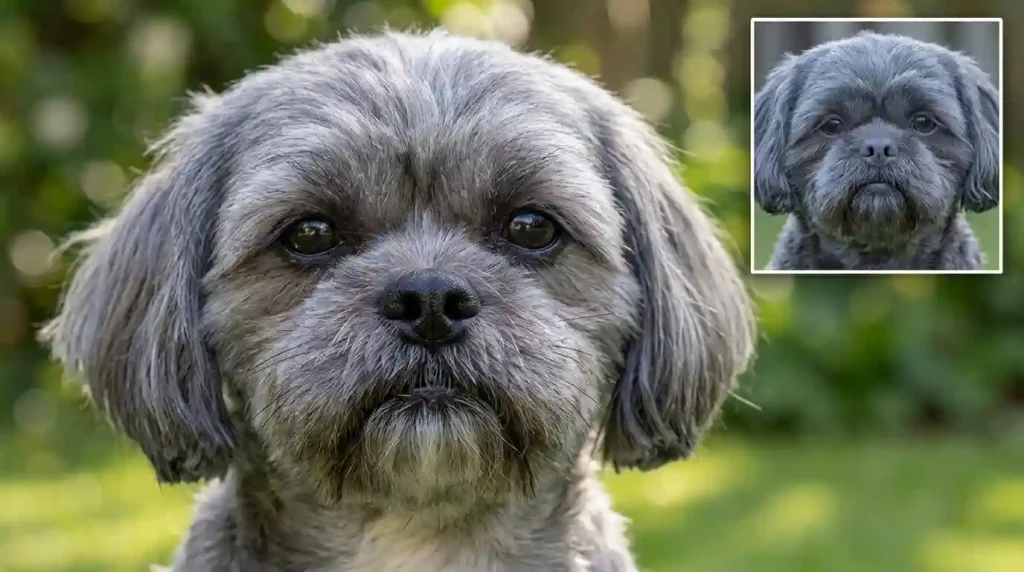
The AKC standard is particularly helpful here. It says that the nose, lips, and eye rims are black except on liver-pigmented dogs, where those points are liver, and blue-pigmented dogs, where they are blue.
You can read the full wording in the official AKC Shih Tzu breed standard.
Start with the coat
Look at the dog in neutral daylight and decide whether the coat appears nearly black, charcoal, medium gray, light gray, silver, blue-gray, or gray-and-white.
This first step describes what is visible. It does not yet tell you the underlying pigment category.
Then inspect the nose
A deep black nose and a slate-gray nose are not the same clue.
If the coat looks gray but the nose remains strongly black, that is different from a dog whose coat and pigment points both have a diluted slate appearance.
Check the eye rims
The color around the eyes offers another useful comparison.
Strong black eye rims support black pigment. Brownish rims point in another direction, while diluted blue-gray rims can support a blue-pigment interpretation.
Look at the lips
Long facial hair can make the lips harder to inspect, but they are still relevant because the breed standard groups lip pigment with the nose and eye rims.
Use the paw pads as secondary evidence
The paw pads may provide additional information, but they should not be treated as the deciding feature.
Pads can be mixed in color, difficult to see under hair, or changed by normal wear. They work best as supporting evidence.
Black Pigment With a Gray Coat
A Shih Tzu can look obviously gray while still having black pigment on the nose, lips, and eye rims.
That combination matters because it shows why visible coat shade and pigment category should be treated separately.
Some dogs that develop this appearance began life much darker. If black areas remain obvious alongside gray, the dog may visually fit a black and grey shih tzu description.
The balance between black and gray can continue to change as the coat matures.
Blue Pigmentation With a Gray-Looking Coat
A blue-pigmented Shih Tzu may look gray because diluted black pigmentation often appears smoky, slate, or cool gray.
The best clue is not that the hair “looks blue.” Instead, examine whether the nose, lips, and eye rims also have a diluted gray-blue appearance.
When those pigment points match, a blue description becomes more defensible than it would be from hair color alone.
Brownish Pigment Is a Separate Category
If the nose or eye rims are brown rather than black or slate-gray, the dog belongs in a different pigment discussion.
Compare that appearance with a liver shih tzu rather than assuming every muted or grayish coat belongs in the blue category.
Photography can easily push cool gray toward taupe or brown, so pigment points are valuable when the coat itself is ambiguous.
Why Light and Photos Can Change How the Coat Looks
Gray is especially easy to misread in photographs because it is relatively neutral.
A small change in lighting can make the same gray Shih Tzu dog look blue-gray, silver, brownish, or almost black.
Warm household bulbs may push neutral gray toward taupe or brown-gray. Under strongly warm lighting, a very pale dog might even appear closer to a blonde shih tzu.
Cool LED lighting can do the opposite and exaggerate blue tones. That can make a black-pigmented gray dog photograph as though it has blue pigment.
Direct sunlight often reveals silver hairs and makes the coat look lighter. Shade usually deepens the color and can make charcoal appear nearly black.
Phone processing adds another layer because cameras automatically adjust exposure, white balance, contrast, saturation, shadows, highlights, and sharpness.
For that reason, do not rely on one attractive breeder portrait.
When evaluating a puppy remotely, request a front view, side view, close-up of the face and nose, full-body photograph, natural-light image, short unfiltered video, and earlier photos when available.
Several ordinary photos are usually more useful for identification than one heavily polished image.
Can a Shih Tzu’s Gray Coat Change With Age?
Yes. Shih Tzu coats can change substantially between puppyhood and maturity.
The AKC notes that many Shih Tzu coats change when dogs are around 10 to 12 months old as the puppy coat transitions toward the mature coat.
Color shifts may begin before that point and remain noticeable as coat texture and length continue to develop.
Puppy-to-Adult Coat Changes
A gray Shih Tzu puppy may eventually look considerably lighter than it did at eight or twelve weeks.
Possible changes include black areas softening to charcoal, charcoal becoming medium gray, gray becoming silver, dark hair tips becoming less visible, facial hair lightening, and the ears remaining darker than the body.
White markings can also appear more prominent once the surrounding colored coat fades.
A dark puppy may mature into a gray adult
A puppy that initially appears nearly black may later develop an obvious gray or silver coat.
That does not automatically mean the original color description was misleading. Young Shih Tzus can genuinely look much darker before the adult coat comes in.
The important issue is whether expectations are explained realistically.
Black-tipped hairs can make puppies look darker
Some puppies have darker tips over lighter underlying hair.
Those tips may create a very dark charcoal or black impression early in life. As the hair grows and the adult coat develops, the darker tipping can become less noticeable and the overall coat may appear much lighter.
Brindle can become less obvious
A brindle shih tzu has patterned coloration rather than a truly uniform gray coat.
As the coat becomes longer or lighter, brindle striping may become harder to see. A silver brindle shih tzu can therefore look broadly gray or silver from a distance even though the underlying coat pattern remains more complex.
Do not assume every fading brindle coat has become solid gray without examining the pattern carefully.
A gray coat is not the same as senior graying
A naturally gray-looking Shih Tzu can be young.
That differs from an older dog of another color developing white or gray hairs around the face as part of aging.
A young adult may have a gray coat because of normal inherited coat coloration and development, while a senior dog may gradually acquire gray hairs regardless of its original color.
What Photos and Parent Dogs Can—and Cannot—Tell You
Pictures of the parents and older relatives can give useful context.
If related dogs repeatedly start dark and become silver-gray as adults, a puppy from the same family may follow a similar pattern.
But those examples cannot guarantee an exact final shade.
When considering a gray Shih Tzu dog, ask for photos of the parents as puppies, adolescents, and adults when possible. Previous related litters can also provide useful comparison.
Early puppy photos can document original darkness, placement of white markings, dark-tipped hairs, facial masks, pigment points, and the progression of color change.
What they cannot promise is the precise adult gray shade, amount of fading, degree of silvering, darkness of the ears, final contrast between markings, or how the coat will photograph later in life.
Adult-color predictions should therefore be treated as estimates.

Is Gray an Accepted Shih Tzu Color?
The Shih Tzu occurs in a wide range of colors and markings, so a gray-looking coat should not be treated as making the dog less characteristic of the breed.
What the Breed Standard Says About Colors
The current AKC Shih Tzu breed standard describes the coat as luxurious, dense, long, flowing, and double-coated. Under color and markings, the standard states that all are permissible and are to be considered equally.
AKC breed education also explains that all colors occur in the Shih Tzu.
Accordingly, overall quality should not be judged merely by whether the coat appears gray, silver, black, gold, red, white, brindle, or multicolored.
The breed standard also considers structure, balance, expression, movement, coat, and temperament.
Color also does not establish whether a dog is a purebred shih tzu. Breed ancestry depends on parentage and pedigree, not on possessing a particular coat shade.
Readers who want broader context can explore the shih tzu Breed Information section, review these shih tzu facts, and learn more about the breed’s background through the shih tzu origin guide.
How to Assess “Rare Color” Claims
The word rare deserves careful scrutiny when it is being used to justify a large price premium for a gray puppy.
AKC educational material says that Shih Tzus occur in all colors and states that no color is rare.
That does not mean every breeder sees every shade equally often in their own litters. It does mean that “I rarely produce this color” is not the same claim as “this color makes the dog inherently superior, healthier, or more valuable.”
If someone advertises a “rare gray Shih Tzu,” ask what color appears on the documentation, whether “gray” is simply a visual description, whether the dog has black or blue pigmentation, whether natural-light photographs are available, whether genetic testing supports any genetic claim, what health screening the parents received, what veterinary records accompany the puppy, and how the puppies are socialized.
Those questions matter more than an unusual color name.
The same caution is useful with size-based marketing terms such as teacup shih tzu.
Health, structure, temperament, socialization, and responsible breeding should remain more important than an exotic-sounding coat label.
How Do You Care for a Gray Shih Tzu’s Coat?
A grey Shih Tzu dog does not need a special grooming routine merely because its coat is gray.
The main factor is the breed’s coat type.
The standard describes the Shih Tzu as having a dense, long, flowing double coat.
Without regular maintenance, that coat can tangle and develop mats.
Brushing, Bathing, and Preventing Mats
Long-coated Shih Tzus need consistent grooming.
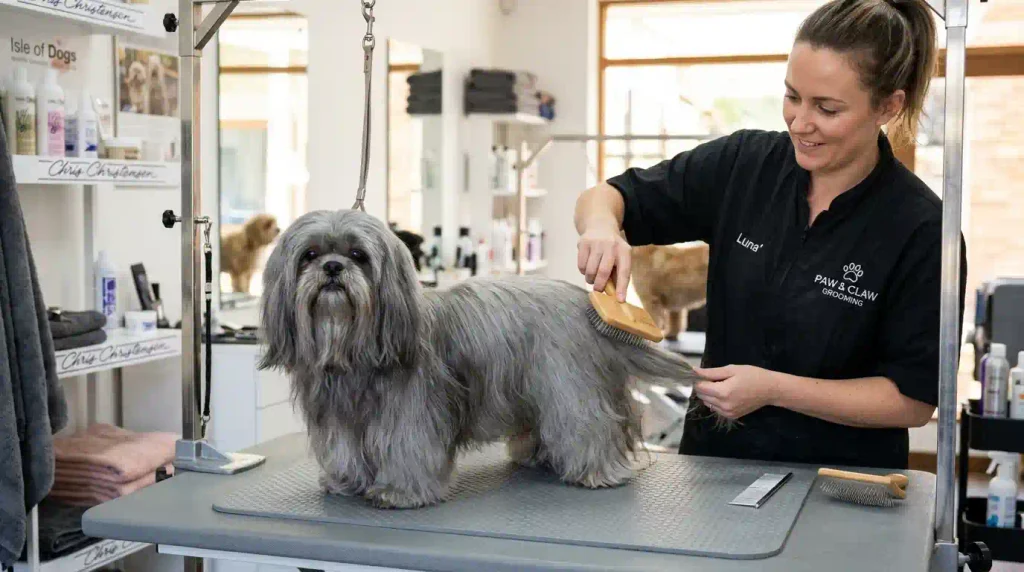
AKC grooming guidance recommends daily brushing for longer coats and advises brushing in layers so that grooming reaches through the coat rather than merely smoothing the visible surface. It also notes that bathing about every three to four weeks can be part of maintaining a long coat.
Pay close attention to areas behind the ears, around the neck, under the front legs, on the chest, belly, inner legs, around the tail, and beneath collars or harnesses because these areas are more prone to matting.
Brushing only the surface can leave hidden knots near the skin. Work through the coat section by section, then use a metal comb to find tangles that remain.
Tight mats should not be pulled aggressively because doing so can hurt the dog and damage the hair.
Long facial hair also needs attention. AKC grooming guidance notes that the mustache and topknot of a long-coated Shih Tzu require daily care.
You can maintain a topknot or keep the facial hair shorter, but comfort and cleanliness should come first.
Bathing frequency depends on coat length and lifestyle. Use products formulated for dogs and rinse thoroughly so residue does not remain trapped in the dense coat.
Existing tangles should be addressed before bathing because mats can tighten when wet. The American Shih Tzu Club’s AKC-hosted health guidance similarly warns that coats tangle and mat when they are not brushed and kept clean.
A shorter puppy clip is a practical option for companion dogs. AKC guidance notes that this trim can make maintenance easier and that dogs kept in a puppy clip commonly need professional grooming about every four to six weeks.
Gray hair itself does not require special color-enhancing products. Choose grooming products for the dog’s skin and coat condition, not merely because a bottle claims to brighten silver or gray.
The same basic routine applies to a gray dog, a grey and white shih tzu, a silver dog, or another Shih Tzu kept at the same coat length.
When a Coat or Skin Change Needs Veterinary Attention
Normal fading usually happens gradually.
A puppy whose charcoal coat becomes silver-gray over many months presents a different situation from a dog that suddenly loses hair or develops inflamed skin.
Watch for sudden hair loss, bald areas, persistent scratching, redness, flaking, scabs, sores, excessive licking, a greasy coat, strong odor, abrupt thinning, major changes in texture, or painful-looking skin.
Those signs should not automatically be dismissed as ordinary graying.
Gradual lightening with healthy skin and normal hair density is different from hair becoming brittle, patchy, thin, or accompanied by discomfort.
If a coat change occurs together with itching, inflammation, pain, or hair loss, veterinary evaluation is more appropriate than experimenting with cosmetic grooming products.
Does Gray Coat Color Affect Health?
A gray-looking coat alone does not determine whether a Shih Tzu will be healthy.
Health is influenced by factors such as genetics, breeding practices, preventive veterinary care, nutrition, environment, age, and individual medical history.
The same applies to personality. Coat shade does not reliably determine temperament.
Temperament reflects genetics, early development, socialization, training, and the dog’s individual personality.
Claims that gray Shih Tzus are automatically calmer, smarter, healthier, or more affectionate should therefore not be treated as reliable simply because they are tied to coat color.
Grey Shih Tzu Quick Answers
Is gray the same as silver or blue?
No; gray usually describes appearance, silver generally means a lighter gray look, while blue is better evaluated through pigmentation as well as coat shade.
Does coat color determine health or temperament?
No; a gray coat alone does not reliably predict health or personality.
Is grey the same as gray?
Yes; “grey” and “gray” are different spellings of the same color.
Can a black Shih Tzu turn gray?
A dark puppy can develop a much lighter gray or silver-looking adult coat as the coat matures.
Can a grey Shih Tzu turn silver?
Yes; some gray-looking coats lighten enough to develop a distinctly silver appearance.
Is every grey Shih Tzu a blue Shih Tzu?
No; gray-looking hair alone does not prove blue pigmentation.
How can I tell gray from blue?
Compare the nose, lips, and eye rims with the coat because gray hair can occur alongside normal black pigment.
Can a grey Shih Tzu have a black nose?
Yes; many gray-looking Shih Tzus retain clearly black nose, lip, and eye-rim pigmentation.
Can grey Shih Tzus have white markings?
Yes; substantial white areas can produce a grey and white shih tzu appearance.
Can a gray Shih Tzu be solid gray?
A dog may appear predominantly or almost solid gray even though small markings or shade differences can still be present.
Are gray Shih Tzus rare?
Gray appearance should not automatically be treated as a rare or premium form of the breed.
Why did my Shih Tzu puppy get lighter?
Normal puppy-to-adult coat development can make dark hair appear progressively gray or silver.
At what age can the Shih Tzu coat change?
Changes can happen throughout puppy development, and the AKC notes that many Shih Tzu coats undergo changes around 10 to 12 months.
Can lighting make a gray Shih Tzu look blue?
Yes; cool lighting and camera white balance can make neutral gray hair appear more blue-gray.
Is a silver Shih Tzu different from a gray Shih Tzu?
The terms can overlap visually, although silver generally suggests a paler or brighter gray appearance.
Can a grey coat be brindle?
A subtle or fading brindle pattern can look broadly gray from a distance, so the actual pattern should be examined closely.
Does a gray Shih Tzu need special shampoo?
No; grooming products should be selected according to skin and coat needs rather than gray color alone.
How often should a long-coated gray Shih Tzu be brushed?
A long-coated Shih Tzu generally needs daily brushing to help prevent mats.
Is a grey Shih Tzu hypoallergenic?
Coat color does not determine allergen exposure; see the shih tzu hypoallergenic guide for a fuller explanation.
Does gray coloring prove that a Shih Tzu is purebred?
No; coat appearance by itself cannot establish ancestry or pedigree.
Final Thoughts
A grey Shih Tzu may mature into anything from deep charcoal to soft silver-gray, so identifying the coat requires more than looking at one current photograph. Compare the hair in natural light, examine the nose, lips, and eye rims, review earlier puppy photos, and consider the dog’s age before deciding whether the appearance is simply gray, silver, or associated with blue pigmentation.
If you are choosing a puppy, regard adult-color predictions as informed estimates rather than guarantees. Whether the mature coat remains dark gray or fades toward silver matters much less than health, temperament, responsible breeding, and consistent grooming.
For a wider comparison of neighboring shades and patterns, begin with the complete shih tzu colors guide.