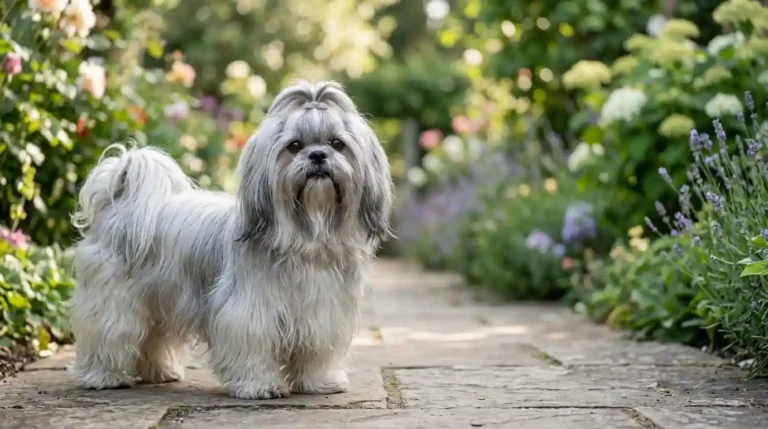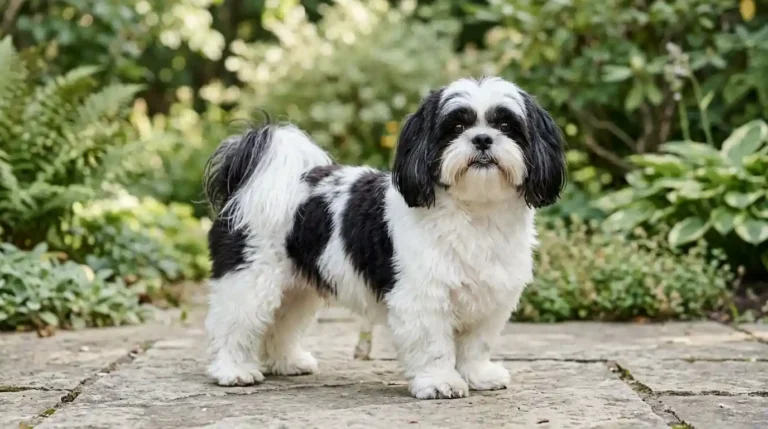

Liver Shih Tzu: Color, Identification, and Care
A liver Shih Tzu is identified mainly by liver pigmentation, not simply by a brown or chocolate-looking coat. Areas that would normally contain black pigment—especially the nose, lips, eye rims, and often paw pads—appear brown. A Shih Tzu can therefore have a red, cream, gold, or other light coat and still be liver-pigmented, while a brown-looking dog with a truly black nose may not be liver.
If you are asking what is a liver Shih Tzu, start with the skin points rather than the body hair. Examine the nose and eye rims in natural daylight, then consider coat shade, markings, age, and documentation separately. This guide explains identification, genetics, breed-standard context, coat changes, health claims, pricing, and care.
Table of Contents
- What does “liver” mean in a Shih Tzu?
- How can you identify a liver Shih Tzu?
- How is liver different from similar Shih Tzu colors?
- What does the breed standard say about liver Shih Tzus?
- What does genetics explain about liver coloring?
- Can a liver Shih Tzu’s coat change with age?
- Does liver coloring affect health, temperament, or price?
- How should you care for a liver Shih Tzu’s coat?
- Liver Shih Tzu identification checklist
- Frequently asked questions
- Final thoughts
What Does “Liver” Mean in a Shih Tzu?
“Liver” is best understood as a description of pigmentation. Dogs normally produce dark eumelanin. When expressed normally, features such as the nose, lips, and eye rims are black. In a liver-pigmented dog, genetic variants change this eumelanin from black to brown.
That is why a liver nose Shih Tzu is easier to identify by its skin points than by coat shade alone. When comparing Shih Tzu colors, treat coat color, pigmentation, and markings as related but separate traits.
Liver Describes Pigmentation, Not Just Coat Color
A liver-pigmented Shih Tzu typically shows brown-based pigmentation on the nose, lips, eye rims, paw pads, and other visible skin.
| Feature | Black-Pigmented Shih Tzu | Liver-Pigmented Shih Tzu |
| Nose | Black | Brown/liver |
| Lips | Black | Brown/liver |
| Eye rims | Black | Brown/liver |
| Paw pads | Usually dark/black-based | Often brown-based |
| Coat | Can occur in many colors | Can also occur with several coat shades |
| Eye color | Usually very dark | May be lighter |
A brown Shih Tzu is therefore not automatically liver simply because its hair looks brown.
Coat Shades That Can Appear With Liver Pigmentation
A liver Shih Tzu does not have to be uniformly chocolate brown. Liver pigmentation can appear with coats described as chocolate, brown, red, gold, cream, white combinations, brown and white, or red and white.
A cream liver Shih Tzu or liver cream Shih Tzu may have pale hair but an unmistakably brown nose and eye rims. A red liver Shih Tzu can have a red or copper coat with liver pigmentation, while a liver and white Shih Tzu combines liver pigmentation with white markings.
Terms such as choco liver Shih Tzu, liver parti Shih Tzu, liver Dobie Shih Tzu, and liver line Shih Tzu may be used informally by breeders or owners, but they should not automatically be treated as separate official breed-standard colors.

How Can You Identify a Liver Shih Tzu?
The best approach is to examine several features together, beginning with the face.
Check the Nose, Lips, Eye Rims, and Paw Pads
A liver-pigmented Shih Tzu should have a brown nose rather than a true black nose. The lips and eye rims should also show brown or liver pigmentation, while the paw pads can provide supporting evidence.
The official American Kennel Club Shih Tzu breed information recognizes Liver as a registration color, and the breed standard distinguishes liver pigmentation from ordinary black pigment.
The breed standard also permits lighter eyes on liver-pigmented dogs. Listings sometimes advertise a liver Shih Tzu with green eyes; some lighter eyes may appear hazel, amber, or greenish depending on lighting, but eye color alone cannot confirm liver pigmentation.
Why Coat Color Alone Can Be Misleading
A rich chocolate-brown puppy with a black nose, black lips, and black eye rims may not be liver. Meanwhile, a cream or reddish puppy with brown skin points may be liver-pigmented.
A golden brown Shih Tzu, black and brown Shih Tzu, or brown black and white Shih Tzu may contain brown-looking hair without liver pigmentation.
Always ask two separate questions: What color is the coat? and What color is the pigmentation?
What Photos Can and Cannot Confirm
Photos can distort brown and black through exposure, white balance, shadows, filters, and editing. If you are evaluating a liver Shih Tzu puppy, ask for natural-light close-ups of the nose, lips, eye rims, eyes, overall coat, and, when practical, paw pads.
Photos can help assess visible phenotype, but they cannot fully confirm genotype. When precise genetics matter, especially for breeding, DNA testing is more informative.

How Is Liver Different From Similar Shih Tzu Colors?
| Color | Main Identification Feature | Common Source of Confusion |
| Liver | Brown-based pigmentation | Mistaken for any brown coat |
| Red | Red/copper coat shade | Can occur with black or liver points |
| Chocolate | Often informal brown description | Frequently used as a synonym for liver |
| Blue | Diluted dark pigmentation | Can look gray |
| Lavender | Pale diluted-looking brown/lilac appearance | Sometimes confused with blue or liver |
Liver Versus Red
A red Shih Tzu is described mainly by coat appearance. The hair may be red, copper, auburn, or reddish-gold, but the dog can have either black or liver pigmentation.
The brown gene does not directly turn red/yellow pigment brown, which is why a red dog with black skin points should not be called liver simply because of its coat. A red liver Shih Tzu combines a red-looking coat with liver pigmentation.
Liver Versus Chocolate
“Chocolate” is commonly used for a rich brown coat and may be used interchangeably with liver in casual breeder terminology. However, liver more precisely refers to pigmentation.
A liver chocolate Shih Tzu can describe a dog with rich chocolate-brown coloration and liver points, but “chocolate” alone does not prove liver pigmentation.
Liver Versus Blue or Lavender
A blue Shih Tzu has diluted dark pigmentation that can appear slate, charcoal, or bluish-gray rather than warm brown. A blue gray Shih Tzu may look especially gray, while a blue and white Shih Tzu combines diluted pigmentation with white markings.
A lavender Shih Tzu may appear pale taupe, lilac, beige-gray, or diluted brown depending on how the term is used. A lavender blue Shih Tzu shows why informal labels should not replace careful pigment identification or genetic evidence.
What Does the Breed Standard Say About Liver Shih Tzus?
The AKC currently lists Liver with registration code 123 and Liver & White with code 125.
The Shih Tzu standard says all colors and markings are permissible and are to be considered equally. It also states that nose, lips, and eye rims are normally black, except that liver-pigmented dogs have liver pigmentation and blue-pigmented dogs have blue pigmentation. Eyes are normally very dark but may be lighter in liver- and blue-pigmented dogs.
This supports the core rule: a liver Shih Tzu is not defined solely by brown hair.
Registration color, visible phenotype, and genetic test results are related but not identical. Color also does not create a separate type of Shih Tzu or determine whether a dog is a purebred Shih Tzu.
For broader context, see our shih tzu Breed Information and Shih Tzu facts guides.
What Does Genetics Explain About Liver Coloring?
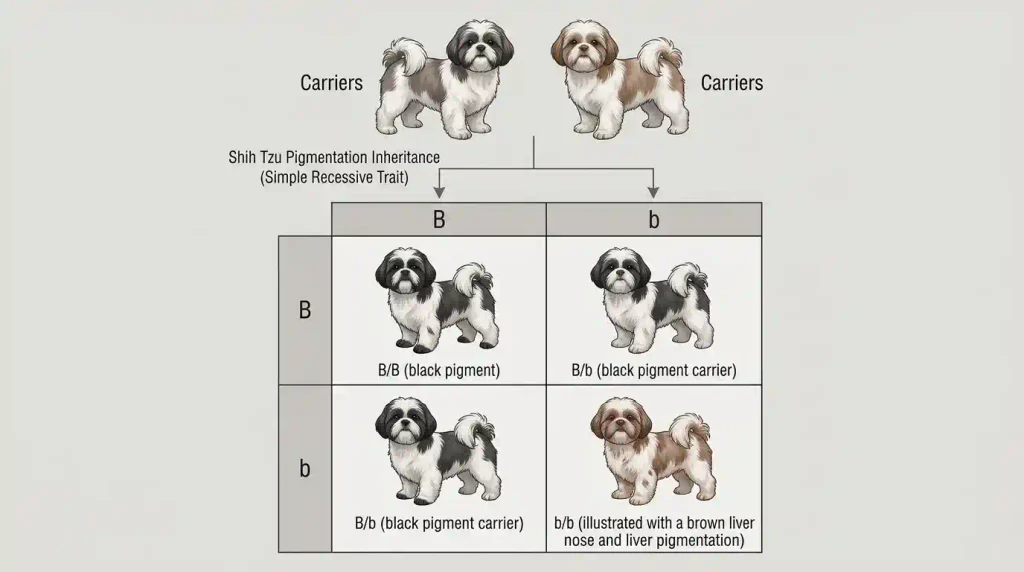
Liver pigmentation is associated with the B locus, involving the TYRP1 gene.
In simplified notation, B represents full color and b a recessive brown allele. Brown is inherited as a recessive trait, so a dog generally needs brown-associated variants from both parents for brown eumelanin to be expressed. This is often simplified as a b/b or bb genotype.
A dog with one brown allele can carry the trait without visibly expressing liver pigmentation. When brown is expressed, eumelanin that would normally be black becomes brown in hair and skin, affecting areas such as the nose, lips, eye rims, and paw pads.
Importantly, the brown gene does not directly change red/yellow pigment. That explains how a light cream, red, or gold Shih Tzu can still have a brown liver nose.
A liver line Shih Tzu or Shih Tzu liver line generally refers informally to a breeding line where liver pigmentation occurs; it is not a standardized genetic classification.
Can a Liver Shih Tzu’s Coat Change With Age?
Yes. A dark brown puppy can become lighter as the adult coat develops, while some dogs retain richer color.
Hair length, grooming, sun exposure, and changes in the distribution of lighter and darker hairs can affect appearance. However, changes in visible coat shade should not be confused with a switch from liver to black pigmentation.
A liver-pigmented dog may become much lighter while its brown nose and other liver skin points remain important identifiers. This is why one puppy photograph cannot reliably predict the exact adult coat shade.
Does Liver Coloring Affect Health, Temperament, or Price?
Liver coloring alone does not tell you whether a Shih Tzu will be healthy, unhealthy, calm, energetic, friendly, difficult, intelligent, or otherwise different in temperament.
If you encounter searches for Shih Tzu liver problems, remember that “liver” has two meanings. Liver pigmentation describes color, while liver disease concerns the internal organ. Brown pigmentation does not mean the dog has a liver-organ problem.
Price can vary with breeder reputation, pedigree, location, veterinary care, health testing, and demand. Be cautious when descriptions such as “ultra rare liver,” “exclusive chocolate,” or “rare liver line” are used mainly to justify a large premium.
The AKC has noted that all colors occur in the breed and that no Shih Tzu color is considered rare in the context of the breed’s range of colors.
Health, temperament, breeding practices, documentation, and suitability for your household matter more than coat shade.
How Should You Care for a Liver Shih Tzu’s Coat?
Liver pigmentation does not require special grooming. Coat care depends on hair length, lifestyle, skin condition, and hairstyle rather than whether the dog is liver, black Shih Tzu, white Shih Tzu, or another color.
Shih Tzus have a long double coat when allowed to grow naturally, and that coat can develop tangles and matting without consistent maintenance.
Brush Through the Entire Coat
For long coats, brush and comb often enough to prevent mats, especially behind the ears, under the front legs, on the chest, belly, legs, tail base, and beneath collars or harnesses.
After brushing, use an appropriate comb to check closer to the skin because surface brushing can leave hidden tangles.
Keep the Face and Eyes Clean
Food, saliva, tears, and moisture can accumulate around the muzzle and eyes. Keep facial hair clean and dry, and seek veterinary advice for persistent discharge, redness, swelling, odor, or discomfort rather than treating it only as cosmetic staining.
Bathe and Condition Appropriately
Use dog-formulated shampoo and rinse thoroughly. Long coats may benefit from an appropriate conditioner to make detangling easier. A short pet trim is generally easier to maintain than a full floor-length coat.
Focus on Coat Health, Not Darkening the Color
There is no need to artificially darken a liver coat. Good nutrition, grooming, veterinary care, and healthy skin matter more than maximizing chocolate color.

Liver Shih Tzu Identification Checklist
- Check whether the nose is genuinely brown/liver rather than black.
- Inspect the lips for matching brown pigmentation.
- Look at the eye rims for liver rather than black pigment.
- Check the paw pads for supporting brown pigmentation.
- Treat lighter eye color as a clue, not proof.
- Judge skin points before the coat.
- Then assess whether the coat is chocolate, red, cream, gold, or another shade.
- Use natural daylight because filters and warm lighting can distort color.
- Review registration information.
- Consider DNA testing when precise genotype matters.
A brown-looking coat does not prove liver—but genuine liver skin pigmentation is a much stronger clue.
Frequently Asked Questions
Is liver an accepted Shih Tzu color?
Yes. Liver is listed as an AKC Shih Tzu registration color.
Can a Shih Tzu have liver pigmentation with a light coat?
Yes. Cream, red, gold, and other lighter coats can still occur with liver pigmentation.
Does a brown-looking coat prove a dog is liver?
No. Check the nose, lips, eye rims, and other skin pigmentation.
What color nose does a liver Shih Tzu have?
A liver Shih Tzu has a brown or liver-colored nose rather than a normal black nose.
Can a liver Shih Tzu have white markings?
Yes. Liver pigmentation can occur with white markings, including liver-and-white dogs.
Is a liver Shih Tzu the same as a chocolate Shih Tzu?
The terms are often used together, but “liver” more precisely describes brown-based pigmentation while “chocolate” often describes appearance.
Can a liver Shih Tzu have green eyes?
Some lighter eyes may appear hazel, amber, or greenish in certain lighting, but eye color alone cannot confirm liver pigmentation.
Is a liver Shih Tzu rare?
Color frequency varies among breeding populations, but color alone should not be treated as proof of exceptional rarity or greater value.
Is a liver Shih Tzu unhealthy?
Liver pigmentation alone does not establish that an individual dog is unhealthy.
Does liver pigmentation mean the dog has liver problems?
No. The color term “liver” is unrelated to diseases affecting the dog’s liver organ.
Final Thoughts
A liver Shih Tzu is best identified through brown-based pigmentation on the nose, lips, eye rims, and other skin points rather than coat color alone. A liver dog may be chocolate, red, cream, gold, parti-colored, or combined with white markings, and its visible coat can change as it matures.
Do not rely only on labels such as chocolate, liver line, or rare liver. Examine the dog in natural light, review registration and parent information, and use genetic testing when precise inheritance matters.
For more comparisons, explore the complete Shih Tzu colors guide.