Blonde Shih Tzu: Is the Coat Gold, Cream, or Changing?
A blonde Shih Tzu usually describes a dog with a light gold, pale cream-gold, yellow-gold, or similar warm coat rather than a separate Shih Tzu color with one fixed definition. That is why one person may call a puppy blonde while another breeder describes the same-looking coat as gold, cream, or light tan. The confusion becomes even greater because a gold Shih Tzu puppy can change noticeably as the puppy coat matures: dark tips may disappear, rich gold may fade, and an adult coat can look much lighter than early photos suggest. Coat shade also should not be confused with pigmentation—the nose, lips, and eye rims provide different information from the hair itself. If you are comparing a golden Shih Tzu, a pale cream dog, or puppies advertised as blonde, this guide will help you identify what you are actually seeing, understand normal coat color change, evaluate “rare golden Shih Tzu” claims, and care for the coat without letting color become more important than health and temperament.
Table of Contents
- What does “blonde” mean for a Shih Tzu?
- How can you tell blonde apart from similar Shih Tzu colors?
- Can a blonde Shih Tzu puppy change color as it grows?
- Is “blonde” an official Shih Tzu color?
- Does a blonde Shih Tzu need special coat care?
- What should you ask before choosing a blonde puppy?
- Blonde Shih Tzu FAQs
- Final Thoughts
What Does “Blonde” Mean for a Shih Tzu?
“Blonde” is best treated as a visual description rather than a precise genetic diagnosis. Owners commonly use the term for a Shih Tzu whose hair is pale, warm, and somewhere between cream and gold.
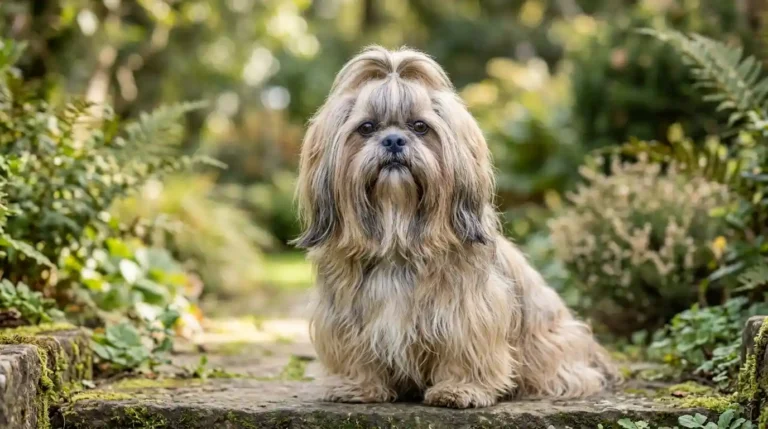
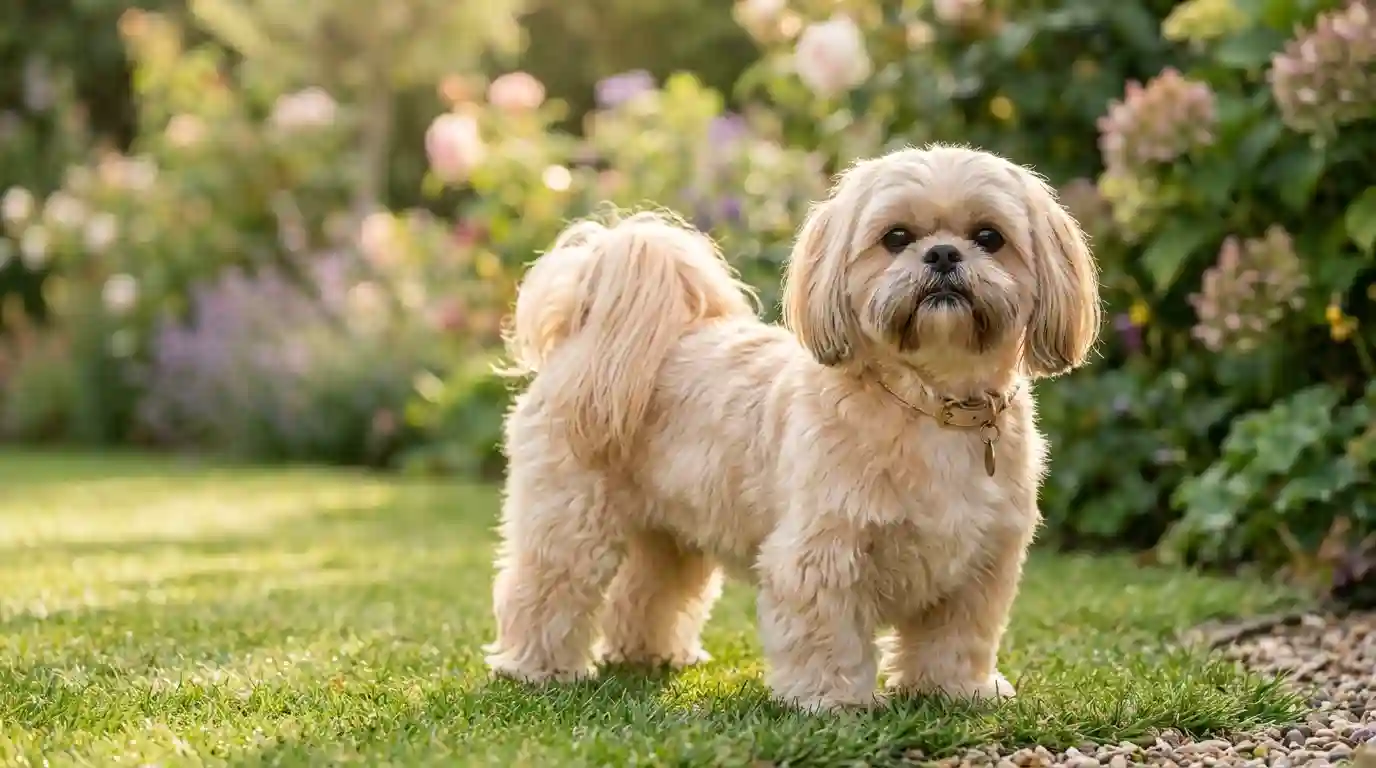
A Shih Tzu blonde coat might appear buttery yellow, champagne-gold, light honey, wheat-colored, or almost cream depending on the dog and the lighting. Some dogs have a nearly solid coat, while others have white markings that produce a two-color coat.
If you are trying to identify a dog from pictures, first become familiar with the broader range of shih tzu colors. Shih Tzus can show substantial variation, so neighboring shades are not always easy to separate from a single photo.
How Blonde Overlaps With Gold, Cream, Yellow, and Tan
In everyday language, the terms blonde coat, gold coat, cream coat, yellow coat, and tan coat may overlap.
That does not mean the words are interchangeable in every context.
A dog described as blonde is often toward the light end of gold. The coat may have enough warm yellow or honey pigment to distinguish it from pure white but not enough reddish depth to look clearly red.
Think of these descriptions as points along a visual spectrum:
Cream → pale blonde → light gold → rich gold → golden-red → red
There are no perfectly sharp visual boundaries between every neighboring shade, especially when descriptions come from owners, online listings, or photographs rather than standardized evaluations.
A richer coat may simply be called a golden Shih Tzu or gold Shih Tzu. Dogs at the darker end of that range can overlap visually with a golden brown shih tzu, while very pale dogs may approach what people casually describe as cream or blonde.
Tan can create similar confusion. A tan shih tzu may visually resemble a pale golden dog, particularly under warm indoor lighting.
The most useful question therefore is not simply, “Is this dog blonde?” Instead ask:
What shade is the hair, what pattern is present, and what pigmentation does the dog have?
Those three observations give you a more useful description.
A Shih Tzu may also be gold with significant white. In that case, comparing the dog with a gold and white shih tzu is more informative than calling the entire coat blonde.
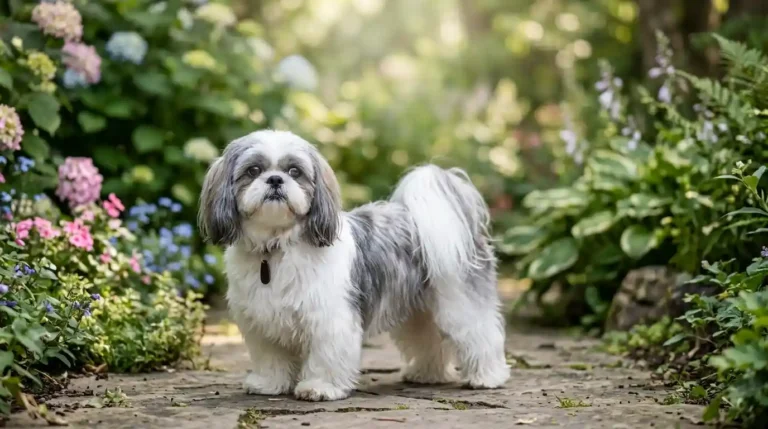
A mostly gold dog with only limited white markings may appear very different from a gold parti Shih Tzu, where white occupies a substantial portion of the visible coat.
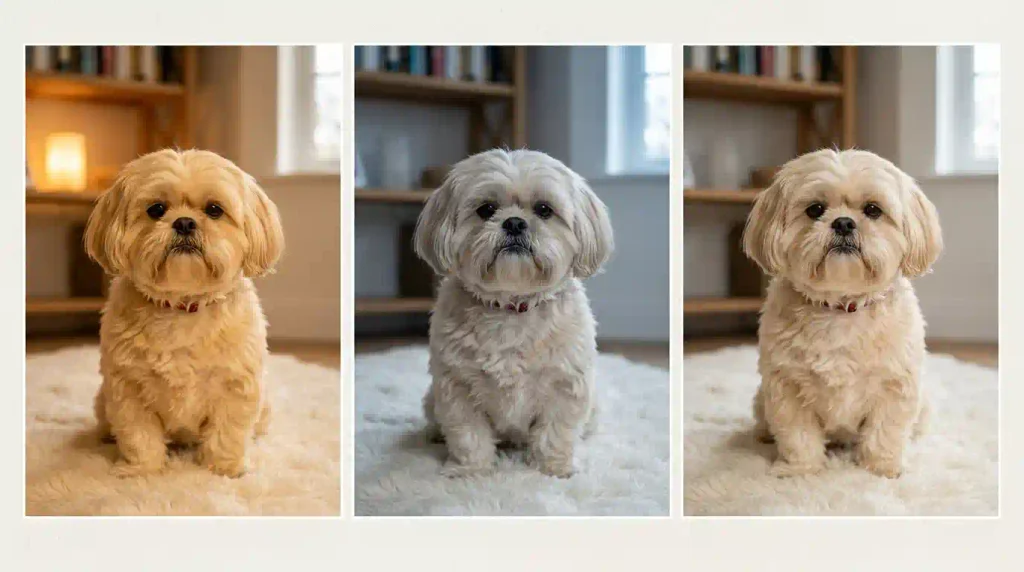
Why Lighting and Photos Can Change How the Coat Looks
Photographs are one of the biggest reasons Shih Tzu colors are misidentified.
Warm indoor bulbs can push a cream coat toward yellow or gold. Cool lighting can remove warmth and make pale gold appear almost grayish or white. Direct sunlight may make individual hairs look considerably lighter.
Phone cameras add another variable. Automatic processing can alter:
- White balance
- Exposure
- Contrast
- Saturation
- Shadows
- Highlights
Social-media filters can change the appearance even further.
For example, a pale Shih Tzu gold coat photographed during sunset may look deeper and redder than it does in person. The same dog beside a bright window may appear nearly cream.
When comparing puppies, ask for photographs taken outdoors in indirect natural daylight. Ideally, compare several pictures instead of relying on a single polished breeder photo.
How Can You Tell Blonde Apart From Similar Shih Tzu Colors?
Identifying a pale Shih Tzu requires looking beyond whether the dog appears “light.”
Consider the intensity of the warm color, whether white is present, whether individual hairs have dark tips, and what color is visible on the nose, lips, and eye rims.
Gold Versus Red or Tan
Gold generally sits between pale cream-like shades and deeper red tones.
A typical gold coat may look honey, wheat, apricot-gold, or yellow-gold. A red shih tzu generally has a richer red, copper, orange-red, or mahogany impression.
The difference becomes difficult when the dog falls near the boundary between deep gold and light red.
Natural daylight is therefore important.
If the coat is consistently warm yellow or honey rather than copper-red, describing it as gold or blonde may make more sense visually.
Tan is another close neighbor. A tan coat may be lighter or more muted and can look beige or sandy. Compare a questionable coat with examples of a tan and white shih tzu when substantial white markings are present.
A solid gold Shih Tzu can also have different depths of gold over different areas of the body. The ears may remain darker than the torso, while the face becomes lighter with age.
That does not automatically mean the dog has become a three-color coat. Color intensity within a coat and genuinely separate coat colors are not the same thing.
Cream or White Versus Pale Gold
At the lightest end, blonde can become difficult to distinguish from cream or white.
A pale gold dog still usually has some warm yellow, biscuit, or honey tone. A white shih tzu lacks that obvious golden warmth in the areas being described as white.
However, white hair itself can acquire temporary staining around:
- Eyes
- Muzzle
- Feet
- Beard
That staining should not be mistaken for the dog’s inherited coat shade.
A nearly white-looking dog should also not automatically be called an albino shih tzu. Albinism concerns pigment production and cannot be identified simply because a Shih Tzu has a very pale coat.
Likewise, an older pale-gold dog can sometimes appear silvery in particular lighting, but that does not necessarily make it a silver shih tzu.
When identification becomes difficult, compare:
Base coat shade + white markings + skin points + historical puppy photos.
That produces a much more reliable picture than the word “blonde” alone.

Coat Color Versus Skin Pigment
One of the most important distinctions in Shih Tzu color identification is the difference between coat color and pigmentation.
A coat may visually look blonde or gold while the dog’s skin points remain strongly pigmented.
Pay attention particularly to:
- Nose pigment
- Eye rims
- Lips
- Paw pads
The official AKC Shih Tzu standard states that the nose, lips, and eye rims are black except on liver-pigmented dogs, where they are liver, and blue-pigmented dogs, where they are blue.
You can review the official AKC Shih Tzu breed standard for the complete wording.
This is why you should not call a pale golden Shih Tzu “liver” simply because some of its coat looks brownish.
A liver shih tzu is identified through liver pigmentation rather than hair color alone. The same principle applies to a liver chocolate shih tzu or liver and white shih tzu.
Likewise, a dog with diluted gray-blue skin pigmentation belongs to a different pigment discussion. Compare that appearance with a blue shih tzu rather than assuming that a cool-looking pale coat establishes blue pigmentation.
A blonde-looking coat can therefore exist alongside different pigment characteristics. The hair shade alone does not answer every color question.
Can a Blonde Shih Tzu Puppy Change Color as It Grows?
Yes. Coat color change is one of the most important things to understand before choosing a light-colored Shih Tzu.
A puppy that looks rich gold at eight or ten weeks may become noticeably paler as the adult coat develops. Conversely, you should not assume every golden puppy will fade to the same extent.
Puppy Coat, Adult Coat, Fading, and Black-Tipped Hairs
The puppy coat differs from the mature adult coat in texture, length, density, and sometimes apparent color.
During growth, a Shih Tzu may experience:
- Coat fading
- Reduced contrast
- Loss of dark hair tips
- Lighter facial hair
- Changing ear color
- Longer adult hair revealing different shades
A gold Shih Tzu puppy may therefore look considerably darker than the same dog at one or two years of age.
Black-tipped hair is especially important.
Some gold puppies carry black or very dark tips that give the coat a shaded appearance. As the hair grows and changes, those tips may become less prominent or disappear from much of the visible adult coat.
A puppy with obvious dark facial shading may resemble a black mask gold shih tzu. The mask and dark tipping should be considered separately from the underlying gold.
Dark-tipped golden hair is also sometimes described informally as sable-like. A sable coat is visually more complex than a simple solid pale gold coat because individual hairs may show darker pigmentation.
Do not confuse this with a brindle shih tzu. A brindle pattern involves a striped or intermingled pattern, and it can change visually as the coat becomes longer.
The key point is that puppy color is a snapshot—not a guarantee of the final adult shade.
What Breeder Photos and Parent Coats Can Suggest
A breeder may be able to provide useful context, particularly if they have mature dogs from related lines.
Ask for:
- Current natural-light photographs
- Earlier photographs of the puppy
- Photos of both parents
- Adult photos of previous related puppies, when available
- Registration color information
- Explanation of visible nose and eye-rim pigmentation
Parents can help you understand possible coat tendencies, but they cannot promise exactly what one puppy will look like as an adult.
For example, two attractive gold adults do not mean every puppy will mature into the exact same shade of gold.
Likewise, the phrase rare golden Shih Tzu does not make a breeder capable of guaranteeing that a puppy will retain an intense golden shade.
Color expectations should remain realistic.
A responsible breeder should be comfortable saying something such as: “This puppy is gold now and may become lighter,” rather than promising an exact adult color from a young puppy photograph.
Is “Blonde” an Official Shih Tzu Color?
“Blonde” is primarily a descriptive term used by owners, prospective buyers, websites, and sometimes breeders.
It is useful because people immediately understand the general visual idea: a light, warm-colored Shih Tzu.
But it should not be treated as a scientifically precise coat classification.
What Breed-Standard Guidance Says About Colors
The official American Kennel Club Shih Tzu breed standard describes the coat as luxurious, double-coated, dense, long, and flowing. More importantly for color identification, its color-and-markings section says that all colors and markings are permissible and considered equally.
The standard therefore does not establish “blonde” as a superior type of Shih Tzu or suggest that a particular coat color should carry greater breed value.
The broader appearance of the dog, structure, temperament, coat quality, and pigmentation remain more meaningful than an attractive marketing label.
This is useful context when reading about different types of shih tzu. Many popular online labels describe appearance, size, or marketing categories rather than separate Shih Tzu breeds.
Similarly, whether a dog is a purebred shih tzu depends on ancestry and registration or pedigree evidence—not whether its coat is blonde, gold, black, silver, or another shade.
For owners learning about the breed more broadly, the shih tzu Breed Information section and these shih tzu facts provide better context than color alone.
How to Evaluate “Rare Color” Claims
Color can be an effective marketing tool.
That makes phrases such as:
- “Ultra-rare blonde”
- “Exclusive golden Shih Tzu”
- “Rare solid gold Shih Tzu”
- “Premium champagne Shih Tzu”
worth evaluating carefully.
A fancy label may describe a beautiful puppy, but it does not by itself establish genetic rarity, better health, superior temperament, or higher breed quality.
When a seller promotes a “rare” color, ask what the claim actually means.
Is the color uncommon within that breeder’s own dogs? Is it a registration term? Is it simply a marketing description? Is the breeder able to explain the pigmentation and likely adult coat honestly?
Be particularly cautious if color is used to distract from more important questions.
A breeder should be willing to discuss health records, parent dogs, living conditions, socialization, veterinary care, and temperament—not merely color and price.
This same approach is useful when encountering other heavily marketed labels such as teacup shih tzu.
A puppy should never be selected primarily because the advertising language makes it sound exclusive.
Does a Blonde Shih Tzu Need Special Coat Care?
A blonde Shih Tzu does not need a fundamentally different grooming routine merely because the coat is pale gold.
Grooming requirements depend far more on coat length, texture, lifestyle, and individual skin condition.
Shih Tzus have a long, dense double coat when allowed to grow naturally. Without regular maintenance, tangles can progress into painful coat matting.
Brushing, Bathing, Trimming, and Preventing Mats
For a long coat, consistency is more important than occasional intensive grooming.
Brush through the coat carefully instead of brushing only the visible top layer. Pay particular attention to areas where movement and friction encourage tangles:
- Behind the ears
- Under the front legs
- Chest
- Neck
- Belly
- Inner legs
- Tail area
A metal comb is useful after brushing because it can reveal small knots that a brush may have passed over.
Use a dog-appropriate shampoo for bathing, rinse thoroughly, and dry the coat carefully. Damp hair left tangled can become more difficult to manage.
A shorter pet or puppy-style trim is often easier for households that do not want the maintenance required by a full flowing coat.
The coat color itself does not change those fundamentals.
A black shih tzu, pale gold dog, grey shih tzu, and white dog all need grooming appropriate to their coat length and condition.
Blonde and cream coats can, however, make certain changes more visually noticeable. Dirt, saliva staining, or discoloration around the face and paws may stand out more clearly than on a very dark coat.
Do not respond by continually using harsh whitening or brightening products. Comfort and skin health matter more than trying to force a pale coat to look unnaturally bright.

When Coat or Skin Changes Deserve Veterinary Advice
Normal coat color change happens gradually.
A puppy slowly becoming lighter is different from sudden hair loss, skin inflammation, or an abrupt change in coat quality.
Pay attention if you notice:
- Bald or thinning areas
- Persistent scratching
- Red skin
- Crusts or sores
- Strong or unusual odor
- Excessive licking
- Sudden texture changes
- Patchy hair loss
These signs should not be dismissed as normal fading.
Likewise, a coat becoming lighter with age does not automatically indicate a health problem. The important distinction is whether only the shade is changing or whether there are accompanying skin and coat abnormalities.
Your veterinarian can evaluate persistent or sudden changes, particularly when itching, inflammation, discomfort, or hair loss is present.
Color should never distract you from examining the skin underneath the coat.
What Should You Ask Before Choosing a Blonde Puppy?
It is understandable to have a color preference. Many people are specifically attracted to a Shih Tzu golden coat because the warm coloring can be striking.
But appearance should be only one part of the decision.
Health Records, Temperament, and Realistic Color Expectations
Before choosing a puppy, ask the breeder about its health history and the health of the parents.
Request available veterinary and health-screening records. Ask how puppies are raised, handled, socialized, and introduced to grooming.
You should also observe temperament.
A well-raised puppy should be evaluated as an individual rather than selected simply because it has the lightest gold coat in the litter.
Important questions include:
- What health screening has been performed on the parents?
- Can I see veterinary records for the puppy?
- Can I meet or see the parent dogs?
- How are the puppies socialized?
- What grooming experiences have they already had?
- What color is the puppy currently registered or described as?
- How much might this coat lighten with maturity?
- Can you show me natural-light photos without filters?
A breeder who deals honestly with color should avoid promising that a puppy will remain exactly the same shade.
If the breeder says a pale gold Shih Tzu puppy will definitely remain rich gold throughout adulthood, ask what that certainty is based on.
Past dogs from the same line may give clues, but adult shade still cannot be guaranteed simply from a puppy photograph.
Temperament also matters far more to everyday life than whether a coat finishes as blonde, cream, or gold.
The Shih Tzu was developed as a companion breed, and understanding the shih tzu origin helps put that priority into perspective.
Choose the puppy whose health, temperament, breeder support, and fit for your household make sense—not merely the one with the most fashionable color description.
Blonde Shih Tzu FAQs
Is blonde the same as gold?
Not exactly; blonde is usually an informal description for a lighter gold or cream-gold Shih Tzu.
Will a blonde puppy stay the same shade?
Not necessarily; many Shih Tzu puppies lighten or change in contrast as the adult coat develops.
Does coat color determine health or temperament?
No; a blonde or golden coat by itself does not reliably determine health or temperament.
Is a blonde Shih Tzu rare?
The word “blonde” does not establish rarity, and the breed standard treats Shih Tzu colors and markings equally.
What color is a blonde Shih Tzu officially?
“Blonde” is usually a descriptive term; many blonde-looking dogs are described more formally as gold or a related light shade.
Can a blonde Shih Tzu turn white?
A gold coat can fade substantially and appear very pale, but that does not necessarily mean the dog’s underlying color classification has changed to white.
Can a golden Shih Tzu have white markings?
Yes; substantial white areas can produce a gold and white shih tzu appearance.
Can a blonde Shih Tzu have a black mask?
Yes; a pale or gold coat can occur with dark facial shading or a black mask.
Is blonde the same as liver?
No; blonde describes hair appearance, while liver refers to brown pigmentation visible especially on the nose, lips, and eye rims.
Can a blonde Shih Tzu have blue pigmentation?
A light coat and skin pigmentation are separate traits; blue pigmentation should be evaluated from pigment characteristics rather than coat brightness alone.
Does black-tipped hair mean the puppy will remain dark?
No; dark tipping can become much less noticeable as the puppy develops its adult coat.
Is a blonde Shih Tzu hypoallergenic?
Coat color does not determine allergen production; read the shih tzu hypoallergenic guide for what the term actually means.
Does a blonde coat require special shampoo?
No special shampoo is required simply because the dog is blonde; use products appropriate for the dog’s skin and coat condition.
Is a solid gold Shih Tzu better than a parti-colored one?
No; coat pattern does not make one Shih Tzu inherently better, healthier, or better-tempered than another.
Final Thoughts
A blonde Shih Tzu is usually a pale gold, cream-gold, or similarly warm-colored dog rather than a completely separate Shih Tzu variety. Because gold, cream, yellow, and tan can overlap visually—and because puppy coats may fade—the safest way to identify the coat is to consider natural-light color, markings, black-tipped hairs, adult development, and the dog’s nose, lip, and eye-rim pigmentation together.
If you are choosing a puppy, enjoy the color but keep realistic expectations. A golden Shih Tzu can become substantially lighter as it matures, and an attractive coat should never outweigh health, temperament, responsible breeding, and suitability for your home.
For a wider comparison before identifying your dog, explore the complete guide to shih tzu colors and then compare the closest individual color guides.