
Shih Tzu Heat Cycle: Signs, Timing and Care
How long is a Shih Tzu in heat? Most female Shih Tzus remain visibly in heat for approximately 2–3 weeks (14–21 days), although individual cycles may be shorter or longer. During this time, you may notice vaginal bleeding, a swollen vulva, increased urination, behavioral changes, and growing attention from male dogs. The heat period includes two reproductive stages called proestrus and estrus, and your Shih Tzu may become pregnant during the fertile stage, even when visible bleeding becomes lighter or disappears.
A Shih Tzu’s first heat commonly occurs around 6–12 months of age, while subsequent cycles often happen approximately twice a year. However, age, hormonal development, and individual reproductive patterns can influence the timing.
Understanding your dog’s heat cycle is important for preventing accidental pregnancy, recognizing unusual symptoms, and providing appropriate care. This guide explains the four heat-cycle stages, day-by-day changes, bleeding duration, fertility, safe home care, spaying, and medical warning signs such as pyometra. You’ll also find practical comparison charts and a heat-cycle tracking checklist to help monitor your Shih Tzu confidently.
Table of Contents
- How Long Is a Shih Tzu in Heat? Quick Overview
- When Do Shih Tzus Start and Stop Going Into Heat?
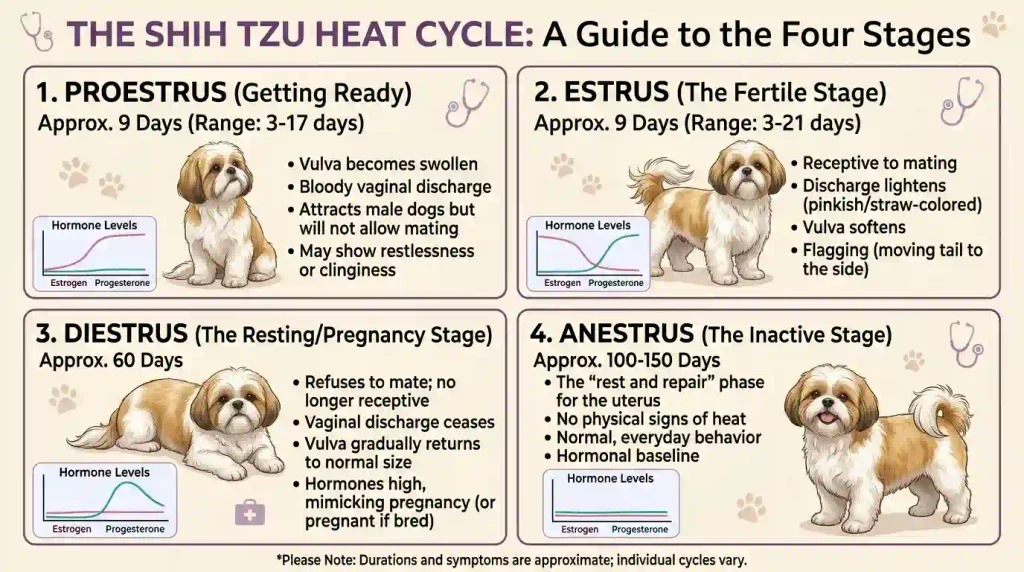
- Understanding the Four Stages of the Shih Tzu Heat Cycle
- Shih Tzu Heat Cycle Timeline: Day-by-Day Guide
- Shih Tzu Heat Cycle Frequency and Timing
- Signs and Symptoms of a Shih Tzu in Heat
- How to Care for a Shih Tzu During Heat
- Shih Tzu Fertility, Ovulation, and Breeding During Heat
- False Pregnancy in Shih Tzus After Heat
- Preventing Pregnancy and Managing Heat Without Breeding
- Health Concerns and Warning Signs During a Shih Tzu’s Heat
- Common Myths About Shih Tzu Heat Cycles
- Frequently Asked Questions About Shih Tzu Heat Cycles
- Final Thoughts on How Long a Shih Tzu Stays in Heat
1. How Long Is a Shih Tzu in Heat? Quick Overview
1.1 How Long Does a Shih Tzu Stay in Heat?
A Shih Tzu typically stays in heat for about 14–21 days. This period usually begins when swelling or bloody vaginal discharge first appears and continues through the sexually receptive stage.
Some dogs finish their visible heat symptoms sooner, while others take longer. The first heat cycle may also be less predictable than later cycles.
Importantly, the visible heat period is different from the complete estrous cycle. After heat ends, your dog enters additional hormonal stages before the next cycle begins.
If you are wondering how long a Shih Tzu stays in heat because you want to prevent pregnancy, do not rely on a fixed 21-day deadline. Fertility varies, and bleeding may stop before the risk of pregnancy has ended.
1.2 What Is the Heat Cycle in Shih Tzu Dogs?
The Shih Tzu heat cycle is the natural reproductive process that prepares an unspayed female dog for a possible pregnancy.
Veterinarians call it the estrous cycle. It is controlled by hormones produced by the brain and ovaries, particularly estrogen, progesterone, and luteinizing hormone.
The cycle has four stages: proestrus, estrus, diestrus, and anestrus.
During proestrus, a female attracts male dogs but usually refuses mating. Estrus is the stage when she becomes sexually receptive and ovulation occurs. Diestrus and anestrus cover the hormonal and resting periods that follow.
Unlike human menstruation, the bleeding associated with a dog’s heat cycle occurs in preparation for potential reproduction, not because the uterus is shedding its lining in the same way as a human menstrual period.
1.3 How Long Does a Shih Tzu Bleed During Heat?
Shih Tzu heat bleeding often begins during proestrus, which averages about nine days.
However, visible bloody or blood-tinged discharge can continue into estrus. Across the noticeable heat period, discharge may be observed for approximately 14–21 days, with considerable variation.
Some Shih Tzus produce only small spots because they frequently clean themselves. Others have more noticeable discharge.
The bleeding often changes from bright red to pink or watery fluid and may become straw-colored as estrus develops.
Bleeding duration does not reliably indicate fertility. A Shih Tzu may still be capable of becoming pregnant after the discharge becomes lighter.
1.4 How Often Do Female Shih Tzus Go Into Heat?
Most unspayed Shih Tzus experience approximately two heat cycles annually, commonly separated by five to eleven months.
Six-month intervals are familiar in small-breed dogs, but a consistent schedule is not guaranteed.
Young females may take several cycles to establish a recognizable pattern, while older dogs sometimes have longer intervals.
Maintaining a calendar of previous heat dates can help owners recognize unusual changes.
1.5 How Can You Tell When a Shih Tzu Is in Heat?
Common early signs include swelling around the vulva, bloody vaginal discharge, increased licking of the genital area, and frequent urination.
You may also notice your Shih Tzu becoming unusually affectionate, restless, distracted, or interested in other dogs.
Some females become more vocal or irritable. Others continue behaving almost normally.
Physical symptoms vary, so an individual dog may not show every typical sign.
For comprehensive preventive guidance, explore our shih tzu health and wellness resources. You may also encounter the incorrect spelling Shit Zhu when researching the breed online; Shih Tzu is the correct spelling.
1.6 Shih Tzu Heat Cycle at a Glance
Heat Duration, Frequency, Stages, and Fertility
| Feature | Typical information |
| Visible heat duration | Approximately 14–21 days |
| First heat | Often around 6–12 months |
| Heat frequency | Commonly about twice yearly |
| Proestrus | Approximately 9 days on average |
| Estrus | Approximately 9 days on average |
| Diestrus | Approximately 2–3 months |
| Anestrus | Several months |
| Main physical signs | Vulvar swelling and vaginal discharge |
| Fertile period | During estrus, varying by individual |
| Pregnancy possible during first heat? | Yes |
| Permanent prevention of heat | Spaying that removes the ovaries |
These are general canine reproductive averages, not precise predictions for an individual Shih Tzu.
Quick Comparison of Normal Heat Cycle Changes
| Early heat | Fertile stage | After visible heat |
| Vulva becomes swollen | Vulva may soften | Swelling gradually resolves |
| Bloody discharge appears | Discharge may lighten | Discharge usually stops |
| Male dogs show interest | Female may accept mating | Female rejects mating |
| Estrogen rises | Progesterone rises | Progesterone remains elevated during diestrus |
| Pregnancy is not usually possible early in proestrus | Pregnancy is possible | Fertility normally ends with estrus |
2. When Do Shih Tzus Start and Stop Going Into Heat?
2.1 When Does a Female Shih Tzu Have Her First Heat?
A female Shih Tzu commonly reaches her first heat between approximately 6 and 12 months of age.
Because Shih Tzus are a toy breed, they often become reproductively mature earlier than large or giant breeds.
Some experience puberty slightly earlier, while others develop later. Individual variation means that an exact first-heat age cannot be guaranteed.
If your female Shih Tzu has not shown signs of heat by around 18–24 months, consult your veterinarian to discuss whether reproductive evaluation is appropriate.
2.2 What to Expect During a Shih Tzu’s First Heat Cycle
A Shih Tzu’s first heat can bring unfamiliar physical and behavioral changes.
The vulva may gradually enlarge, followed by spots of blood on bedding or furniture. Your puppy might lick herself frequently, become more attached to you, or display unusual restlessness.
Some first cycles are subtle or irregular.
During this period, avoid unsupervised contact with male dogs. A puppy can become pregnant during her first heat even though she has not reached full physical maturity.
Breeding during the first heat is generally discouraged because pregnancy places demands on a still-developing dog.
2.3 How Long Does a Shih Tzu’s First Heat Last?
The first heat often lasts around two to three weeks, similar to later cycles.
However, juvenile hormonal development can create shorter, less noticeable, or interrupted cycles.
A first heat may sometimes be followed by another apparent heat relatively soon, a pattern known as split heat.
If bleeding persists, symptoms repeatedly return, or your puppy seems unwell, veterinary evaluation is important.
2.4 At What Age Do Shih Tzus Stop Going Into Heat?
Female Shih Tzus do not normally stop going into heat at a specific age.
An intact female may continue cycling into her senior years.
Heat intervals can become longer or less predictable with age, and reproductive efficiency may decline.
However, older age does not eliminate the possibility of pregnancy.
2.5 Do Female Shih Tzus Experience Menopause?
No. Dogs do not experience menopause in the same way humans do.
An older Shih Tzu may have less frequent or less obvious cycles, but her ovaries can remain hormonally active.
This also means that an elderly unspayed female remains vulnerable to reproductive conditions, including pyometra.
A prolonged absence of expected cycles should be discussed with a veterinarian rather than automatically attributed to menopause.
2.6 How Heat Cycles Change as a Shih Tzu Ages
During adolescence, heat cycles can be irregular while reproductive hormones become established.
Many healthy adults develop relatively consistent intervals.
In later life, cycles may become less predictable, and reproductive health risks can increase.
Conditions affecting overall hormone regulation may also influence reproductive patterns. For example, dogs with endocrine disorders such as Shih Tzu Cushing’s Disease may require broader hormonal assessment when unexplained symptoms occur.
3. Understanding the Four Stages of the Shih Tzu Heat Cycle
A Shih Tzu’s reproductive cycle contains four biologically distinct stages.
Only proestrus and estrus are generally considered the visible heat period. Diestrus and anestrus explain what happens after the dog stops accepting mating.
3.1 Proestrus: The Beginning of the Heat Cycle
Proestrus starts when the female reproductive system begins preparing for ovulation.
Estrogen concentrations rise as ovarian follicles develop.
A Shih Tzu may attract male dogs but usually resists mating during this stage.
How Long Does Proestrus Last?
Proestrus lasts approximately nine days on average but may range from only a few days to around three weeks.
This variation explains why a simple day-counting method is unreliable for predicting fertility.
Physical and Behavioral Changes During Proestrus
Typical changes include a swollen vulva, increased urination, genital licking, restlessness, and attraction from males.
Some dogs become more affectionate. Others appear irritable or distracted.
The female often moves away, sits down, or otherwise refuses attempted mating.
Vaginal Bleeding and Vulvar Swelling
Estrogen stimulates reproductive tissues, contributing to vulvar enlargement and blood-tinged discharge.
Bleeding may begin as small spots and become more noticeable.
The amount varies widely, and frequent grooming can make discharge difficult to detect.
3.2 Estrus: The Fertile and Receptive Stage
Estrus is the stage during which a female dog typically accepts mating.
Estrogen decreases while progesterone begins rising. An increase in luteinizing hormone helps trigger ovulation.
How Long Does Estrus Last?
Estrus averages approximately nine days, although a healthy dog’s receptive period may be considerably shorter or longer.
This stage does not necessarily begin on day eight or day nine of visible heat.
Its timing depends on the individual dog’s hormonal cycle.
Ovulation and Fertility During Estrus
Ovulation occurs after the luteinizing hormone surge.
Unlike humans, dogs release immature eggs that require additional time to become capable of fertilization.
Because sperm may survive within the reproductive tract for several days, successful conception depends on the relationship between mating, ovulation, and egg maturation.
Breeding based only on the number of days since bleeding began can produce inaccurate timing.
Signs That a Shih Tzu Is Ready to Mate
A sexually receptive female may stand still when approached by a male and move her tail sideways.
This tail movement is called flagging.
The vulva may become softer, and the discharge may lighten.
However, behavioral receptivity is not a sufficiently precise method of confirming ovulation.
3.3 Diestrus: The Post-Estrus Stage
Diestrus begins when the female stops accepting mating.
Hormonal activity continues even if pregnancy has not occurred.
How Long Does Diestrus Last?
In a nonpregnant dog, diestrus typically lasts approximately two to three months.
During this period, progesterone concentrations remain elevated before gradually falling.
Hormonal Changes After Estrus
The ovaries produce progesterone during diestrus regardless of whether fertilization occurred.
This hormone supports uterine conditions associated with pregnancy.
In nonpregnant females, hormonal changes may sometimes trigger pseudopregnancy, commonly called false pregnancy.
What Happens if a Shih Tzu Becomes Pregnant?
Following successful fertilization, embryos develop within the uterus.
The Shih Tzu gestation period is approximately 63 days from ovulation, although the interval measured from mating can vary considerably.
Pregnancy should be monitored by a veterinarian, particularly because Shih Tzus are small, brachycephalic dogs and may face additional reproductive or delivery challenges.
3.4 Anestrus: The Resting Stage
Anestrus is the relatively inactive stage between reproductive cycles.
The ovaries produce low levels of reproductive hormones, and the uterus undergoes recovery and repair.
How Long Does Anestrus Last?
Anestrus commonly lasts several months, although the duration varies substantially.
This stage contributes to the interval between one heat cycle and the next.
What Happens Between Heat Cycles?
The reproductive tract returns toward its resting condition.
Normal vulvar swelling and discharge are absent, and the female generally does not attract males for mating.
The uterus undergoes involution and tissue repair in preparation for future reproductive activity.
3.5 Shih Tzu Heat Cycle Stages and Duration Comparison Chart
| Stage | Average duration | Main hormone pattern | Typical signs | Fertility |
| Proestrus | About 9 days | Rising estrogen | Bloody discharge, vulvar swelling | Usually not yet receptive |
| Estrus | About 9 days | Rising progesterone | Receptive behavior, changing discharge | Fertile period occurs |
| Diestrus | About 2–3 months | Elevated then declining progesterone | Receptivity ends | Not normally fertile |
| Anestrus | Several months | Low reproductive activity | No normal heat signs | Not fertile |
4. Shih Tzu Heat Cycle Timeline: Day-by-Day Guide
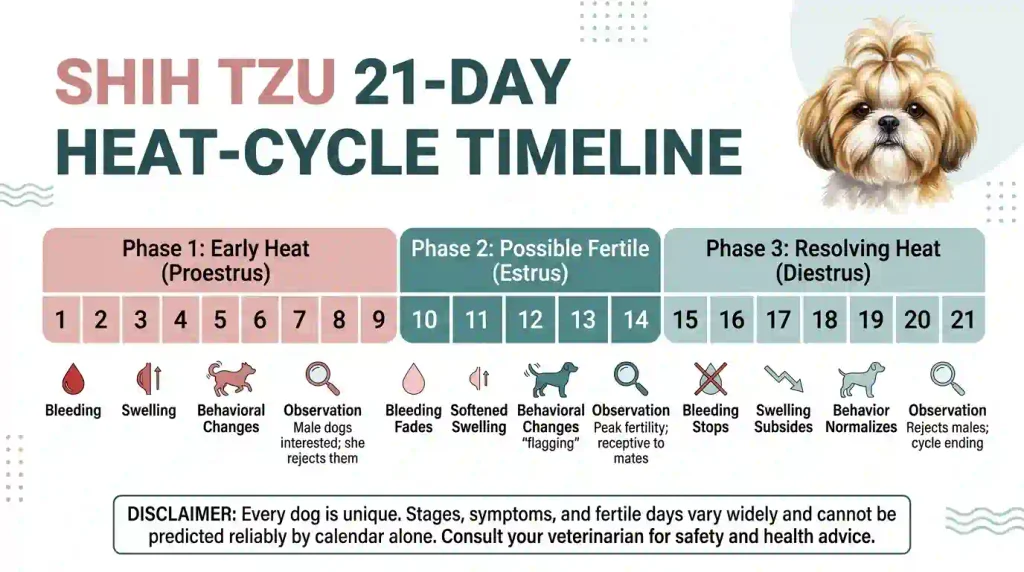
A day-by-day timeline can help you understand common changes, but it must not be treated as a fertility calculator.
The following timeline illustrates a typical heat period rather than predicting exactly when your Shih Tzu will ovulate.
4.1 Days 1–7: Early Heat Signs and Bleeding
During the first several days, you may notice swelling around the vulva and red or pink vaginal discharge.
Some females lick themselves repeatedly or urinate more frequently.
Male dogs may become interested even though the female is not yet receptive.
Keep your Shih Tzu separated from unneutered males beginning with the first signs of heat.
4.2 Days 8–14: Possible Fertile Period and Behavioral Changes
For some dogs, the second week overlaps with estrus and the fertile period.
The discharge may become lighter or watery.
Your Shih Tzu might stand for mating, move her tail sideways, or show stronger interest in male dogs.
However, some dogs will still be in proestrus during these days, while others may have entered estrus earlier.
Never assume that ovulation occurs on day ten, eleven, or fourteen for every Shih Tzu.
4.3 Days 15–21: Signs That Heat May Be Ending
In a typical cycle, discharge and vulvar swelling gradually decrease as the visible heat period ends.
Your Shih Tzu may become less interested in males and return to her usual behavior.
Some dogs complete estrus earlier, while others remain receptive beyond this period.
Continue pregnancy-prevention precautions until the heat has clearly ended and any uncertainty has been resolved.
4.4 What if Your Shih Tzu’s Heat Lasts Longer Than 21 Days?
A heat period longer than three weeks is not automatically abnormal.
Proestrus and estrus have individually variable durations, so some healthy dogs show signs for more than 21 days.
Nevertheless, prolonged bleeding, continuing sexual receptivity, or repeated changes in discharge deserve veterinary attention.
If your Shih Tzu seems unwell, develops foul-smelling discharge, or experiences heavy bleeding, seek care promptly rather than waiting for a particular number of days.
4.5 Day-by-Day Heat Cycle Timeline Chart
Typical Changes in Bleeding, Behavior, and Fertility
| Approximate days | Possible signs | Owner precautions |
| 1–3 | Vulvar swelling, first blood spotting | Record start date and begin separation |
| 4–7 | Discharge, licking, increased male interest | Maintain hygiene and supervised activity |
| 8–10 | Discharge may lighten; behavior may change | Continue strict pregnancy prevention |
| 11–14 | Estrus may be occurring | Do not assume fertility from dates alone |
| 15–17 | Some dogs become less receptive | Continue monitoring and separation |
| 18–21 | Signs may gradually resolve | Check that the visible heat has ended |
| Beyond 21 | Some cycles continue | Seek advice if prolonged or concerning |
Why Individual Heat Cycle Timelines Vary
Variation occurs because hormonal changes do not follow a fixed calendar.
Proestrus can last longer in one Shih Tzu than another, and the start of estrus is not always obvious.
Age, reproductive development, and individual physiology can also affect the pattern.
5. Shih Tzu Heat Cycle Frequency and Timing
5.1 How Many Times a Year Does a Shih Tzu Go Into Heat?
Most female Shih Tzus go into heat approximately twice a year.
Some have shorter intervals, while others cycle less frequently.
The interval is more meaningful than the number of heats in one calendar year because cycles do not necessarily align with January through December.
5.2 How Long Is the Interval Between Heat Cycles?
A common interval is roughly six months, although five to eleven months can occur in healthy dogs.
Veterinarians evaluate the pattern over time rather than relying on a single missed date.
A noticeable change from an established schedule may deserve investigation, particularly in an adult dog.
5.3 What Factors Influence the Timing and Duration of Heat?
Age and Reproductive Maturity
Young Shih Tzus may experience irregular cycles before their reproductive system settles into a more predictable pattern.
Older females can also develop changes in cycle frequency.
Breed Size and Individual Variation
Small breeds frequently mature earlier than large breeds, but individual dogs still vary considerably.
Even two Shih Tzus from the same family may have different reproductive schedules.
Health and Hormonal Factors
Hormonal disorders, significant illness, certain medications, and ovarian abnormalities can affect reproductive function.
Stress and changes in health may also influence the way a heat cycle appears.
Normal seasonal changes are not usually the main driver of cycling in Shih Tzus, unlike certain breeds that show more seasonal reproductive patterns.
5.4 Is It Normal for Shih Tzus to Have Irregular Heat Cycles?
Some irregularity is common during the first one or two years of reproductive maturity.
However, unusually frequent cycles, prolonged bleeding, or a major change in an established pattern can indicate an underlying condition.
A veterinarian may recommend physical examination, hormone testing, or ultrasound when warranted.
5.5 Unusual Shih Tzu Heat Cycle Patterns
What Is a Silent Heat in Shih Tzus?
Silent heat occurs when a female experiences reproductive hormonal activity with few noticeable external signs.
She may have minimal bleeding, subtle swelling, or changes that are easily missed.
Despite the absence of obvious discharge, pregnancy may still be possible.
What Is a Split Heat Cycle?
A split heat occurs when a young female begins showing signs of heat, then the signs stop before a normal cycle is completed.
A second episode may occur weeks later.
This can happen during reproductive maturation, but repeated or unusual episodes warrant veterinary assessment.
Can a Shih Tzu Ovulate Without Obvious Heat Signs?
Yes. A female with silent heat may ovulate despite having very subtle external symptoms.
This is one reason that owners should not assume the absence of visible bleeding guarantees infertility.
When Irregular Heat Requires Hormonal Testing
Hormone testing may be useful when a Shih Tzu has unusually prolonged heat, uncertain ovulation, repeated split heats, or problems conceiving.
Veterinarians may assess progesterone, perform vaginal cytology, or investigate underlying ovarian abnormalities.
5.6 Why Is My Shih Tzu Still in Heat After Three Weeks?
Normal Variation vs. Abnormally Prolonged Heat
A heat period extending beyond three weeks can still fall within normal variation, especially when stages are longer than average.
However, repeated or persistent symptoms should not be ignored.
The veterinarian may need to determine whether your dog is still in a normal stage of the cycle or experiencing a reproductive disorder.
What if a Shih Tzu Is Still Bleeding After Four Weeks?
Bleeding for four weeks warrants veterinary examination, particularly if it is continuous, heavy, or accompanied by illness.
The veterinarian may investigate reproductive tract abnormalities, urinary problems, hormonal disorders, or other causes.
Persistent Estrus and Possible Hormonal Disorders
Persistent estrus refers to abnormally prolonged signs of the receptive reproductive stage.
Veterinary definitions commonly involve signs continuing for six weeks or longer, but owners should not delay evaluation until that threshold is reached.
Ovarian Cysts and Other Reproductive Conditions
Functional ovarian follicular cysts can sometimes produce prolonged estrogen activity.
Other possible causes include ovarian tumors, hormone exposure, or reproductive tract disorders.
Ultrasound and specialized hormonal testing may help identify the cause.
6. Signs and Symptoms of a Shih Tzu in Heat
6.1 Physical Signs of Heat
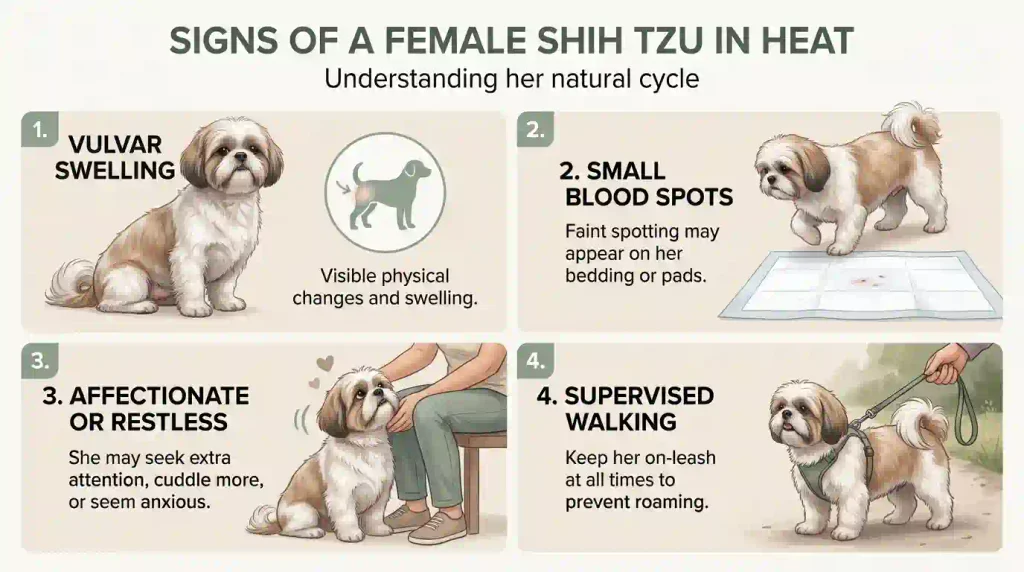
Swollen Vulva
Vulvar swelling is one of the most recognizable early changes.
The external genital area may appear larger or firmer than usual.
Swelling generally decreases as the cycle progresses and ends.
Bloody Vaginal Discharge
A Shih Tzu may produce red, pink, watery, or blood-tinged discharge.
Some owners first notice spots on bedding or flooring.
A dog that licks herself frequently may leave little visible evidence.
Increased Urination and Scent Marking
Hormonal changes can increase urination and urine marking.
Females may leave scent signals that attract male dogs.
However, frequent urination accompanied by straining, discomfort, or blood specifically in the urine may indicate a urinary problem rather than normal heat.
Changes in Appetite and Energy
Some Shih Tzus temporarily eat less or appear more tired during heat.
Others maintain their normal appetite and energy.
Marked lethargy, prolonged refusal of food, or significant weight loss is not something to dismiss as a routine menstrual symptom.
6.2 Shih Tzu Heat Bleeding: What’s Normal?
How Much Blood Is Normal During Heat?
Discharge volume differs substantially between dogs.
A Shih Tzu may produce only a few spots or a more noticeable amount.
Normal discharge should not produce severe weakness, pale gums, or other signs of substantial blood loss.
Bright Red, Pink, and Straw-Colored Discharge
Early discharge is often red or blood-tinged.
It may become pink, thinner, or straw-colored as estrus approaches.
Not every dog follows the same color sequence.
Why Bleeding May Become Lighter During Estrus
As hormonal conditions change, the amount of blood in vaginal discharge may decrease.
The female may simultaneously become more receptive to mating.
Therefore, lighter discharge can coincide with the fertile period rather than indicate that pregnancy risk has ended.
Can Bleeding Stop and Start Again?
Minor fluctuations in discharge can occur during heat.
However, repeated bleeding episodes separated by several weeks, unexpectedly heavy bleeding, or persistent discharge require veterinary attention.
When Bleeding Needs Veterinary Evaluation
Contact a veterinarian if bleeding is unusually heavy, persists far beyond the expected period, or accompanies pain, weakness, foul odor, or a swollen abdomen.
Also seek assessment if you are unsure whether the blood originates from the urinary tract.
6.3 Behavioral Changes During Heat
Increased Affection and Clinginess
Some females seek extra attention, follow their owners more closely, or become unusually affectionate.
These changes may be related to reproductive hormones and temporary changes in comfort.
Restlessness and Irritability
A Shih Tzu may pace, whine, sleep differently, or become less tolerant of handling.
However, discomfort from unrelated problems should not be overlooked.
For example, scooting and irritation around the rear can be associated with Shih Tzu anal glands, while scratching and skin irritation may involve shih tzu allergies.
Attraction to Male Dogs
Male dogs may show strong interest in an unspayed female before she becomes receptive.
This attraction is associated with chemical scent signals and pheromones.
Owners should expect determined attempts to reach a female in heat, even across fences or barriers.
Tail Positioning and Mating Behavior
During estrus, some females hold their tail to the side and stand still when approached.
This is called tail flagging.
Although it suggests sexual receptivity, it cannot identify the precise day of ovulation.
6.4 How to Recognize the Different Stages of Heat From Symptoms
Proestrus often involves noticeable swelling and bloody discharge without acceptance of mating.
Estrus may bring lighter discharge and receptive behavior.
Diestrus begins when receptivity ends, and visible signs generally resolve.
Anestrus involves little reproductive activity.
Because signs overlap, veterinary testing is more accurate than observation alone when precise stage identification is important.
6.5 How Do You Know When Your Shih Tzu’s Heat Is Over?
Heat is generally ending when vulvar swelling decreases, discharge resolves, and the female stops showing receptive behavior toward males.
However, the disappearance of bleeding alone does not prove that the fertile period has ended.
When pregnancy prevention is essential, maintain separation through the entire heat period and consult your veterinarian if timing remains uncertain.
7. How to Care for a Shih Tzu During Heat
7.1 Preparing for Your Shih Tzu’s First Heat Cycle
Before your Shih Tzu reaches reproductive maturity, prepare a comfortable resting area and a plan for preventing contact with male dogs.
Useful supplies include washable bedding, absorbent pads, correctly fitted dog diapers, and gentle cleaning materials.
Know how to contact your veterinarian if concerning symptoms appear.
7.2 Indoor Care and Hygiene During Heat
Managing Vaginal Discharge and Bleeding
Keep the genital area reasonably clean without excessive washing.
Your Shih Tzu will often groom herself naturally.
If needed, use a soft damp cloth to remove discharge from surrounding fur.
Avoid using strongly scented products, human intimate washes, or harsh disinfectants on sensitive tissues.
Keeping Bedding and Living Areas Clean
Wash bedding regularly and place absorbent covers over favorite resting areas.
A waterproof liner beneath a washable blanket can protect furniture.
Clean any soiled surfaces promptly to maintain a comfortable environment.
Using Dog Diapers and Protective Products
Disposable or washable dog diapers can reduce household mess.
Choose a size that fits securely without rubbing the skin.
Change diapers frequently, inspect the surrounding skin, and allow appropriate breaks for cleaning and airflow.
Dog diapers do not prevent mating or pregnancy.
7.3 Outdoor Safety During Heat
Can You Walk a Shih Tzu While She Is in Heat?
Yes, provided she feels well and walks can be completed safely.
Use a secure leash and avoid places where unneutered male dogs may approach.
Short walks in quiet locations are usually preferable to busy dog parks.
Preventing Contact With Unneutered Male Dogs
Keep your Shih Tzu indoors or under direct supervision.
Use secure doors, gates, and fencing, but do not rely on a fence as the only barrier.
Male dogs can become highly motivated to reach a receptive female.
Safe Exercise and Supervised Outdoor Activities
Gentle activity can help maintain a normal routine.
Avoid strenuous exercise if your dog appears uncomfortable or tired.
Because of the breed’s brachycephalic anatomy, owners should also consider shih-tzu breathing problems when exercising in hot or humid weather.
7.4 How to Keep Your Shih Tzu Comfortable During Heat
Providing a Quiet Resting Area
Give your Shih Tzu a clean, quiet place where she can rest without disturbance.
Provide soft bedding away from excessive noise or activity.
Managing Behavioral Changes
Be patient if your dog becomes clingy, restless, or less interested in normal activities.
Offer gentle interaction, familiar toys, and calm indoor enrichment.
Avoid punishing behavior changes associated with discomfort or hormonal activity.
Maintaining Food and Water Intake
Continue feeding a balanced diet and make fresh water freely available.
Mild changes in appetite may occur, but persistent refusal to eat or drink requires veterinary attention.
Avoid changing the diet unnecessarily during a temporary heat cycle.
7.5 Daily Heat Cycle Care Routine for Shih Tzu Owners
A simple routine makes monitoring easier.
In the morning, check your dog’s appetite, behavior, discharge, and overall comfort. Replace bedding or diapers as necessary.
During the day, provide supervised exercise and maintain separation from male dogs.
In the evening, note any changes in bleeding, swelling, or energy.
Persistent discomfort, weakness, vomiting, or worsening symptoms should prompt veterinary advice.
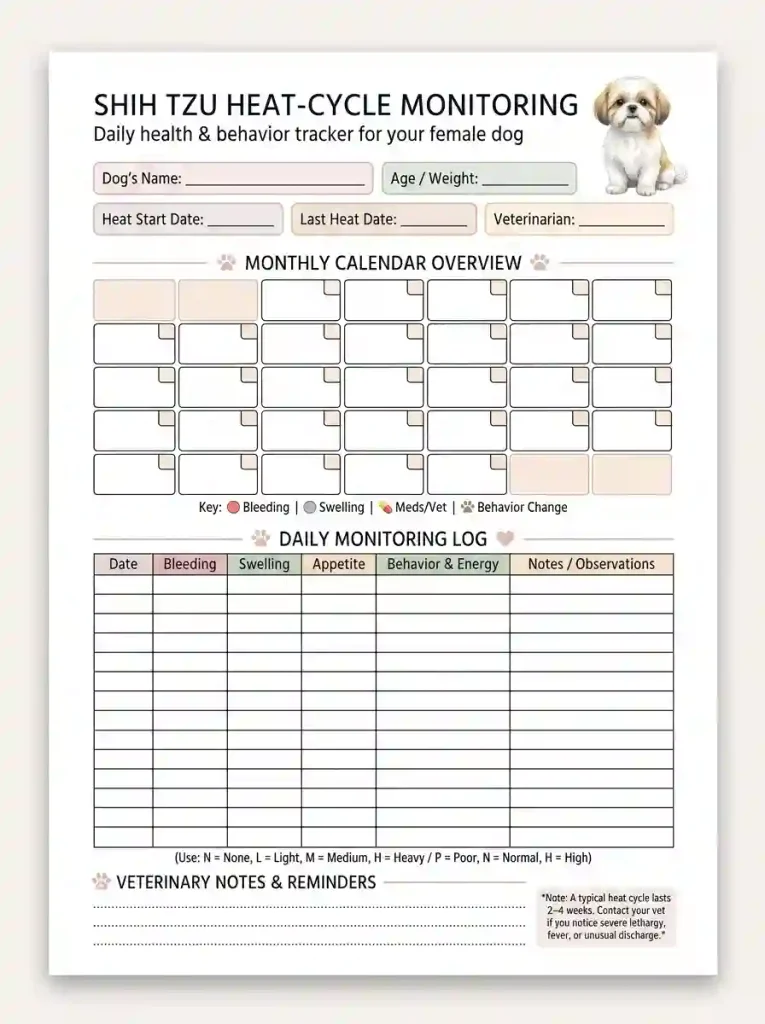
7.6 Shih Tzu Heat Cycle Calendar and Tracking Checklist
How to Record the First Day of Heat
Record the first day you notice bloody discharge or clear heat-related changes.
If you are unsure of the true start date, mark it as an estimate.
This information can help your veterinarian evaluate cycle intervals.
Daily Bleeding and Behavioral Observation Log
Maintain a record of discharge color, amount, appetite, energy, and interest from male dogs.
You can also note unusual symptoms such as frequent urination, discomfort, or persistent restlessness.
Tracking Heat Duration and Cycle Intervals
Compare the beginning of each heat cycle with previous dates.
This can reveal whether your Shih Tzu has a reasonably consistent pattern or experiences unusual intervals.
Estimating the Next Heat Cycle
A Shih Tzu with regular cycles may return to heat approximately six months after the previous onset.
However, this is only an estimate.
Do not rely on a heat calendar to determine safe periods for unsupervised access to intact males.
Printable Shih Tzu Heat Cycle Tracking Chart
| Date | Cycle day | Discharge | Vulvar swelling | Behavior | Appetite | Notes |
| Example: Day 1 | 1 | Light red spotting | Mild | Restless | Normal | First observed signs |
| Day 2 | 2 | Record findings | Record findings | Record findings | Record findings | Additional observations |
| Day 3 | 3 | Record findings | Record findings | Record findings | Record findings | Additional observations |
| Continue daily | — | — | — | — | — | Contact vet for concerns |
8. Shih Tzu Fertility, Ovulation, and Breeding During Heat
8.1 When Is a Shih Tzu Most Fertile During Heat?
A female Shih Tzu is fertile during a portion of estrus, when ovulation occurs and released eggs mature.
The exact fertile window varies.
Some dogs ovulate earlier or later than expected based on visible bleeding.
For accurate reproductive planning, a veterinarian may recommend progesterone testing rather than using an assumed calendar day.
8.2 Can a Shih Tzu Get Pregnant During Her First Heat?
Yes. A Shih Tzu can become pregnant during her first heat cycle if ovulation occurs and she mates successfully.
However, pregnancy during the first heat is generally discouraged because the female may not have completed physical and reproductive development.
Small breed size also makes careful reproductive planning important.
8.3 When Is the Best Time to Breed a Shih Tzu?
Responsible breeding should take place only after the female reaches appropriate physical maturity and completes recommended health screening.
The ideal breeding time within a particular cycle depends on ovulation rather than a fixed number of days after bleeding begins.
Before breeding, discuss reproductive health, inherited conditions, pregnancy risks, and delivery planning with a veterinarian.
Owners can also review How many puppies can a Shih Tzu have to understand typical litter-size considerations.
8.4 How Veterinarians Determine the Optimal Breeding Time
Vaginal Cytology
Vaginal cytology involves collecting cells from the vaginal lining and examining them under a microscope.
The proportion and appearance of epithelial cells change as estrogen levels rise and fall.
These changes help indicate the reproductive stage.
However, cytology alone cannot pinpoint ovulation as accurately as appropriate serial hormone testing.
Progesterone Testing
Progesterone levels begin rising around the transition from proestrus to estrus.
A veterinarian may use serial blood samples to estimate ovulation timing.
Results must be interpreted using the laboratory method, the pattern of change, and the dog’s reproductive history.
8.5 Can Vaginal Discharge Predict Fertility?
Changes in Discharge During Proestrus
Early discharge is often red or blood-tinged.
Its appearance can help owners recognize that heat may have begun.
Why Discharge May Become Lighter During Estrus
As estrogen decreases and progesterone rises, discharge may become thinner, lighter, or straw-colored.
Some females continue to have visible blood during estrus.
Can a Shih Tzu Ovulate While Still Bleeding?
Yes. Ovulation can occur while vaginal discharge remains blood-tinged.
Bleeding does not mean a dog is infertile.
Why Discharge Color Cannot Confirm Ovulation
Discharge color is influenced by individual physiological changes and does not identify a precise ovulation date.
Veterinary testing provides more reliable information for breeding decisions.
8.6 How to Improve the Chances of Successful Mating
Successful breeding begins with appropriate health screening, mature breeding animals, and professionally guided ovulation timing.
The female should be comfortable, healthy, and receptive.
Forced mating is unsafe and should never be attempted.
A veterinarian experienced in canine reproduction, sometimes called a veterinary theriogenologist, can help manage breeding decisions and identify potential problems.
8.7 Understanding the Mating Tie in Dogs
A mating tie occurs when the male and female remain temporarily connected after penetration because of normal anatomical changes.
The dogs may remain joined for several minutes or longer.
Do not pull them apart, as forced separation can cause injury.
Keep the environment calm and seek veterinary advice if there is distress or injury.
8.8 What to Do if Your Shih Tzu Accidentally Mates
Contact your veterinarian promptly if an unwanted mating occurs.
Provide the approximate date of heat onset, mating time, and any known reproductive history.
Do not administer human emergency contraception or unprescribed hormonal medication.
Veterinary options depend on the timing, the dog’s health, and available treatments.
8.9 What Happens After Successful Mating?
If fertilization occurs, pregnancy develops within the uterus over approximately nine weeks.
A veterinarian may use ultrasound or other appropriate tests to confirm pregnancy.
The female will require suitable nutrition, monitoring, and a delivery plan.
Because Shih Tzus can experience difficult labor, discuss emergency access to veterinary obstetric care before breeding.
9. False Pregnancy in Shih Tzus After Heat
9.1 What Is Pseudopregnancy?
Pseudopregnancy, also called false pregnancy or phantom pregnancy, occurs when a nonpregnant female develops physical or behavioral changes resembling pregnancy.
It results from normal reproductive hormone fluctuations after estrus.
The condition can occur even if the female never mated.
9.2 When Do False Pregnancy Symptoms Begin?
False pregnancy signs commonly appear about four to nine weeks after heat.
Progesterone decreases while prolactin activity contributes to maternal behavior and mammary changes.
The severity varies between individual dogs and between cycles.
9.3 Nesting, Mothering Toys, and Behavioral Changes
A Shih Tzu experiencing pseudopregnancy may gather toys, arrange bedding, guard objects, or behave as though caring for puppies.
Some become unusually affectionate, while others become anxious, restless, or protective.
These behaviors can be temporary but sometimes require veterinary guidance.
9.4 Swollen Mammary Glands and Milk Production
False pregnancy may cause mammary enlargement, nipple changes, and milk production.
Avoid repeatedly expressing milk because stimulation may encourage continued production.
If glands become hot, painful, red, or produce abnormal discharge, seek veterinary evaluation for possible mastitis.
9.5 False Pregnancy vs. Real Pregnancy
Both conditions can cause mammary enlargement, behavioral changes, and changes in appetite.
A veterinarian may recommend ultrasound or other tests to determine whether pregnancy is present.
Do not assume a Shih Tzu is experiencing false pregnancy if she had possible access to a male during heat.
9.6 When Does False Pregnancy Need Veterinary Treatment?
Mild cases frequently resolve without medication.
Veterinary care may be appropriate if symptoms are severe, prolonged, or accompanied by aggression, significant distress, or mammary inflammation.
A veterinarian may consider medication in selected cases.
10. Preventing Pregnancy and Managing Heat Without Breeding
10.1 How to Prevent Pregnancy During a Shih Tzu’s Heat Cycle
Keep an unspayed Shih Tzu securely separated from intact male dogs throughout her heat period.
Use supervised leash walks, closed doors, and secure indoor spaces.
Do not rely on diapers, ordinary fencing, or behavioral observations to guarantee pregnancy prevention.
10.2 What if You Don’t Want to Breed Your Shih Tzu?
If breeding is not planned, discuss spaying with your veterinarian.
Spaying that removes the ovaries prevents future heat cycles and pregnancy.
Until surgery is completed, careful separation and supervision are necessary whenever your dog may be fertile.
10.3 How Long Should You Keep a Shih Tzu Away From Male Dogs?
Why Separation Must Begin at the First Signs of Heat
Male dogs can detect reproductive scent signals before a female becomes receptive.
Begin separation when you first suspect heat.
Waiting until bleeding becomes heavy or mating behavior appears may be too late to establish reliable precautions.
Can Pregnancy Occur After Bleeding Stops?
Yes. Some females remain fertile after visible blood has diminished or disappeared.
The end of discharge does not necessarily mark the end of estrus.
Why Dog Diapers Do Not Prevent Mating
Dog diapers are designed mainly to manage discharge.
They can be displaced or removed and do not provide a dependable physical barrier against breeding.
When Is It Safe to Reintroduce Male Dogs?
Reintroduction should occur only after the entire heat period has ended and your dog is no longer receptive.
Because estrus can last longer than expected, no fixed day is universally safe.
If you cannot confidently determine that the fertile period has ended, continue separation and ask your veterinarian for guidance.
10.4 Why Should a Female Shih Tzu Be Spayed?
Spaying prevents pregnancy and future heat cycles when the ovaries are completely removed.
It also prevents pyometra when the uterus is removed and may reduce mammary tumor risk, particularly when performed before repeated heat cycles.
The decision should account for your dog’s age, health, and individual surgical risks.
10.5 Is Spaying Safe for Shih Tzus?
Spaying is a common veterinary procedure, and many healthy Shih Tzus recover successfully.
However, every surgery and anesthetic involves some risk.
Brachycephalic dogs require careful airway and anesthesia management.
A preoperative examination helps determine an appropriate surgical plan.
10.6 When Is the Best Time to Spay a Shih Tzu?
The best timing depends on individual development, overall health, and veterinary advice.
For many small-breed dogs, spaying around the age of reproductive maturity may be considered, but there is no single ideal age for every dog.
If the dog has recently completed heat, a veterinarian may recommend waiting approximately two months before an elective procedure.
10.7 How to Prepare Your Shih Tzu for Spay Surgery
Follow the veterinarian’s instructions regarding fasting, medications, and arrival time.
Provide an accurate health history.
Ask about anesthesia monitoring, pain management, incision care, and activity restrictions.
Prepare a quiet recovery area and arrange appropriate supervision after surgery.
10.8 Can a Shih Tzu Be Spayed While in Heat?
Yes, but elective spaying during heat can involve greater surgical complexity because reproductive tissues are enlarged and more vascular.
The veterinarian may recommend postponing the procedure until the hormonal changes resolve.
Urgent medical circumstances may justify surgery during heat.
10.9 What Happens to Heat Cycles After Spaying?
After a complete ovariectomy or ovariohysterectomy, normal ovarian hormone cycling stops.
The dog should no longer enter a typical estrous cycle.
Hormonal changes occurring immediately around the time of surgery may take some time to resolve.
10.10 Why Is My Spayed Shih Tzu Showing Heat Symptoms?
What Is Ovarian Remnant Syndrome?
Ovarian remnant syndrome occurs when functioning ovarian tissue remains after spaying.
This tissue can continue producing reproductive hormones and cause recurring heat-like signs.
Signs of Hormonal Activity After Spaying
Possible signs include vulvar swelling, bloody discharge, attraction of male dogs, and receptive mating behavior.
These symptoms should be investigated rather than assumed to be normal after spaying.
How Veterinarians Diagnose Ovarian Remnant Syndrome
Diagnosis may involve hormone testing, vaginal cytology, and imaging.
Tests such as progesterone or anti-Müllerian hormone measurement may help identify functioning ovarian tissue.
Confirmed ovarian remnants are generally treated surgically.
11. Health Concerns and Warning Signs During a Shih Tzu’s Heat
11.1 What Is Normal During a Shih Tzu Heat Cycle?
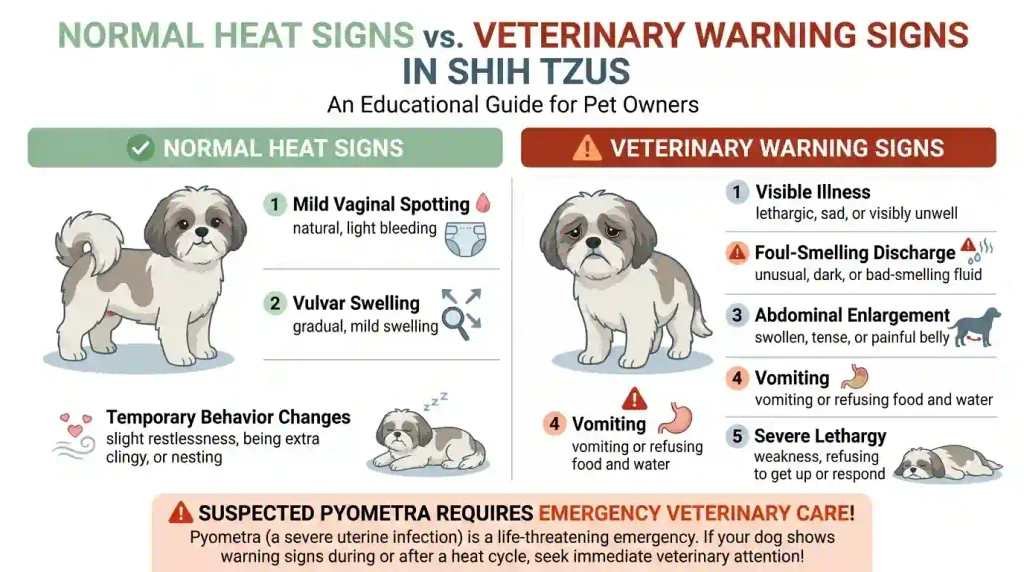
Normal changes can include mild vaginal discharge, vulvar swelling, increased genital grooming, scent marking, and temporary behavioral differences.
A healthy Shih Tzu should generally remain alert, comfortable, and interested in her surroundings.
Heat does not explain every new symptom.
11.2 Abnormal Bleeding or Vaginal Discharge
Abnormal signs include very heavy bleeding, foul-smelling discharge, pus-like material, or discharge accompanied by significant illness.
Persistent bleeding beyond the usual heat period also deserves assessment.
Never assume that unusual vaginal discharge is harmless because your dog recently experienced heat.
11.3 Unusual Pain, Weakness, or Behavioral Changes
Severe abdominal pain, collapse, repeated vomiting, marked lethargy, or refusal to eat requires prompt veterinary attention.
Some dogs may become mildly tired during heat, but profound weakness is not a normal reproductive symptom.
If your Shih Tzu shows reluctance to walk, consider that unrelated conditions such as IVDD in Shih Tzu dogs can also cause pain and reduced activity.
Likewise, shih tzu coughing and an existing shih tzu heart murmur are separate medical concerns that should not be automatically attributed to hormonal changes.
11.4 Pyometra After Heat in Shih Tzus
What Is Pyometra?
Pyometra is a serious bacterial infection of the uterus that can occur in unspayed female dogs.
Hormonal changes after heat create conditions in which bacteria may grow within the uterine lining.
Without prompt treatment, the infection can become life-threatening.
How Soon After Heat Can Pyometra Develop?
Pyometra commonly develops several weeks after heat, often around one to two months afterward.
However, the timing varies and cases can occur outside this typical interval.
Owners should remain attentive to illness after the visible heat period has ended.
Open vs. Closed Pyometra
In open pyometra, the cervix remains sufficiently open for infected material to drain through the vagina.
Owners may notice pus-like, cream-colored, or blood-tinged discharge.
In closed pyometra, the cervix remains closed, trapping infected fluid inside the uterus.
Closed pyometra may produce no visible vaginal discharge and can cause rapid deterioration.
Warning Signs of a Uterine Infection
Concerning signs include reduced appetite, vomiting, excessive thirst, increased urination, weakness, fever, abdominal swelling, or abnormal discharge.
Some symptoms can overlap with digestive problems.
For example, Shih Tzu diarrhea or complaints such as my shih tzu is constipated may initially appear unrelated to reproduction, but abdominal discomfort or gastrointestinal signs following a recent heat should be discussed with a veterinarian.
Why Pyometra Requires Emergency Veterinary Treatment
Pyometra can lead to systemic infection, shock, organ dysfunction, and death.
Treatment commonly requires stabilization with intravenous fluids and antibiotics followed by urgent surgery to remove the infected uterus and ovaries.
Do not attempt to manage suspected pyometra with home remedies or wait for discharge to resolve.
11.5 Shih Tzu in Heat vs. Other Medical Conditions
Heat Symptoms vs. Urinary Tract Infection
Heat may cause increased urination and scent marking.
A urinary tract infection may cause frequent attempts to urinate, straining, discomfort, accidents indoors, or blood in the urine.
A veterinarian may recommend urinalysis and urine culture to distinguish the causes.
Normal Heat Discharge vs. Vaginitis
Vaginitis is inflammation of the vaginal tissues and may cause discharge, irritation, and genital licking.
Unlike ordinary heat, some forms of vaginitis can occur independently of the reproductive cycle.
A veterinary examination helps determine the cause.
Blood in Urine vs. Vaginal Bleeding
Blood originating from the vagina may appear on bedding or fur even when the dog is not urinating.
Blood in urine is associated with urinary tract disease or other conditions.
Owners should not rely on appearance alone to determine the source.
How Veterinarians Distinguish Heat From Illness
Veterinarians may use physical examination, reproductive history, vaginal cytology, urinalysis, blood tests, hormone measurements, or ultrasound.
The recommended tests depend on the symptoms and the dog’s overall condition.
Some unrelated health concerns may also arise during heat. For example, Shih Tzu Eye Discharge, other Shih Tzu Eye problems, a shih tzu ear infection, or shih tzu ear mites require their own evaluation rather than being treated as heat symptoms.
11.6 When to Contact a Veterinarian During Heat
Contact your veterinarian if your Shih Tzu has unusually prolonged heat, repeated abnormal discharge, significant discomfort, or changes that do not match her normal pattern.
Seek immediate emergency care for collapse, severe weakness, a swollen painful abdomen, or suspected pyometra.
Serious illness should not be managed by waiting for end-of-life symptoms described in resources such as Shih Tzu Signs of Death. Many reproductive emergencies are treatable when addressed promptly.
11.7 Veterinary Care and Reproductive Health Monitoring
Regular veterinary visits help assess reproductive health and determine whether unusual symptoms need investigation.
Keep records of heat dates, medication exposure, and previous medical concerns.
Broader Shih Tzu health issues should be considered when symptoms are not clearly reproductive.
For example, hormonal problems may sometimes contribute to changes such as Shih Tzu losing hair, while unrelated masses or skin changes may require evaluation for conditions including Shih Tzu Skin Cancer.
These are not typical heat symptoms, but evaluating the whole dog helps prevent important conditions from being overlooked.
For authoritative information on normal canine reproductive stages, review Cornell University College of Veterinary Medicine’s guide to dog estrous cycles.
12. Common Myths About Shih Tzu Heat Cycles
12.1 Myth: Heat Always Lasts Exactly 21 Days
A Shih Tzu’s noticeable heat period commonly lasts two to three weeks, but individual stage durations vary.
Some dogs show signs for shorter or longer periods.
12.2 Myth: Bleeding Means a Shih Tzu Cannot Get Pregnant
Pregnancy may occur while discharge is still present.
Bleeding is not a reliable indicator of infertility.
12.3 Myth: A Shih Tzu Must Have One Litter Before Spaying
There is no medical requirement for a female Shih Tzu to produce a litter before spaying.
Discuss the appropriate timing with your veterinarian.
12.4 Myth: Female Shih Tzus Stop Cycling When They Get Old
Female dogs do not undergo menopause like humans.
Senior Shih Tzus may continue cycling and remain capable of pregnancy.
12.5 Myth: Dog Diapers Prevent Pregnancy
Diapers only manage discharge and household cleanliness.
They are not effective contraception.
12.6 Myth: Every Unusual Discharge Is Part of a Normal Heat Cycle
Abnormal discharge can result from infection, urinary disease, vaginitis, or other reproductive conditions.
Foul-smelling discharge, severe bleeding, or illness requires veterinary attention.
13. Frequently Asked Questions About Shih Tzu Heat Cycles
13.1 Do Shih Tzus Have Periods Like Humans?
No. Shih Tzus experience estrous cycles with reproductive bleeding, which differs biologically from human menstruation.
13.2 Can a Shih Tzu Be in Heat Without Bleeding?
Yes. Silent heat or frequent self-grooming can make discharge difficult to notice.
13.3 Can a Shih Tzu Get Pregnant While Bleeding?
Yes. Fertility can overlap with visible bloody discharge.
13.4 Can a Female Shih Tzu Become Pregnant After Bleeding Stops?
Yes. A Shih Tzu may still be fertile after visible bleeding decreases or stops.
13.5 Do Male Shih Tzus Go Into Heat?
No. Male Shih Tzus do not experience estrous cycles, although intact males can respond to females in heat.
13.6 How Do Male Dogs Know When a Female Shih Tzu Is in Heat?
Male dogs detect chemical scent signals and pheromones associated with reproductive hormonal changes.
13.7 Should I Keep My Shih Tzu Away From Other Dogs During Heat?
Keep her separated from intact males throughout heat and use supervised interactions with other dogs.
13.8 Can I Bathe My Shih Tzu While She Is in Heat?
Yes. Gentle bathing is usually safe if your dog is comfortable and otherwise healthy.
13.9 Is It Normal for a Shih Tzu to Sleep More During Heat?
Mild tiredness can occur, but pronounced lethargy or weakness requires veterinary assessment.
13.10 Can a Shih Tzu’s Heat Cycle Be Delayed or Skipped?
Yes. Cycles can be delayed or appear absent because of normal variation or underlying reproductive or hormonal conditions.
14. Final Thoughts on How Long a Shih Tzu Stays in Heat
14.1 Key Takeaways About Shih Tzu Heat Duration and Stages
A Shih Tzu usually stays visibly in heat for approximately 14–21 days, although individual cycles can vary. Understanding the differences between proestrus, estrus, diestrus, and anestrus helps owners recognize normal changes and avoid common mistakes about bleeding and fertility.
Most female Shih Tzus experience heat approximately twice a year, and pregnancy is possible even during the first cycle.
14.2 Keeping Your Shih Tzu Safe, Comfortable, and Healthy
Provide clean bedding, gentle exercise, appropriate nutrition, and careful supervision during heat. Keep your dog separated from intact males whenever pregnancy is possible, and record her cycle dates for future reference.
If unusual bleeding, severe discomfort, or illness occurs, contact your veterinarian promptly. Discuss spaying if breeding is not planned.
A little preparation and careful monitoring can make each heat cycle safer and more manageable for both you and your Shih Tzu.