Silver Shih Tzu: Color, Coat Changes, and How to Identify One
A silver Shih Tzu has a cool gray-to-metallic coat that can range from smoky charcoal-silver to pale platinum-looking gray. Some dogs are predominantly silver, while others combine silver with white, black tipping, brindle, gold, or additional markings. Silver can be difficult to identify from photographs because lighting, coat length, grooming, and age may make the same dog look gray, white, blackish, or even slightly blue. The most useful approach is to evaluate the actual hair color separately from the dog’s nose pigmentation, eye rims, lips, paw pads, and coat pattern. A silver-looking coat with an ordinary black nose is not automatically a blue Shih Tzu, while a very pale silver dog should not be confused with a true white coat simply because the colors blend together. Silver is currently an AKC Shih Tzu registration color, but a puppy’s exact adult shade cannot be guaranteed from one early photo. This guide explains how to recognize silver, compare similar colors, understand coat changes, evaluate rarity claims, and care for the coat correctly.
Table of Contents
- What does a silver Shih Tzu look like?
- How silver differs from white, gray, and blue
- Which silver coat patterns can Shih Tzus have?
- Can a Shih Tzu’s silver coat change with age?
- Is silver an accepted Shih Tzu color?
- How common is silver, and what can be verified about rarity?
- How should you care for a silver Shih Tzu’s coat?
- Photo and breeder checklist for confirming a color description
- Silver Shih Tzu FAQs
- Final thoughts
What Does a Silver Shih Tzu Look Like?
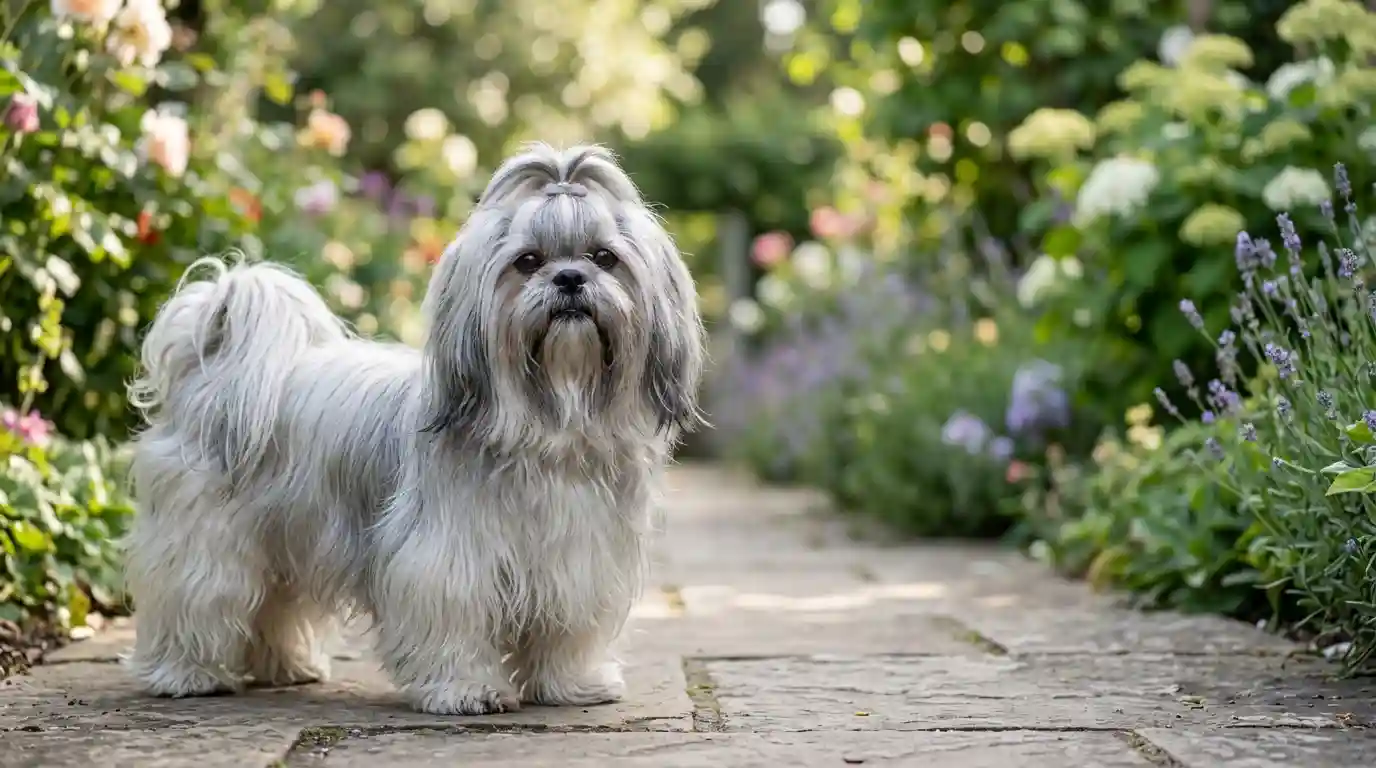
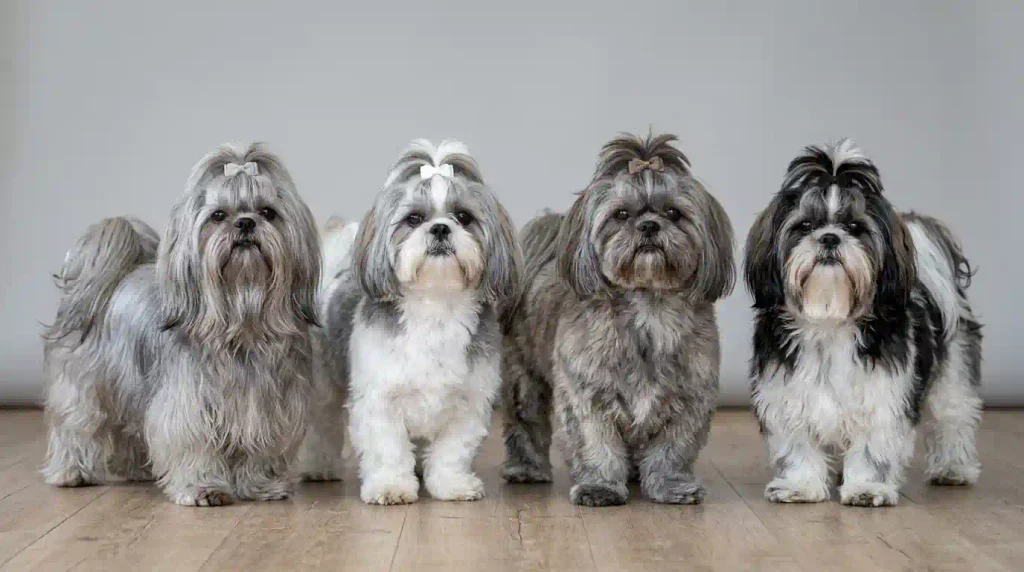
A silver Shih Tzu usually has hair that appears cool gray, pale charcoal, metallic gray, or platinum-silver rather than warm gold, tan, red, or brown.
The intensity varies considerably.
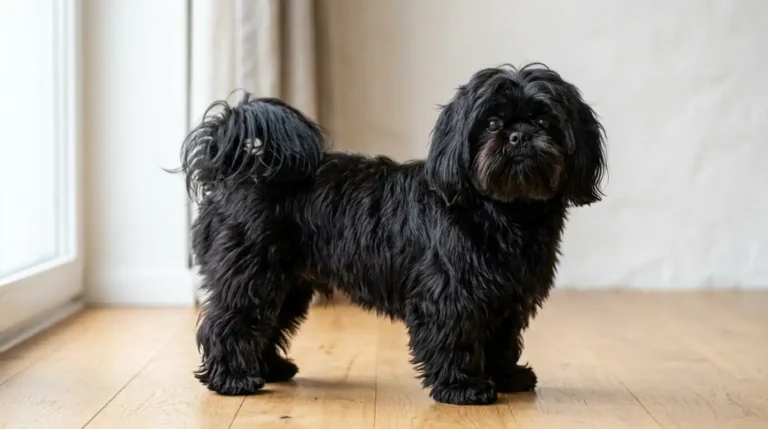
One dog may have medium-gray silver over most of the body. Another may appear very pale and almost white from a distance. A puppy that eventually develops a silver appearance may initially look much darker, especially when black-tipped hairs are prominent.
This is one reason the word “silver” should be treated as a coat description, not one exact paint-like shade.
Common silver appearances can include:
- Dark smoky silver
- Medium metallic gray
- Pale silver-gray
- Platinum-looking silver
- Silver with black tipping
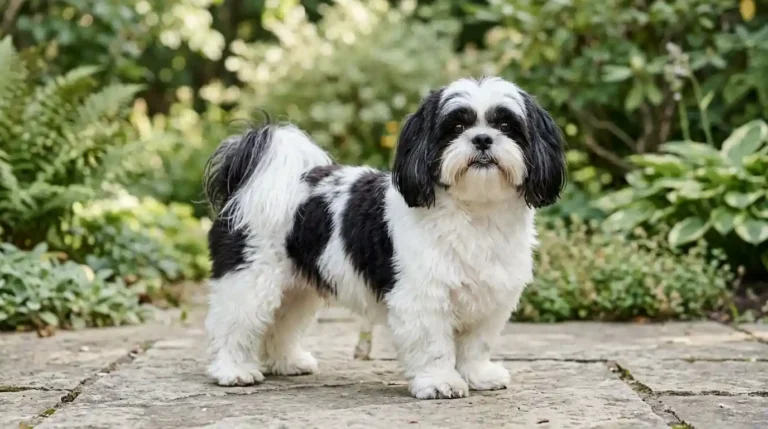
- Silver and white
- Silver brindle
- Silver mixed with gold or white in a tri-color coat
The breed’s long double coat makes color identification even more complicated because individual hairs can catch light differently depending on their length and direction.
A short puppy coat often looks darker and more saturated. A long adult coat may appear softer, paler, or more reflective.
If you’re comparing the full range of Shih Tzu colors, silver sits visually between several categories that owners commonly confuse.
Silver Is Usually a Cool-Toned Coat
The easiest first clue is tone.
Silver tends to look cool rather than warm.
Compare:
| Coat Description | Typical Visual Tone |
| Silver | Cool gray, metallic, smoky, platinum |
| Gold | Warm yellow, honey, golden |
| Red | Copper, orange-red, auburn |
| Brown | Warm brown, chocolate, chestnut |
| White | Little or no visible coat pigment |
| Blue | Gray-looking coat or pigment combined with diluted skin pigmentation |
This distinction is easiest to see in natural daylight.
Warm indoor bulbs can make silver hair look beige or brownish. Strong direct sun can wash pale silver until it looks almost white. Shadows can make medium silver appear charcoal or black.
For accurate color identification, evaluate the dog outdoors in open shade or beside a large window without a filter.
What About Black-Tipped Silver Hair?
Some silver-looking Shih Tzus retain darker or black-tipped hairs, particularly during puppyhood or within certain patterned coats.
The American Shih Tzu Club has historically referred to platinum silver-and-white dogs with black tipping among the range of coat appearances found in the breed.
Black tipping does not automatically mean the dog is black.
Instead, look at the coat as a whole.
If much of the mature hair is pale silver but darker pigment remains mainly at the tips, ears, or selected sections, silver may still be the most useful overall description.
A black Shih Tzu should look substantially darker overall.
Likewise, a black and white Shih Tzu generally maintains much stronger contrast between deep black and white than an adult silver-and-white dog.

How Silver Differs From White, Gray, and Blue
Silver is particularly confusing because ordinary descriptive language and formal breed terminology do not always use the same words.
A person may look at a dog and say:
“That is a gray Shih Tzu.”
A registration form might use Silver.
Another person may see a grayish coat and assume it is “blue.”
These descriptions are not necessarily equivalent.
The safest approach is to separate:
- Visible hair color
- Nose and skin pigmentation
- Coat pattern
- Registration terminology
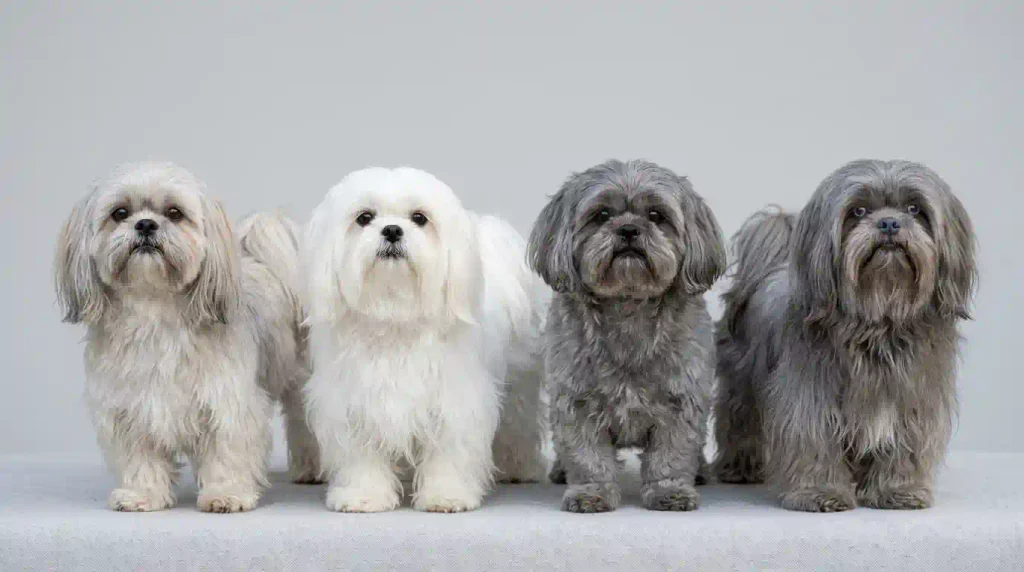
Silver vs. White vs. Gray vs. Blue Comparison
| Description | Coat Appearance | Nose/Eye-Rim Clue | Key Distinction |
| Silver | Cool gray or metallic coat | Usually black | Recognized color label |
| White | Bright white hair | Usually black unless another pigment type | Hair lacks visible silver-gray shade |
| Gray | Everyday visual description | Usually black if not blue-pigmented | May overlap visually with silver |
| Blue | Gray/slate appearance | Blue-gray/slate pigmentation | Identified partly through pigment points |
Look for a Silver Sheen and Compare Coat Areas
If you’re unsure whether a pale dog is silver or white, compare different parts of the coat directly.
True white hair usually appears brighter, while silver retains a gray cast.
This becomes especially helpful in dogs that carry both colors.
A silver and white Shih Tzu provides its own comparison: white markings on the chest, face, or legs can make the surrounding silver sections easier to recognize.
For example:
White facial blaze: bright white
Silver ear: cool metallic gray
Seeing the two shades side by side makes identification easier than evaluating silver alone.
Silver Versus White
A white Shih Tzu should not be called silver simply because shadows make the coat look gray.
Look at the dog in consistent daylight.
A pale silver dog usually retains at least some cool gray pigmentation through portions of the coat, while truly white hair appears comparatively bright.
Do not confuse ordinary white with an albino Shih Tzu, either. White coat color and albinism are different biological characteristics.
Silver Versus Gray
The difference between silver and gray can be partly a matter of terminology.
“Gray” is a common visual description.
“Silver” is a current AKC registration label for Shih Tzus.
That means a dog someone casually calls gray may be recorded as silver depending on its documented color and appearance.
Our grey Shih Tzu guide focuses specifically on this visual terminology.
Likewise, a grey and white Shih Tzu may look extremely similar to a dog formally described as silver and white.
The labels should therefore be used carefully rather than treated as entirely different biological colors.
Silver Versus Blue
Silver and blue should not be treated as synonyms.
A blue Shih Tzu involves diluted pigmentation.
Instead of an ordinary black nose, a blue-pigmented Shih Tzu may show a slate or blue-gray nose, lips, and eye rims.
A silver Shih Tzu with standard black pigmentation should not automatically be called blue just because the coat looks gray.
This difference becomes especially important when comparing a silver dog with a blue gray Shih Tzu or blue and white Shih Tzu.
Check Color Labels Against Visible Nose and Skin Pigmentation
The Shih Tzu breed standard provides an important identification rule.
For ordinary coat colors, the nose, lips, and eye rims should be black.
The exceptions are:
- Liver pigmentation on liver-pigmented dogs
- Blue pigmentation on blue-pigmented dogs
So if a dog has:
Silver-looking coat + black nose + black eye rims
ordinary silver is a reasonable possibility.
If the dog has:
Gray-looking coat + slate-blue nose + blue-gray eye rims
blue pigmentation deserves closer consideration.
If the dog has:
Taupe-gray or brownish coat + brown nose
you may be looking at liver or diluted-brown terminology rather than ordinary silver.
This is why nose pigmentation can be more informative than coat shade alone.
A liver Shih Tzu has brown-based pigmentation, while a lavender Shih Tzu may be used informally to describe a diluted brown/lilac-looking appearance.
Do not call every unusual gray-beige Shih Tzu silver without examining these skin points.
What About Paw Pads?
Paw pads can provide supporting information.
An ordinarily pigmented silver dog often has dark pads.
A liver-pigmented dog may show brown-based pads, while blue pigmentation may create a diluted appearance.
However, paw pads are less convenient to evaluate accurately than the nose, lips, and eye rims.
Use them as a supporting clue rather than the only test.
Which Silver Coat Patterns Can Shih Tzus Have?
Silver does not need to cover the entire dog.
It can occur with white spotting, brindle, black tipping, gold areas, and other markings.
This is why two silver Shih Tzus may look completely different while sharing the same general color description.
Solid or Predominantly Silver
A predominantly silver dog has silver across most of the visible coat.
Small white markings may still occur, particularly on:
- Chest
- Toes
- Chin
- Forehead
A tiny amount of white does not necessarily change the way an owner casually describes the dog.
Silver and White Versus White and Silver
A silver-and-white coat typically combines clear silver areas with white markings.
One dog may have:
- Silver back
- Silver ears
- Silver tail
- White chest
- White legs
- White facial blaze
Another may reverse the proportions:
- Mostly white body
- Silver ears
- Silver facial patches
- Small silver saddle
Owners might casually call the second dog “white and silver.”
However, the current AKC registration terminology uses Silver & White rather than creating separate Silver & White and White & Silver categories.
For an in-depth identification guide, see our silver and white Shih Tzu article.
White Markings and Parti-Style Coats
A silver dog with clearly separated white patches may be described as having a parti-style appearance.
Typical white areas include:
- Blaze
- Muzzle
- Neck
- Chest
- Belly
- Paws
- Legs
- Tail tip
The pattern does not need to be symmetrical.
A silver patch might cover one ear completely while leaving the other partially white.
That asymmetry is normal.
Silver Brindle
A silver brindle Shih Tzu adds another layer of complexity.
Brindle describes patterned darker and lighter hairs rather than one smooth silver shade.
The colored sections may show:
- Dark bands
- Gray bands
- Black tips
- Silver background
- Mixed warm or cool hairs
Long adult coat can make brindle less obvious than it was in puppyhood.
A strongly patterned puppy may eventually look predominantly silver-gray when viewed from a distance.
Silver, Gold, and White
AKC registration terminology also includes Silver Gold & White as a Shih Tzu color combination.
This creates a three-color appearance.
Possible distribution could include:
- Silver back
- Gold facial areas
- White chest and legs
or other arrangements.
There is no single required patch layout.
Black, White, and Silver
Another current registration combination is Black White & Silver.
This can create strong contrast between:
- Black
- Pale silver
- White
A dog with these three colors may be casually called tri-color.
Black, Gold, and Silver
AKC also lists Black Gold & Silver.
Again, this demonstrates why coat color combinations should not be treated as separate types of Shih Tzu.
They are appearance variations within one breed.
Black Masks and Facial Markings
Silver dogs may also display darker facial hairs.
A black mask is a specific facial pattern more familiar in other warm-colored Shih Tzus, such as a black mask gold Shih Tzu, but dark facial tipping can also complicate the appearance of other coat combinations.
Look at the overall distribution rather than naming the dog from one dark facial patch.
Can a Shih Tzu’s Silver Coat Change With Age?
Yes.
A Shih Tzu’s coat can look considerably different between early puppyhood and adulthood.
This is particularly relevant to silver because some puppies that mature into a silver appearance begin life with a much darker-looking coat.
However, adult color should never be promised with absolute certainty from one puppy photograph.
Puppy Coat, Adult Coat, and Black-Tipped Hairs
Young Shih Tzus have a puppy coat that differs in length, density, and visual effect from the mature double coat.
The American Shih Tzu Club notes that many Shih Tzus undergo a noticeable coat change around 10 to 12 months of age, when puppy hair gives way to the adult coat.
During this stage, owners may notice:
- Lighter hair becoming more visible
- Black tipping becoming less dominant
- Dark gray becoming silver
- Brindle becoming less obvious
- White markings appearing more prominent
- A softer overall coat shade
Suppose a puppy has medium-gray hair with heavy black tips.
At ten weeks, it might look almost black.
As the hair grows, the lighter portion of each shaft may become much more visible, producing a silver or platinum appearance.
This does not mean the dog’s genetics suddenly changed.
The visible balance of darker and lighter hair changed as the coat matured.
Can a Black Puppy Become Silver?
A puppy that looks extremely dark can become considerably lighter.
However, this should not be turned into a rule that every black-looking puppy will become silver.
Some remain black.
Some develop gray or silver areas.
Some are brindle.
The safest approach is to consider:
- Current appearance
- Color at the roots
- Parent coats
- Previous offspring from the same lines
- Registration information
- Multiple photos over time
without treating any one clue as a guarantee.
Silver Coat and Fading
Owners often describe a Shih Tzu becoming lighter as coat fading.
The word is useful visually, but it should not imply that one simple “fading gene” explains every case.
Canine pigmentation is influenced by multiple genes and their interactions.
Research into dog coat genetics has identified many loci that control pigment type, distribution, dilution, and patterning, but that does not provide a simple formula such as:
“Dark Shih Tzu puppy + specific gene = exact silver shade at 12 months.”
The biology is more complex.
For ordinary owners, the practical lesson is easier:
Expect change, but don’t expect an exact prediction.
What About Brindle Color Change?
Brindle is particularly prone to dramatic visual differences.
A black brindle Shih Tzu puppy may have strongly visible dark patterning.
If those darker tips become less dominant as the coat lengthens, the adult can appear much lighter.
Similarly, silver brindle may become visually more silver with age even though the brindle pattern remains genetically present.
What Appearance Can’t Predict About the Adult Coat
A photograph of an eight-week-old puppy cannot reliably guarantee:
- Exact adult shade
- Exact percentage of silver
- Whether the coat will become platinum
- How much black tipping will remain
- How noticeable brindle will remain
- Final visual contrast with white
- How clipping will change the appearance
Even parent photos have limits.
Parents can provide useful context, but puppies inherit combinations from both sides of the pedigree, including traits that may not be visually obvious in either parent.
A responsible breeder can describe likely possibilities, not promise an exact paint color.
Is Silver an Accepted Shih Tzu Color?
Yes.
Silver is currently listed as an American Kennel Club Shih Tzu registration color.
The current AKC Shih Tzu color list includes:
- Silver — code 176
- Silver & White — code 182
- Black Gold & Silver — code 235
- Black White & Silver — code 033
- Silver Gold & White — code 188
You can confirm the current list on the American Kennel Club Shih Tzu breed page.
The breed standard separately states that:
All colors and markings are permissible and are to be considered equally.
This means a silver dog is not inherently preferred over a black, gold, red, liver, brindle, or other permitted Shih Tzu.
Likewise, it is not inferior because it is silver.
Registration color and breed quality are different concepts.
Does Silver Prove Purebred Status?
No.
A puppy having an AKC-listed color does not automatically prove that it is a purebred Shih Tzu.
Pedigree, registration records, parentage, and breeder documentation address ancestry.
Color tells you what the dog looks like.
It does not prove where the dog came from.
For broader information about how color fits into the breed, explore our shih tzu Breed Information section and Shih Tzu facts guide.
How Common Is Silver, and What Can Be Verified About Rarity?
Silver is sometimes advertised as:
- Rare silver
- Platinum silver
- Ultra-rare silver
- Rare silver bloodline
- Exotic silver
- Rare silver-and-white
These labels can sound impressive, but there is a major evidence problem:
There is no comprehensive, continuously updated worldwide database showing what percentage of living Shih Tzus are silver.
Without population data, it is difficult to rank silver objectively against every other coat color.
Silver May Be Less Common in Some Breeding Populations
A breeder may genuinely produce few silver puppies.
A local region may have far more gold-and-white dogs than silver dogs.
One pedigree may rarely produce silver.
Another may produce it regularly.
All of those statements can be true without proving that silver is universally “rare.”
Frequency varies according to:
- Bloodlines
- Breeding choices
- Geographic region
- Registration population
- Historical selection
- How colors are recorded
The American Shih Tzu Club has noted historically that breeding preferences can change the visibility of particular colors in the show population.
For example, periods when breeders strongly selected for gold and white reduced the prominence of some other colors.
That tells us coat frequency can be influenced by breeding fashion.
It still does not give us a reliable modern percentage for silver.
Is Silver the Rarest Shih Tzu Color?
There is not enough reliable population evidence to declare silver the universal rarest color.
Claims that it is “the rarest Shih Tzu color” should therefore be treated cautiously unless the source provides a defined population and actual numbers.
The same applies to claims involving blue, liver, lavender, solid black, or other colors.
A responsible article should not invent a ranking simply because shoppers search for “rare Shih Tzu colors.”
Should Silver Cost More?
Individual sellers may charge more for particular colors.
That is a market decision, not evidence that the puppy is healthier, more purebred, or objectively superior.
A higher price might reflect:
- Local demand
- Breeder reputation
- Pedigree
- Veterinary care
- Health testing
- Availability
- Marketing
- Geographic location
Color alone should never replace evaluation of health and breeding practices.
If someone charges a large premium for “rare platinum silver,” ask what evidence supports the rarity claim.
How Should You Care for a Silver Shih Tzu’s Coat?
Silver coloring does not require a fundamentally different grooming routine from other Shih Tzu colors.
The main issue is the breed’s dense, long double coat.
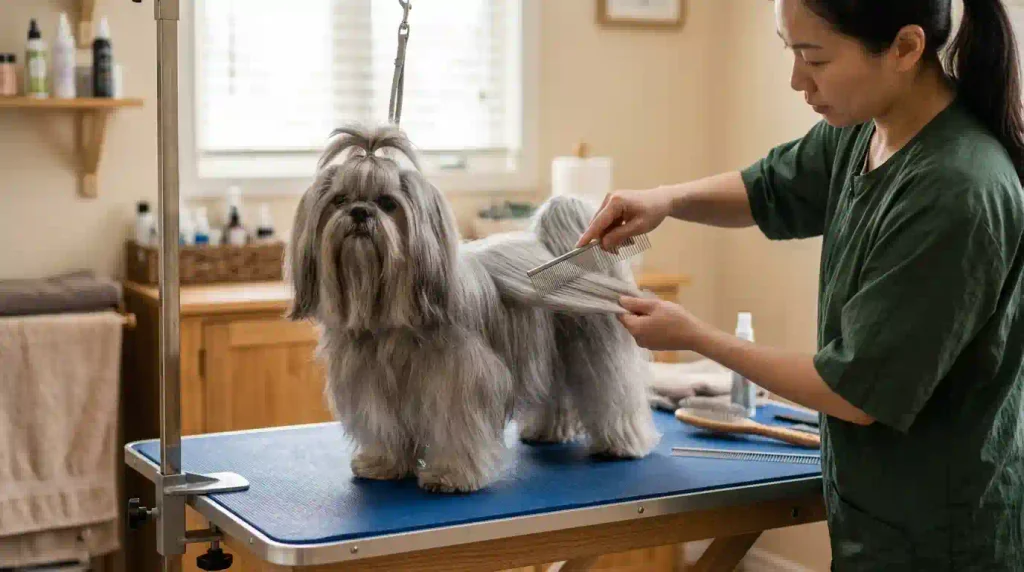
When the coat is kept long, consistent maintenance is necessary to prevent tangles from becoming painful mats.
Brush the Coat in Sections
A long coat may need very frequent—and in many dogs daily—attention.
Pay special attention to:
- Behind the ears
- Neck
- Armpits
- Chest
- Belly
- Inner legs
- Tail area
- Hair beneath collars or harnesses
Brush in layers instead of smoothing only the top.
A coat can look perfectly neat while hiding mats close to the skin.
Use an appropriate comb afterward to check your work.
Groom More Carefully During Coat Change
The puppy-to-adult transition can temporarily make coat care harder.
Loose puppy hair becomes caught in the developing adult coat and can tangle quickly.
This stage is often more important than the dog’s color.
Whether the puppy is silver, red Shih Tzu, gold, or black, consistent grooming is essential.
Bathing
Bathing needs depend on:
- Coat length
- Activity
- Environment
- Skin condition
- Grooming schedule
Use dog-formulated shampoo and rinse thoroughly.
Conditioning can make a long coat easier to detangle.
Avoid bathing a heavily matted dog before dealing with the mats, because water can tighten tangles.
Should You Use Silver-Enhancing Shampoo?
A healthy coat is more important than trying to artificially intensify silver.
Whitening or brightening products marketed for pale coats should be used cautiously and only if they are appropriate for dogs.
Do not use harsh bleaching products near:
- Eyes
- Nose
- Mouth
- Irritated skin
The goal is cleanliness and skin health—not forcing a natural coat to look artificially platinum.
Keeping White Markings Clean
If your silver dog also has white markings, stains may be more noticeable around:
- Eyes
- Beard
- Mouth
- Chest
- Feet
Tears, saliva, food, moisture, and dirt can discolor pale hair.
Persistent eye discharge, excessive licking, odor, redness, swelling, or skin irritation should be investigated rather than treated only as a cosmetic problem.
Does Silver Affect Shedding or Allergies?
No evidence suggests that silver coloring makes a Shih Tzu more or less allergy-friendly than another color.
Color does not determine allergy potential.
For that topic, see our guide to whether the Shih Tzu is hypoallergenic.
Photo and Breeder Checklist for Confirming a Color Description
If you are evaluating a puppy advertised as silver, do not rely only on the listing title.
Use the following checklist:
- Ask for natural-light photographs. Neutral daylight reduces color distortion.
- Request several angles. Look at the face, ears, back, sides, chest, legs, and tail.
- Compare the coat with truly white areas. White markings can help reveal whether nearby hair is actually silver.
- Check for warm tones. Strong gold, red, or brown tones may suggest another description.
- Look at the nose. Ordinary silver should generally have black pigmentation rather than brown liver or slate-blue pigment.
- Check the eye rims and lips. These should support the pigmentation assessment.
- Look for black tipping. Dark tips can make a young silver puppy appear much darker.
- Look for brindle. Repeated darker streaks may point toward a brindle pattern.
- Ask how the puppy’s color is recorded. Registration terminology may differ from casual advertising language.
- Request photos of both parents as puppies and adults. This can show color-development tendencies in the family.
- Ask for adult photos from previous litters if available. They provide useful context without guaranteeing the current puppy’s outcome.
- Do not rely on filters. Highly saturated or edited social-media photographs can make silver look blue, black, white, or lavender.
- Be cautious with exact color promises. “Guaranteed platinum adult” is stronger than appearance alone can justify.
- Separate color from pedigree. A coat label does not prove breed ancestry.
- Separate rarity from quality. A rare-sounding label does not prove responsible breeding.
A Simple Identification Rule
If you need one practical rule, use this:
Evaluate the coat first, pigment points second, pattern third, and breeder documentation last.
For example:
Cool silver coat + black nose + black eye rims + no obvious brindle = consistent with ordinary silver appearance.
Gray coat + slate nose = investigate blue pigmentation.
Taupe-gray coat + brown nose = investigate liver/diluted-brown terminology.
Silver-gray coat + obvious darker striping = consider brindle.
This process is more reliable than identifying a dog from a single marketing label.
Silver Shih Tzu FAQs
What is a silver Shih Tzu?
A silver Shih Tzu has a cool gray, metallic, smoky, or platinum-looking coat rather than a warm gold, red, or brown coat.
Is silver an official Shih Tzu color?
Yes. Silver is currently listed as an AKC Shih Tzu registration color.
What is the AKC color code for silver Shih Tzu?
Silver currently uses registration code 176.
Is Silver & White also an AKC color?
Yes. Silver & White is currently listed with code 182.
What color nose should a silver Shih Tzu have?
An ordinarily pigmented silver Shih Tzu should have a black nose.
Should a silver Shih Tzu have black eye rims?
Yes, ordinary pigmentation should be black unless the dog is liver- or blue-pigmented.
Is silver the same as gray?
They can overlap visually, but Silver is an AKC registration term while gray is often used as an everyday description.
Is silver the same as blue?
No. Blue involves diluted pigmentation and can be identified partly through a slate or blue-gray nose and skin points.
Is a pale silver Shih Tzu the same as white?
No. Pale silver retains a cool gray cast, while white hair lacks that visible silver pigmentation.
Can a silver puppy look black?
Yes. Dark puppy hair or black tipping can make a future silver-looking coat appear much darker when young.
Do silver Shih Tzus get lighter?
Some do become noticeably lighter as the adult coat develops, but the degree of change varies.
When does a Shih Tzu’s adult coat develop?
A noticeable puppy-to-adult coat transition often occurs around 10–12 months.
Can a breeder guarantee a silver puppy’s final shade?
No puppy photograph can guarantee the exact adult shade with certainty.
Can a silver Shih Tzu have white markings?
Yes, and Silver & White is a current AKC registration color.
Can a silver Shih Tzu be mostly white?
Yes. White distribution can vary widely.
Can a silver Shih Tzu be brindle?
Silver-toned brindle appearances can occur, and visible dark striping should be assessed separately from the silver base.
What is a silver brindle Shih Tzu?
It describes a brindle-patterned Shih Tzu with a silver or gray-toned appearance.
Can silver Shih Tzus be tricolor?
Yes, current AKC color terminology includes several three-color combinations containing silver.
Is silver a rare Shih Tzu color?
Its frequency varies by population and bloodline, and there is no reliable worldwide dataset establishing a universal rarity rank.
Is silver the rarest Shih Tzu color?
There is insufficient population evidence to identify silver as the universal rarest Shih Tzu color.
Are silver Shih Tzus expensive?
Prices vary by breeder, location, pedigree, demand, health testing, and other factors; color alone does not establish value.
Does silver color affect temperament?
No reliable evidence suggests that silver coat color determines a Shih Tzu’s personality.
Does silver color affect health?
Silver color alone does not provide an overall health diagnosis.
Does a silver Shih Tzu need special grooming?
No. Grooming needs come from the Shih Tzu’s double coat rather than its silver color.
Can grooming make silver look different?
Yes. Hair length, clipping, bathing, lighting, and coat condition can change how the silver shade appears.
Does a short haircut permanently change silver color?
No. Clipping can reveal darker or lighter portions of the hair shaft but does not change the dog’s underlying color genetics.
Can parent photos predict the adult silver shade?
They provide useful context but cannot guarantee one puppy’s exact adult appearance.
Is a silver Shih Tzu a separate type of Shih Tzu?
No. Silver is a coat color within the single recognized Shih Tzu breed.
Final Thoughts
A silver Shih Tzu can range from dark smoky gray to pale platinum silver, and the coat may look very different as a puppy matures. The most reliable identification comes from combining visible hair color with nose, lip, and eye-rim pigmentation rather than assuming every gray-looking dog is silver or blue.
Silver is an accepted AKC registration color, as is Silver & White, but those labels do not predict health, temperament, pedigree, rarity, or value. Be cautious of guaranteed adult-color promises and unsupported “ultra-rare silver” marketing.
If you are comparing a puppy, request unedited natural-light photographs, examine the parents, and allow for normal coat development. For broader comparisons, continue with our complete Shih Tzu colors guide and dedicated silver and white Shih Tzu article.