Red and White Shih Tzu: Coat Color, Identification, and Care
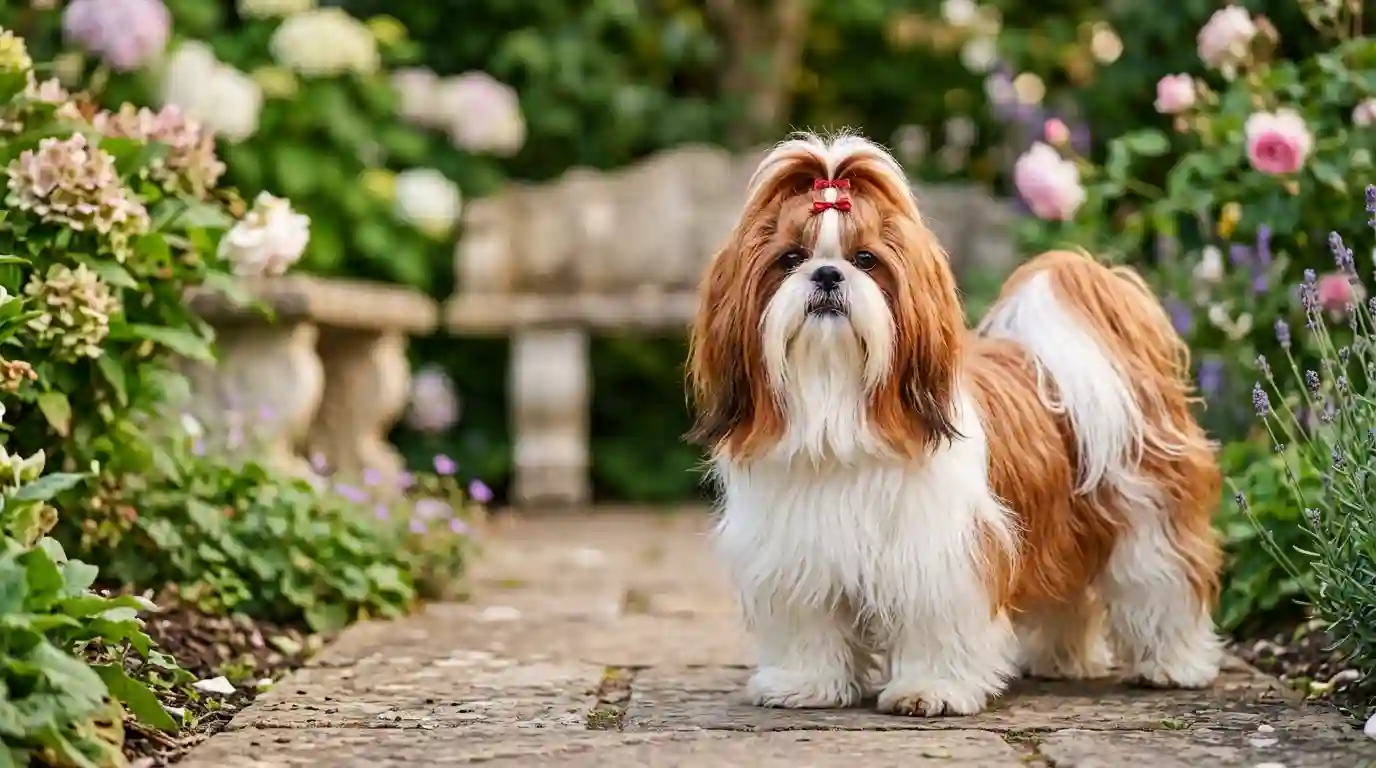
A red and white Shih Tzu has warm red, copper, auburn, or reddish-orange areas combined with clearly defined white markings. The exact pattern can vary dramatically: one dog may be mostly red with a white chest and facial blaze, while another may be predominantly white with red patches over the ears, head, back, or tail. There is no single required red-and-white pattern.
The most important part of identification is separating coat shade from pigmentation. A red-and-white coat usually occurs with a black nose, black lips, and black eye rims unless the dog has another pigmentation type, such as liver. That distinction helps separate a red white Shih Tzu from similar-looking gold, liver, brown, and brindle combinations. The coat can also look different as a puppy matures and its adult hair develops. Below, you’ll learn how to recognize the color combination, compare it with similar Shih Tzu colors, understand breed-standard terminology, and properly groom the long double coat.
Table of Contents
- What does a red-and-white Shih Tzu look like?
- How can you distinguish red and white from similar colors?
- Is red and white an accepted Shih Tzu color?
- Can a puppy’s red-and-white coat change with age?
- How to care for a red-and-white Shih Tzu’s coat
- Red and white Shih Tzu FAQs
- Final thoughts
What Does a Red-and-White Shih Tzu Look Like?
A red-and-white coat contains two visually distinct areas: colored hair ranging from warm reddish gold to deeper auburn, and white hair that may cover small or large sections of the dog.
The amount of each color varies considerably.
A Shih Tzu red and white puppy might have a predominantly red body with only a white chest, paws, and facial blaze. Another could be mostly white with red ears and several patches across its back.
Neither arrangement is inherently more correct.
The word red describes the visible coat shade. It does not mean that every red-and-white dog must have the same dark cherry-red color.
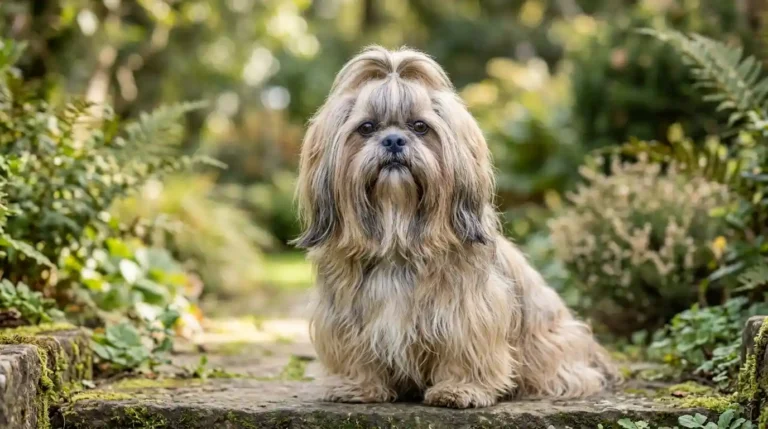
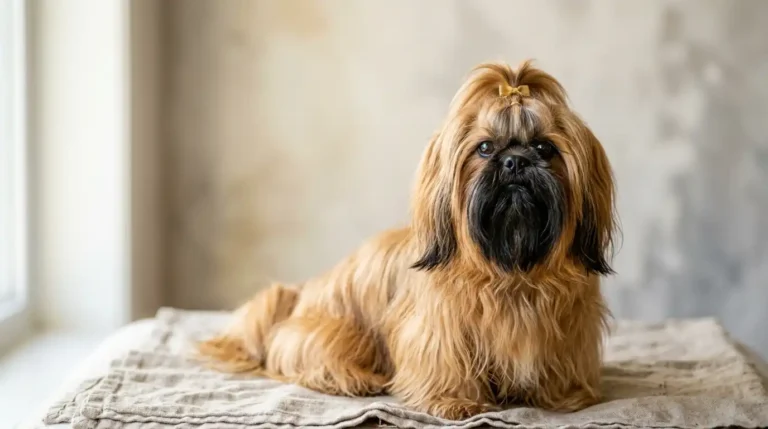
Red Shih Tzu hair may appear:
- Copper
- Auburn
- Reddish gold
- Burnt orange
- Warm mahogany
- Light orange-red
- Deep gold-red
This range explains why red can sometimes overlap visually with gold, orange, tan, or brown.
If you want to understand the broader color spectrum first, our shih tzu Breed Information section and complete Shih Tzu colors guide provide useful context.
How the Red and White Areas Can Vary
A red-and-white Shih Tzu does not need to have a 50/50 division between colors.
Possible appearances include:
Mostly red: The body is predominantly red with white on the chest, paws, muzzle, or forehead.
Mostly white: The dog has a largely white coat with red patches over the ears, face, saddle area, or tail.
Balanced red and white: Large areas of both colors are distributed across the head and body.
Red head with white body: Strong red coloring may remain on the head and ears while the torso is largely white.
White face with red ears: A broad white facial area may separate red ears or temples.
Red saddle: The dog’s back may carry a broad red section surrounded by white on the neck, chest, belly, and legs.
These combinations may be described casually as parti-color, meaning the coat contains clearly separated colored and white areas.
However, parti-color is a pattern description rather than a separate breed.
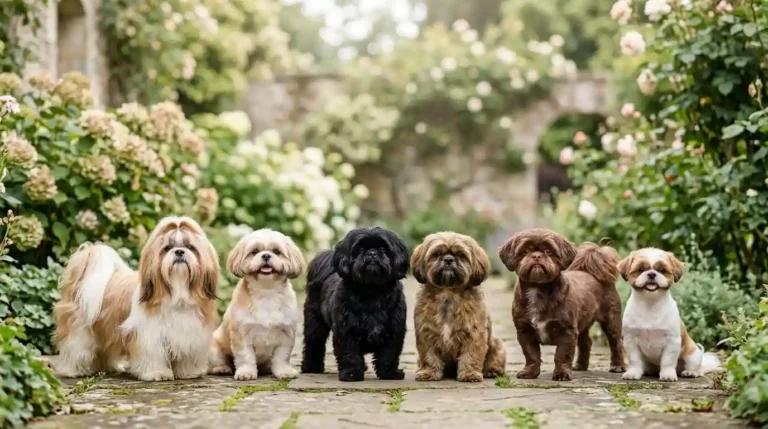
A black and white Shih Tzu, blue and white Shih Tzu, or silver and white Shih Tzu can display similar distributions of white—the main difference is the color of the pigmented coat sections.
Common Markings on the Face and Body
White markings can create visually distinctive facial and body patterns.
Common examples include:
- White facial blaze
- White muzzle
- White chin
- White chest
- White collar
- White paws
- White legs
- White belly
- White tail tip
- White shoulder area
- Red saddle over a white body
A narrow strip of white running upward from the muzzle between the eyes is often described as a blaze.
A broader area around the neck may resemble a collar or shawl.
There is no requirement that the pattern be symmetrical. One side of the face may contain more red than the other, and red body patches can differ significantly in shape.
Some dogs may also have a black mask or darker facial shading. A black mask gold Shih Tzu shows how strongly a dark mask can change the overall appearance of a warm-colored coat.
Similarly, black-tipped or shaded hairs can make portions of a red puppy appear darker without changing the dog’s underlying red-and-white description.

How Can You Distinguish Red and White From Similar Colors?
Color identification becomes difficult because red exists on a spectrum.
One person may call a warm coat red, while another describes the same dog as gold, orange, or auburn.
The best approach is to examine the overall shade and the dog’s pigment points, particularly its nose, lips, and eye rims.
| Color | Typical Coat Appearance | Pigmentation Clue |
| Red and white | Copper, auburn, red or orange-red + white | Usually black points unless another pigment type is present |
| Gold and white | Yellow-gold to warm golden + white | Usually black |
| Liver and white | Variable colored areas + white | Brown/liver nose, lips and eye rims |
| Solid red | Predominantly red with little or no white | Usually black unless liver-pigmented |
| Brindle and white | Patterned/streaked colored areas + white | Evaluate separately from pattern |
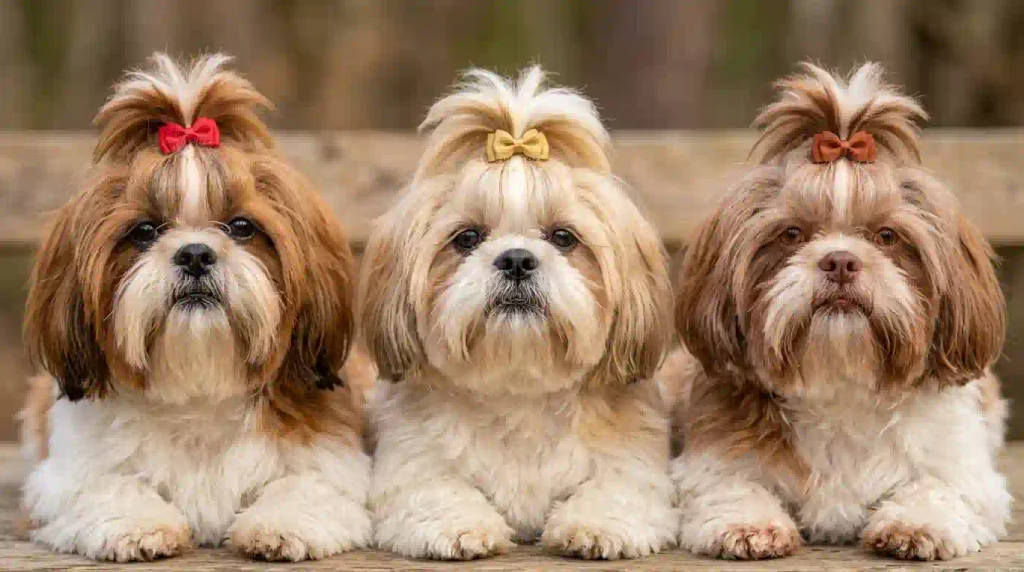
Red, Gold, and Liver: Coat Shade and Pigment Points
Red and gold can visually overlap.
A gold and white Shih Tzu generally appears more golden, honey-colored, yellow-gold, or light tan, whereas red tends to have stronger copper, orange, auburn, or reddish tones.
However, there is no reliable dividing line that can be judged from every photograph.
Lighting matters.
Warm indoor lights can make a gold dog look orange or red, while bright outdoor exposure can make a red coat appear much lighter.
This is why natural daylight is best when comparing colors.
A blonde Shih Tzu or tan Shih Tzu can also overlap visually with very light warm-colored coats.
The distinction from liver is more important genetically.
A liver Shih Tzu has brown-based pigmentation instead of ordinary black pigmentation.
According to the American Shih Tzu Club breed standard, nose, lips, and eye rims are black on ordinary colors, with liver pigmentation on liver-pigmented dogs and blue pigmentation on blue-pigmented dogs.
Therefore:
Red coat + white markings + black nose = typical red-and-white appearance
while:
Red coat + white markings + liver/brown nose = liver-pigmented red-and-white appearance
A red liver Shih Tzu demonstrates why red coat color and liver pigmentation need to be considered separately.
Likewise, a liver and white Shih Tzu should not be identified only because the colored hair looks brown.
The skin points matter.
Red and White Versus Solid Red
The difference between a red-and-white dog and a red Shih Tzu is primarily the amount and distribution of white.
A solid-red dog may still have a few small lighter hairs, but its overall coat is predominantly red.
A red-and-white dog has clearly recognizable white coat areas.
These may appear on the:
- Face
- Neck
- Chest
- Belly
- Legs
- Paws
- Back
- Tail
There is no universal minimum percentage of white that owners need to calculate before using the description.
Instead, think about how a reasonable observer would describe the dog’s dominant visual pattern.
If there are clearly separated red and white areas, red and white Shih Tzu is a practical description.
Red and White Versus Brindle
Brindle is different because it involves a patterned mixture or banding of hairs rather than simple blocks of red and white.
A brindle Shih Tzu can contain warm red, brown, gold, or dark-looking areas interspersed with darker striping.
A red brindle Shih Tzu may be especially easy to confuse with red at first glance.
Look closely at the pigmented portions of the coat.
If they contain obvious darker streaks, bands, or intermingled hairs, brindle may be a more accurate pattern description than plain red.
When white is added, the result may visually resemble a brindle and white Shih Tzu rather than ordinary red and white.
Coat pattern and base color should therefore be evaluated separately.
Is Red and White an Accepted Shih Tzu Color?
Yes.
Red & White is currently listed by the American Kennel Club as a Shih Tzu registration color, with registration code 146.
The official Shih Tzu breed standard also says that all colors and markings are permissible and are to be considered equally.
That means a red-and-white coat is not considered inferior simply because another Shih Tzu is black, gold, silver, brindle, or another permitted color.
You can review the current color listing on the American Kennel Club Shih Tzu breed page.
It is important, however, to understand what this does not mean.
A dog’s color does not prove its ancestry.
A red-and-white puppy is not automatically a purebred Shih Tzu simply because its color appears on an AKC list. Pedigree and registration records address ancestry separately.
Likewise, red and white does not represent a separate type of Shih Tzu.
It is a coat-color combination within the breed.
Owners interested in the history behind the breed rather than just appearance can also explore our guide to Shih Tzu origin.
Can a Puppy’s Red-and-White Coat Change With Age?
Yes. A red and white Shih Tzu puppy may not look exactly the same as an adult.
Shih Tzus develop from a puppy coat into an adult coat, and changes in hair length, texture, density, and pigment intensity can alter how the color appears.
Red areas that look extremely rich in a young puppy may become:
- Lighter red
- Copper
- Reddish gold
- Gold
- Orange-gold
- Softer or more muted
Other dogs retain relatively strong red coloration.
It is not possible to look at one puppy photograph and guarantee exactly what shade the dog will have several years later.
Puppy Coat Versus Adult Coat
The American Shih Tzu Club notes that many Shih Tzus go through a noticeable coat change around 10 to 12 months, when the puppy coat is transitioning to the adult coat.
That coat transition relates primarily to hair development and grooming needs, but it can also alter how markings and colors appear visually.
Longer adult hair may make a small red patch look more extensive.
Conversely, growing white hair may visually soften the edge between red and white areas.
A white facial blaze can also appear broader or narrower depending on coat growth and grooming.
Do the White Areas Change?
The basic distribution of genetically white coat areas does not simply turn red because the dog gets older, but the pattern can look different as:
- The dog’s body grows
- Hair becomes longer
- Coat texture changes
- Colored hair lightens
- Facial furnishings develop
A puppy with a small white chest patch may appear to have more white when its chest coat becomes long and full.
Similarly, a red saddle can look less dominant on an adult if the surrounding white coat becomes longer and more noticeable.
Can Red Fade Toward Gold?
Some Shih Tzus that look strongly red as puppies may appear more golden as adults.
However, the amount of change varies from dog to dog, so owners should avoid assuming that every red puppy will fade dramatically.
If maintaining an exact adult shade is your main reason for choosing a puppy, understand that coat color is less predictable than many sellers imply.
Temperament, health, responsible breeding, and suitability for your home are more meaningful factors than whether a puppy remains one particular shade of red.

How to Care for a Red-and-White Shih Tzu’s Coat
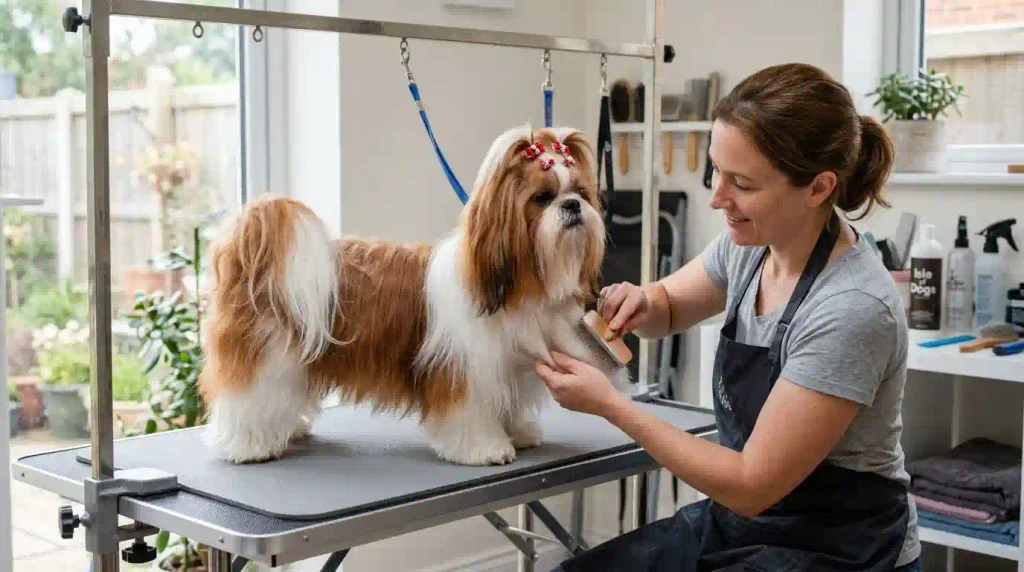
Red-and-white coloring does not require a special grooming method.
The important factor is the Shih Tzu’s long, dense double coat.
When kept long, that coat requires consistent maintenance to prevent tangles from becoming mats.
Brushing, Bathing, and Keeping the Coat Free of Tangles
For a long-coated Shih Tzu, frequent brushing is essential.
The AKC advises daily brushing for a Shih Tzu kept in a long coat, while the American Shih Tzu Club notes that grooming frequency may vary with coat texture and length.
Areas especially prone to matting include:
- Behind the ears
- Under the front legs
- Around the neck
- Chest
- Belly
- Inner legs
- Tail area
- Areas under collars or harnesses
Brush in layers rather than simply passing a brush over the outside of the coat.
A comb can then help confirm that you have worked through to the skin.
This is particularly important during the puppy-to-adult coat transition, when some Shih Tzus can become more prone to tangling.
Bathing
Bathing should be based on:
- Coat length
- Lifestyle
- Activity
- Skin condition
- How quickly the coat becomes dirty
Use a shampoo formulated for dogs and rinse thoroughly.
Conditioning can make a long coat easier to detangle, especially when the hair is dry or friction-prone.
Do not bathe a badly matted coat without addressing the mats first. Water can tighten existing tangles and make them harder to remove.
A short pet trim may be a practical alternative for owners who do not want to maintain a floor-length coat.
Whether you have a red-and-white dog, grey and white Shih Tzu, brown and white Shih Tzu, or tan and white Shih Tzu, grooming requirements depend far more on coat length and texture than on color.
Keeping White Areas Clean Without Overclaiming Stain Causes
White hair makes discoloration more visible.
Commonly noticeable areas include:
- Hair below the eyes
- Muzzle
- Beard
- Chest
- Front paws
- Hair around the mouth
Moisture, food, saliva, dirt, environmental debris, and natural secretions can all affect how light-colored hair looks.
However, visible staining should not automatically be blamed on a single cause.
For example, persistent discoloration under the eyes may occur alongside excessive tearing, but the underlying reason for tearing can vary.
Do not assume that every reddish or brown stain means:
- Food allergy
- Infection
- Poor-quality food
- Water minerals
- One particular disease
Instead, focus on routine cleanliness and look for signs that indicate a veterinary evaluation may be appropriate.
These include:
- Persistent excessive tearing
- Eye redness
- Swelling
- Squinting
- Foul odor
- Thick discharge
- Skin irritation
- Constant rubbing of the face
For routine cleaning, gently keep facial hair clean and dry using products appropriate for dogs.
Avoid harsh bleaching chemicals or products that could irritate the eyes or skin just to make white hair look brighter.
Protect the Red Coat Without Chasing Color
Sun exposure, normal coat maturation, grooming, and hair wear can influence the visible intensity of a red coat.
You do not need special supplements or color-enhancing treatments simply because your dog is red and white.
A healthy coat depends more on:
- Appropriate nutrition
- Routine grooming
- Healthy skin
- Veterinary care
- Gentle detangling
- Preventing severe matting
Do not choose supplements purely because they claim to make a red coat darker unless your veterinarian has identified an actual nutritional need.
The goal is a healthy coat, not artificially maintaining puppy color.
Red and White Shih Tzu FAQs
Is red and white an official Shih Tzu color?
Yes. Red & White is currently listed as an AKC Shih Tzu registration color.
What does a red and white Shih Tzu look like?
It has red, copper, auburn, or reddish-gold coat areas combined with clearly visible white markings.
Does a red-and-white Shih Tzu need to be half red and half white?
No. The proportion and distribution of the two colors can vary greatly.
Can a red and white Shih Tzu be mostly white?
Yes. A dog can be predominantly white with red patches and still reasonably be described as red and white.
Can a red and white Shih Tzu be mostly red?
Yes. Some dogs are predominantly red with smaller white areas on the chest, face, paws, or other parts of the body.
What color nose should a red-and-white Shih Tzu have?
Ordinarily the nose is black, unless the dog has liver or blue pigmentation.
Is red and white the same as liver and white?
No. Red describes coat shade, while liver refers primarily to brown-based pigmentation.
Is red and white the same as gold and white?
No, although shades can overlap; red generally appears more copper, auburn, or orange-red, while gold is usually more yellow-gold.
Can a red-and-white puppy become gold as an adult?
Its red areas may become lighter or more golden-looking, but the degree of color change varies among individual dogs.
Can red-and-white Shih Tzus have black masks?
Dark facial shading or black markings can occur, so markings should be evaluated separately from the base coat colors.
Is red and white a parti-color Shih Tzu?
The term parti-color may be used for dogs with clearly separated white and colored areas, including some red-and-white Shih Tzus.
Is a red and white Shih Tzu rare?
Color frequency can vary among bloodlines and populations, so the label alone should not be used to make unsupported rarity or price claims.
Are red-and-white Shih Tzus more expensive?
Price depends on breeder practices, pedigree, location, health care, demand, and other factors rather than coat color alone.
Does the red-and-white coat affect temperament?
Coat color alone does not determine whether an individual Shih Tzu will be affectionate, active, calm, stubborn, or easy to train.
Does a red and white Shih Tzu need special grooming?
No. Its grooming needs are based on the Shih Tzu coat itself, although staining may be more visible on white hair.
Are red-and-white Shih Tzus hypoallergenic?
Color does not affect allergy potential; see our guide to whether the Shih Tzu is hypoallergenic for a fuller explanation.
Final Thoughts
A red and white Shih Tzu can range from a mostly red dog with small white markings to a predominantly white dog with striking red patches. The colored areas may appear copper, auburn, orange-red, or reddish gold, and that intensity can change as the puppy develops its adult coat.
For accurate identification, consider the coat shade, white markings, and pigmentation separately. A black nose is typical, while brown liver pigmentation points to a different pigment type even when the coat itself looks red.
Most importantly, do not choose a puppy based only on a particular shade or claims that one pattern is superior. Health, temperament, responsible breeding, and proper care matter more. For broader comparisons, explore our complete Shih Tzu colors guide and dedicated red Shih Tzu article.