
Can Shih Tzu Swim? Risks, Safety Tips, and Training Steps
Can Shih Tzu swim? Some can paddle and even enjoy the water, but Shih Tzus are generally not strong swimmers. Their short legs, compact bodies, flat faces, and heavy coats can make swimming tiring. A dog that paddles for a few seconds may still struggle to keep its nose above water or find a way out of a pool. That is why swimming should be an optional, closely supervised activity for this breed.
If your Shih Tzu seems curious about water, you can introduce it slowly in a calm, shallow place. Use a properly fitted dog life jacket, stay close enough to help immediately, and stop before your dog becomes tired or frightened. You should also consider your dog’s health, the weather, and the water conditions before every session. This guide explains how to recognize a comfortable swimmer, teach safe entry and exit, handle pools and natural water, and care for your Shih Tzu afterward. It also covers enjoyable ways to play in water if swimming is not right for your dog.
Table of Contents
- Can Shih Tzus Swim?
- Why Is Swimming Difficult for Shih Tzus?
- Is Swimming Good Exercise for a Shih Tzu?
- When Should a Shih Tzu Avoid Swimming?
- First-Swim Checklist for Shih Tzu Owners
- How to Teach a Shih Tzu to Swim
- Swimming Safety at Pools, Lakes, and Beaches
- How to Care for Your Shih Tzu After Swimming
- Water Activities for Shih Tzus That Do Not Involve Swimming
- Frequently Asked Questions
- Final Thoughts
Can Shih Tzus Swim?
Yes, a Shih Tzu may be able to dog paddle, especially when introduced to water gently. Swimming ability varies from dog to dog, however. Paddling does not prove that a dog can swim safely for long, breathe comfortably, or reach an exit without help.
The American Kennel Club describes the breed as a poor swimmer because of its short face and heavy coat. That does not mean every individual Shih Tzu dislikes water. It means owners should avoid assuming that swimming comes easily to the breed.
Think of swimming as a choice your dog may enjoy under the right conditions, not a skill it must master. Your goal is a calm experience with an easy way out. If your dog prefers to stand in ankle-deep water or watch from dry ground, that is a perfectly good outcome.
Do Shih Tzus Like Water?
Some Shih Tzus willingly step into a kiddie pool or follow their owner toward a quiet shoreline. Others dislike wet paws, splashing, or the feeling of losing contact with the ground. A dog’s response may depend on its confidence, previous experiences, and the setting.
Pay attention to your own dog instead of relying on breed-wide claims that Shih Tzus either love or hate water. A dog that enjoys a bath may dislike a lake, while one that avoids baths may happily splash in a shallow pool. Those activities feel and sound different.
Let your Shih Tzu investigate at its own pace. Start near water without asking it to enter. Reward relaxed curiosity with praise or a treat. If it chooses to walk away, allow that choice. Forcing a nervous dog into deeper water can create fear and make later introductions harder.
What Does Comfortable Swimming Look Like?
A comfortable dog appears calm and able to move toward a clear exit. Its paddling is coordinated, its body remains reasonably level, and it can keep its nose and mouth above water without repeatedly throwing its head back. Once out, it settles and breathes normally.
Also watch what your Shih Tzu chooses to do after a break. Does it approach the shallow edge again, or does it avoid the water? Willingness to return is one useful sign of comfort, though it never replaces close supervision.
Stop the session if your dog begins frantic splashing, holds its head unusually high, sinks at the rear, tries desperately to climb onto you, or cannot reach the exit. Noisy breathing, coughing, gasping, or a sudden drop in energy are further reasons to get it out immediately. A life jacket offers flotation support, but it cannot tell you whether your dog feels safe.
Why Is Swimming Difficult for Shih Tzus?
A Shih Tzu faces several challenges at once in water. Short legs limit how efficiently it can paddle. Its short muzzle leaves less room to keep the nose clear of the surface. A long coat can hold water, adding to the effort of moving.
These traits do not predict exactly what every dog will do. They do explain why a Shih Tzu that looks confident on land might tire quickly while swimming. Learn the risks before deciding whether your dog should enter water beyond standing depth.
Short Legs, Body Shape, and Limited Stamina
Swimming demands continuous movement. On land, your Shih Tzu can stop walking whenever it wants. In deeper water, it must keep paddling or rely on flotation and your help. Its short legs and compact body can make that work demanding.
Fatigue may arrive sooner than an owner expects. A dog might manage a short, supported paddle and then lose coordination on the next attempt. Excitement can hide early tiredness, so do not wait for obvious exhaustion before taking a break.
A brief session in shallow, calm water gives you a better chance to observe your dog than a long swim across a pool. Keep the exit close, return to dry ground frequently, and end while your dog is still comfortable. There is no distance a Shih Tzu needs to swim to make the experience worthwhile.
Flat Faces and Breathing Difficulties
Shih Tzus are a brachycephalic breed, meaning they have relatively short muzzles and flat faces. Some also have narrowed nostrils or other airway difficulties. Swimming can make breathing harder because the dog must work physically while keeping its mouth and nose above the surface.
To clear the water, a Shih Tzu may lift its head high. That head position can make efficient paddling more difficult. Warm weather adds another concern: flat-faced dogs may struggle during heat and exertion, even when the water feels refreshing to a person.
A Shih Tzu that breathes noisily during ordinary activity, tires easily, or has a known airway condition needs veterinary advice before swimming. Stop immediately if breathing sounds harsh, your dog gasps, or it cannot recover comfortably during a break. Do not treat repeated breathing difficulty as a normal part of learning.
Long Coats and Waterlogging
A long Shih Tzu coat absorbs and holds water. Wet fur can add weight, cling around the legs, and cover the eyes or face. Your dog may then need to work harder to paddle and see where it is going.
A shorter haircut can make drying easier, but it does not remove the breed’s other swimming limitations. A long-haired Shih Tzu can still enter shallow water with close support if its health and behavior make that reasonable. It needs careful supervision, a suitable life jacket, and an owner ready to lift it out.
Wet coats also require attention after the activity. Moisture trapped near the skin or ears may lead to irritation. Plan for rinsing and thorough drying before you plan a swim; do not wait until a tired, soaked dog is already in the car.
Is Swimming Good Exercise for a Shih Tzu?
For a healthy Shih Tzu that enjoys water, a short swim may provide low-impact exercise. The water supports some of the dog’s weight while it moves its legs. Yet “low impact” does not mean “low effort.” Swimming can place a considerable demand on a small dog’s stamina and breathing.
Ask your veterinarian whether swimming suits your dog if it has a heart condition, breathing problem, joint pain, or another health concern. The answer depends on the individual dog, not simply its breed or age. A professional may suggest a controlled setting, a different form of exercise, or no swimming.
Do not use swimming to push a dog that is reluctant to walk or play. A change in activity or stamina may need a health check. Likewise, a Shih Tzu that enjoys water does not need increasingly long sessions. Comfort and recovery matter more than exercise time.
Swimming Compared With Walks and Agility
Short walks allow a Shih Tzu to move, sniff, and rest with all four paws on the ground. Indoor play and simple training games can provide activity without the risks of deep water. Beginner-level agility or carefully chosen obstacle games may appeal to a lively dog, provided the activity suits its health.
Swimming offers a different experience: water movement, novelty, and a way to exercise without repeatedly landing on a hard surface. It also requires special equipment and immediate supervision. For many Shih Tzus, ordinary walks and play are easier activities to fit into a routine.
If your dog swims occasionally, treat it as one option within Shih Tzu daily care. Keep its usual walks, rest, grooming, and play in mind. A busy water day may leave your dog ready for a quieter evening; the guide to shih tzu sleeping can help you think about its normal rest routine.
When Should a Shih Tzu Avoid Swimming?
Skip swimming whenever your dog’s health, mood, or surroundings make safe paddling uncertain. There is no benefit in persuading a frightened Shih Tzu to enter deep water. Shallow water play or a dry activity can still make the outing enjoyable.
Check both the dog and the setting before each session. A place that worked last week may have colder water, stronger currents, or a busier shoreline today.
Age, Health Conditions, and Recent Surgery
Puppies need gentle introductions and should never be expected to cope with deep water on instinct. Older dogs may have reduced strength, balance, sight, or hearing. Age alone does not give a yes-or-no answer, but it changes how carefully you should assess the activity.
Speak with a veterinarian before swimming if your Shih Tzu has breathing or heart problems, joint disease, an active ear or skin condition, or a history of struggling in water. Wait for veterinary clearance after surgery or illness. A dog that cannot comfortably exercise on land is unlikely to be ready for an unsupported swim.
Also consider medication, recent symptoms, and your dog’s behavior that day. If it seems weak, unusually sleepy, uncomfortable, or reluctant to move, choose rest and seek veterinary advice where appropriate. Swimming should happen only when your dog is well enough to enjoy it.
Cold Water, Currents, and Wildlife
A quiet-looking lake or pond can hide hazards. Water temperature may be much colder than the air. Rivers can have currents that are difficult to see, while ocean waves and tides can change quickly. A small dog that loses its footing may be carried away before it can paddle back.
Wildlife adds another reason to remain cautious near natural water. Keep your Shih Tzu under close control and away from animals it may chase. Do not enter water when you cannot judge its depth, footing, or cleanliness.
For a first introduction, a controlled shallow pool is easier to assess than an open beach. Even there, check the surface for slips and make sure your dog can leave without climbing a steep wall. If you are unsure about the setting, enjoy the view from shore.
Signs of Fear, Fatigue, or Breathing Trouble
Fear may show up as freezing, backing away, refusing treats, trembling, or frantic efforts to escape. Your dog does not need to reach the point of panic before you end the activity. Step back to dry ground and let it settle.
Fatigue can look like slower paddling, a sinking rear, difficulty turning, or an unusually high head position. Breathing trouble may include gasping, harsh airway noise, or coughing. Lift your dog out promptly if these occur.
After an upsetting water experience, watch its breathing and energy. If it has persistent coughing, labored breathing, collapse, or other concerning symptoms, contact a veterinarian urgently. Problems can become apparent after a dog has left the water. The American Animal Hospital Association’s water-safety guide also advises owners to monitor for delayed symptoms after water activities.

First-Swim Checklist for Shih Tzu Owners
Before allowing your dog into water, check the following:
- Your dog feels well: No unusual breathing, weakness, illness, or recent procedure that requires veterinary clearance.
- Your dog seems willing: It approaches calmly and can leave whenever it wants.
- The water is calm and shallow: You can clearly see and reach your dog.
- The exit is obvious: A gentle slope, pool steps, or a suitable ramp lets your dog return to dry ground.
- A dog life jacket fits: It stays secure without slipping or restricting movement.
- An adult is within reach: Someone can help immediately throughout the session.
- Fresh water and shade are available: Your dog can drink and rest away from the sun.
- The session is brief: You plan to stop while your dog is still relaxed.
Bring a towel, too. If you visit a lake, check local water advisories and inspect the shoreline before your dog approaches. If you use a pool, secure the area when swimming is over so your Shih Tzu cannot return alone.
A checklist makes preparation easier, but it is not permission to continue when your dog looks distressed. Your Shih Tzu’s behavior always takes priority over the plan.
How to Teach a Shih Tzu to Swim
Teach water confidence before you ask for swimming. The steps below are a gradual introduction, not a promise that every Shih Tzu will learn to enjoy deep water. You can stop at shallow wading if that is what your dog prefers.
Keep your voice relaxed and each attempt short. Never throw a dog into water to see whether it can paddle. A frightened dog may move its legs instinctively while still struggling to breathe or find safety.
Choose a Calm, Shallow Place With an Easy Exit
Pick a location where your Shih Tzu can stand with its head comfortably above water. A shallow pool with a gradual entry or an appropriate sloped shoreline can work. Avoid waves, slippery drops, and crowded areas during early sessions.
Identify the exit before your dog enters. At a pool, show it the steps or pet ramp. At a shoreline, choose firm ground that will not slide under its paws. If the only exit is a ladder or a wall too high for your dog, choose another place.
Stay close enough to reach your Shih Tzu at once. Check the water temperature with your hand and observe how the dog reacts. If it shivers, hesitates, or repeatedly heads back to dry ground, end the attempt. You can try another day without turning the experience into a struggle.
Fit a Dog Life Jacket and Check That It Fits Properly
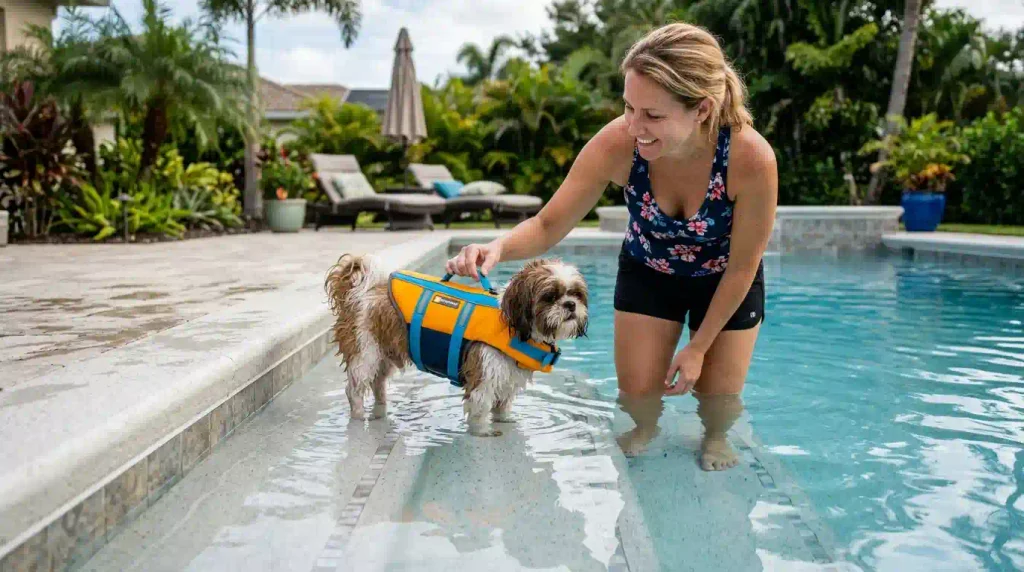
Choose a canine life jacket sized for your dog’s measurements and weight. Fasten it according to the maker’s instructions, then check that it sits securely around the chest without rubbing the neck or restricting the shoulders. Your Shih Tzu should be able to walk and turn comfortably on land.
A jacket that twists, slides forward, or lets a leg slip through is unsafe. Check the fit again in very shallow water, where you can fully support your dog. A bright color can make your dog easier to spot, while a sturdy rescue handle may help you lift it from the water.
A life jacket adds buoyancy; it does not prevent panic, breathing difficulty, overheating, or every accident. Never use one as a reason to let your Shih Tzu swim alone or venture farther away. Keep a hand ready to support your dog throughout the first attempts.
Introduce Water Gradually
Begin near the edge. Allow your Shih Tzu to sniff, look, and decide whether to step closer. Praise calm interest. If it willingly places its paws in shallow water, let it pause there rather than leading it deeper immediately.
On another attempt, your dog may choose to walk through slightly deeper water while its feet remain on the bottom. Follow its pace. The aim is to build water confidence through familiar, manageable experiences.
If your dog backs away, do not pull it in on a leash. Return to an easier step or stop for the day. Some Shih Tzus enjoy shallow water but never want to swim. That preference is worth respecting.
Support Your Dog While They Paddle
Once your Shih Tzu is relaxed in shallow water and wearing its jacket, you can gently support its chest and rear as its feet leave the bottom for a moment. Keep its face clear of the surface. Guide it toward a nearby exit so the movement has a clear, safe end.
Look for coordinated paddling and comfortable breathing. If your dog splashes frantically, stiffens, or tries to climb up your body, take it back to standing depth. Do not hold it in place to “finish” a swimming lesson.
Keep the distance very short. Supported paddling is enough to learn how your dog responds; it does not need to cross a pool. Your hands and the life jacket are there to provide security while you observe, not to make a reluctant dog swim.
Teach Them How to Leave the Water
A Shih Tzu may paddle toward the side of a pool yet be unable to climb out. Knowing the exit matters as much as knowing how to move through water.
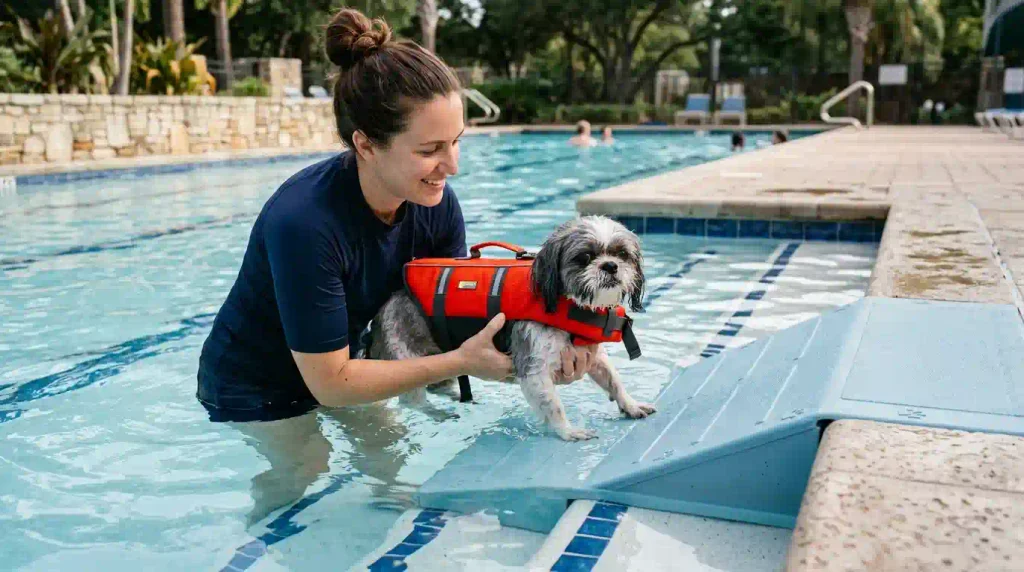
From a point close to the steps or ramp, calmly guide your dog to it. Let it feel firm ground and walk out. Repeat only while it remains relaxed. Over time, you can practice approaching the same exit from a few nearby positions, always with immediate support.
Keep that exit available whenever your dog is near the water. A ramp should be secure, easy to find, and suitable for a small dog. Once the session ends, close gates and restore the pool barrier. An exit lesson is helpful, but it does not make unsupervised pool access safe.
Use Praise and Keep Sessions Short
Reward the behaviors you want to see: approaching calmly, standing in shallow water, turning toward the exit, and resting when called. A small treat or gentle praise can help make the activity pleasant. Keep treats on dry ground where your dog can eat and swallow comfortably.
There is no universal safe swim duration for every Shih Tzu. A dog’s fitness, breathing, coat, water conditions, and level of excitement all matter. Start with very brief exposure and take frequent breaks on land. Stop before you see fatigue.
Finish with an easy success, such as stepping out of shallow water. If your Shih Tzu still seems curious next time, you can repeat the lesson. If it avoids the water, choose another activity. Positive reinforcement works best when your dog has a real choice.
Swimming Safety at Pools, Lakes, and Beaches
Different places call for different precautions. A pool has walls and chemicals. A lake may have changing water quality and an uneven bottom. A beach brings waves, salt water, and tides. None becomes safe simply because your dog can paddle.
Assess the setting before you let your Shih Tzu near the edge. Keep its life jacket on around deeper water, stay within reach, and give it a clear route back to land. Bring fresh drinking water so it is less likely to drink from the pool, lake, or ocean.
Supervision, Pool Barriers, and Exit Ramps
An owner should actively watch a Shih Tzu whenever the dog is in or near water. “Supervised” means close enough to notice a problem and respond immediately. Watching from across the yard is not enough for a small dog that may tire quickly.
Install a secure pool fence to limit accidental access. Check gates after gatherings, when people may leave them open. Pool steps or a pet-friendly exit ramp can help a dog leave the water, but your Shih Tzu needs to learn where that exit is while you are present.
Do not rely on a pool cover as a walking surface. A dog could fall onto it or become trapped. Keep toys, food, and drinking bowls away from an unfenced edge so they do not draw your dog toward a fall. Around boats and docks, use the same close supervision and a fitted life jacket.
Check Local Water Advisories Before Visiting a Lake
Before a lake or pond visit, look for local warnings about water quality. Conditions may change after warm weather or runoff. Avoid water that looks scummy, foamy, discolored, or paint-like, and keep your dog away from visible algae.
A clear-looking area does not guarantee that an entire lake is safe. Follow posted closures and local health guidance. If you cannot assess the water confidently, let your Shih Tzu enjoy the shoreline without entering it.
Prevent your dog from drinking lake water or licking suspicious material from the bank. Bring fresh water and a towel. If you suspect exposure to a harmful bloom, move your dog away from the area and contact a veterinarian promptly. Do not wait for obvious illness before seeking advice.
Prevent Your Shih Tzu From Swallowing Too Much Water
Dogs may gulp water while paddling, playing with a floating toy, or repeatedly snapping at splashes. Drinking a large amount quickly can make a dog ill. Offer fresh water on land and interrupt games that encourage constant swallowing.
Watch your Shih Tzu’s mouth and head position during swimming. Frantic paddling or repeated dips below the surface may increase the chance of inhaling or swallowing water. Remove your dog from the water if it coughs, gags, or appears unable to keep its face clear.
Use rest breaks to observe how it behaves away from the excitement of play. If vomiting, weakness, unusual behavior, or other concerning symptoms develop after substantial water intake, seek veterinary help. Preventing repeated gulping is much easier than trying to judge afterward how much water a small dog swallowed.
Pool Chemicals and Salt Water
A properly maintained pool can be suitable for a brief, supervised swim, but pool water is not drinking water. Keep chemicals and chlorine tablets stored where your dog cannot reach them. After swimming, rinse its coat with fresh water and dry it well.
At the beach, prevent your Shih Tzu from drinking salt water. Bring a bowl of fresh water and offer breaks in the shade. Stay away from waves and currents that could knock a small dog off its feet or carry it away.
You do not need to choose between a large lake and a chlorinated pool simply because one sounds more “natural.” Evaluate the actual conditions: clean water, calm entry, easy exit, and your ability to help at once. If those conditions are missing, skip swimming.
What to Do if Your Shih Tzu Falls In or Shows Distress
Respond quickly and calmly. Reach your dog from a safe position and use the life jacket’s handle if one is fitted and you can lift without causing injury. If you must enter the water, consider your own safety and avoid creating a second emergency. Move your Shih Tzu to dry ground and check its breathing and responsiveness.
Seek urgent veterinary care if your dog has labored breathing, persistent coughing, unusual weakness, collapse, or pale or bluish gums. Contact a veterinarian after a serious immersion even if your dog initially seems better; breathing changes may appear later.
An accident is also a reason to reassess the area. Secure the pool, repair a gate, or change how your dog accesses the yard before it returns. Do not make the dog swim again that day to “restore confidence.” Give it time to recover, and ask your veterinarian about any health concerns first.
How to Care for Your Shih Tzu After Swimming
Once your dog is safely out, aftercare helps you spot problems and protect its coat and skin. Offer a quiet rest in the shade and fresh drinking water. Observe its breathing while it settles.
A normal-looking swim does not remove the need to check your dog afterward. Water can remain in a dense coat or around the ears, while coughing and fatigue may become easier to notice after play stops.
Rinse and Dry the Coat, Face, and Ears
Rinse your Shih Tzu with fresh water after a pool, lake, or beach visit. This removes some chlorine, salt, sand, and other material from the coat. Keep the rinse gentle around the eyes and face.
Use a towel to dry the face, paws, skin folds, and ears carefully. Work through a long coat rather than drying only its surface. Damp fur close to the skin can be easy to miss. Brush or comb as appropriate for your dog’s haircut once the coat is ready, taking care not to pull at wet tangles.
Check for redness, discomfort, or trapped debris. Do not put objects into the ear canal to dry it. If your Shih Tzu develops head shaking, an unpleasant ear odor, discharge, or persistent scratching, contact your veterinarian about possible ear irritation or infection.
Watch for Delayed Breathing or Health Problems
Pay attention to coughing, changes in breathing, unusual tiredness, vomiting, diarrhea, or behavior that seems unlike your dog. These signs may relate to water exposure, exertion, or something your dog swallowed. They deserve particular attention after an accidental immersion or a difficult swim.
Breathing trouble is urgent. A Shih Tzu’s short face can already make respiratory effort harder to judge, so do not dismiss persistent coughing or labored breaths as ordinary tiredness. Call a veterinarian promptly for advice, and seek emergency care for severe signs.
Record where your dog swam and what happened if you need veterinary help. Knowing whether it encountered pool water, salt water, or a lake with questionable water quality may help the clinician assess the situation.

Water Activities for Shih Tzus That Do Not Involve Swimming
A Shih Tzu can enjoy water without losing contact with the ground. If yours dislikes swimming or has a health reason to avoid it, choose a gentler activity. The purpose is pleasant play, not completing a swimming lesson.
Continue to supervise shallow water. Small dogs can slip, become frightened, or drink more water than expected during play. Keep the activity brief and stop if your dog shows discomfort.
Shallow Wading, Splash Pools, and Sprinklers
A kiddie pool with a shallow layer of water lets a willing Shih Tzu wet its paws while standing securely. Set it on stable ground in a shaded area, and let your dog step in and out freely. Empty and clean it after use.
Some dogs prefer walking through a shallow splash area or watching a gentle sprinkler. Avoid spraying directly into the face, and prevent repeated biting at the water stream. A dog that stands nearby and watches may still be enjoying the activity on its own terms.
These options can be especially helpful when you want a water-themed play session without deep water, currents, or a pool wall. Keep fresh drinking water available, check the outdoor temperature, and dry your dog afterward.
Supervised Hydrotherapy
Hydrotherapy uses controlled water-based exercise as part of a planned program. A veterinarian may recommend it for a particular dog’s mobility or recovery needs and advise whether it is suitable. It is different from taking a dog to an open lake for a swim.
If your Shih Tzu has joint pain or is recovering from an injury, do not start water exercise on your own. Ask your veterinarian whether a qualified rehabilitation professional and a controlled facility are appropriate. The dog’s breathing, comfort, and medical condition still matter in water.
Hydrotherapy is not necessary for a healthy Shih Tzu to live an active life. Walks, play, and training may be all the exercise your dog needs. Use water activities only when they serve your individual dog well.
Frequently Asked Questions
Can every Shih Tzu learn to swim?
No. Some can learn to paddle, but others dislike water or have health limitations that make swimming unsuitable.
Can a Shih Tzu swim without a life jacket?
Some can paddle briefly, but a fitted dog life jacket is the safer choice around deep water; close supervision is still essential.
How long can a Shih Tzu stay in the water?
There is no safe time for every dog. Keep sessions brief, take frequent breaks, and stop at the first sign of fatigue or distress.
Can a long-haired Shih Tzu swim?
Possibly, but a wet long coat adds work and requires careful supervision, a suitable life jacket, and thorough drying afterward.
Is a chlorinated pool safe for a Shih Tzu?
A properly maintained pool may be suitable for a short supervised swim if your dog can enter and exit safely; prevent pool-water drinking and rinse the coat afterward.
Final Thoughts
Can Shih Tzu swim? Some Shih Tzus can, but paddling ability alone does not make swimming safe. Their short legs, flat faces, and coats can limit stamina, so start in calm shallow water, fit a dog life jacket, and stay close enough to help immediately. Teach your dog where to exit, watch its breathing, and end the session while it is still comfortable. Check lake conditions or pool access before every visit, then rinse, dry, and observe your dog afterward.
If your Shih Tzu prefers shallow wading or staying dry, follow its lead. The best water activity is one your dog can enjoy safely. Before planning a swim, use the first-swim checklist above and ask your veterinarian about any breathing or health concerns.