
Purebred Shih Tzu: How to Verify Pedigree and Breed Traits
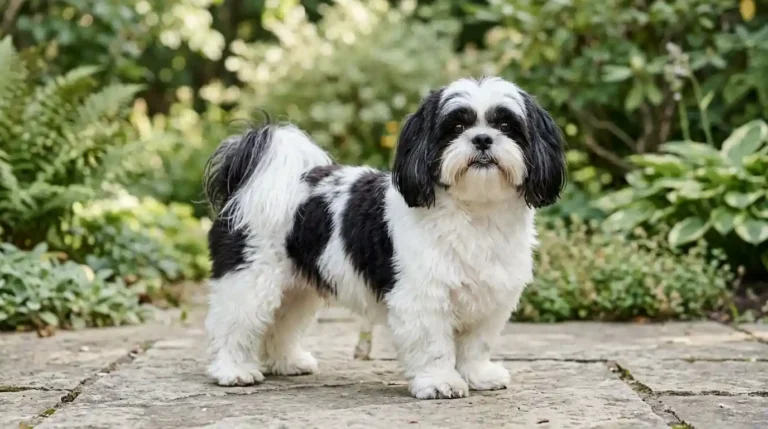
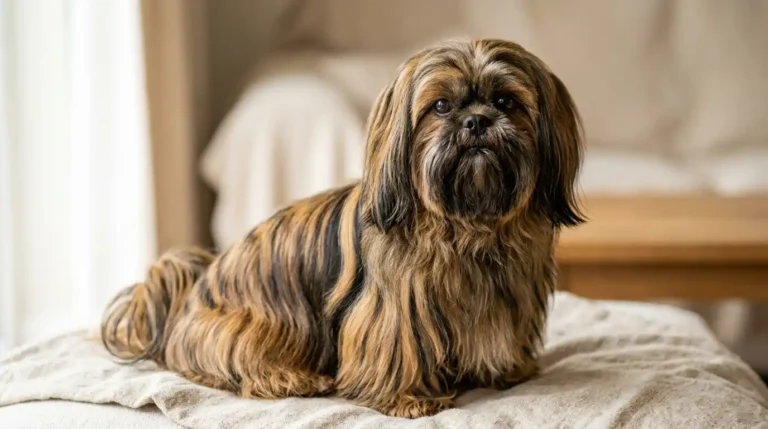
A purebred Shih Tzu is defined primarily by documented ancestry, not simply by having a round face, long coat, curled tail, or other recognizable Shih Tzu features. A dog can look remarkably close to the breed standard yet still have unknown or mixed ancestry, while a registered purebred may have individual traits that differ somewhat from the ideal show description. If you are wondering how to know if your Shih Tzu is purebred, start with registration records, pedigree papers, and information about the sire and dam rather than appearance alone. DNA can also help in specific ways, particularly with parentage verification, but a commercial breed-heritage test is not the same thing as an official pedigree. This guide explains how registration works, which physical characteristics are useful for comparison, how to read a pedigree, what DNA testing can establish, and what to ask a breeder before buying a pure breed Shih Tzu puppy.
Table of Contents
- What does “purebred Shih Tzu” mean?
- Can you identify a purebred Shih Tzu by appearance?
- What documents should you check?
- Can a DNA test confirm that a Shih Tzu is purebred?
- What should you ask a Shih Tzu breeder?
- What if your Shih Tzu has no pedigree papers?
- Purebred Shih Tzu quick answers
- Final Thoughts
What Does “Purebred Shih Tzu” Mean?
A purebred Shih Tzu is a dog whose ancestry traces through Shih Tzus according to the rules and records of the applicable kennel club registry.
In the United States, people commonly associate purebred status with American Kennel Club registration. Other countries have their own recognized kennel clubs and pedigree systems.
Terms such as full breed Shih Tzu, full blooded Shih Tzu, full blood Shih Tzu, and pure Shih Tzu are often used conversationally to mean the same basic thing: a dog whose parents and earlier ancestors are Shih Tzus.
However, those informal phrases are not substitutes for documentation.
If someone tells you that a puppy is a “Shih Tzu full breed” because both parents look like Shih Tzus, that is not the same level of evidence as a traceable pedigree containing registered dogs across multiple generations.
Understanding the breed’s historical development can also help provide context. Our guide to the shih tzu origin explains how the companion breed developed and became established.
How Registry Rules and Documented Ancestry Fit Together
A kennel club registry maintains records connecting dogs with their recorded parents and earlier generations.
For AKC purposes, purebred status is based on recorded ancestry. AKC educational guidance describes a purebred dog as having four generations of recorded pedigree within an AKC-recognized breed.
This is why pedigree papers are more meaningful for ancestry verification than visual appearance.
A pedigree can connect a dog with:
- Its sire
- Its dam
- Grandparents
- Great-grandparents
- Earlier recorded ancestors
The sire is the father of the dog, while the dam is the mother.
A pedigree does not merely say that a dog “looks like a Shih Tzu.” It provides a documented family tree through dogs recorded within the registry.
That distinction becomes especially important when comparing different types of shih tzu. Many terms used online describe appearance, size, or marketing categories rather than separate recognized breeds.
A dog described as imperial, miniature, teacup, European, or another informal type does not gain or lose purebred status simply because of that label.
Purebred Status Versus Breeding Quality
One of the most important distinctions for prospective owners is this:
Purebred does not automatically mean well bred.
A dog can have documented purebred ancestry while coming from poor breeding practices.
Registration alone does not guarantee:
- Excellent health
- Correct structure
- Ideal temperament
- Responsible socialization
- High-quality veterinary care
- Show quality
- Ethical breeding
This is why buyers should look beyond the word “purebred.”
A responsible breeder should care about the overall health, temperament, structure, welfare, and suitability of the dogs being bred.
Likewise, a purebred Shih Tzu price should never be treated as proof of quality.
A very expensive puppy can still come from questionable breeding practices, while price alone cannot tell you whether the pedigree records are accurate or whether appropriate health precautions were taken.
The same principle applies when sellers use terms such as teacup shih tzu to justify unusually high prices.
Can You Identify a Purebred Shih Tzu by Appearance?
Appearance can tell you whether a dog resembles the Shih Tzu breed standard, but it cannot prove its ancestry.
This difference is essential.
A mixed-breed dog can inherit enough Shih Tzu characteristics to look extremely similar to a purebred dog. Conversely, a genuine registered Shih Tzu may have characteristics that differ from the ideal breed-standard description.
You can therefore use physical traits for comparison—but not as definitive pedigree evidence.
Breed-Standard Features to Compare
The official AKC Shih Tzu breed standard describes the physical ideal used when evaluating dogs of the breed.
Several characteristics are especially recognizable.
Compact Toy-Dog Build
An adult standard Shih Tzu is a compact toy dog rather than a tall, narrow, long-legged breed.
The AKC standard gives an ideal height of approximately 9 to 10½ inches at the withers, while allowing a range from 8 to 11 inches. Mature weight is ideally around 9 to 16 pounds.
These measurements are useful for comparison, but they are not a purity test.
A Shih Tzu outside an ideal measurement does not automatically become mixed breed.
Likewise, a dog that falls perfectly within the range is not automatically proven purebred.
Round, Broad Head
The breed standard describes the Shih Tzu’s head as round and broad, with good width between the eyes.
The overall head should look balanced with the dog’s body rather than excessively small or oversized.
Owners often recognize this broad, rounded head shape as one of the classic Shih Tzu characteristics.
Large, Expressive Eyes
Shih Tzus typically have large, round eyes set well apart.
The expression is often described as warm, friendly, trusting, and sweet.
However, eye shape alone cannot establish ancestry. Many companion breeds and mixes can have similar large eyes.
Short Muzzle
A pure Shih Tzu breed typically has a short muzzle.
The breed standard calls for a broad, short, square muzzle with good cushioning around the face.
A very long or narrow muzzle may make a dog look less typical of the breed, but again, appearance cannot replace pedigree evidence.
Long Double Coat
The Shih Tzu has a double coat that can grow long and flowing.
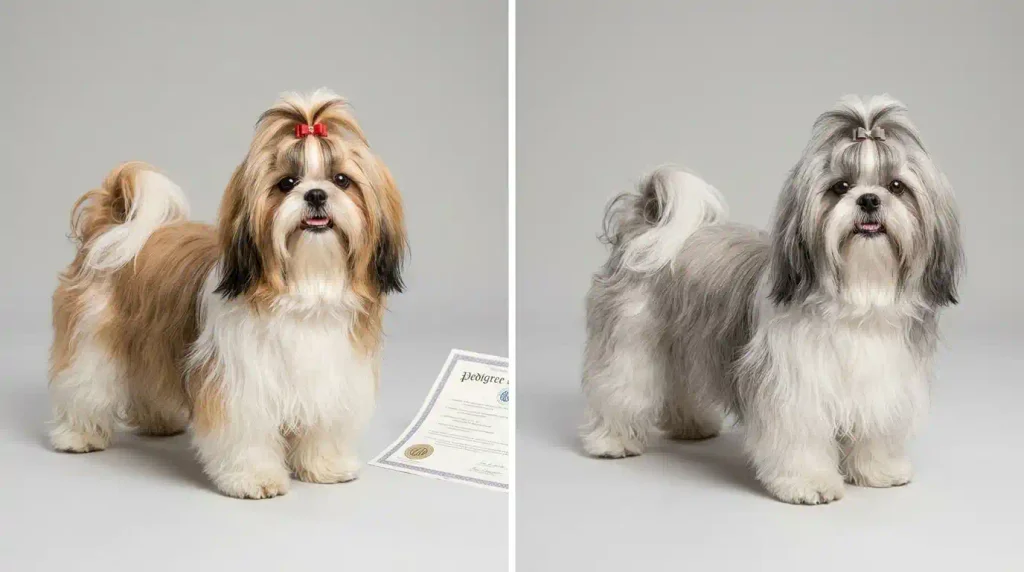
Color itself is not a purity indicator.
A Shih Tzu can occur in many coat colors and markings, which is why a black shih tzu, grey shih tzu, liver shih tzu, or gold and white shih tzu can all belong to the same breed.
If color is causing confusion, the broader shih tzu colors guide explains the range in more detail.
Tail Carried Over the Back
Another recognizable trait is the high-set tail carried curved over the back.
A well-furnished tail contributes to the breed’s characteristic outline.
Again, many mixed dogs can inherit a curled tail, so this feature is useful for comparison but not proof.
Typical Shih Tzu Temperament
Shih Tzus were developed as companion dogs, and their temperament is generally expected to reflect that role.
Common breed characteristics include being:
- Affectionate
- Alert
- Friendly
- Playful
- Companion-oriented
- Comfortable around people when properly socialized
Temperament varies among individuals, so a shy, independent, highly energetic, or unusually reserved dog should not automatically be labeled mixed breed.
Training, socialization, age, previous experiences, environment, and individual personality all influence behavior.
You can explore more general characteristics in our shih tzu Breed Information section and these shih tzu facts.
Why Appearance Cannot Prove Ancestry
Imagine two dogs standing side by side.
One has a round head, short muzzle, long coat, curled tail, and classic Shih Tzu expression but no known ancestry.
The second has documented Shih Tzu parents, grandparents, and great-grandparents but has a slightly longer muzzle or less dramatic coat.
Which one has stronger evidence of purebred status?
The second dog.
Breed resemblance is visual evidence. Pedigree is ancestry evidence.
A mixed-breed dog may strongly resemble one parent breed, especially if the mix contains a high proportion of Shih Tzu ancestry.
This is why phrases such as:
“My dog looks 100% Shih Tzu.”
or:
“The veterinarian said he looks purebred.”
should not be treated as equivalent to pedigree documentation.
A veterinary professional may offer an informed opinion about breed appearance, but without ancestry records, some uncertainty may remain.
What Documents Should You Check?
If you are buying a puppy advertised as a Shih Tzu purebred, paperwork should be part of the verification process.
Do not rely solely on:
- A breeder’s verbal promise
- Photos of the parents
- A social-media listing
- The puppy’s appearance
- A high purchase price
Ask to see the relevant records.
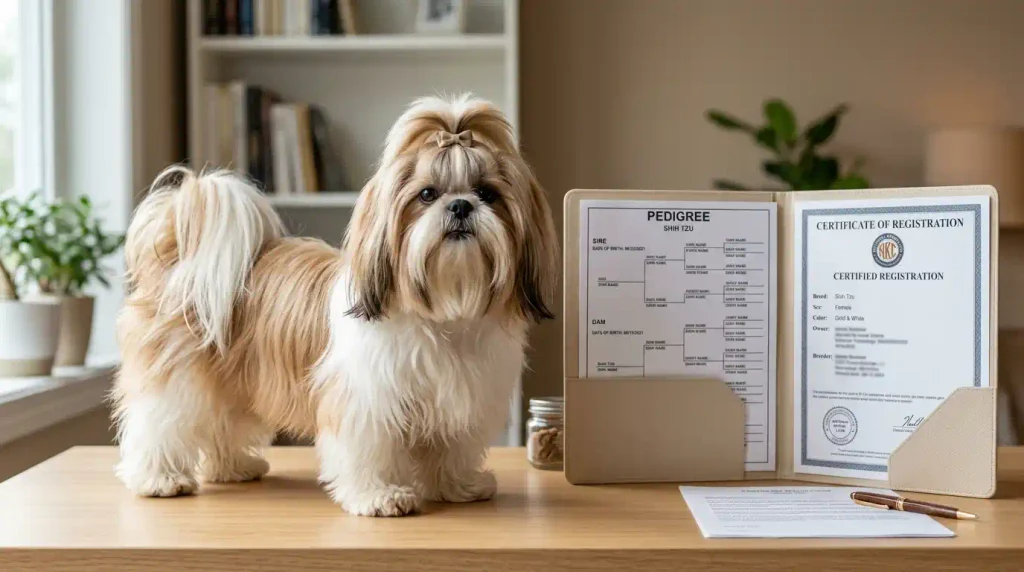
Registration Certificate and Pedigree
A registration certificate identifies the dog within a particular kennel club’s records.
Depending on the registry and document, information may include:
- Registered name
- Registration number
- Breed
- Sex
- Date of birth
- Color or markings
- Breeder information
- Owner information
A pedigree serves a different but related purpose.
It shows the dog’s recorded family tree.
An AKC pedigree can display registered names and registration numbers for ancestors. A four-generation pedigree provides a deeper look at the dog’s recorded lineage than the registration certificate alone.
When checking documentation, confirm that names and identifying information are consistent.
For a puppy, ask whether:
- The litter was registered
- The sire is registered
- The dam is registered
- Puppy registration paperwork is available
- The names on the records match the breeder’s explanation
Do not hesitate to ask questions if something appears inconsistent.
How to Read the Parents and Generations Listed
Pedigrees may look complicated at first, but the basic structure is straightforward.
Your dog appears at the starting point.
Then come the two parents:
- Sire — father
- Dam — mother
Behind each parent are their parents.
That gives four grandparents.
The next generation contains eight great-grandparents.
The family tree continues outward as more generations are displayed.
A four-generation pedigree therefore allows you to trace multiple layers of recorded ancestry rather than simply seeing the names of the immediate parents.
When reviewing pedigree information, look for consistent registered names and registration numbers.
Do not worry if color descriptions differ among ancestors. Shih Tzus occur in many colors, and coat color alone is not evidence that another breed entered the pedigree.
Similarly, one ancestor being smaller or larger than expected does not automatically invalidate the pedigree.
Pedigree evidence concerns documented parentage and lineage, not whether every ancestor perfectly matched the visual ideal.
Can a DNA Test Confirm That a Shih Tzu Is Purebred?
This is one of the most misunderstood parts of purebred verification.
The answer depends on what kind of DNA test you mean.
A breed-heritage test and a parentage verification test answer different questions.
Breed-Ancestry Tests Versus Parentage Verification
Commercial breed-ancestry tests compare genetic markers from your dog against reference populations.
They may return a result suggesting that a dog is:
- Mostly Shih Tzu
- Entirely consistent with Shih Tzu ancestry
- A combination of several breeds
- Genetically similar to certain breed populations
These results can be useful, especially for adopted dogs with unknown backgrounds.
But a breed-heritage result is not the same thing as an official registry pedigree.
A pedigree asks:
Who were this dog’s recorded ancestors?
A breed-ancestry test asks something closer to:
Which reference breed populations does this dog’s DNA most resemble?
Those are related questions, but they are not identical.
What Parentage Verification Does
DNA becomes particularly useful when verifying specific parents.
If the DNA profiles of the puppy, sire, and dam are available, parentage testing can evaluate whether the alleged parents are genetically compatible with producing that puppy.
This strengthens the accuracy of a pedigree because it tests the parent-child relationship.
AKC’s DNA program is designed primarily for genetic identity and parentage verification.
It does not use the DNA profile itself to declare a dog purebred.
That is an important distinction.
What DNA Results Can and Cannot Establish
A DNA profile can be valuable for:
- Identifying an individual dog genetically
- Confirming or excluding parentage
- Supporting registry accuracy
- Investigating uncertain sire or dam information
A commercial breed-heritage test may also provide useful clues for an unregistered dog.
But DNA results do not automatically create missing pedigree papers.
If an adopted dog has no documented ancestry but receives a result showing strong Shih Tzu genetic similarity, that can support the conclusion that the dog has Shih Tzu ancestry.
It does not reconstruct a missing official family tree.
Likewise, a DNA profile alone cannot tell you:
- Whether the dog meets the show standard
- Whether the dog has ideal temperament
- Whether the breeder used responsible practices
- Whether the dog will remain healthy
- Whether the dog is breeding quality
Genetic identity, pedigree, health testing, conformation, and breeding quality are separate concepts.
This also explains why discussions about shih tzu wolf dna should not be confused with modern pedigree verification. Breed history and distant genetic relationships are very different from proving the identity of a puppy’s recent sire and dam.
What Should You Ask a Shih Tzu Breeder?
If you are buying a purebred Shih Tzu, the breeder should be willing to discuss more than color, size, and price.
A responsible breeder should be able to explain the puppy’s background and provide relevant records.
Verify Parent Records, Health Tests, and Contract Terms
Start with ancestry.
Ask:
Are the sire and dam registered?
Request their registered names and available documentation.
Then ask:
Is the litter registered or eligible for registration?
Clarify what paperwork you will receive and whether there are registration restrictions.
Next, discuss health.
Even when a registry or parent club does not impose a mandatory test for every condition, responsible breeders should know the health history of their lines and discuss health concerns openly.
Ask about:
- Veterinary care
- Health history of the parents
- Previous health problems in the breeding line
- Vaccinations
- Parasite control
- Puppy health examinations
- Any health screening performed on the parents
The breeder should also provide a written breeder contract explaining important terms.
Read it before paying a deposit.
Look for information about:
- Health guarantees
- Return policies
- Registration
- Breeding rights
- Spay/neuter agreements where applicable
- What happens if you cannot keep the dog
- Responsibilities of buyer and breeder
A high pure Shih Tzu price does not make these checks unnecessary.
In fact, the more money involved, the more carefully you should verify what you are being promised.
Warning Signs and Responsible Breeder Practices
Be cautious if the seller:
- Refuses to show parent information
- Cannot explain the pedigree
- Claims paperwork will “come later” without clear details
- Uses appearance as the only evidence of purity
- Will not provide a written agreement
- Avoids health questions
- Has many puppies constantly available
- Pressures you to pay immediately
- Focuses almost entirely on “rare” colors
- Charges large premiums for marketing labels without documentation
- Guarantees exact adult size or appearance
- Will not discuss taking the dog back if circumstances change
Also be cautious with claims such as:
“100% pure because both parents look pure.”
“Full breed but no papers needed.”
“Rare color proves premium bloodline.”
“DNA test means AKC registered.”
None of those statements should replace actual records.
A responsible breeder may also ask you many questions.
That is usually positive. Someone who cares where puppies go will want to know about your home, experience, schedule, and expectations.
What if Your Shih Tzu Has No Pedigree Papers?
Many loved Shih Tzus come from shelters, rescues, private rehoming situations, or families that no longer have the original paperwork.
If that describes your dog, lack of papers does not affect the dog’s value as a companion.
It simply limits what can be proven about ancestry.
What You Can Check—and What May Remain Unknown
Start by gathering whatever history is available.
Ask previous owners or the rescue whether they know:
- Where the dog came from
- Who the breeder was
- Whether registration ever existed
- Names of the parents
- Veterinary records
- Microchip information
- Previous owner records
Next, compare the dog’s appearance with the breed standard.
Look at:
- Body size and proportions
- Head shape
- Muzzle
- Eyes
- Coat type
- Tail carriage
- Overall expression
This can tell you whether the dog strongly resembles a Shih Tzu.
You can also consider a commercial breed-heritage test if ancestry information is important to you.
However, be realistic about the conclusion.
Without documented pedigree records connecting your dog to registered parents and earlier generations, you may not be able to prove official purebred status retrospectively.
A dog can still be accurately described as Shih Tzu-like, predominantly Shih Tzu by ancestry testing, or believed to be a Shih Tzu depending on the evidence available.
There is nothing wrong with acknowledging uncertainty.
For most companion owners, knowing the dog’s actual health needs, temperament, grooming requirements, and personality is much more useful in daily life than proving a formal label.
Purebred Shih Tzu Quick Answers
Does a Shih Tzu that looks purebred count as proven purebred?
No; appearance can support identification, but documented ancestry provides stronger evidence of purebred status.
Does registration guarantee health or show quality?
No; registration documents ancestry within the registry and does not guarantee health, temperament, or show quality.
How do I know if my Shih Tzu is purebred?
Check registration records, pedigree documentation, registered parents, and available parentage information rather than relying only on appearance.
What is a full blooded Shih Tzu?
“Full blooded Shih Tzu” is an informal phrase generally used to mean a purebred Shih Tzu.
Is a full breed Shih Tzu the same as a purebred Shih Tzu?
People usually mean the same thing, although “purebred” is the clearer pedigree-related term.
Can a veterinarian tell if my Shih Tzu is purebred?
A veterinarian can assess breed characteristics, but appearance alone cannot definitively prove documented ancestry.
Can DNA prove my Shih Tzu is purebred?
Breed-heritage DNA can suggest ancestry, while parentage DNA can verify parents; official purebred status remains tied to pedigree records under registry rules.
What is a four-generation pedigree?
It is a family-tree record showing multiple generations of registered ancestors behind the dog.
What are sire and dam on Shih Tzu papers?
The sire is the father and the dam is the mother.
Can a purebred Shih Tzu have unusual colors?
Yes; Shih Tzus occur in many colors and markings, so coat color alone does not determine purebred status.
Can a purebred Shih Tzu have a longer muzzle?
Individual dogs can vary from the breed-standard ideal, so one physical difference does not automatically prove mixed ancestry.
Does being small prove a Shih Tzu is purebred?
No; size alone does not establish ancestry.
Is a teacup Shih Tzu more purebred than a regular Shih Tzu?
No; “teacup” does not represent a higher degree of purebred ancestry.
Does a high purebred Shih Tzu cost prove quality?
No; price alone does not prove pedigree accuracy, health, temperament, or responsible breeding.
How much is a purebred Shih Tzu?
Prices vary widely by breeder, location, pedigree, and other factors, so cost should not be used to verify purebred status.
Can a mixed-breed dog look exactly like a Shih Tzu?
Yes; mixed dogs can inherit enough Shih Tzu traits to strongly resemble the breed.
Can I register a Shih Tzu with no pedigree information?
Eligibility depends on the registry and circumstances, so missing ancestry records may prevent ordinary purebred registration.
Are pedigree papers the same as a registration certificate?
No; a registration certificate identifies the individual registered dog, while a pedigree shows its recorded ancestry.
Final Thoughts
A purebred Shih Tzu is best verified through documented ancestry rather than physical appearance alone. Round eyes, a short muzzle, a long double coat, compact build, and curled tail can show that a dog resembles the breed standard, but those characteristics cannot reconstruct a missing pedigree. When buying a puppy, check the registration certificate, pedigree, sire and dam records, breeder contract, health history, and any relevant parentage information before making a decision.
DNA can strengthen parentage verification or provide ancestry clues, but it should not be confused with official pedigree documentation. If your Shih Tzu has no papers, you can still learn a great deal from its appearance, history, veterinary records, and DNA ancestry results—even if some questions about lineage remain unanswered.
For more help understanding the breed itself, explore our shih tzu Breed Information section.