Brindle and White Shih Tzu: Identify the Pattern and Care for the Coat
A brindle and white Shih Tzu has two visible features: darker streaks running through some of its colored hair and separate white areas where that streaking is absent. The colored areas might look gold, tan, red, brown, gray, or almost black; the white might cover a large part of the body or appear as smaller patches on the chest, face, or paws. What matters most is the pattern within the colored areas, not one exact shade or a required amount of white. A white chest and dark face alone do not establish brindle; look for repeated streaks across the back, shoulders, or other colored sections. Hair growth and haircuts may alter how obvious those streaks appear, so a puppy photo is only a starting point. Below, compare the coats that cause the most confusion, learn what genetics and registration actually describe, and follow a grooming routine that protects the dense coat. If you are selecting a puppy, ask for clear photographs and health records before accepting any claim about a “rare” color.
Table of Contents
- What does brindle and white look like?
- Is it brindle and white or another coat pattern?
- Will a brindle and white puppy’s coat change?
- What can genetics and registration tell you?
- Is brindle and white accepted or especially rare?
- How do you maintain the coat and watch the skin?
- What should you check when choosing a puppy?
- Frequently asked questions
- Final thoughts
What does brindle and white look like?
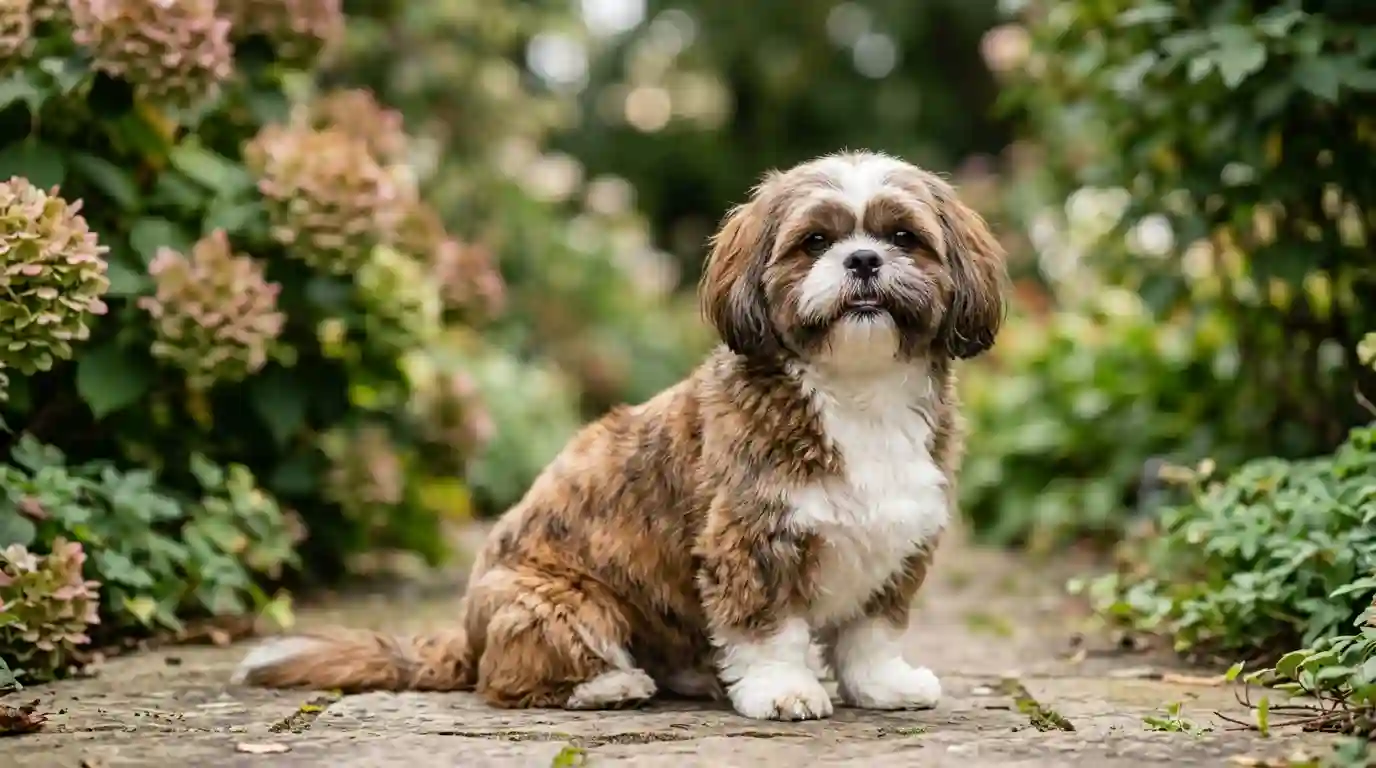
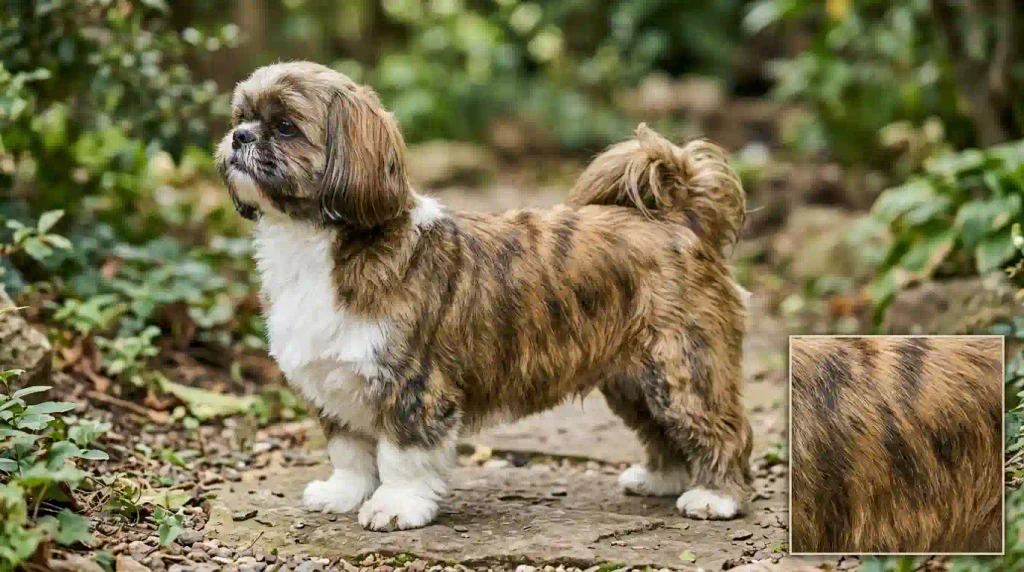
Picture a Shih Tzu with a white chest and legs, plus colored patches over its back and ears. Look closely at one of those colored patches. If darker streaks break up a lighter base, the dog may be brindle and white. On a long coat, the streaks can look less like crisp tiger stripes and more like uneven ribbons of differently colored hair.
Find the streaks in the colored areas
Start with an area large enough to judge, such as the shoulder, flank, or back. Part the hair gently and look from the roots toward the ends in natural daylight. Compare several neighboring sections rather than deciding from a single dark strand. Brindle typically presents as darker streaking across a lighter colored area. A gold or tan base with dark streaks may look bold on a puppy; fine streaks across darker hair may be barely visible until you lift and spread the coat. Very dense striping is sometimes called reverse brindle, a visual description rather than a separate breed.
Similarly, a dog described as a red brindle Shih Tzu has warm-looking colored areas with brindling, while a silver brindle Shih Tzu may look cooler or grayer. These color descriptions should not replace a close inspection of the pattern.
Identify white patches without mistaking them for stripes
The white in brindle and white refers to distinct white markings or patches; substantial white is sometimes called a parti-color coat. The white areas may form a chest marking, cover some paws, run up the face as a blaze, or create a partial shawl around the neck.
Look at where the colored hair ends and the white begins. A white stripe on the face is a marking, not a brindle stripe. A white chest beside a uniformly dark back does not make the back brindle. Equally, a dog can show fine brindle streaks on only the small colored areas visible around its ears or back. White sections give you no information about the stripe pattern beneath the colored sections, so assess those sections separately.
For a wider look at accepted and commonly used descriptions, see the Shih Tzu colors guide.
Is it brindle and white or another coat pattern?
Several Shih Tzu coats combine white and dark-looking hair. The presence of two colors alone cannot distinguish them. Use the pattern in the colored area as your first check; then inspect other markings and pigmentation if a seller uses an additional color term such as blue or liver.
Compare brindle with solid color, black-tipped hair, and a black mask
| Appearance | What to inspect | Practical interpretation |
| Brindle plus white | Repeated darker streaks within colored patches, alongside separate white areas | Consistent with a brindle and white description. |
| Solid color plus white | Colored patches stay fairly uniform when the hair is parted | A two-color coat, but no visible evidence of brindle. |
| Black-tipped hair plus white | Individual hairs have dark ends that create an overall shadow | Tipping can mimic striping from a distance; check several adjacent sections. |
| Black mask plus white | Dark fur is concentrated around the muzzle or face | A facial mask can coexist with brindle, but it does not establish body striping. |
| Mottled light and dark patches | Irregular broad patches rather than streaks through a base color | A description such as merle Shih Tzu refers to a different pattern; have ambiguous cases evaluated carefully. |
A brindle Shih Tzu may have very little white. Conversely, a black and white Shih Tzu has black and white coat areas without necessarily showing any brindle streaks. A face resembling a black mask gold Shih Tzu can draw attention away from faint stripes on the dog’s body. Inspect the back or sides before making the call.
Do not rely on eye color, nose pigment, or one close-up as a stand-alone brindle test. Nose, lip, and eye-rim pigment can help explain an accompanying blue or liver label, but it does not create or rule out striping by itself. A blue brindle Shih Tzu is a useful comparison when gray-looking areas and pigment labels are being confused.

How the amount and placement of white affect the description
White can appear as a small chest patch, white toes, a facial blaze, a neck shawl, or extensive areas across the trunk and legs.
For example, a mostly white dog with a brindled saddle across the back may still be described as brindle and white. A mostly brindled dog with a white chest may also attract the same everyday description. If its back is evenly gold, compare a gold and white Shih Tzu instead. If the colored area looks uniformly pale gray, compare a silver and white Shih Tzu. The difference lies in what happens within the colored hair.
Will a brindle and white puppy’s coat change?
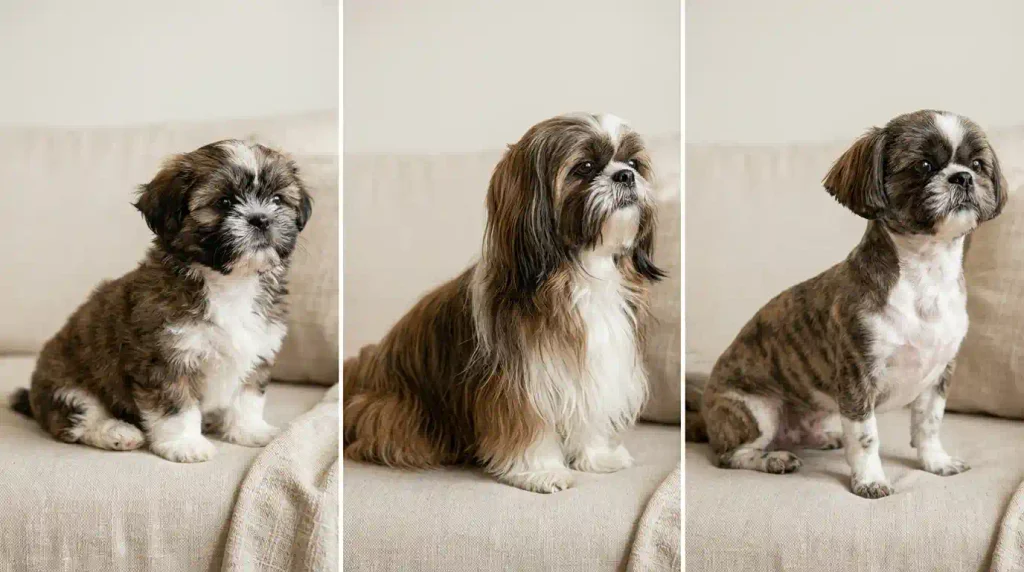
Yes, its appearance may change as new hair grows and the puppy matures. The contrast, length, and arrangement of colored hairs can shift, making a previously obvious pattern look subtler or revealing streaks that were hard to see in the short puppy coat. That does not mean every brindle and white puppy will lose its stripes, and no photograph can guarantee an exact adult shade.
Changes as longer adult hair replaces the puppy coat
A young puppy may display sharp stripes across a short, fluffy coat. As longer adult hair develops, strands from neighboring areas can overlap. Some dark hairs may look less prominent, while lighter or gray-looking hairs become more noticeable. On another dog, increased length or a different trim may make contrasting strands easier to separate. Changes in visible contrast can therefore reflect hair growth and grooming as well as true color fading.
Notice the location of each feature. White markings may remain recognizable even when the adjacent colored area looks different, though their apparent edges can change as hair grows.
If you are comparing several types of Shih Tzu or advertised coat colors, focus on the individual dog’s present features and care needs.
Photograph the same areas before and after grooming
Create a simple record if you are trying to identify your own dog or assess a puppy over time:
- Take a full side view and close views of the back, chest, face, and paws in daylight without a filter.
- Photograph the coat dry and gently combed; wet, matted, or freshly styled hair can alter its appearance.
- Repeat from the same angles after growth or a haircut, with the date and age noted.
- Include a close view of one colored patch with enough surrounding fur to show whether streaks repeat.
- Keep unedited originals rather than judging from a social-media image with boosted contrast.
What can genetics and registration tell you?
Appearance offers a useful description; genes help explain how pigment patterns arise. Keep those two questions separate. A brindle pattern involves how darker and lighter pigment are expressed in colored hair, whereas white markings affect where pigmented coat is visible.
Pigment pattern and white markings in plain language
Dog coat color involves two broad pigment types: eumelanin, associated with black and brown, and pheomelanin, associated with red and yellow tones. Interactions involving the K locus and A locus can influence whether and where those pigments appear in the colored coat. Other loci, including the B locus and D locus, can alter the appearance of dark pigment. White markings involve additional genetic mechanisms. A dog’s final appearance results from several influences together, so a color word is a summary of what you see, not a full genetic formula.
This matters when a page claims that black nose pigment is mandatory for every brindled dog or that one recessive gene alone explains the coat. Such shortcuts leave out other pigment interactions. Likewise, the presence of white paws does not, on its own, establish a particular white-spotting genotype. If a dog has unusual markings, a breeder color claim should be treated as a description until the evidence behind it is clear.
Why a color label or DNA result has limits
A registration color records a selected description for paperwork. It does not certify that every dark strand is brindle, guarantee an adult color, or replace an assessment of the dog’s health. A genetic test can report the variants its laboratory actually examines. Read the named loci, reported variants, interpretation notes, and stated limitations instead of accepting “DNA confirmed rare color” as a complete answer.
Is brindle and white accepted or especially rare?
The breed standard and the limits of rarity claims
For US readers, the direct reference is the American Kennel Club’s official Shih Tzu breed standard. It says that all colors and markings are permissible and considered equally. It also describes the Shih Tzu’s long, dense double coat. Thus, brindle and white is compatible with the standard’s color language; its appearance alone does not create a separate breed or make a dog better suited to show, breeding, or family life.
“Rare” needs evidence. A pattern may be infrequent within one seller’s litters without being rare across all Shih Tzus. If a seller asks a premium for “exclusive brindle and white,” ask for the basis of the claim and evaluate the dog and breeding practices on their own merits. Avoid a numeric rarity ranking unless reliable breed-wide data actually supports it.
Owners considering a purebred Shih Tzu should keep breed identity, color description, and health documentation as separate questions.
How do you maintain the coat and watch the skin?
Brush through the double coat and choose a manageable trim
A Shih Tzu has a double coat, so a smooth surface does not prove the hair underneath is tangle-free. For a long coat, brush daily in small sections and follow with a comb to check near the skin. Work gently from the ends toward the roots. Give extra attention to areas where friction forms mats: behind the ears, beneath the collar or harness, under the legs, along the belly, and around the tail. Tugging at a tight mat hurts; ask a groomer or veterinarian for help rather than cutting close to the skin with scissors. A shorter puppy cut may simplify upkeep, but it still needs regular combing as hair grows. Ask your groomer to show you how to reach the undercoat without scraping the skin.
Clean white areas and recognize changes worth a veterinary check
Check white paws after muddy walks and gently wipe dirt from the chest or muzzle as needed. Bathe when necessary with a dog-appropriate shampoo, rinse thoroughly, and dry the coat completely. A suitable conditioner may make combing easier. Avoid strong whitening agents, especially near the eyes. Persistent eye discharge, squinting, red skin, or a bad odor warrants veterinary advice; do not dismiss it as ordinary staining.
Likewise, color fading is different from patches of missing hair. New bald areas, inflamed skin, persistent scratching, sores, an unpleasant smell, or a coat that suddenly becomes brittle deserve attention. Matted hair can conceal problems beneath both dark and white areas, so part the coat during routine brushing. The brindle and white pattern is not a diagnosis or a reason to delay care. Ask your veterinarian to assess symptoms and their possible causes for the individual dog.

What should you check when choosing a puppy?
A photo can start a conversation about color, but the decision to bring home a puppy should rest on the animal’s welfare, your ability to meet its needs, and clear records. Begin by asking the seller to show the actual puppy in normal lighting, then examine what the label means to them.
Request useful photos and clarify the seller’s color description
Ask for a current, dated side view, a view from above, and close photos of the chest, face, and colored patches.
If the puppy has a uniformly dark back and white chest, it is reasonable to ask whether black and white describes the current appearance more clearly. If a seller uses blue brindle or liver brindle, ask whether they mean the visible hair, skin-point pigmentation, or a test result. Clear answers matter more than a glamorous label.
Review health records and grooming expectations
Use this brief checklist before committing:
- Meet the actual puppy: See it interact in person where practical, or request a live video that identifies the puppy clearly.
- Ask about its parents: Request available health-screening records, the conditions screened, and the identity of each parent.
- Read the paperwork: Check the puppy’s veterinary records, vaccinations and parasite-care history, any written agreement, and what the seller will provide at handover.
- Clarify testing: If color or health DNA testing is advertised, request the complete report and confirm what each result actually addresses.
- Observe everyday care: Look for a clean, comfortable environment, normal movement, and a puppy accustomed to gentle handling.
- Plan for grooming: Budget time for brushing and arrange access to a groomer if you intend to maintain a long coat or regular trims.
- Treat urgency with caution: A claim that this is your only chance to buy a “rare” coat is not a substitute for reviewing the records.
For broader ownership context, browse Shih Tzu Breed Information and practical Shih Tzu facts after you have evaluated the seller’s specific claims.
Frequently asked questions
What is a brindle and white Shih Tzu? A Shih Tzu with brindle streaking in colored coat areas and separate white areas.
Does every brindle and white dog have a mostly white coat? No; the amount and placement of white vary.
Is a black mask the same as brindle? No; a mask is concentrated on the face, while brindle describes streaking in colored coat areas.
Can a brindle and white puppy change color? Yes; growing hair, changes in contrast, and grooming can alter how its coat looks.
Does a DNA result guarantee the adult pattern? No; a report addresses the variants tested and does not promise an exact adult appearance.
Is brindle and white an accepted Shih Tzu marking? The AKC standard permits all Shih Tzu colors and markings equally.
Does the pattern require special grooming products? No; choose gentle, dog-appropriate products according to the coat and skin.
Can a dog with white patches also have a black mask? Yes; a facial mask and white markings can coexist with or without body brindling.
Final Thoughts
To identify a brindle and white Shih Tzu, start with the colored fur: look for repeated darker streaks across a lighter area, then locate the separate white patches. Compare several sections in natural light before settling on a description. A facial mask, dark hair tips, or white chest can change the overall look without proving brindle. As the coat matures or gets trimmed, keep dated photos so you can compare the same areas fairly. Give daily attention to a long coat, watch for mats and skin changes, and seek veterinary advice for symptoms rather than attributing them to color. If you are choosing a puppy, request clear photographs and complete records, then choose for health, temperament, and the care you can provide. The pattern is lovely; the dog behind it deserves the greater attention.