
Black and White Shih Tzu: Coat Patterns, Changes, and Care
A black and white Shih Tzu has one of the breed’s most recognizable looks, but the two colors can appear in surprisingly different ways. One dog may have a mostly black coat with a white chest and paws; another may be predominantly white with dark ears and patches across the back. Owners often wonder what to call these markings, whether a black and white puppy will keep the same appearance, and whether the coloring affects grooming, health, or price. The practical answer is that “black and white” describes what you see, while terms such as parti and piebald describe types of white spotting. A photograph can help you describe a coat, but it cannot prove the exact genes behind it or predict an adult dog’s final shade. This guide gives you a simple identification checklist, explains the genetics without overstating what a DNA test can reveal, and covers the care decisions that matter most. If you are comparing puppies, you will also learn how to evaluate color and rarity claims while keeping health, temperament, and lifelong grooming needs in view.
Table of Contents
- What Does a Black and White Shih Tzu Look Like?
- What Is the Difference Between Parti, Piebald, and Tuxedo Markings?
- Why Does This Coat Have White Areas?
- Will a Black and White Puppy Change Color?
- Is Black and White Recognized or Rare?
- How Do You Groom a Black and White Shih Tzu?
- Does Coat Color Affect Health or Personality?
- How Do You Choose a Puppy or Adopt an Adult?
- Frequently Asked Questions
- Final Takeaway
What Does a Black and White Shih Tzu Look Like?
The quick answer and common placement of black and white
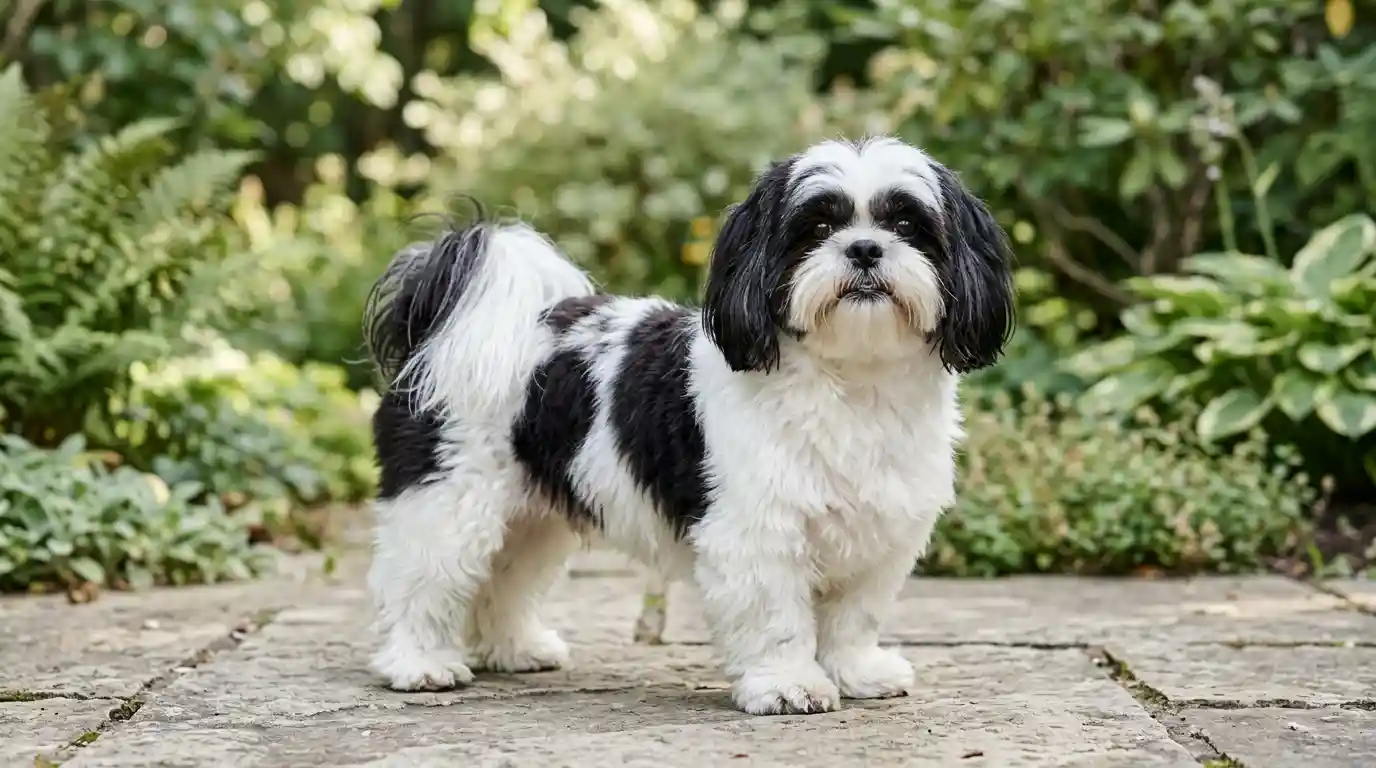
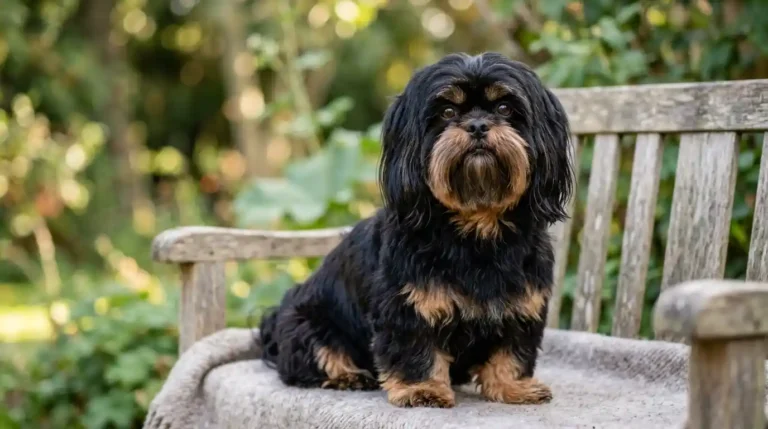
A black and white Shih Tzu has visibly black hair and visibly white hair in the same coat. The description does not require an even split. Both a mostly black dog with small white areas and a mostly white dog with distinct black patches can fit it.
Black may cover the ears, face, back, sides, or tail. White may appear on the forehead, muzzle, chest, belly, paws, or legs. Each dog has its own arrangement. Two puppies in the same litter can have noticeably different markings, and the left and right sides of one dog need not match.
A Shih Tzu’s long coat also affects how clearly you can see the pattern. Flowing hair can overlap a patch, while a shorter haircut reveals the boundary between colors. That is why two photos of the same dog may seem to show different amounts of black and white.
Look at the hair as well as its location. A black nose on an otherwise white face is normal pigmentation; it is not a patch of black fur. Similarly, a dark eye rim should not be counted as a black facial marking. If you are comparing a dog with an almost entirely dark coat, see how a black shih tzu is described. If the coat has very little dark hair, a white shih tzu guide may be the more useful comparison.
The black and white combination changes appearance, but it does not create a separate breed or size category. This dog is still a Shih Tzu, with the coat maintenance and companionship needs associated with the breed.
A photo checklist for the face, chest, back, and legs
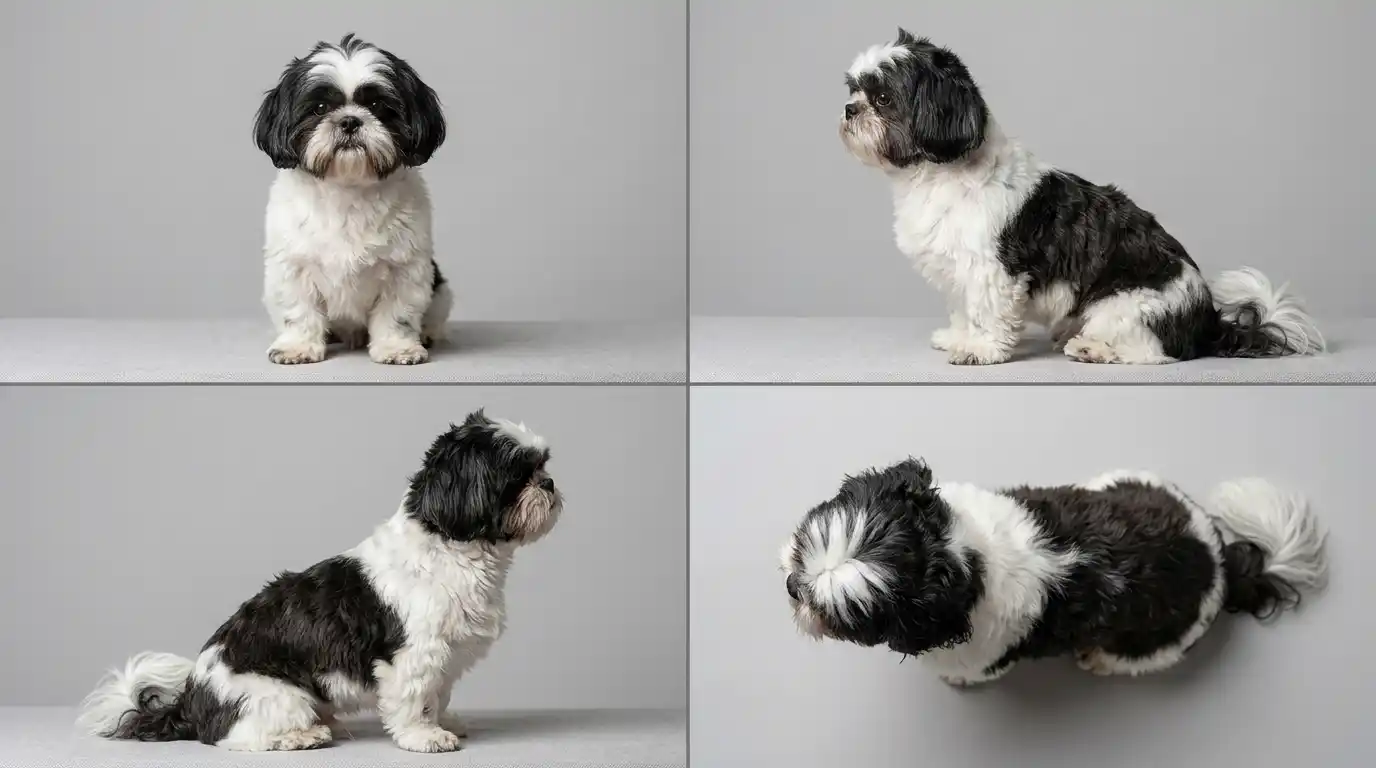
If you are trying to identify your dog’s pattern—or evaluating a puppy from an online listing—use several clear photographs rather than relying on one appealing portrait. Ask for images taken in ordinary daylight, without a heavy filter or strong shadows.
| Area to inspect | What to look for | Why it helps |
| Face | White forehead blaze, white muzzle hair, dark ears, or dark patches around the eyes | Shows whether the dark area is hair rather than nose or eye-rim pigment |
| Chest and belly | Small white chest spot or a broad white underside | Helps distinguish limited white markings from a more extensively white coat |
| Back and sides | Solid black areas, isolated black patches, or a mostly white body | Shows the overall distribution more clearly than a headshot |
| Legs and paws | White feet, white lower legs, or black patches continuing down the limbs | Makes the extent of white easier to describe |
| Tail | Black, white, or mixed tail hair | Adds a useful detail that front-facing photos often hide |
For a long-coated dog, gently part the hair in a few places and check the color closer to the skin. Do this in good light and without pulling. Newer growth may look different from older hair at the ends, particularly when the coat is changing or has been clipped.
A useful photo set includes a front view, both sides, and a view from above. For a puppy, dated photos taken over several months are more informative than a single image taken just after grooming.
What Is the Difference Between Parti, Piebald, and Tuxedo Markings?
Useful descriptions for different amounts of white
The simplest and most useful description is often black and white. Other terms can add detail, but they are not always used consistently in advertisements or casual conversation.
Parti-color commonly describes a dog whose coat includes white along with another color. Piebald is often used for irregular white spotting over a pigmented coat. Tuxedo is an informal visual description, typically suggesting a mostly dark dog with a contrasting white chest and sometimes white feet. A blaze is a white marking that runs up part of the face or forehead.
These terms do different jobs: some describe the general mix of colors, while others describe the placement or extent of white. They can overlap.
| Description | What someone is usually pointing out | What it does not prove |
| Black and white | The two visible coat colors | A particular genetic result |
| Parti-color | White combined with another coat color | An exact percentage of white |
| Piebald | Irregular white spotting or larger white areas | That a dog has a specific tested variant |
| Tuxedo | A mostly dark look with a white chest or other limited white markings | An official, uniquely defined Shih Tzu color |
| Blaze | A white strip or area on the face | Anything about the rest of the coat |
For example, a black shih tzu with white chest might be casually called tuxedo marked. A dog with a white body and several black patches may be described as parti-color or piebald. If you are writing a listing or recording your dog’s appearance, “mostly black with a white chest and paws” is clearer than using an uncertain label alone.
White markings are not an exact map of the underlying genes. Veterinary genetics guidance describes the inheritance of white spotting as complex and notes that its visible expression varies between breeds and individual dogs. The UC Davis Veterinary Genetics Laboratory’s white-spotting explanation is a useful reference for understanding those limits.
When a black mask or a third color changes the description
Long Shih Tzu hair can make a pattern look like something else, especially in a tightly cropped photo. Look for where each color occurs and whether the hair is uniformly colored or mixed.
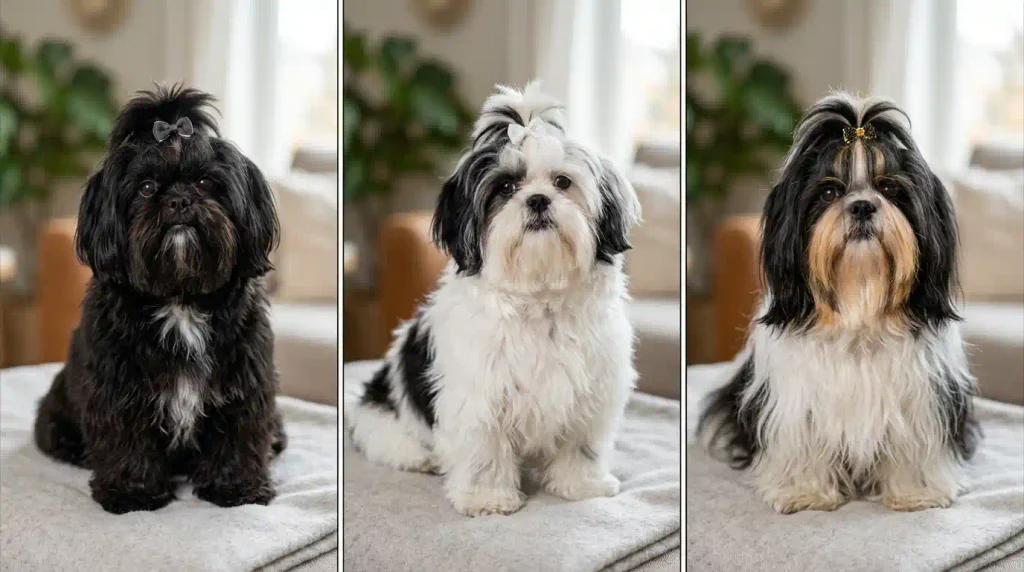
A black mask means dark facial hair against a lighter face or body. Black ears and a black nose alone do not establish a mask. A gold dog with a dark face, for instance, may be better described using the black mask gold shih tzu pattern than as black and white.
If you also see clear tan, gold, or brown areas, your dog may be better described as a brown black and white shih tzu. A dog with black hair and distinct tan points near the eyebrows, muzzle, chest, or legs may call for comparison with a black and tan shih tzu.
Striping is a separate feature. If the darker area contains narrow, interwoven streaks rather than a solid black patch, compare it with a black brindle shih tzu or a brindle and white shih tzu. Black-tipped hairs can also make a lighter area look dark in a distant photograph.
A practical description can include more than one observation: “white chest and legs, black back patches, with a little gold near the face.” It gives a reader a better picture than forcing the dog into a single disputed category. For a broader view of combinations and markings, explore shih tzu colors.
Why Does This Coat Have White Areas?
White spotting and pigment in plain English
Coat color depends on whether pigment is produced and distributed in particular hairs and areas of skin. Black hair contains dark pigment. Where a white spotting pattern prevents pigment from appearing in the hair, the hair looks white. That can produce anything from a small chest marking to much larger white areas.
You may see the phrase S locus in articles about dog coat genetics. It refers to a region discussed in connection with white spotting. Researchers have identified a variant in the MITF gene associated with certain piebald or random white-spotting patterns. However, white spotting does not follow one simple rule in every breed. Other inherited factors can affect how much white is visible and where it appears.
This is why a visual label should be treated as a description, not a complete genetic explanation. Two black and white dogs can look similar without having identical test results. Conversely, dogs carrying a relevant variant may show different extents of white.
The distinction also matters when comparing a black and white coat with other light-colored appearances. A white shih tzu is not automatically an albino shih tzu. White fur, the pigmentation of the nose and eye rims, and any confirmed genetic condition are separate things to assess. Avoid diagnosing albinism from a photograph.
For most owners, the first step is simple: describe the colors you can actually see. Genetics becomes useful when a breeder needs to understand inheritance or an owner wants a more specific answer about a tested trait.
What a coat-color DNA test can and cannot establish
A reputable dog coat-color DNA test can check for the particular variants included in its panel. That may help explain part of a dog’s visible pattern or what it could pass to offspring. The usefulness of any result depends on the genes examined and how the laboratory interprets them.
Before buying a test, check:
- Which variants are tested? A broad marketing description such as “color test” does not tell you what is included.
- What does the result say about this breed? A variant’s visible effect can vary between breeds.
- Will the test answer your actual question? A white-spotting result may not explain every patch or predict a puppy’s adult appearance.
- Is breed identity being tested separately? A coat-color test is not, by itself, proof of pedigree.
A photo can suggest where white spotting appears. A genetic test can report specific tested variants. Neither automatically provides a perfect reconstruction of every factor behind an individual Shih Tzu’s coat.
That limit is particularly important when someone advertises a puppy as carrying a supposedly exclusive “rare gene.” Ask to see the actual laboratory report and its explanation. If no test was performed, the claim may simply be a description of the puppy’s appearance.
Will a Black and White Puppy Change Color?
Puppy coat versus adult coat
A black and white puppy will not necessarily look identical throughout life. Shih Tzus develop a different coat texture as they mature, and the contrast between areas can appear to shift. The American Kennel Club notes that many Shih Tzu coats change around adolescence and that texture varies from dog to dog.
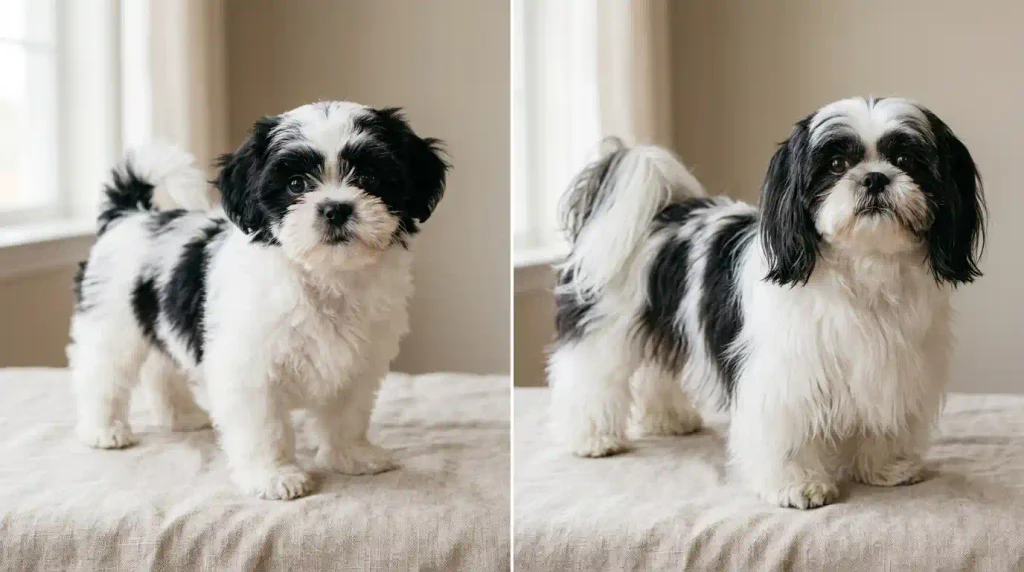
A baby shih tzu black and white in its first listing photo may have a fluffy, short puppy coat. Months later, longer facial and body hair may cover parts of the original pattern. White that looked like a small stripe can seem broader when it grows out; a black patch may look narrower when surrounding white hair falls across it.
Owners sometimes describe an adult black and white shih tzu as lighter than it looked as a puppy. There are several possible reasons:
- New hair may differ in shade from older hair.
- Some dark areas can look softer or grayer as the coat develops.
- A haircut can expose hair previously hidden under the longer coat.
- Camera settings and lighting can change perceived contrast.
- Ordinary aging can alter the appearance of hair over time.
Those observations do not let anyone promise a specific result. A dark puppy may stay strongly black and white, or its coat may look different as it matures. Even a breeder who knows the parents and earlier litters cannot guarantee the precise adult arrangement or intensity from a puppy photograph.
Fading, graying, clipping, and misleading photos
If a dog seems to have “changed color” immediately after a haircut, compare hair from the same body area before and after grooming. Long outer hair and shorter hair closer to the skin can look different. Clipping changes which hairs you see; it does not change the dog’s inherited coat-color genes.
Likewise, black hair photographed in direct sun may look brownish or washed out, while the same hair indoors can appear nearly jet black. White can look cream under warm indoor lighting. Wet hair may make the underlying skin or darker roots more visible.
If you are trying to track a puppy’s development, take a monthly set of photographs:
- Use similar natural daylight each time.
- Photograph the face, back, both sides, and chest.
- Record the dog’s age and the date of its latest haircut.
- Note whether the coat is wet, clipped, or grown out.
This record will tell you more than comparing a seller’s studio photo with a casual phone picture. If an adult dog suddenly develops an unusual patch along with redness, hair loss, itching, or skin changes, treat that as a health question for a veterinarian rather than assuming it is normal coat fading.
For dogs with a visibly gray or silver appearance, the comparison may be a black and grey shih tzu or silver and white shih tzu. A photograph alone may not establish whether “blue,” silver, or ordinary gray-looking hair is the most accurate term.
Is Black and White Recognized or Rare?
What the Shih Tzu breed standard permits
Yes. A purebred shih tzu can have a black and white coat. The American Shih Tzu Club’s breed standard says that all colors and markings are permissible and should be considered equally. Black and white coloring does not, by itself, suggest that a dog is mixed breed or unsuitable under the color portion of the standard.
There is an important difference between these statements:
- “This color is allowed.” A breed-standard question.
- “This dog is purebred.” A question about ancestry and documentation.
- “This puppy will look like this as an adult.” A prediction about future appearance.
- “This pattern is exceptionally rare.” A claim that needs evidence about frequency.
A coat photo can support the first description you make of a dog’s appearance. It cannot establish the remaining claims on its own. If pedigree matters to you, request the appropriate registration and parent information and understand what those documents do and do not verify.
A seller might use a different color name on a form than the everyday words you would use for the dog. Registration terminology and the visible arrangement of markings are related, but they need not be an exact, detailed match.
How to assess rarity and premium-price claims
Black and white can be striking, but “rare” is often a sales word with no stated comparison. Rare within one breeder’s current litter is different from rare across the breed. A puppy’s unusual-looking face markings may be distinctive without being genetically exceptional.
If a seller charges extra for the pattern, ask a few direct questions:
- What makes this puppy’s coloring rare, and what evidence supports that claim?
- Are similarly marked puppies available in other litters?
- Are parent information and relevant health records available?
- What care and support are included in the price?
- Would the seller give the same attention to the puppy’s health and temperament if its color were different?
Do not rely on a fixed “black and white Shih Tzu price” copied from an article. Asking prices can vary with the breeder or rescue, location, age, and what care has already been provided. More importantly, the purchase fee is only one part of ownership.
If you want a particular pattern but are flexible about age, an adult dog may be easier to evaluate visually: its current coat is already present, even though grooming and ordinary aging can still affect its look. Adoption also lets you ask about a known dog’s habits and care needs.
How Do You Groom a Black and White Shih Tzu?
Brushing, mats, and long-coat or puppy-cut routines
The black and white pattern does not create a special kind of hair. Grooming depends mainly on coat length, texture, and the individual dog’s tendency to tangle. A Shih Tzu has a long double coat when left to grow, with a softer undercoat beneath the outer hair. The AKC recommends daily, layered brushing for long coats so the brush reaches through the hair rather than smoothing only the surface.
Pay particular attention to the areas where friction traps loose hair: behind the ears, under the collar or harness, in the armpits, and around the legs. Work gently in small sections. If a comb cannot pass through a section, there may be a tangle beneath hair that looks neat from the outside.
A puppy cut keeps the coat shorter and can make daily maintenance more manageable. A groomer can also shape a rounded teddy bear cut. Neither haircut removes the need to check for mats, keep facial hair comfortable, or schedule regular trims. The AKC describes professional maintenance about every four to six weeks as typical for many dogs in a puppy clip, while individual needs vary.
A workable routine looks like this:
| Task | What to do |
| Daily coat check | Feel behind the ears, under the harness, and around the legs for developing tangles. |
| Brushing | Brush a long coat in layers; adjust the frequency for a shorter coat according to how readily it mats. |
| Combing | Gently comb facial hair and areas where a brush may miss knots. |
| Bathing | Wash when the coat needs it, using products intended for dogs; brush out tangles first and dry the coat thoroughly. |
| Professional grooming | Choose a trim schedule that keeps the dog comfortable and the coat manageable. |
Do not pull hard at a tight mat or cut close to the skin with household scissors. A groomer or veterinarian can help when matting is extensive or the skin underneath is irritated.
The care routine is the same whether the dog is mostly dark or mostly white. The white sections simply make dirt and discoloration easier to notice, while dark sections can make small debris or changes near the skin harder to see.
Cleaning white fur and caring for hair around the eyes
White facial hair can show food residue, saliva staining, or moisture beneath the eyes. Wipe soiled hair gently, keep it dry, and make sure long strands do not rub against the eyes. Hair above the eyes can be kept neatly trimmed or secured in a comfortable topknot by someone who knows how to do it safely.
A visible tear stain is a description of discolored hair, not a diagnosis. If staining is new, persistent, or accompanied by squinting, redness, discharge, or discomfort, ask a veterinarian to examine the eye area. The breed club advises prompt veterinary attention when an eye problem is suspected.
Use care around facial folds and damp hair. A clean-looking white face is a reasonable grooming goal, but eye comfort and skin health come first. Avoid putting a whitening product or an unapproved cleanser close to the eyes simply to improve the appearance of a photograph.
Also check the coat beneath white areas for skin irritation. A dog with a long coat may look immaculate from above while a hidden mat holds moisture or rubs against the skin. Regular handling makes it easier to notice a change early.

Does Coat Color Affect Health or Personality?
Separate coat appearance from breed health considerations
A black and white coat is a description of pigmentation and pattern. It is not a reliable health assessment. You cannot determine from the two-color appearance whether a particular dog has healthy eyes, comfortable breathing, good movement, or an inherited medical condition.
Evaluate health as you would for any Shih Tzu. Ask about veterinary care and any health concerns in the dog or its family. Watch how the dog moves and breathes during ordinary activity. Arrange routine examinations and seek veterinary advice for symptoms such as persistent breathing difficulty, eye pain, or a sudden skin problem. The American Shih Tzu Club highlights heat tolerance and eye protection as care considerations for the breed, regardless of coat color.
This is also why a striking pattern should not dominate a puppy-buying decision. A black patch placed perfectly over one eye tells you nothing about the quality of care the puppy has received. The same caution applies to dramatic claims about other colors or patterns: appearance is useful for description, while health requires its own evidence.
A coat may sometimes help you notice a problem. Redness may stand out against white hair, while dry flakes may be easier to spot on black hair. That is a matter of visibility, not evidence that one color causes the problem.
Temperament, training, exercise, and household fit
Shih Tzus are companion dogs, and many owners value their affectionate, sociable nature. Individual personalities still vary. A black and white female Shih Tzu will not necessarily behave differently from a black and white male—or from a Shih Tzu of another color—because of the markings.
Look instead at the dog in front of you. Does a puppy recover after a mildly unfamiliar sound? Does an adult appear comfortable being handled? How does the dog respond to people, routine grooming, and a calm introduction to another pet? A rescue or breeder who spends time with the dog should be able to discuss its observed behavior rather than promise a personality based on color.
Early, positive socialization and reward-based training can help a Shih Tzu learn household routines. Keep sessions short and clear. Practice coming when called, settling in a comfortable space, and accepting gentle brushing. Training for grooming is especially valuable because coat care will be part of the dog’s life.
Daily movement and play matter too. Provide walks and indoor activities suited to your individual dog, while taking care in hot weather. The best match is a household prepared for companionship, regular attention, training, and coat maintenance—not simply one that likes the appearance of a black and white puppy.
For general background beyond coloring, the site’s shih tzu Breed Information and shih tzu facts can help you explore the breed’s everyday needs.
How Do You Choose a Puppy or Adopt an Adult?
Photos, parent dogs, records, and questions for a breeder or rescue
When you inquire about shih tzu black and white puppies, begin with the questions that will still matter after the puppy has its first haircut. Ask about health, behavior, early care, and the level of support available to you.
A useful conversation with a breeder or rescue might include:
- Can I see recent, dated photos of the puppy or dog from several angles?
- Can I meet the dog, or have a live video call if an in-person visit is impractical?
- What is known about the parents or the dog’s background?
- What veterinary records, vaccinations, and care information will come with the dog?
- How has the dog responded to brushing, handling, and unfamiliar people?
- What happens if the placement does not work out?
- Are any claims about pedigree or genetic testing supported by documents I can read?
For a puppy, parent photos may help you understand family appearances, but they cannot guarantee the exact adult coat. For an adult rescue, ask for photos before and after grooming if possible. They may reveal a pattern that is hidden by an overgrown coat in the current listing.
Be cautious if a seller shows only heavily edited images, will not discuss the dog’s health or environment, or pressures you to pay immediately because the color is supposedly disappearing from the market. Those are reasons to slow the decision down, whatever the asking price.
The phrase purebred shih tzu concerns ancestry and documentation. The phrase black and white Shih Tzu concerns appearance. Keep those questions separate when reviewing a listing.
Planning for grooming and ongoing costs
Before bringing the dog home, decide how you will maintain its coat. Will you learn to brush a longer coat thoroughly, or keep the dog in a shorter trim with regular groomer visits? Either choice takes time and money. You will also need to budget for food, routine veterinary visits, supplies, and unexpected care.
The coat can influence small practical choices. A white muzzle may need more frequent gentle cleaning. A black-and-white dog with long facial hair may benefit from a trim that keeps its eyes clear. These are manageable details, but they are easier to plan for than to discover after a coat has become matted.
If you are comparing a black and white dog with a black and brown shih tzu or gold and white shih tzu, use the same health, behavior, and ownership checklist for each. A preferred color can help you choose between equally suitable dogs; it should not substitute for learning what living with the dog will require.
It can also help to read about shih tzu origin and the different types of shih tzu labels you may encounter. Breed history and marketing labels are background information; the individual dog’s care and suitability remain the immediate decision.
Frequently Asked Questions
Can a purebred Shih Tzu be black and white?
Yes. The breed standard permits all colors and markings; pedigree is assessed through records, not coat color alone.
Can black fur turn gray?
It can look lighter or grayer over time, but the extent varies by dog; compare dated photos taken in similar lighting.
Do black and white Shih Tzus shed?
Yes, they can shed. Their coat still needs regular brushing, and the amount of loose hair you notice varies with the dog and grooming routine.
Is this coat hypoallergenic?
No coat color guarantees an allergy-free dog. If allergies matter in your household, read more about shih tzu hypoallergenic claims and assess your reaction to the individual dog.
Final Takeaway
A black and white Shih Tzu may have a small white chest marking, broad white areas with black patches, or a pattern somewhere between those extremes. Describe what you can see, use several daylight photos, and treat labels such as parti, piebald, and tuxedo as helpful descriptions rather than proof of a particular gene. A puppy’s coat can look different as it matures or after grooming, so promises about its exact adult appearance deserve caution. When choosing a dog, give more weight to health information, temperament, responsible placement, and the grooming routine you can maintain. Next step: use the photo checklist to describe your dog’s markings, then compare its current coat with dated pictures if you are tracking a change.

4 Comments