

Blue Merle Shih Tzu: Pattern, Genetics, and Health
A blue merle Shih Tzu is a dog described as having irregular patches of lighter and darker pigment, often creating a gray-and-black marbled appearance. The label deserves a closer look: merle names a coat pattern, while blue can also describe a different, more uniform dilution of black pigment. A gray Shih Tzu, a blue-pigmented Shih Tzu, and a dog with a genetically confirmed merle pattern are not automatically the same thing.
If you are identifying your dog or considering a puppy advertised as blue merle, start with clear photographs in natural light and ask what supports the label. The distinction matters for breeding: some combinations of merle-associated variants increase the risk of hearing and eye problems in offspring. This guide covers identification, DNA reports, US and UK breed standards, health, and buyer questions.
Table of Contents
- What Is a Blue Merle Shih Tzu?
- How Can You Identify a Merle Pattern?
- What Causes Merle, and Can DNA Testing Confirm It?
- Is Merle Accepted in the Shih Tzu Breed Standard?
- What Health Risks Should Owners Understand?
- What Should You Ask Before Buying or Adopting?
- Does a Blue Merle-Looking Coat Need Special Care?
- Frequently Asked Questions
- Final Thoughts
What Is a Blue Merle Shih Tzu?
What “blue merle” describes in a dog’s coat
In conventional coat-color language, blue merle describes irregular, diluted gray areas among more fully pigmented dark areas on a black-based coat. The result can look marbled, mottled, or patchy. The word blue refers to the blue-gray appearance of the lighter patches; it does not mean the dog’s entire coat or nose is genetically blue-pigmented.
Merle may appear alongside white markings. Its patchwork can also be partly obscured by long hair. Appearance alone is not a genetic diagnosis. The UC Davis Veterinary Genetics Laboratory’s merle explanation describes irregular diluted areas next to more fully colored patches.
This is a narrower question than the broad range of Shih Tzu colors. If you are researching merle across coat backgrounds, read about the merle Shih Tzu as well. Keep the appearance of an individual dog separate from assumptions about its ancestry, registration, or health.
Why a blue Shih Tzu is not automatically merle
The word blue causes much of the confusion. In a blue Shih Tzu, blue pigmentation generally refers to black pigment diluted toward a gray-blue shade. It can affect exposed pigment, including the nose, lips, and eye rims. That dilution is associated with the D locus and is different from the genetic change associated with a merle pattern.
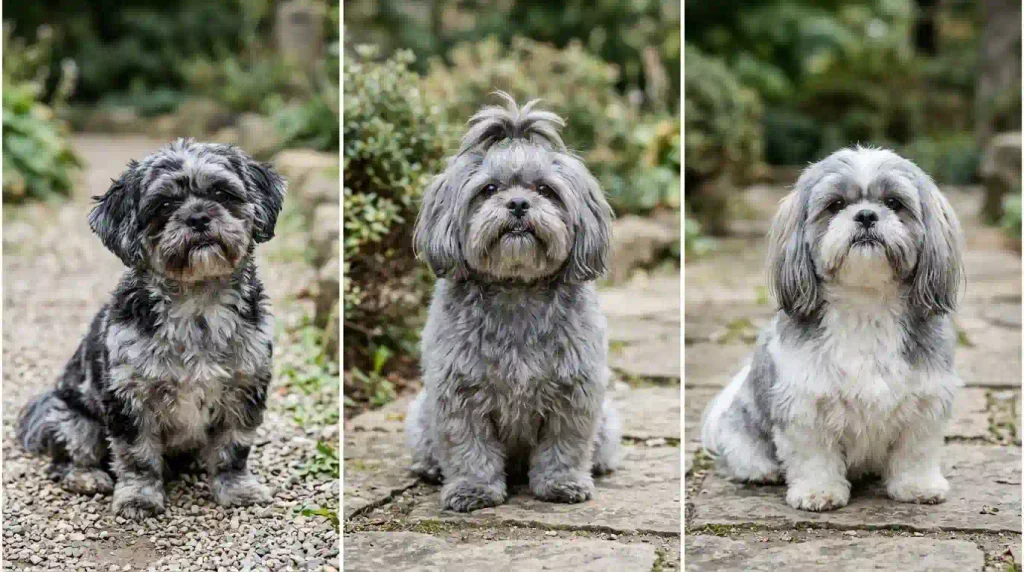
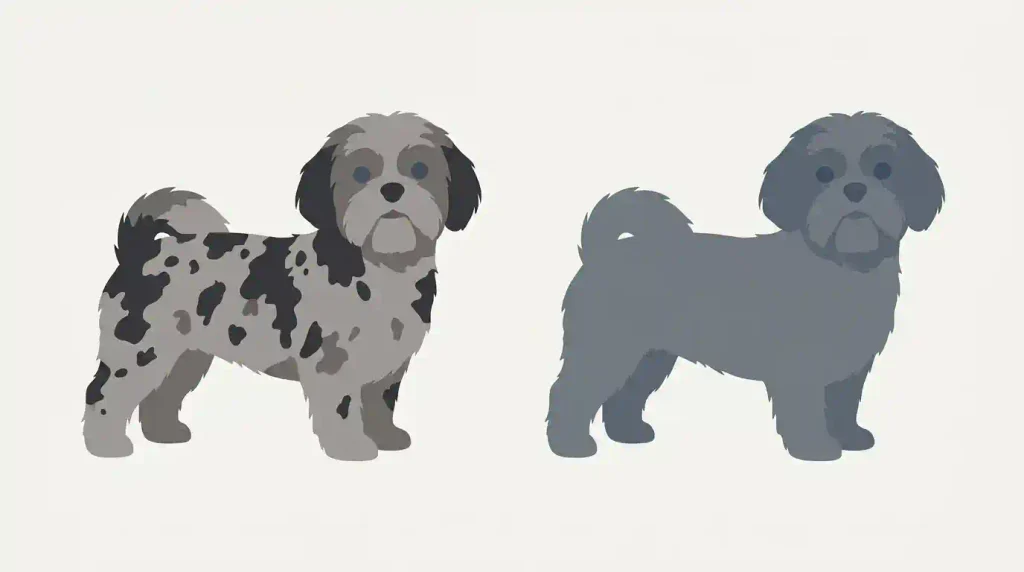
A dog can therefore look blue-gray without having merle patches. Conversely, the lighter areas of a black-based merle pattern can look blue-gray even when the dog does not have D-locus blue dilution. The two descriptions should not be used interchangeably, and a photograph cannot reliably establish either genotype. If a listing says “blue merle,” ask whether the seller means a visible marbled pattern, a genetic merle result, diluted black pigment, or a combination.
A blue gray Shih Tzu or lavender blue Shih Tzu may look cool-toned without showing merle. Color labels are descriptions; test results identify the variants examined.
How Can You Identify a Merle Pattern?
Irregular light and dark patches versus ordinary gray or white markings
Look for irregular boundaries between paler and fully colored areas within the pigmented coat. Check the back, sides, ears, and hair roots. Long hair can soften the pattern’s edges; a short trim may reveal hidden patches.
Use this comparison as a visual starting point, not a diagnosis:
| Appearance | What it may suggest | What it does not prove |
| Irregular gray and dark patches within colored hair | A merle pattern is possible | Which merle-associated variants are present |
| Fairly uniform gray-blue hair and blue-gray exposed pigment | Blue dilution may be possible | That the dog is merle |
| Silver-looking hair with black facial pigment | A gray or silver appearance | D-locus dilution or merle |
| White patches with clear borders against colored hair | White spotting may contribute to the look | That the pale areas are merle |
A grey Shih Tzu or silver Shih Tzu can be mistaken for merle when lighting makes its coat uneven. White areas can add to the effect in a grey and white Shih Tzu or blue and white Shih Tzu. Ask to see several views rather than assigning a genetic label to one pale patch.
Patterns deserve their own comparison, too. A brindle Shih Tzu has striping, which is a different visual pattern from merle mottling. The combination of color words in a blue brindle Shih Tzu listing is no substitute for examining the dog. A puppy’s coat may also change in shade and length as it grows, making dated photographs of its parents useful context.
What eyes, nose pigment, and photographs can—and cannot—show
Merle can be associated with blue or partly blue eyes and mottled exposed pigment, but blue eyes do not prove merle. A dark-eyed dog can also have a merle-associated variant. The eyes, nose, and paw pads are observations to record alongside the coat, not stand-alone tests of the pattern.
Photograph both sides, the back, face, and suspected patches in indirect daylight without filters or flash. Request dated, unedited images or video from a seller. Camera white balance can shift gray toward blue or purple; clipping changes what is visible.
Inspect both the color and the arrangement of the hair. A dark nose with a silvery coat may be useful when evaluating a claim of blue pigmentation, but it says little on its own about merle. Compare a black and grey Shih Tzu with a dog whose dark coat contains irregular faded patches. If the distinction matters for a purchase or breeding decision, move beyond appearance to appropriate DNA testing and professional advice.
What Causes Merle, and Can DNA Testing Confirm It?
Merle-pattern genetics versus blue-pigment dilution
Merle is associated with an insertion in the PMEL gene, also called SILV in some research and test descriptions. It affects dark pigment unevenly, creating irregular diluted patches alongside areas that remain more fully pigmented. Merle expression varies; a dog with a merle-associated insertion will not necessarily display the same amount of mottling as another dog.
Blue dilution involves a different mechanism at the D locus, associated with variants in MLPH. That mechanism can lighten black pigment toward gray-blue across the pigmented parts of a dog. The simple distinction for an owner is patchwork versus pigment dilution, though other genes and markings may complicate the visible result. The distinction is particularly relevant when a seller uses “blue” both for a mottled appearance and for the dog’s nose color.
Merle acts on dark pigment called eumelanin. Other genes influence whether and where that pigment is visible. A pale cream or red-looking dog can therefore carry a merle-associated variant while displaying little obvious mottling. Likewise, white spotting can cover an area where a pattern might otherwise be seen. This is why a mating decision should not rely on the assumption that an unpatterned-looking dog is genetically non-merle.
Hidden or subtle patterns and interpreting a test report
Modern merle reports may describe the number and measured size of merle-associated insertions, rather than simply stamp a dog “merle” or “non-merle.” UC Davis explains that the size of the insertion contributes to a range of visible effects; some smaller variants may produce little or no obvious pattern. Laboratories can differ in how they name categories, so read the specific report and its interpretation notes rather than transferring a label from another company’s chart.
When reviewing a report, check the dog’s name or identifying information, the laboratory, the date, the exact test performed, and the reported result. Ask the breeder to explain any result described as cryptic, atypical, or otherwise difficult to interpret. A merle test can help establish whether the tested dog carries a detected merle-associated insertion. It does not prove a puppy’s breed, determine all its coat-color genes, or certify its hearing and eyesight.
Is Merle Accepted in the Shih Tzu Breed Standard?
What the AKC standard says in the United States
The American Kennel Club’s Shih Tzu breed standard states that all colors and markings are permissible and considered equally. It discusses black, liver, and blue pigment when describing the nose, lips, and eye rims, but it does not define “blue merle” as a separate named breed-standard color. Be precise: the US standard’s broad color wording is different from a statement that every dog sold as blue merle has a verified pedigree.
A breed standard describes the ideal characteristics used in breed evaluation. It does not serve as a genetic test or authenticate a seller’s claim about a particular puppy. For someone researching a purebred Shih Tzu, the relevant evidence includes the dog’s documented ancestry and the identity of its parents, not a photograph of an unusual coat.
How the Royal Kennel Club standard differs
The Royal Kennel Club’s UK Shih Tzu standard says that all colors are permissible except merle, which it calls unacceptable. That is an explicit difference from the wording of the AKC’s US standard. A blanket claim that “every kennel club bans merle Shih Tzus” misstates the US document; a blanket claim that “merle is accepted everywhere” misstates the UK document.
Neither standard establishes an individual dog’s genotype, pedigree, or health. If event eligibility matters, check that organization’s rules against the dog’s documents.
What a coat pattern can tell you about pedigree
An unusual pattern may prompt a sensible question about ancestry, but appearance alone cannot resolve it. Ask to see the parents’ identities, registration information if claimed, and consistent records linking the puppy to them. A commercial breed-ancestry report, a merle-variant test, and a pedigree document have different purposes; none should be presented as a substitute for all the others.
Avoid treating “rare blue merle” as a separate Shih Tzu breed or guaranteed bloodline. General information about types of Shih Tzu can help distinguish breed-related terms from seller descriptions. If a seller offers a confident explanation of how the pattern appeared in a family, ask what documentation supports it and judge that evidence on its merits.
What Health Risks Should Owners Understand?
Why breeding two merle-patterned dogs raises concern
The most consequential health issue is merle-to-merle breeding. When both parents carry relevant merle-associated variants, some puppies can inherit variants from both. Such “double merle” combinations are associated with a higher risk of hearing and eye defects. The precise appearance and risk can vary with the variants involved and other coat-color genes; a mostly white coat is a reason to investigate, not a diagnosis by itself.
This distinction protects two kinds of dogs from misleading claims. A single merle-patterned dog is not automatically deaf or blind. Equally, a parent that looks solid-colored is not automatically safe to assume non-merle if its pattern is hidden or subtle. UC Davis advises genetic testing to establish merle status where this pattern is present and discourages breeding two dogs with merle-associated variants because of the risk to offspring.
Owners do not need to interpret complex allele-size reports without help. If you are considering breeding, discuss both dogs’ complete results with the testing laboratory and a veterinarian familiar with canine genetics before a mating. If you are choosing a companion puppy, ask whether each parent was tested and whether the breeder can explain the results clearly. Do not accept “the parents look fine” as an answer to a question about inherited variants.
Hearing and eye assessment for an individual dog
Watch how an individual puppy responds to sound and moves around its surroundings, but remember that casual observation can miss a problem in one ear or a subtle eye abnormality. Ask a veterinarian about a formal hearing assessment, such as a BAER test, when the history or examination warrants it. For eye concerns, request a veterinary examination and, when advised, assessment by a veterinary ophthalmologist.
Seek veterinary advice promptly if a dog repeatedly fails to respond to sounds, bumps into objects, squints, develops persistent eye discharge, or appears uncomfortable. These signs have several possible explanations; a coat pattern alone cannot identify the cause. If adopting a dog with known hearing or vision limitations, discuss its practical needs with the rescue and veterinarian. A dog can still be a valued companion while receiving care suited to its abilities.
Merle-related questions sit alongside routine Shih Tzu health needs. A responsible seller or rescue should talk about the whole dog—its breathing, eyes, grooming tolerance, temperament, and medical records—not frame every discussion around the color. Explore broader Shih Tzu breed information while assessing whether the breed fits your household.

What Should You Ask Before Buying or Adopting?
Parentage, photographs, and merle-test results
Ask questions that turn an attractive listing into checkable information:
- What does “blue merle” mean in this listing? Is it a visual description, a result from a merle test, a blue-dilution result, or both?
- Can I see unedited, dated photographs and meet the dog? Request views of both sides, the back, the face, and the nose in natural light.
- Who are the parents? Request their identities, recent photographs, and relevant pedigree or registration records if those are being advertised.
- Were the puppy and both parents tested for merle? Ask for complete reports, not only a message saying “DNA clear.”
- How were unusual or subtle results interpreted? Ask the laboratory or an appropriately qualified professional to clarify results that the seller cannot explain.
- What happens if a health concern is found? Read the written agreement and understand the seller’s process before making a decision.
For a rescue with unknown parentage, focus on its condition, available veterinary history, temperament, and any testing that helps with care.
Health records, screening, and price claims
Request age-appropriate veterinary records and details of any known hearing, eye, skin, or breathing concerns. Ask what health evaluations were performed on the parents and what those reports actually say. Color testing and health screening answer different questions. A puppy with a beautiful coat can still need treatment, and a dog with an unremarkable coat can still need careful medical attention.
Be wary of a large premium based solely on “rare” coloring. The label guarantees no particular temperament or health outcome. Compare records, the dog’s condition, its care environment, and the seller’s willingness to answer questions.
Spend time with each puppy rather than choosing from filtered images. General Shih Tzu facts help you prepare; the puppy’s records, behavior, and care needs should guide your choice.
Does a Blue Merle-Looking Coat Need Special Care?
The pattern itself does not call for a special shampoo or brushing technique. Care for the Shih Tzu coat you actually have: comb and brush often enough to prevent mats, pay attention behind the ears and under a harness, and arrange trims that keep the dog comfortable and able to see. A long double coat needs more hands-on maintenance than a short practical cut, whatever its color.
Part the hair to check for redness, flakes, sores, or thinning. Ask a veterinarian about persistent itching or hair loss. Coat length, age, and lighting can alter how markings look without changing inherited variants.
Owners comparing a patterned dog with a black Shih Tzu or black and white Shih Tzu should make grooming decisions according to coat length and skin condition, not the color name. Questions about whether a Shih Tzu is hypoallergenic are separate from merle identification; no coat label guarantees that a person with dog allergies will not react.
Frequently Asked Questions
Can a gray Shih Tzu be mistaken for blue merle?
Yes. A gray or silver coat can look patchy in photographs, so compare the pattern in natural light and consider testing if confirmation matters.
Do blue eyes prove a Shih Tzu is merle?
No. Blue or partly blue eyes can occur with merle, but eye color alone cannot confirm a merle-associated variant.
Does a merle test prove a dog is purebred?
No. A merle test examines a coat-pattern variant; ancestry and pedigree require different evidence.
Final Thoughts
A blue merle Shih Tzu is best understood by separating what you see from what you can verify. Irregular light and dark patches may suggest merle, while a uniformly blue-gray dog may have a different pigment trait. Photographs help you describe the coat; a relevant DNA report can clarify detected merle-associated variants. Neither settles the dog’s pedigree or replaces an individual health assessment.
If you are evaluating a puppy, ask for the parents’ identities, complete test results, and health records before paying extra for a color label. If you already own the dog, keep up with regular grooming and bring hearing, vision, or skin concerns to your veterinarian. The best next step is simple: ask what evidence supports the description, then choose the dog for its health and fit with your home.