
Black Shih Tzu: How to Identify the Coat and Care for Your Dog
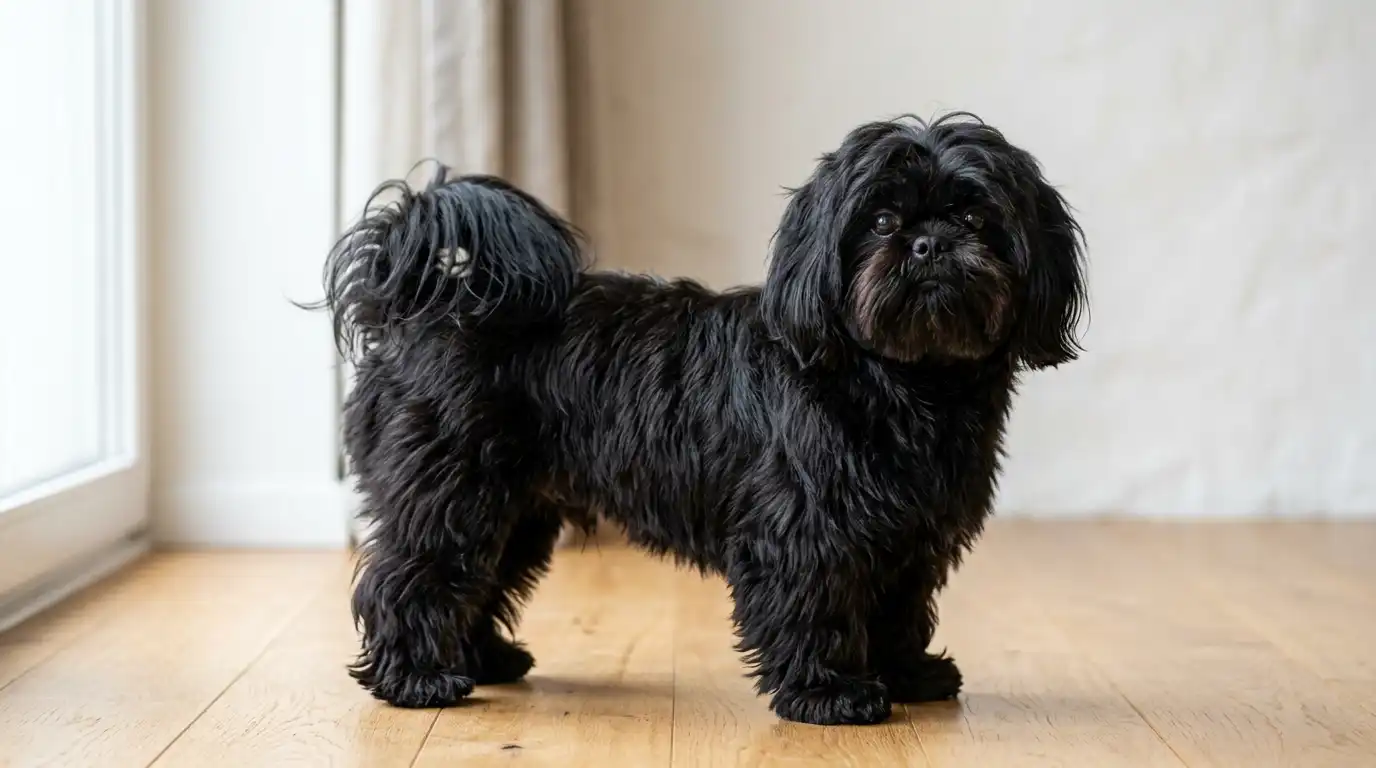
A black Shih Tzu can be striking, but the word black does not always mean the same thing in a photo, a breeder’s description, and a conversation with another owner. A dog may be solid black from head to tail, or mostly black with a small white chest patch that is easy to miss. A black puppy’s coat can also look different after its first haircut or as its adult hair grows in. So how can you tell what you are seeing—and should color affect which dog you choose? Start with a daylight inspection of the hair on the chest, paws, face, and tail. Then consider the dog’s pigmentation, age, and grooming history. Genetics can help explain a dark coat, but a photograph cannot reveal every inherited trait or promise that a puppy will stay jet black. This guide walks you through visual identification, similar-looking colors, coat changes, grooming, health considerations, and the questions worth asking before you buy or adopt.
Table of Contents
- What Counts as a Black Shih Tzu?
- Black, Black and White, Blue, or Dark Brindle?
- Why Do Some Shih Tzus Have Black Coats?
- Will a Black Shih Tzu Puppy Stay Black?
- Is Solid Black Recognized or Rare?
- How Do You Groom a Black Shih Tzu?
- Does Black Coloring Affect Health or Temperament?
- How Do You Choose a Black Puppy or Adopt an Adult?
- Frequently Asked Questions
- Final Takeaway
What Counts as a Black Shih Tzu?
Solid black versus a mostly black coat
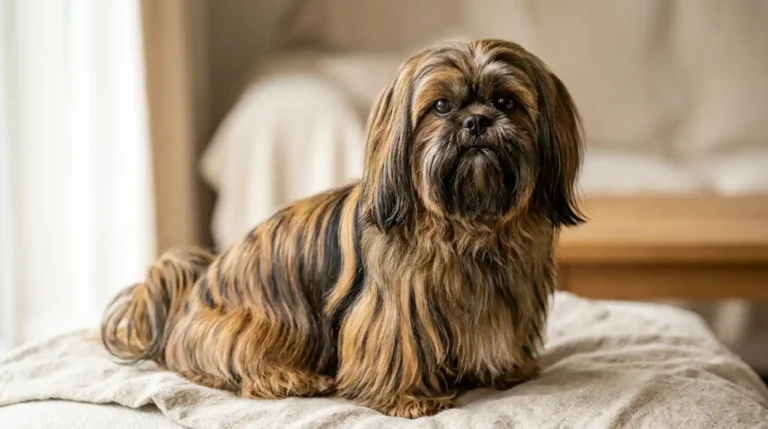
A solid black Shih Tzu has black hair throughout the visible coat, without an obvious patch of another color. A mostly black Shih Tzu may have the same overall dark appearance but also have white hairs on the chest, a pale chin, or a small marking on one paw.
In everyday conversation, both dogs may be called black. When you need an accurate description for a listing, photo caption, or discussion about coat patterns, the distinction is useful. “Mostly black with a white chest” tells someone more than “black” alone.
Look at hair color separately from skin pigmentation. A black nose, dark eye rims, and dark paw pads do not mean that all the dog’s hair is black. These pigmented areas can also appear on Shih Tzus with much lighter coats. Likewise, a long facial coat may hide a few pale hairs that become visible after trimming.
There is no reason to treat the mostly black dog as a lesser version of the solid black one. Its markings are simply different. If white covers a clear portion of the chest, face, or legs, a black and white shih tzu guide will offer a more precise comparison.
The black coat is a color variation within the breed, not a separate breed. The Shih Tzu remains a small companion dog with the same basic need for attention, grooming, exercise, and veterinary care. If you are new to the breed, the site’s shih tzu Breed Information provides broader context beyond coat color.
A daylight checklist for the chest, paws, face, and tail
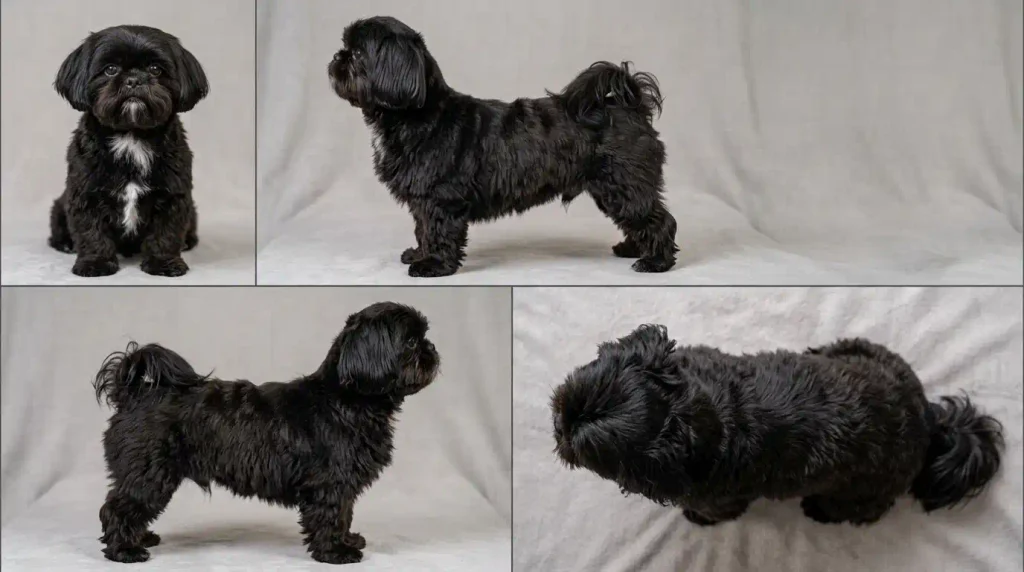
Black hair can conceal small markings in shadow. A puppy photographed on a dark blanket may appear solid black even when a white patch is present. To identify the coat, examine the dog in diffuse daylight and take photographs from several angles.
| Area | What to check | What you can learn |
| Chest and chin | Part the hair gently and look for white, cream, or tan hairs. | A small marking can be hidden beneath longer outer hair. |
| Paws and lower legs | Inspect all four feet, including the hair between and above the pads. | One white toe may be invisible in a front-facing portrait. |
| Face | Check the eyebrows, muzzle, cheeks, and ears. | Tan points, a pale chin, or dark facial hair over a lighter coat can change the description. |
| Back and sides | Look at both sides and part the coat in a few places. | Mixed hairs or a lighter underlayer may be easier to see near the skin. |
| Tail | Lift the plume gently and view its upper and lower surfaces. | Long tail hair may hide a lighter tip or patch. |
Check the dog while the coat is clean and dry. Wet hair looks darker, and a freshly clipped coat may reveal shades that longer hair concealed. For a puppy, record the age and date of each photo. That makes later comparisons much more useful.
A close inspection should remain comfortable for the dog. You only need to separate a few strands with your fingers; there is no need to tug at knots or turn the session into a prolonged search for a single contrasting hair.
If you are evaluating a seller’s listing, request one front view, one photo of each side, and a clear view of the chest and feet. A short, unfiltered video of the puppy moving in daylight can show markings that a carefully posed image misses.
Black, Black and White, Blue, or Dark Brindle?
What the hair color and markings show
Several Shih Tzu coats can appear nearly black in a small image. The clearest first question is: Are you looking at an even dark area, a contrasting patch, or a pattern within individual hairs?
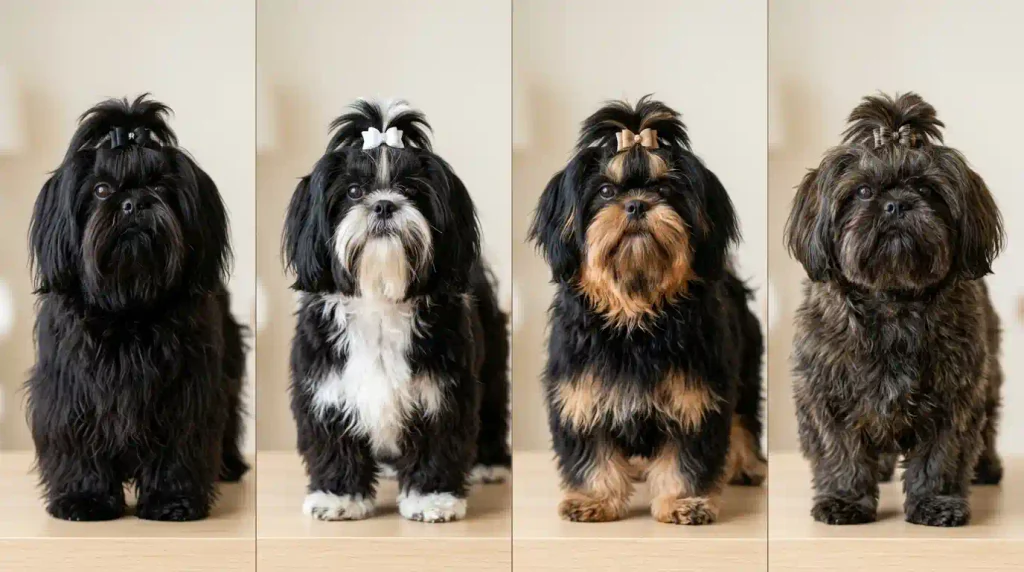
A dog with black hair across nearly all of its body may be described as solid or mostly black. A visible white chest, blaze, or collection of white patches makes black and white the clearer description. Tan or gold around the eyebrows, muzzle, chest, or legs may suggest comparison with a black and tan shih tzu rather than a solid black dog.
Brindle is another possibility. If you see narrow, interwoven dark streaks against a lighter base, compare the coat with a black brindle shih tzu. Long hair can blur a brindle pattern, so inspect several areas in good light before deciding that the dog is uniformly black.
Gray or silver-looking hair creates a different question: Was the dog black as a puppy and later lightened, or is the current coat being described with an imprecise color label? If its hair now has distinct black and gray areas, a black and grey shih tzu comparison may be useful. “Blue” in dog color terminology has a particular relationship to diluted dark pigmentation; it should not be assigned to every black coat that photographs with a cool gray cast.
| What you observe | A useful starting description | What to check next |
| Black hair throughout | Solid black | Look for hidden lighter hair on chest, paws, and tail. |
| Black hair with a definite white area | Black and white | Record where the white occurs and how much is visible. |
| Dark hair with distinct tan areas | Black and tan or black and brown | Check whether the lighter areas form recognizable points. |
| Dark streaks over lighter hair | Brindle | Inspect close-up hair and several parts of the body. |
| Gray-looking dark hair | Gray, silver, or possibly blue-looking | Check pigmentation and compare daylight photographs. |
These are descriptions of appearance, not diagnoses of genotype. A coat photo can tell you what hair is visible today. It cannot fully explain which variants the dog carries.
A black face can also be misleading. A dog with a gold body and dark facial hair may be better described as a black mask gold shih tzu. The mask refers to dark hair on a lighter dog; every Shih Tzu with a black nose does not have a black mask.
What the nose, lips, and eye rims can clarify
The American Shih Tzu Club’s breed standard describes black pigmentation of the nose, lips, and eye rims for most colors, with liver pigmentation on liver-pigmented dogs and blue pigmentation on blue-pigmented dogs. That makes these features useful when a coat looks ambiguous.
A black-coated dog with a black nose is visually consistent with the ordinary description of a black Shih Tzu. If a dog has brown-looking nose and eye-rim pigmentation, however, ask whether the dog is being described as liver or chocolate rather than assuming that its dark hair is genetically black. A liver shih tzu guide can help explain that terminology.
Similarly, a gray-looking photograph is not enough to identify a blue shih tzu. Pigment in the nose, lips, and eye rims can provide another clue, but difficult cases still call for careful interpretation rather than a confident label based on one picture.
Paw pads are worth observing, though pads can have variation and can be obscured by hair or surface wear. Focus first on the plainly visible coat and the nose and eye-rim pigmentation. If you notice a new change in the skin itself—for example, an irritated or enlarging dark spot—treat that as a question for a veterinarian. Skin pigmentation and coat-color labels are different topics.
Why Do Some Shih Tzus Have Black Coats?
Dark pigment and the K locus in plain English
Dog hair color involves two principal types of pigment: eumelanin, which produces black or related dark coloration, and pheomelanin, which produces red-to-yellow coloration. Inheritance influences which pigment appears in the coat, where it appears, and how other traits modify its look.
You may encounter the term K locus when reading about a solid black coat. UC Davis Veterinary Genetics Laboratory explains that a dominant-black variant at this locus affects pigment switching and can produce solid dark pigmentation in the colored areas of a dog’s coat. The laboratory also notes that a dog’s overall appearance depends on interactions with other genes. Its dominant-black K-locus explanation provides the technical details.
An allele is a version of a gene or genetic variant inherited from a parent. You do not need to memorize allele notation to identify your dog. The practical point is that one inheritance rule does not explain every visible detail. Other variants may influence white markings, pigment shade, or patterns that are present but not apparent in a particular coat.
A dominant-black test result also should not be treated as a guarantee that a dog has no white. UC Davis describes the effect in the dog’s fully pigmented areas. White markings involve other parts of coat-color genetics. A mostly black puppy can therefore look very dark while still having a white chest patch.
Likewise, the word dominant does not mean every dark-looking dog must have the same tested variant, or that breeding two black-looking dogs will produce a litter of identical solid black puppies. Parent dogs pass on combinations of inherited traits, and appearance alone does not show all the variants they carry.
What a coat-color DNA test can and cannot prove
A coat-color DNA test can report the specific variants it examines. That can help answer a focused question, such as whether a dog carries a tested dominant-black variant. The report should state what was tested and how the laboratory interprets each result.
It cannot, by itself, establish everything an owner might want to know:
- It does not prove breed pedigree. Color testing and breed ancestry or parentage are separate questions.
- It does not photograph the future. A test result may help explain inherited color, but it cannot perfectly predict how every adult hair will look.
- It does not assess overall health. A coat-color result is not a substitute for veterinary care or relevant health information.
- It does not establish rarity. Finding a variant in one dog tells you little about its frequency in all Shih Tzus.
- It only answers what the laboratory tested. An untested trait remains untested, even when the report looks extensive.
If a breeder uses a DNA claim to advertise an unusually priced puppy, ask to see the actual report. Read the test name, dog identification, result, and interpretation. A sentence in a listing such as “carries the rare black gene” is not equivalent to a documented genetic result—and even a documented coat result is only one part of evaluating a dog.
For most owners, a test is optional. A clear description such as “black hair with a small white chest marking” may already answer the practical identification question. Testing becomes more useful when a breeder is making inheritance decisions or an owner has a specific question that a suitable test can address.
Will a Black Shih Tzu Puppy Stay Black?
Puppy-to-adult fading and graying
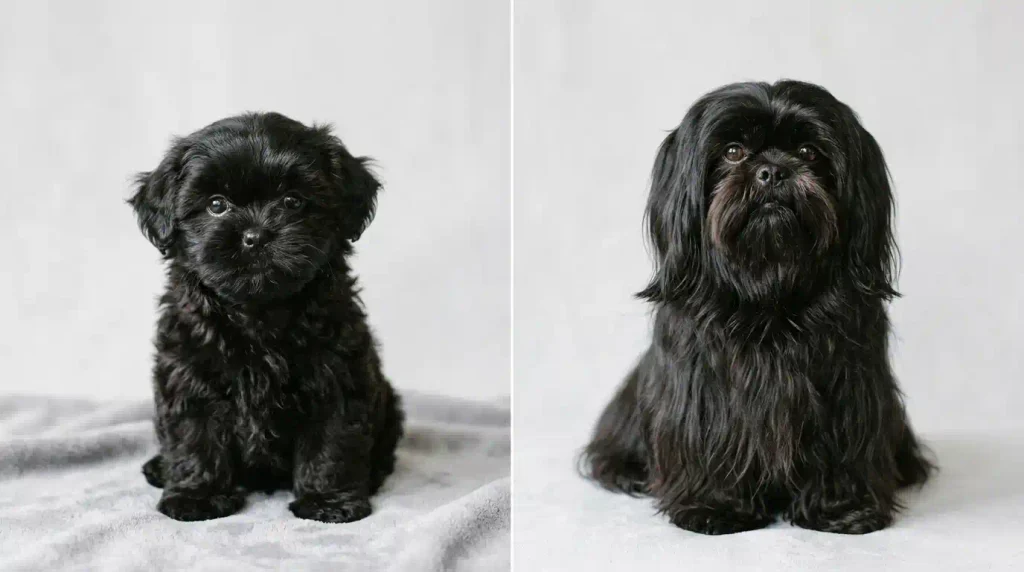
A black Shih Tzu puppy may retain a strongly black appearance into adulthood, but no photograph of a newborn or eight-week-old puppy can guarantee its eventual shade. Hair grows, coat texture develops, and some dogs appear lighter with age.
The AKC notes that many Shih Tzu coats undergo changes as puppies mature, including changes around adolescence. The amount and type of change vary by individual dog.
If you have an all black shih tzu puppy, watch for gradual changes rather than expecting a dramatic transformation on a particular birthday. A few gray-looking hairs near the face do not establish that the whole dog will turn silver. Likewise, a puppy that looks deeply black today is not guaranteed to have the identical tone as an adult.
A long, layered coat can exaggerate apparent change. New hair growing close to the skin may look different from older ends. When that older length is removed, the newly exposed coat becomes the part you notice. Owners may describe this as the dog “changing overnight,” even though the underlying hair was already present.
A dog that was black as a puppy but now has widespread silvery hair may be described more accurately by its current appearance. If you are researching that progression, compare the examples of a silver shih tzu with photographs of your own dog at different ages. Use the label that helps another person picture the dog you have now.
Haircuts, lighting, and comparing dated photos
Photographs are most informative when they are comparable. Black hair can appear warm brown in direct sun, charcoal under bright flash, or almost featureless against a dark background. A phone camera may brighten shadows and change the perceived shade without the coat changing at all.
A haircut presents another challenge. Short hair can reveal roots, a lighter underlayer, or small markings that longer hair covered. Trimming does not change a dog’s inherited genes. It changes which part of the coat is visible and how the hair lies.
To track your dog’s appearance, take a small monthly photo set:
- Use open shade or soft daylight instead of a colored indoor lamp.
- Photograph the front, both sides, chest, and paws.
- Record your dog’s age and how recently the coat was trimmed.
- Keep at least one photo showing the hair parted gently near the skin.
- Compare the same body areas, not a close-up face shot with a distant full-body image.
This approach is especially useful if you are considering a newborn black Shih Tzu puppy offered through a breeder. Request dated photos of the individual puppy as it develops, and ask to see the parents. Family photos can offer context, but they cannot promise that the puppy will copy either parent’s adult shade.
If you notice abrupt hair loss, itching, redness, a new skin lesion, or discomfort along with an apparent color change, arrange a veterinary examination. Those signs call for more than a coat-color explanation.
Is Solid Black Recognized or Rare?
Breed-standard status versus claims about frequency
Yes, solid black is permitted in a purebred Shih Tzu. The American Shih Tzu Club’s breed standard states that all colors and markings are permissible and should be considered equally. A black coat does not, on its own, disqualify a dog under the color portion of that standard.
Recognition and rarity are different questions. A recognized color may be seen less often in the dogs a particular breeder produces, yet that does not supply a reliable breed-wide frequency. Articles and listings sometimes call solid black “the rarest” without showing how dogs were counted, what populations were sampled, or whether “solid black” excludes tiny white markings.
A better way to discuss rarity is specific: “This breeder has no other solid black puppies in the current litter.” That observation may be true without establishing that solid black is the rarest Shih Tzu color nationwide.
The AKC has described Shih Tzus as occurring in many colors and cautions against treating color as the defining feature of the breed. If someone makes a precise rarity claim, ask what evidence supports it rather than repeating it as an established fact.
Color also says little about how a dog will be judged on its structure, movement, or temperament. The breed standard describes a complete dog, not a color contest. If you want to understand why the breed developed as a companion rather than as a coat-color category, read about shih tzu origin.
Why color does not establish pedigree or justify a price by itself
A dog’s coat can tell you what color it appears. It cannot establish the dog’s parents. A purebred shih tzu is identified through credible ancestry and records, not by how dark its fur looks in a photograph.
Similarly, a high asking price does not verify rarity, good breeding practices, or future coat color. Before paying a premium for “pure black,” ask what is included beyond appearance:
- What is known about the parents and the dog’s ancestry?
- What veterinary records are available?
- How has the puppy been raised and handled?
- What support will the breeder offer after placement?
- Is there a written agreement and a clear return policy?
- Can you meet the puppy or see an unedited, current video?
Avoid assuming that a listing price is representative of all black Shih Tzu puppies. Local availability, the dog’s age, breeder practices, rescue fees, and included care all vary. A lower adoption fee can still come with significant ongoing grooming and veterinary expenses; a higher purchase price does not remove those expenses.
If your preference is primarily visual, consider an adult Shih Tzu. Its current coat can be inspected directly, and the rescue may have useful information about behavior and grooming tolerance. You may find that a mostly black dog with a small white marking is every bit as appealing as the precise solid-black image you had in mind.
How Do You Groom a Black Shih Tzu?
Brushing a long coat and preventing mats
A black Shih Tzu needs the same fundamental coat care as a Shih Tzu of another color. The breed has a double coat that can become tangled when long hair is not maintained. Dark hair may make a small mat or bit of debris harder to notice, so use your hands and a comb as well as your eyes.
For a long coat, brush in small layers, reaching through the hair rather than smoothing only the outer surface. The AKC recommends daily brushing for longer coats and attention to the mustache and topknot. Coat texture differs between dogs, so adjust your routine to what prevents knots on your individual Shih Tzu.
Check behind the ears, beneath a collar or harness, in the armpits, on the belly, and where the legs meet the body. Friction makes these areas prone to tangles. If a comb catches, stop and work gently from the edge of the knot instead of pulling from its base.
A useful routine is brief and consistent:
| When | Coat-care task |
| Each day with a long coat | Brush in layers and check high-friction areas for tangles. |
| During face care | Keep hair out of the eyes and gently comb the mustache and topknot. |
| Before a bath | Find and address mats, since wetting a tight mat can make it harder to manage. |
| After outdoor activity | Check the coat for damp areas, debris, and anything caught near the paws. |
| At grooming appointments | Discuss coat length, eye-area comfort, nail care, and any skin changes you noticed. |
A tight mat close to the skin can be painful to remove. Ask a professional groomer or veterinarian for help rather than cutting blindly beneath dark hair. The goal is a comfortable coat and healthy skin, whether the dog wears a flowing style or a shorter trim.
Puppy cuts, bathing, and checking dark hair for skin changes
A puppy cut keeps the hair shorter and often makes day-to-day grooming easier. It does not make the dog maintenance-free. Hair still grows around the face, paws, and underside, and a shorter coat can mat if brushing is neglected. The AKC describes recurring professional grooming as common for Shih Tzus kept in a puppy clip.
Bathe your dog according to its coat condition and a grooming schedule appropriate for that individual. Use dog-appropriate products, rinse carefully, and dry the coat thoroughly. A black coat may still hold dust or residue even when it looks uniformly glossy.
Use grooming time for a gentle skin check. Part the hair and look for redness, flaky patches, irritation, or any spot that has changed. A search such as “my Shih Tzu has black spots on her skin” asks about the skin, not the black coat. Those spots can have different explanations, and a veterinarian is the right person to assess a new, spreading, raised, itchy, or otherwise concerning change.
The same distinction applies when someone asks why a Shih Tzu’s skin is turning black. A coat-color gene does not automatically explain a new skin change. Take a clear photo for your veterinarian and note when you first saw it, where it appeared, and whether the dog has been scratching or licking the area.
Keep the facial hair comfortable too. Hair rubbing the eyes or persistent discharge deserves attention regardless of coat color. The American Shih Tzu Club advises prompt veterinary care if an eye problem is suspected.
Does Black Coloring Affect Health or Temperament?
Breed health needs to assess separately from color
A black coat is not a health certificate or a diagnosis. You cannot tell from pigment alone whether a particular dog has healthy eyes, comfortable breathing, sound movement, or a skin condition. Assess those questions separately.
Shih Tzus have breed-related care considerations, including attention to their eyes and comfort in hot conditions. The American Shih Tzu Club discusses heat tolerance and eye protection in its owner guidance. These concerns apply to Shih Tzus broadly; they are not established by the presence of black hair.
Some online articles suggest that a solid black dog is automatically unusually prone to overheating or requires a different medical routine because of its color. That conclusion goes beyond what the coat alone can tell you. Provide shade, water, and activity suited to the weather and your individual dog. If your Shih Tzu struggles to breathe, seems distressed in the heat, or develops a painful-looking eye, seek veterinary advice.
When choosing a puppy, prioritize the dog’s care history and available health information. Ask how it has been doing, whether there are concerns in its family, and what veterinary assessment it has received. Do not let a dramatic coat distract from a dog that appears unwell.
Skin checks are particularly useful with dark hair because the coat may make a small irritated area less visible. That is a reason to inspect carefully during grooming, not evidence that black dogs inherently develop different skin diseases.
Personality, exercise, training, and household fit
Shih Tzus were developed as companion dogs. The breed standard describes an outgoing, affectionate, friendly temperament, but each dog is an individual. A solid black male, a black female Shih Tzu, and a gold-and-white dog cannot be sorted into reliable personality types by coat color.
Spend time observing how the dog behaves. Does it approach people willingly? How does it respond to gentle handling, a brush, an unfamiliar but calm environment, or a short separation? A breeder or rescue who knows the dog should be able to describe its actual behavior instead of promising that a color will produce a particular personality.
Use positive, consistent training to teach household routines. Practice short sessions for coming when called, settling, and accepting grooming. Early socialization should introduce a puppy to suitable people, sounds, and experiences at a manageable pace.
Provide walks and play appropriate for the dog’s age, health, and the weather. A toy breed still benefits from activity and interaction. A black Shih Tzu whose owner enjoys the coat but cannot maintain it or spend time with the dog is unlikely to have the quality of life that either wanted.
For wider breed context, explore shih tzu facts. If allergies are part of the household decision, remember that black hair does not change whether a person reacts to a dog; the shih tzu hypoallergenic discussion addresses that question directly.
How Do You Choose a Black Puppy or Adopt an Adult?
Questions about photos, parents, health records, and behavior
Start by deciding whether you want a solid black coat specifically or whether a mostly black dog with a small marking would suit you just as well. That simple choice can prevent confusion when a listing says “all black” but the puppy has white hairs on its chest.
Then ask for information you can evaluate:
- Recent images: Can you see an unfiltered daylight photo or video showing the face, chest, paws, both sides, and tail?
- Age and grooming history: When were the images taken, and has the puppy or adult dog been clipped since then?
- Parents or background: What is known about the parents, ancestry, or rescue history?
- Health information: What veterinary records are available, and have any concerns been identified?
- Behavior: How does this individual respond to people, handling, grooming, and everyday sounds?
- Placement terms: What support or return arrangement is available if the match does not work?
If the puppy is very young, expect its coat and personality to continue developing. Even an all black Shih Tzu puppy photographed honestly may not keep precisely the same adult shade. Ask for candor about that uncertainty rather than a guarantee.
An adult dog offers a different advantage: you can observe its current appearance and often learn more about how it behaves in a home. If its coat is overgrown, request a photo after grooming before deciding that it is solid black.
A seller’s use of purebred should prompt a documentation question, not a color argument. A black coat does not prove pedigree, and a small white marking does not disprove it. If you are comparing marketing phrases such as types of shih tzu, clarify exactly what the seller means by each one.
Rarity claims, “teacup” labels, and ongoing costs
Some listings combine two appealing labels—“rare black” and “teacup”—to create urgency. Teacup is a marketing description, not a new breed created by black coloring. Ask for the dog’s actual age, current weight, parent information, and health records instead of making a decision from the label. The teacup shih tzu topic deserves separate consideration from coat color.
Plan for the continuing costs of ownership: food, routine veterinary care, grooming appointments, brushing tools, and unexpected treatment. Professional grooming can remain a regular expense whether you choose a long coat or a puppy cut. A price premium for solid black does not reduce those costs.
If two dogs are otherwise equally suitable, a color preference is a reasonable way to choose. First confirm that you can provide for the dog’s needs and that the individual dog fits your household. That approach also makes it easier to consider a lovely black and brown shih tzu or another dark-coated dog if a completely black one is unavailable.
Use caution with claims that a photographed puppy must become silver, must stay black, or possesses an exclusive genetic trait. Request the evidence behind each claim. A responsible answer may simply be: “We cannot guarantee its adult shade.”
Frequently Asked Questions
Can a purebred Shih Tzu be solid black?
Yes. The Shih Tzu breed standard permits all colors and markings; ancestry requires its own documentation.
Can a black puppy turn silver?
A black puppy can look lighter or grayer as it matures, but an individual puppy’s exact adult shade cannot be guaranteed from a photo.
Does one white chest hair change the description?
It means the coat is not literally uniform black, although many owners would still casually describe the dog as black.
Do black Shih Tzus shed?
Yes. Black coloring does not prevent shedding, and the coat still needs regular brushing and grooming.
Final Takeaway
A black Shih Tzu may be truly solid black or mostly black with markings hidden beneath a long coat. Check the hair on the chest, paws, face, and tail in daylight, and describe what you see rather than relying on a label from a single photograph. Nose and eye-rim pigmentation can add context, while a coat-color DNA test answers only the specific variants it examines. Puppies can look different as they mature or after grooming, so treat promises about an exact adult shade with caution. Most of all, choose a dog for its health information, individual temperament, and fit with the care you can provide. Next step: take a clear set of daylight photos, use the checklist above to identify the visible coat, and keep dated images if you want to follow how it changes.
5 Comments