
Shih Tzu Weight: Healthy Ranges, Growth Chart, and Weight Management
Shih Tzu weight typically ranges from 9 to 16 pounds (4.1–7.3 kg) for a full-grown adult, with an average height of approximately 9–10.5 inches at the shoulder, according to the American Kennel Club (AKC). However, the ideal weight for your Shih Tzu depends on more than a number on the scale. Genetics, bone structure, age, muscle mass, nutrition, and body condition all influence how much your dog should weigh. A healthy Shih Tzu puppy gains weight rapidly during its first several months, with most small dogs approaching adult size by 8–12 months. Some Shih Tzus naturally grow larger or smaller than the breed standard without being overweight or underweight. The most reliable way to assess healthy weight is to combine regular weighing with a body condition assessment, including checking the ribs, waistline, and abdominal tuck. Whether you’re wondering how much a 3-month-old puppy should weigh, when your Shih Tzu will stop growing, or whether a 20-pound adult is overweight, this guide explains healthy weight ranges, puppy growth patterns, adult size, and safe weight management.
Table of Contents
- Shih Tzu Weight at a Glance
- Shih Tzu Weight Chart by Age
- What Affects a Shih Tzu’s Weight?
- How to Tell If Your Shih Tzu Is at a Healthy Weight
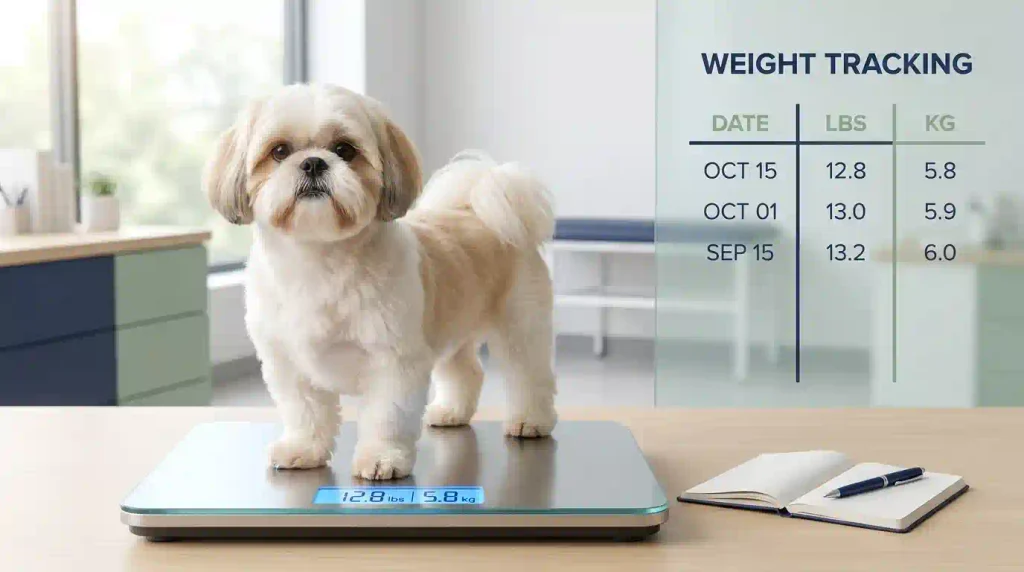
- How to Weigh and Track Your Shih Tzu at Home
- Health Risks and Medical Causes of Weight Changes
- How to Help Your Shih Tzu Reach a Healthy Weight
- Common Shih Tzu Weight Questions
- Final Thoughts
Shih Tzu Weight at a Glance
Typical adult weight range in pounds and kilograms
The Shih Tzu is a small companion dog belonging to the American Kennel Club’s Toy Group. Despite its compact size, the breed is known for a solid, sturdy body with good substance and a long, flowing double coat.
According to the AKC breed standard, the ideal weight of a mature Shih Tzu is 9–16 pounds (approximately 4.1–7.3 kilograms).
The ideal height is 9–10.5 inches (22.9–26.7 cm) when measured at the withers, the highest point of the shoulders.
The breed standard also allows some variation in height, describing a range from 8 to 11 inches.
Here is a quick overview of standard Shih Tzu size and weight.
| Measurement | Typical adult Shih Tzu |
| Breed group | Toy |
| Adult weight | 9–16 lb |
| Adult weight in kilograms | 4.1–7.3 kg |
| Ideal shoulder height | 9–10.5 inches |
| Ideal shoulder height in centimeters | 22.9–26.7 cm |
| General body structure | Compact, sturdy, slightly longer than tall |
| Male weight standard | 9–16 lb |
| Female weight standard | 9–16 lb |
| Time to approach adult size | Approximately 8–12 months |
| Coat type | Long, dense double coat |
Important: These are breed-standard measurements, not strict medical boundaries separating healthy dogs from unhealthy dogs.
A naturally larger Shih Tzu may exceed 16 pounds without having excessive body fat. Similarly, a smaller Shih Tzu may be overweight even when its weight falls within the standard range.
To determine whether your dog has a healthy weight, consider its body shape, muscle condition, and veterinary assessment.
Breed standard weight and why individual dogs may differ
The American Kennel Club establishes breed standards to describe the desired appearance, structure, and proportions of purebred dogs.
However, breed standards do not mean that every healthy member of a breed has identical measurements.
Shih Tzus can differ in skeletal frame, chest width, body length, muscle development, and inherited growth patterns.
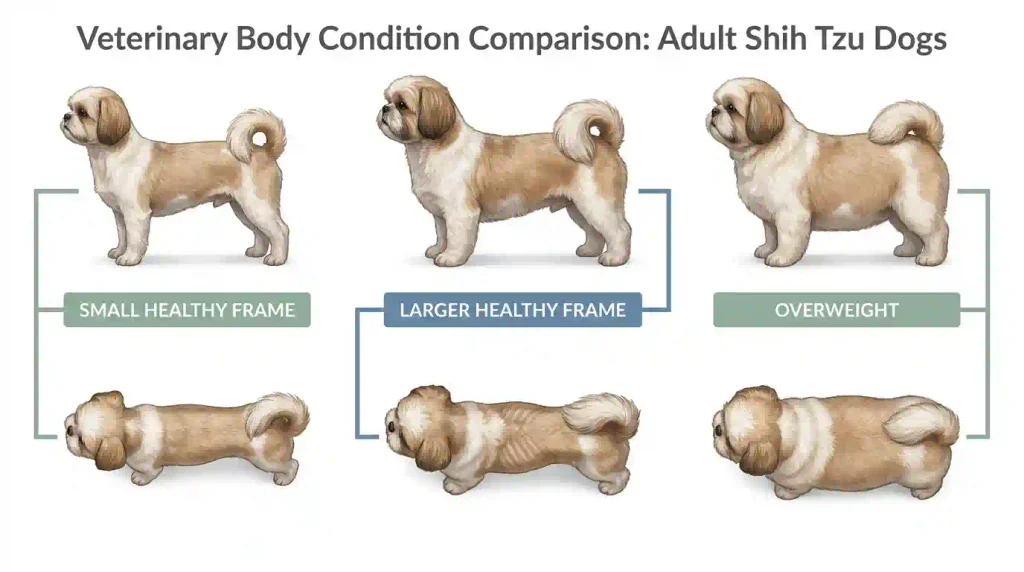
For example, consider two adult Shih Tzus.
Dog A: Weighs 11 pounds, has a small skeletal frame, easily felt ribs, and a visible waist.
Dog B: Weighs 17 pounds, has a larger skeletal frame, good muscle development, easily felt ribs, and a defined waist.
Both dogs may have healthy body conditions despite their different weights.
Now consider another 11-pound Shih Tzu with a very small frame, excess fat covering its ribs, and no visible waist.
Even though this dog falls within the AKC weight standard, it could still be overweight.
This illustrates why the Shih Tzu’s ideal weight cannot be determined from the scale alone.
A veterinarian can assess the dog’s skeletal structure, body condition, and muscle condition to establish a more meaningful target.
Male and female Shih Tzu size differences
Male and female Shih Tzus have the same official AKC adult weight range of 9–16 pounds.
The breed standard does not assign a separate ideal weight range to each sex.
However, males may be heavier on average in some populations.
A Royal Veterinary College VetCompass study published in 2024 examined veterinary records from 11,082 Shih Tzus in the United Kingdom.
The researchers reported the following average adult body weights.
| Sex | Observed average weight | Approximate pounds |
| Male Shih Tzu | 8.5 kg | 18.7 lb |
| Female Shih Tzu | 7.3 kg | 16.1 lb |
| All adult Shih Tzus | 7.9 kg | 17.4 lb |
These figures represent observed body weights within a veterinary population.
They are not recommended ideal weights.
Some of the dogs in the study may have been overweight or had health conditions affecting body mass.
The findings show that male Shih Tzus were heavier on average in that population, but they do not establish that every male should weigh more than every female.
A healthy female Shih Tzu can be larger than a healthy male.
When evaluating male Shih Tzu weight or female Shih Tzu weight, the individual dog’s body condition remains more important than sex alone.
Bone structure versus excess body fat
One of the most common mistakes in assessing Shih Tzu weight is confusing a larger skeletal frame with obesity.
Shih Tzus naturally have compact bodies, broad chests, and relatively short legs.
Some have heavier bone structure than others.
A dog with a broad rib cage and substantial skeletal build may weigh more than a smaller dog without carrying excess body fat.
Body fat, on the other hand, accumulates around areas such as the ribs, abdomen, lower back, and base of the tail.
A dog with excess body fat may develop a rounded shape, reduced waist definition, and thicker fat coverage over the ribs.
To distinguish these possibilities, examine three features:
- Rib coverage: Can you feel individual ribs without pressing hard?
- Waistline: Is there a gentle inward curve behind the rib cage?
- Abdominal tuck: Does the belly rise slightly toward the hind legs when viewed from the side?
A veterinarian can combine these observations with a nine-point Body Condition Score (BCS).
Body composition is particularly important in Shih Tzus because their long, dense coats can conceal their underlying shape.
A fluffy appearance does not automatically indicate excess body fat.
Shih Tzu Weight Chart by Age
Puppy weight from 3 to 12 months
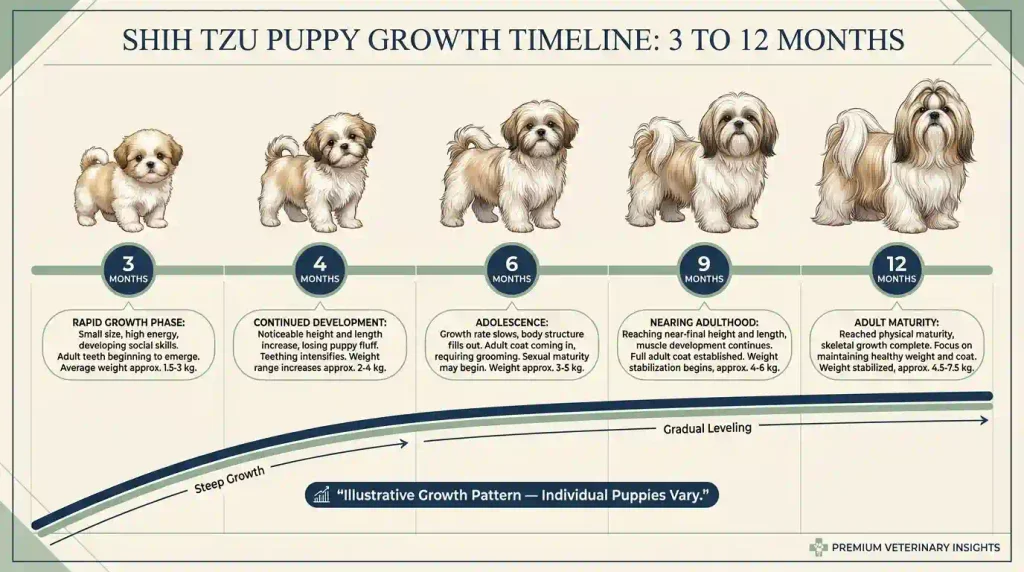
Shih Tzu puppies grow quickly during their first year, but their growth rate is not constant.
The most rapid increases in body size usually occur during early puppyhood, followed by a gradual slowing of growth as the dog approaches physical maturity.
Owners frequently search for a Shih Tzu weight chart by age because they want to know whether their puppy is developing normally.
However, there is no single universal monthly weight chart that accurately describes every healthy Shih Tzu puppy.
A puppy expected to mature at 9 pounds will follow a different growth pattern from one expected to mature at 16 pounds.
Genetics, sex, nutrition, body condition, and individual developmental differences also influence weight.
The most useful approach is to monitor your puppy’s weight over time rather than comparing one measurement with an arbitrary monthly target.
Illustrative Shih Tzu Puppy Weight Chart
The table below shows an example growth record for a hypothetical Shih Tzu expected to weigh approximately 12 pounds (5.4 kg) as an adult.
It is designed to demonstrate how growth typically slows with age.
These values are illustrative, not veterinary growth standards, population averages, or minimum and maximum healthy weights.
| Puppy age | Example weight in pounds | Example weight in kilograms | Growth stage |
| 3 months | 3.5 lb | 1.6 kg | Rapid early growth |
| 4 months | 5.0 lb | 2.3 kg | Continued rapid growth |
| 5 months | 7.0 lb | 3.2 kg | Active development |
| 6 months | 9.0 lb | 4.1 kg | Growth beginning to slow |
| 7 months | 9.5 lb | 4.3 kg | Approaching mature size |
| 8 months | 10.3 lb | 4.7 kg | Slower weight gain |
| 9 months | 10.8 lb | 4.9 kg | Near adult weight |
| 10 months | 11.2 lb | 5.1 kg | Final growth phase |
| 11 months | 11.6 lb | 5.3 kg | Approaching adult weight |
| 12 months | 12.0 lb | 5.4 kg | Example adult size |
A puppy growing faster or slower than this example is not necessarily unhealthy.
For instance, a 6-month-old Shih Tzu weighing 7 pounds may have a perfectly normal growth pattern if it is developing toward a smaller adult frame.
Similarly, a 6-month-old puppy weighing 11 pounds may be developing toward a larger frame.
The puppy’s growth trajectory, physical condition, and veterinary findings are more informative than a single measurement.
How much does a Shih Tzu weigh at 3 months?
At three months, Shih Tzus are still experiencing rapid growth.
Their weights may differ considerably depending on the expected adult size.
A 3-month-old Shih Tzu weighing 3.5 or 5 pounds, for example, cannot be classified as healthy or unhealthy based solely on that number.
Your veterinarian should consider the puppy’s birth history, previous weights, appetite, body condition, and overall development.
A puppy that is consistently gaining weight and remaining active may be developing normally even if it is smaller than another puppy from the same litter.
How much should a Shih Tzu weigh at 4 months?
At four months, many Shih Tzu puppies are still gaining weight rapidly.
Some may already be approaching the middle of their expected adult weight, while others remain considerably smaller.
The example chart shows a hypothetical 5-pound puppy at four months, but that is not a universal ideal.
A healthy growth pattern matters more than hitting a specific figure.
If your puppy suddenly stops gaining weight, loses weight, develops diarrhea, or seems unusually weak, seek veterinary advice.
Shih Tzu weight at 6 months
By six months, many small-breed puppies have achieved a substantial proportion of their expected adult size.
The AKC‘s general puppy growth guidance gives approximately 75% of adult size at six months for small dogs, although this is a broad approximation.
For example:
| Expected adult weight | Approximate 75% at 6 months |
| 9 lb (4.1 kg) | 6.8 lb (3.1 kg) |
| 12 lb (5.4 kg) | 9.0 lb (4.1 kg) |
| 14 lb (6.4 kg) | 10.5 lb (4.8 kg) |
| 16 lb (7.3 kg) | 12.0 lb (5.4 kg) |
These are mathematical illustrations based on the general 75% guideline, not validated Shih Tzu-specific growth percentiles.
A puppy may be healthy above or below these examples.
Shih Tzu weight at 9 months
At nine months, many small dogs are approaching adult size.
General AKC guidance suggests that small dogs may be approximately 90% grown around this age.
For a Shih Tzu expected to mature at 12 pounds, that would correspond to approximately 10.8 pounds.
Some Shih Tzus will already be near their final weight, while others may continue gaining muscle and body mass.
A puppy should not be placed on a weight-loss diet merely because its weight differs from a generic chart.
Expected weight from 1 year to adulthood
Most Shih Tzus are close to their full adult size by their first birthday.
Once skeletal growth is nearly complete, changes in weight are more likely to reflect muscle development, body fat, hydration, or other physiological factors.
A full-grown Shih Tzu generally weighs between 9 and 16 pounds according to the breed standard.
However, the individual dog’s healthy weight may be slightly outside this range.
| Age | Typical growth status | Weight considerations |
| 12 months | Most physical growth complete or nearly complete | Assess mature body size and condition |
| 15 months | Adult structure usually established | Monitor muscle and fat development |
| 18 months | Fully mature for most Shih Tzus | Maintain individualized healthy weight |
| 2 years | Established adult | Weight should be relatively stable |
| 3–6 years | Mature adult | Monitor changes in activity and body condition |
| 7 years and older | Later adulthood | Watch for body-fat gain and muscle changes |
A healthy 2-year-old Shih Tzu weighing 14 pounds does not need to gain more weight simply because it has reached adulthood.
Likewise, a 2-year-old weighing 17 pounds should not automatically be placed on a restrictive diet.
Veterinary assessment is needed to determine the dog’s ideal body condition.
When Shih Tzus stop growing
Most Shih Tzus reach or approach their adult height and weight between approximately 8 and 12 months of age.
Small dog breeds generally mature earlier than large breeds.
The AKC notes that smaller breeds often finish most of their physical growth by around 6–8 months, while some continue developing toward their first birthday.
Even after a Shih Tzu stops growing taller, muscle development and changes in body composition may continue.
Physical maturity, sexual maturity, and behavioral maturity are also different processes.
For example, a Shih Tzu may have reached its adult height while still displaying adolescent behaviors.
Signs your Shih Tzu is approaching full size
You may notice that:
- Height measurements change very little between checkups.
- Weekly or monthly weight gain becomes slower.
- The chest and shoulders begin looking more mature.
- Adult teeth have replaced most puppy teeth.
- The dog’s proportions resemble those of an adult Shih Tzu.
These observations are useful, but they cannot determine the exact date when growth plates close.
A veterinarian can assess skeletal development when medically necessary.
Explore our Shih Tzu Growth & Life Stages section for more information about puppy development, maturity, and aging.
Why weight charts can differ
You may find different numbers when comparing Shih Tzu puppy weight charts online.
One website might suggest that a 4-month-old puppy should weigh 4–6 pounds, while another gives a broader range.
These differences may result from variations in:
- Sample populations
- Expected adult weight
- Sex
- Age measurements
- Body condition
- Data collection methods
- Whether figures are measured or estimated
- Whether the chart is breed-specific or size-based
Some online charts are based on breeder experience, while others are calculated using adult-weight assumptions.
More sophisticated veterinary growth charts use repeated measurements from large populations of healthy puppies.
The WALTHAM Puppy Growth Charts, for example, were developed using data from approximately 50,000 healthy young dogs.
These charts consider age, sex, and estimated adult size, allowing veterinarians to assess growth patterns over time.
Unlike a simple table, growth curves help identify whether a puppy is following a relatively consistent developmental trajectory.
Crossing multiple growth percentile lines may suggest that the puppy is growing substantially faster or slower than expected and deserves further evaluation.
Limits of puppy weight formulas for predicting adult size
Many websites offer a Shih Tzu puppy weight calculator.
Some calculators estimate adult weight by multiplying a puppy’s current weight by a fixed number.
For example, a common informal formula doubles the weight at a selected puppy age.
Other calculators extrapolate from weekly growth rates.
These methods can provide rough estimates, but they are not reliably accurate for every Shih Tzu.
A puppy’s growth is not linear.
The rate of weight gain changes substantially between early puppyhood and adulthood.
Simple formulas also ignore important factors such as:
- Parental size
- Genetics
- Current body condition
- Growth stage
- Nutrition
- Health problems
- Natural variation between littermates
A more useful approach combines parental measurements, repeated puppy weights, and veterinary growth-curve assessment.
If a puppy has three or more reliable weight measurements taken over time, its developing growth pattern may provide a more meaningful estimate than one isolated weight.
Do not restrict food to force a growing Shih Tzu to reach a predicted adult weight.
Healthy development is more important than matching a calculator.
What Affects a Shih Tzu’s Weight?
Genetics and family size
Genetics play an important role in determining Shih Tzu size and body structure.
Puppies inherit growth-related traits from their parents and previous generations.
A puppy from two naturally larger Shih Tzus may develop into a larger adult than one from smaller parents.
However, adult size is influenced by many genes, and inheritance is not perfectly predictable.
A small mother and father do not guarantee that every puppy will remain unusually small.
Similarly, littermates can differ in mature size despite sharing the same parents.
Responsible breeders can often provide useful information about parental weights and growth patterns from previous litters.
Ask for the parents’ mature weights and, ideally, their body conditions.
A parent weighing 18 pounds because of excess fat does not provide the same information about inherited size as a naturally large, lean parent weighing 18 pounds.
Genetic size should be assessed separately from nutritional weight gain.
Age and growth stage
A Shih Tzu’s weight changes naturally throughout life.
During early puppyhood, weight increases rapidly because bones, muscles, organs, and other tissues are developing.
As the puppy approaches adulthood, the rate of gain slows.
During mature adulthood, weight should generally remain reasonably stable when calorie intake and activity are balanced.
Later in life, reduced physical activity may contribute to body-fat accumulation.
Some senior dogs also develop sarcopenia, or age-related muscle loss.
A Shih Tzu may therefore become weaker even if its weight has not changed significantly.
This is why weight should always be interpreted alongside age, body condition, and muscle condition.
Diet, portion size, and treats
Food intake strongly influences body weight.
Shih Tzus are small dogs, so their total daily calorie needs are considerably lower than those of large breeds.
Small feeding errors can accumulate over time.
For example, an owner may measure kibble accurately but forget to count:
- Training treats
- Dental chews
- Table scraps
- Food toppers
- Peanut butter
- Pieces of cheese or meat
- Snacks offered by family members
- Food stolen from another pet
Calorie density also matters.
Two dog foods with the same serving size may contain very different numbers of calories.
A cup of one food might provide 320 calories while another provides 420.
Therefore, the physical volume of food does not necessarily reveal how much energy your Shih Tzu consumes.
A balanced diet should provide adequate nutrients without excessive calories.
For puppies, adequate feeding supports healthy development.
For adults, appropriate portions help maintain body condition.
For seniors, nutrition may need adjusting according to muscle mass, appetite, and existing health conditions.
Activity level and exercise
Physical activity influences energy expenditure, muscle development, and general health.
Shih Tzus were developed primarily as companion dogs, but they still benefit from regular movement and mental enrichment.
Daily activity may include:
- Comfortable walks
- Indoor play
- Gentle fetch games
- Scent games
- Puzzle toys
- Positive-reinforcement training
- Supervised outdoor exploration
A Shih Tzu that becomes less active may gain weight if its calorie intake remains unchanged.
Reduced activity can occur because of weather, lifestyle changes, injury, or age-related illness.
However, exercise requirements must be adjusted for the breed’s short-muzzled anatomy.
Some Shih Tzus experience brachycephalic obstructive airway syndrome (BOAS), which can reduce exercise tolerance.
Avoid strenuous activity in hot or humid conditions.
Watch for excessive panting, noisy breathing, weakness, or difficulty recovering after exercise.
Exercise should support fitness, not create respiratory distress.
Neutering and other health factors
Spaying or neutering can influence energy requirements and appetite in some dogs.
After surgery, an unchanged feeding routine may provide more calories than the dog needs.
However, this does not mean that every neutered Shih Tzu becomes overweight.
Weight gain depends on the interaction between calorie intake, physical activity, metabolism, and individual characteristics.
Your veterinarian can help review food portions after spaying or neutering.
Other medical factors may also influence weight.
These include:
Hypothyroidism: Reduced thyroid hormone production can contribute to weight gain, lethargy, and coat changes.
Cushing’s syndrome: Excess cortisol may increase appetite and produce abdominal enlargement.
Chronic pain: Arthritis or other painful conditions may reduce physical activity.
Medication effects: Certain medications, including corticosteroids, may increase appetite or alter body composition.
Unexpected weight changes should not automatically be attributed to neutering or aging.
Weight changes in senior Shih Tzus
Senior Shih Tzus require particular attention to changes in body composition.
Some older dogs gain weight because they move less.
Others lose weight because of dental disease, reduced appetite, chronic illness, or muscle wasting.
A Shih Tzu can even lose muscle while gaining fat, causing its overall weight to remain relatively stable.
Signs of muscle loss may include more prominent bones around the shoulders, spine, or hips, weakness when standing, and reduced physical stamina.
A veterinarian can evaluate both Body Condition Score and Muscle Condition Score.
For detailed guidance on feeding, health monitoring, mobility, and comfort, read our senior Shih Tzu care guide.
Age also influences how weight should be interpreted.
If you’re unsure whether your companion has entered adulthood or its senior years, our Shih Tzu age in human years guide explains the breed’s approximate life stages and age conversions.
How to Tell If Your Shih Tzu Is at a Healthy Weight
Body condition score for a heavily coated Shih Tzu
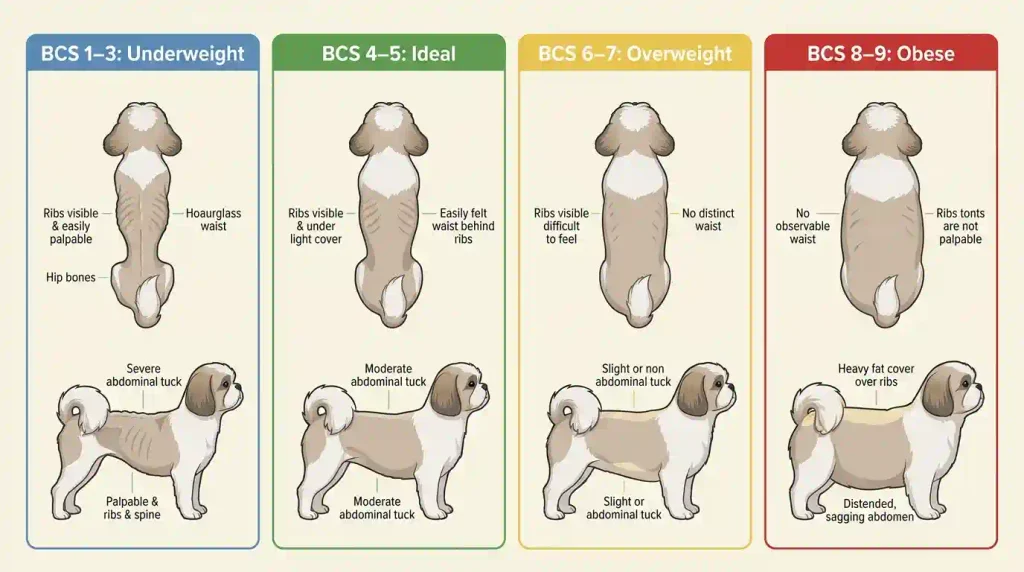
The most useful way to assess whether a Shih Tzu has a healthy weight is to combine body weight with a physical body-condition examination.
Veterinarians frequently use the nine-point Body Condition Score (BCS) system.
This method evaluates fat coverage over the ribs, waist, abdomen, and other body areas.
The ideal score for most healthy adult dogs is 4 or 5 out of 9.
| Body Condition Score | Classification | Typical appearance and feel |
| 1–3/9 | Underweight | Ribs and other bones may be prominent, with insufficient fat coverage |
| 4–5/9 | Ideal condition | Ribs easily felt, visible waist, abdominal tuck |
| 6–7/9 | Overweight | Excess fat over ribs and reduced waist definition |
| 8–9/9 | Obese | Heavy fat deposits and little or no visible waist |
This system is particularly useful for Shih Tzus because their long double coats can conceal excess body fat.
A dog may look broad and fluffy while having an appropriate body condition.
Another dog may appear normal in photographs while carrying excess fat beneath its coat.
Body Condition Score is more informative than relying on appearance alone.
How to check body shape and feel the ribs through the coat
You can perform a basic body-condition check at home.
Choose a calm moment when your Shih Tzu is comfortable being handled.
Step 1: Feel the ribs
Place your hands gently along the sides of your dog’s chest.
Move your fingertips beneath the fur until you can feel the rib cage.
In a dog with ideal body condition, the ribs should be easy to locate beneath a thin layer of fat.
You should not need to press forcefully.
If the ribs feel heavily padded, your dog may have excess body fat.
If the ribs are extremely sharp or prominent, your dog may be underweight.
Step 2: Check the waist
Stand above your dog while it is standing naturally.
Look for an inward curve behind the rib cage.
A defined waist generally suggests healthier proportions than a completely rounded outline.
Because Shih Tzus have dense coats, you may need to gently smooth the fur or feel the body to identify the actual waistline.
Step 3: Examine the abdominal tuck
Look at your dog from the side.
The abdomen should generally rise slightly from the lower chest toward the hind legs.
A hanging belly may suggest excess fat, but abdominal appearance can also be affected by anatomy or medical conditions.
Step 4: Evaluate muscle condition
Feel the shoulders, spine, and pelvic region.
An older Shih Tzu may have poor muscle condition even if its body fat is excessive.
Muscle loss should be addressed through veterinary assessment and appropriate nutrition.
Step 5: Confirm the result with your veterinarian
Home checks provide useful information, but a professional assessment can identify factors that owners may overlook.
A veterinarian can recommend an individualized ideal weight and help you monitor progress.
Signs your Shih Tzu may be overweight
Possible signs of an overweight Shih Tzu include:
- Ribs that are difficult to feel
- Little or no defined waist
- Rounded abdominal appearance
- Fat deposits around the lower back or tail base
- Reduced interest in activity
- Difficulty climbing stairs
- Reluctance to jump
- Heavy panting after mild exercise
- Reduced stamina during familiar walks
- Difficulty grooming or reaching certain body areas
These signs are not specific to obesity.
Difficulty exercising may also indicate respiratory disease, joint pain, or heart problems.
For example, a Shih Tzu with BOAS may pant heavily even when its body weight is appropriate.
Weight assessment should therefore be combined with an evaluation of overall health.
A 20-pound Shih Tzu deserves body-condition assessment because that weight exceeds the usual breed-standard range, but it does not automatically prove obesity.
Similarly, a 10-kilogram Shih Tzu is well above the standard range and should be evaluated for excess body fat and other relevant factors.
Signs your Shih Tzu may be underweight
A Shih Tzu can also become too thin.
Possible signs include:
- Clearly prominent ribs
- Visible or easily felt pelvic bones
- Marked abdominal tuck
- Loss of muscle around the shoulders or spine
- Poor coat condition
- Reduced energy
- Weakness
- Unexplained weight loss
- Persistent appetite changes
A naturally small dog is not necessarily underweight.
However, a dog with insufficient fat reserves, muscle loss, or poor nutritional condition needs veterinary assessment.
In puppies, slow weight gain may reflect inadequate food intake, intestinal parasites, illness, or other growth-related problems.
In older dogs, unexplained weight loss can be associated with dental disease, kidney problems, digestive disorders, diabetes, or other conditions.
Never attempt to correct unexplained weight loss simply by offering large amounts of high-calorie food without investigating the cause.
How to Weigh and Track Your Shih Tzu at Home
How to weigh your Shih Tzu consistently
Regular weighing helps you monitor puppy growth and detect unexpected adult weight changes.
A digital pet scale is particularly useful for small dogs because it can measure relatively small differences.
If you don’t have a pet scale, you can weigh your dog using a bathroom scale.
Method 1: Using a digital pet scale
- Place the scale on a flat, stable surface.
- Make sure it displays zero before weighing.
- Encourage your Shih Tzu to stand or sit calmly on the scale.
- Wait for a stable reading.
- Record the weight in pounds or kilograms.
- Repeat if your dog moved during the measurement.
Method 2: Using a bathroom scale
If your dog is comfortable being safely held:
- Weigh yourself without holding the dog.
- Record your weight.
- Weigh yourself while holding your Shih Tzu.
- Subtract your weight from the combined measurement.
For example:
Your weight: 150 pounds.
Combined weight: 164 pounds.
Shih Tzu weight: 14 pounds.
This method is convenient, but some bathroom scales are not sufficiently precise to detect small changes in a toy-breed dog.
A veterinary or dedicated pet scale is preferable when accuracy matters.
How often to record your dog’s weight
The ideal weighing frequency depends on your Shih Tzu’s age and health.
| Life stage or situation | Suggested weighing frequency |
| Young puppy | Weekly or as advised by the veterinarian |
| Older growing puppy | Every 1–2 weeks |
| Healthy adult | Approximately monthly |
| Senior Shih Tzu | Monthly or more frequently when indicated |
| Active weight-loss program | Often every 2 weeks under veterinary guidance |
| Illness or unexpected weight change | As recommended by the veterinarian |
Puppies with growth concerns may need more frequent measurements.
Likewise, dogs with kidney disease, appetite problems, or other medical conditions may require closer monitoring.
The goal is to identify meaningful trends without becoming overly concerned about small day-to-day fluctuations.
Shih Tzu weight-tracking log
A simple log allows you to compare weight over time.
You can keep the information in a notebook, spreadsheet, or mobile phone.
| Date | Age | Weight (lb) | Weight (kg) | BCS | Notes |
| Week 1 | 6 months | 8.8 | 3.99 | Vet assessed | Normal appetite |
| Week 3 | 6.5 months | 9.3 | 4.22 | — | Active and playful |
| Week 5 | 7 months | 9.7 | 4.40 | — | Growing steadily |
| Week 7 | 7.5 months | 10.1 | 4.58 | Vet assessed | Healthy development |
This is a fictional example of a puppy growth log, not a universal weight target or a recommended rate of gain.
For the most consistent results, weigh your dog:
- On the same scale
- At approximately the same time of day
- Under similar feeding conditions
- Without additional clothing or accessories when possible
Recording the dog’s Body Condition Score alongside its weight makes the information more useful.
How to interpret weight changes over time
A single weight measurement provides limited information.
Several measurements reveal whether your Shih Tzu is gaining, losing, or maintaining weight.
Healthy puppy growth
A puppy should generally show a progressive increase in body mass during development.
The rate of gain slows as adulthood approaches.
A temporary small fluctuation may not be concerning, but persistent weight loss or failure to grow appropriately deserves veterinary assessment.
Healthy adult maintenance
Once a Shih Tzu reaches adulthood, its weight should generally remain relatively stable.
Minor fluctuations can occur because of feeding, hydration, and normal biological variation.
Repeated upward changes may indicate that calorie intake exceeds energy expenditure.
Repeated downward changes may indicate insufficient intake or an underlying health problem.
Senior weight changes
Weight changes in senior dogs deserve particular attention.
Unexpected weight loss can be associated with muscle wasting, dental pain, digestive disorders, or other illnesses.
Weight gain may reflect decreased activity, overfeeding, or medical conditions.
An older dog may also experience muscle loss without major changes in total body weight.
Calculating percentage weight change
You can calculate the percentage of weight gained or lost using:
Percentage weight change = (New weight − Previous weight) ÷ Previous weight × 100
For example, a Shih Tzu increases from 12 pounds to 13 pounds.
The increase is:
(13 − 12) ÷ 12 × 100 = 8.3%
That is an approximately 8.3% increase in body weight.
Whether the change is appropriate depends on whether the dog is still growing, its previous body condition, the time involved, and its health.
A gradual increase during puppyhood may be expected.
The same increase in a mature adult over a short period may warrant investigation.
Health Risks and Medical Causes of Weight Changes
Health concerns linked to excess weight
Excess body fat can negatively affect a Shih Tzu’s mobility, breathing, and general health.
Weight-related problems may include:
Joint discomfort: Additional body mass increases mechanical demands on joints, potentially worsening existing arthritis or orthopedic problems.
Reduced mobility: Overweight dogs may become less willing to walk, jump, or play.
Breathing difficulties: Because Shih Tzus are brachycephalic, excess weight can complicate existing respiratory problems.
Heat intolerance: Dogs with excessive body fat may struggle more with physical exertion and temperature regulation.
Metabolic problems: Obesity is associated with insulin resistance and other metabolic health concerns.
Reduced quality of life: Chronic discomfort and decreased activity can affect a dog’s enjoyment of everyday activities.
Excess weight is also associated with poorer health outcomes in dogs generally.
However, not every condition in an overweight Shih Tzu is caused by obesity.
A veterinarian should investigate symptoms rather than assuming weight explains everything.
Health concerns linked to low weight
Insufficient weight can also present risks.
A Shih Tzu with poor body condition may have inadequate energy reserves, reduced muscle mass, and difficulty maintaining normal physical function.
Possible health concerns include:
- Muscle weakness
- Reduced stamina
- Nutritional deficiencies
- Poor coat quality
- Delayed growth in puppies
- Impaired recovery during illness
- Greater vulnerability to complications from underlying disease
In growing puppies, adequate nutrition is especially important.
Restricting calories to produce an unusually small Shih Tzu can interfere with normal development.
For adult dogs, significant weight loss should be evaluated even if the dog previously carried excess fat.
The goal is healthy body composition, not simply achieving the lowest possible number on a scale.
Possible medical causes of unexplained weight gain or loss
Unexpected weight changes can occur for several reasons.
Causes of unexplained weight gain
Potential causes include:
- Excess calorie intake
- Reduced physical activity
- Medication effects
- Hypothyroidism
- Cushing’s syndrome
- Fluid accumulation
- Changes in metabolism or hormonal status
Abdominal enlargement can sometimes be mistaken for obesity.
For example, fluid accumulation or enlargement of internal organs may increase abdominal size without representing ordinary fat gain.
Causes of unexplained weight loss
Potential causes include:
- Dental disease
- Digestive disorders
- Intestinal parasites
- Diabetes mellitus
- Kidney disease
- Liver disease
- Chronic inflammation
- Cancer
- Inadequate food intake
- Muscle wasting
Some diseases cause weight loss despite a normal or increased appetite.
Others cause poor appetite, nausea, or difficulty chewing.
Veterinary testing may include a physical examination, bloodwork, urinalysis, fecal testing, or imaging when indicated.
A diagnosis should be based on examination and appropriate evidence rather than symptoms alone.
When a weight change needs veterinary attention
Contact your veterinarian if your Shih Tzu:
- Loses weight unexpectedly
- Stops gaining weight during puppyhood
- Gains weight despite consistent measured feeding
- Develops a swollen abdomen
- Shows reduced appetite for a prolonged period
- Drinks or urinates noticeably more than usual
- Becomes weak or unusually tired
- Develops vomiting or persistent diarrhea
- Experiences difficulty breathing
- Shows significant muscle loss
A small puppy that refuses food and becomes weak requires prompt attention because young toy-breed puppies may be vulnerable to low blood glucose.
Severe weakness, collapse, labored breathing, or other signs of acute distress require emergency veterinary care.
Do not begin an aggressive diet or use weight-gain supplements before the underlying problem has been assessed.
How to Help Your Shih Tzu Reach a Healthy Weight
Set a weight goal with your veterinarian
The first step in weight management is determining your Shih Tzu’s appropriate target weight.
This should be based on body condition and health rather than automatically choosing the middle of the AKC breed-standard range.
A veterinarian may assess:
- Current body weight
- Body Condition Score
- Muscle Condition Score
- Skeletal size
- Age and growth stage
- Reproductive status
- Medical history
- Existing medications
- Activity level
- Current food intake
For a healthy adult dog with excess body fat, the goal is usually gradual fat loss while preserving muscle and adequate nutrition.
For an underweight dog, the goal may involve identifying and treating the cause before adjusting calorie intake.
Puppies require a different approach because their bodies are still growing.
A puppy should not follow an adult weight-loss plan without veterinary supervision.
Plan food portions and daily calories
Shih Tzus have relatively small total daily calorie requirements.
However, daily calorie needs differ according to age, body size, activity, reproductive status, and medical conditions.
Veterinarians may estimate energy requirements using a calculation called Resting Energy Requirement (RER).
A commonly used formula is:
RER = 70 × (Body weight in kilograms)^0.75
RER estimates the energy required for essential body functions at rest.
It is not automatically the correct daily feeding allowance.
Veterinarians adjust this estimate using factors related to growth, activity, reproductive status, and weight-management goals.
For example, a healthy adult weighing 5.4 kilograms (approximately 12 pounds) has a calculated RER of roughly 248 kilocalories per day.
Its actual daily food requirement may be substantially different.
A growing puppy may need considerably more energy than an inactive adult of the same weight.
A senior dog with illness may also require an individualized nutritional plan.
Therefore, an RER calculation should be treated as a starting point rather than a feeding prescription.
How many meals should a Shih Tzu eat?
Meal frequency varies by age and health.
Young puppies often need several smaller meals throughout the day.
Older puppies may transition to fewer meals as they mature.
Most healthy adult Shih Tzus can be fed in two measured meals daily, although some benefit from alternative schedules.
Dogs with certain medical conditions may need more frequent or specially timed feeding.
Ask your veterinarian to recommend an appropriate schedule for your individual dog.
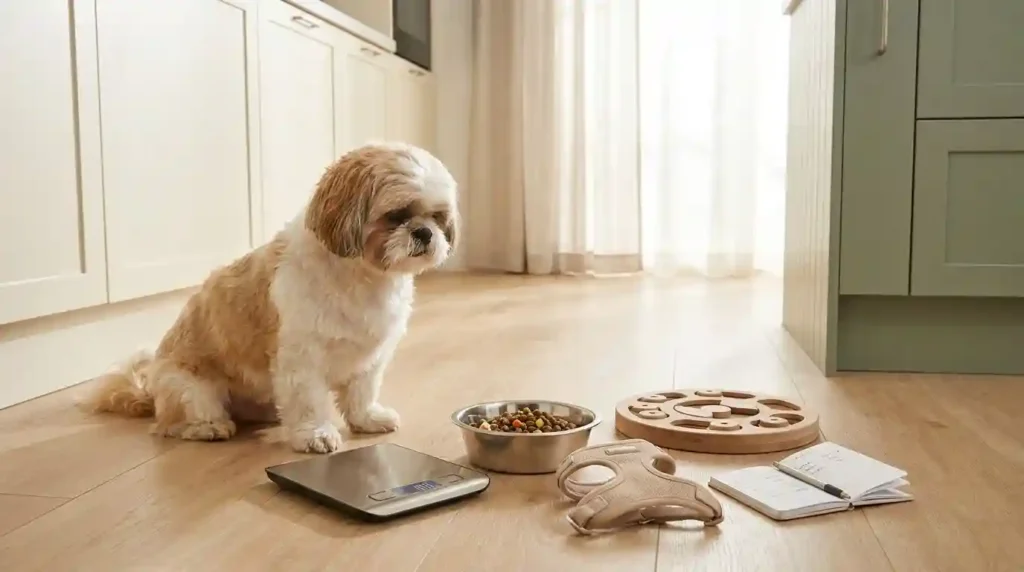
Measure food portions accurately
Accurate food measurement is essential for reliable weight management.
A digital kitchen scale is usually more precise than using an ordinary measuring cup.
Measuring cups can produce inconsistent portions because kibble pieces differ in size, shape, and density.
For example, one cup of loosely packed kibble may weigh considerably less than one cup packed tightly.
Follow these steps:
- Check the food label for calorie density.
- Identify the daily calorie allowance recommended for your dog.
- Determine the corresponding amount of food in grams.
- Weigh that amount using a digital scale.
- Divide the portion into the day’s meals.
- Reserve part of the allowance for appropriate food rewards if needed.
Example of calculating a food portion
Suppose a dog food contains 360 calories per 100 grams.
That means each gram provides 3.6 calories.
If a veterinarian recommends obtaining 288 calories per day from that food, the required amount is:
288 ÷ 3.6 = 80 grams.
The daily portion would therefore be 80 grams of that specific food.
This is an arithmetic example, not a recommended feeding allowance for every Shih Tzu.
If the food formula changes, the portion size may also need to change.
Count treats and table scraps
Treats can provide useful training rewards and enrichment, but excessive quantities can contribute to weight gain.
The American Animal Hospital Association (AAHA) recommends keeping treats at or below approximately 10% of total daily calories.
The remaining calories should come primarily from a complete and balanced diet.
For example, if a veterinarian has established a 400-calorie daily allowance, a maximum of approximately 40 calories from treats would follow the 10% guideline.
This does not mean every dog should receive 400 calories per day.
The total allowance must be individualized.
Count all extras, including:
- Training treats
- Dental chews
- Table scraps
- Food toppers
- Peanut butter
- Snack biscuits
- Calorie-containing supplements
- Food used in puzzle toys
For lower-calorie rewards, consider tiny portions of your dog’s regular kibble or suitable dog-safe vegetables when appropriate.
Non-food rewards such as praise, attention, and favorite toys can also be effective.
Avoid sharing toxic human foods, including grapes, raisins, onions, chocolate, and products containing xylitol.
Encourage safe exercise and play
Exercise can support healthy body condition, mobility, and emotional well-being.
For Shih Tzus, gentle and consistent activity is usually more appropriate than prolonged strenuous exercise.
Possible activities include:
Short daily walks: Choose comfortable distances and adjust for weather and individual stamina.
Indoor games: Hide toys, practice simple commands, or encourage gentle movement.
Food puzzles: Use part of your dog’s regular food allowance in puzzle feeders.
Scent activities: Allow your dog to find familiar treats or toys in safe locations.
Gentle play: Short play sessions can encourage movement without excessive physical demands.
Avoid heavy exercise in hot or humid conditions.
Because Shih Tzus are short-muzzled, breathing comfort is an important consideration.
Stop the activity if your dog shows:
- Excessive panting
- Breathing difficulty
- Weakness
- Limping
- Pain
- Unusual fatigue
- Poor recovery after activity
For dogs with arthritis, airway problems, or spinal conditions, ask your veterinarian about suitable exercise or rehabilitation options.
Track progress and adjust the plan with your veterinarian
Weight management should involve regular monitoring.
For a dog on a veterinary weight-loss plan, weigh-ins approximately every two weeks may help identify progress and guide adjustments.
The veterinarian may recommend a different interval according to the dog’s needs.
Track both body weight and body condition.
A successful program should aim to reduce excess fat without causing nutritional deficiencies or unnecessary muscle loss.
What if your Shih Tzu is not losing weight?
Review the feeding routine.
Ask yourself:
- Are all meals weighed accurately?
- Is the food’s calorie density correct?
- Are treats being included?
- Does anyone else feed the dog?
- Has activity decreased?
- Could medication or illness affect weight?
Do not automatically reduce portions further.
Your veterinarian may need to revise calorie targets, review diet composition, or investigate other problems.
What if weight loss happens too quickly?
Rapid weight loss can indicate excessive calorie restriction, dehydration, or illness.
A veterinarian may aim for approximately 1–2% of body weight loss per week in appropriate overweight adult dogs, although some need slower progress.
For a 15-pound Shih Tzu, 1% represents approximately 0.15 pounds per week.
That small weekly change illustrates why accurate weighing is useful for toy breeds.
Unexpectedly rapid loss, weakness, reduced appetite, or muscle wasting requires veterinary reassessment.
Maintaining a healthy weight after reaching the goal
Once your Shih Tzu reaches an appropriate body condition, the feeding plan may need adjustment to prevent continued weight loss.
Continue measuring food and monitoring treats.
Maintain regular, comfortable activity.
Check body condition periodically and discuss meaningful changes with your veterinarian.
Long-term consistency is usually more useful than short periods of strict dieting followed by uncontrolled feeding.
Common Shih Tzu Weight Questions
What is the ideal weight for a Shih Tzu?
The AKC adult breed standard is 9–16 pounds (4.1–7.3 kg), but individual ideal weight depends on skeletal size, body condition, and muscle mass.
Is 20 pounds too heavy for a Shih Tzu?
A 20-pound Shih Tzu is above the standard weight range, but body-condition assessment is needed to determine whether the dog is overweight.
Is 10 kilograms heavy for a Shih Tzu?
Yes, 10 kg (approximately 22 lb) is well above the typical adult breed-standard range and warrants veterinary evaluation of body condition.
How much should a Shih Tzu puppy weigh at 3 months?
There is no single healthy weight for every 3-month-old Shih Tzu; expected adult size, growth history, and body condition should guide the assessment.
How much should a 2-year-old Shih Tzu weigh?
A full-grown 2-year-old Shih Tzu typically falls within the 9–16-pound breed-standard range, although individual healthy weights can differ.
How much should I feed my Shih Tzu puppy?
Feed a complete and balanced puppy diet in measured portions based on age, current weight, expected adult size, food calorie density, and veterinary guidance.
Why is my Shih Tzu puppy not gaining weight?
Slow or absent weight gain may result from insufficient food intake, parasites, illness, digestive problems, or individual growth differences and should be assessed by a veterinarian.
Can a Shih Tzu’s coat make it harder to judge its weight?
Yes, the Shih Tzu’s long double coat can hide body shape, making rib palpation and body-condition scoring more reliable than visual appearance alone.
Are “teacup,” “miniature,” or “imperial” Shih Tzus different size categories?
No, these are not officially recognized AKC Shih Tzu size varieties; they are informal or marketing terms often applied to unusually small dogs.
Final Thoughts
Understanding Shih Tzu weight involves more than checking whether your dog falls within the typical 9–16-pound adult range. Genetics, skeletal structure, age, muscle condition, nutrition, and physical activity all influence a Shih Tzu’s healthy body weight. Puppies grow rapidly during their first several months, with most approaching adult size by 8–12 months, while mature and senior dogs need consistent monitoring to detect unwanted weight changes. The most useful approach combines a growth chart, accurate weighing, body-condition scoring, and veterinary guidance. Whether your Shih Tzu is naturally small, larger-framed, overweight, or struggling to gain weight, the goal is healthy development and long-term comfort rather than achieving one fixed number. For more information about breed development, health, grooming, and everyday care, explore our Shih Tzu guides and learn how to support your companion throughout every life stage.