
Shih Tzu Age in Human Years: Chart, Calculator, and Life Stages
Shih Tzu age in human years is calculated differently from the traditional rule of multiplying a dog’s age by seven. Because Shih Tzus are small dogs, they mature rapidly during their first two years but generally age more slowly than larger breeds afterward. Using a commonly applied small-dog age conversion chart, a 1-year-old Shih Tzu is approximately 15 human years old, a 5-year-old is about 36, a 10-year-old is around 56, and a 15-year-old is approximately 76 human years old. These figures are estimates rather than exact biological ages, and every dog ages differently depending on genetics, health, body condition, and lifestyle. The American Kennel Club (AKC) lists the Shih Tzu’s typical lifespan as 10–18 years, meaning many healthy dogs can remain active well into their teens. Understanding your Shih Tzu’s age helps you recognize important life stages, adjust nutrition and exercise, schedule appropriate veterinary care, and prepare for age-related changes. Below, you’ll find a complete Shih Tzu age chart, a simple conversion method, explanations of scientific aging research, and practical care recommendations for every stage of your dog’s life.
Table of Contents
- Shih Tzu Age Chart: Dog Years to Human Years
- How Dog Years Convert to Human Years
- What a Shih Tzu’s Human-Age Estimate Can—and Cannot—Tell You
- Shih Tzu Life Stages and Aging
- Shih Tzu Lifespan and Factors That Affect Aging
- How to Use Your Shih Tzu’s Age to Guide Daily Care
- Frequently Asked Questions About Shih Tzu Age in Human Years
- Final Thoughts
Shih Tzu Age Chart: Dog Years to Human Years
Shih Tzu age conversion by year
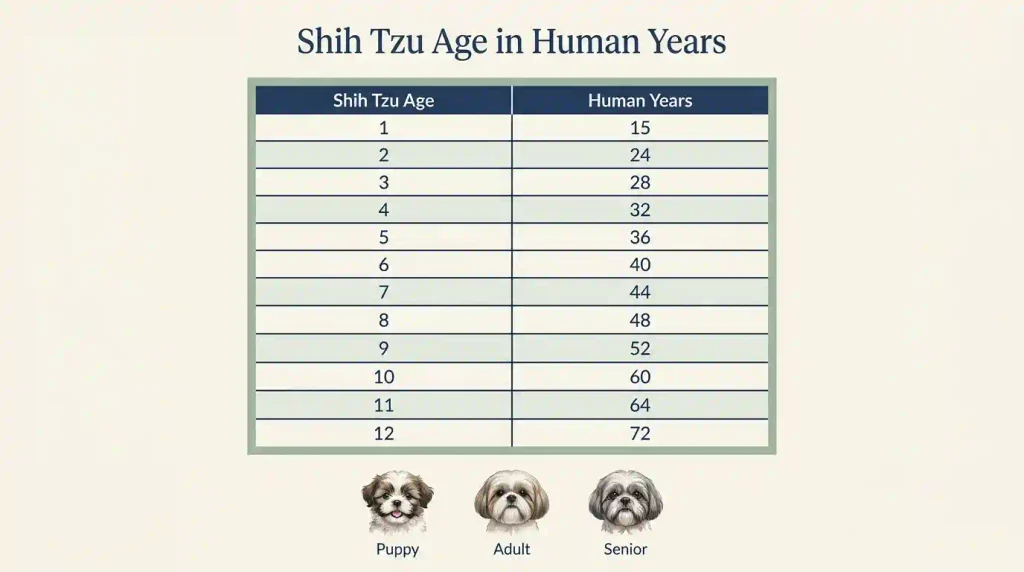
If you’re wondering, “How old is my Shih Tzu in human years?”, the following age conversion chart provides a practical starting point.
Shih Tzus typically weigh 9–16 pounds (4.1–7.3 kg) as adults, placing them in the small-dog category used by many general age conversion charts.
The chart below estimates a Shih Tzu’s human-equivalent age from 1 through 20 chronological years.
| Shih Tzu age | Human years (approx.) |
| 1 year | 15 years |
| 2 years | 24 years |
| 3 years | 28 years |
| 4 years | 32 years |
| 5 years | 36 years |
| 6 years | 40 years |
| 7 years | 44 years |
| 8 years | 48 years |
| 9 years | 52 years |
| 10 years | 56 years |
| 11 years | 60 years |
| 12 years | 64 years |
| 13 years | 68 years |
| 14 years | 72 years |
| 15 years | 76 years |
| 16 years | 80 years |
| 17 years | 84 years* |
| 18 years | 88 years* |
| 19 years | 92 years* |
| 20 years | 96 years* |
Figures for ages 17–20 extend the same approximate small-dog conversion pattern beyond age 16. They are illustrations, not independently validated biological ages.
Important: This is a general small-breed conversion chart, not a scientifically validated Shih Tzu-specific biological aging clock.
The values are intended to illustrate relative life stages. They do not mean that a 15-year-old Shih Tzu has the same health status, remaining lifespan, or disease risk as a 76-year-old human.
How to read and use the age chart
To estimate your Shih Tzu’s human-equivalent age:
- Find your dog’s actual age in the first column.
- Read the corresponding estimated human age in the second column.
- Use the result as a general developmental comparison.
- Consider your dog’s health, activity, and physical condition when planning care.
For example:
- A 4-year-old Shih Tzu in human years is approximately 32.
- A 7-year-old Shih Tzu in human years is approximately 44.
- An 8-year-old Shih Tzu in human years is approximately 48.
- A 10-year-old Shih Tzu in human years is approximately 56.
- A 12-year-old Shih Tzu in human years is approximately 64.
- A 13-year-old Shih Tzu in human years is approximately 68.
- A 14-year-old Shih Tzu in human years is approximately 72.
- A 15-year-old Shih Tzu in human years is approximately 76.
- A 16-year-old Shih Tzu in human years is approximately 80.
- A 17-year-old Shih Tzu in human years is approximately 84 using the extended chart.
A Shih Tzu reaching 17 years old has achieved an advanced chronological age, regardless of which human-year comparison is used.
Quick Shih Tzu Age Calculator
You can estimate your Shih Tzu’s human age without a specialized online calculator.
For dogs aged two years or older, use this approximate small-breed calculation:
Human-equivalent age = 24 + 4 × (Dog’s age − 2)
For example, if your Shih Tzu is 9 years old:
24 + 4 × (9 − 2) = 52
Therefore, a 9-year-old Shih Tzu is approximately 52 human years old on this chart.
For a 13-year-old Shih Tzu:
24 + 4 × (13 − 2) = 68
The estimated human-equivalent age is 68 years.
For a 15-year-old Shih Tzu:
24 + 4 × (15 − 2) = 76
The estimated human-equivalent age is 76 years.
This simple calculator reproduces the values in the adult small-dog chart. It should not be mistaken for a personalized medical assessment.
How to convert a Shih Tzu’s age in months
Puppies age especially quickly, making month-by-month conversion less straightforward.
A Shih Tzu puppy goes through rapid physical and behavioral changes during its first year, including teething, social development, growth, and sexual maturation.
A simple human-year conversion cannot precisely match all these developments.
| Shih Tzu age | Developmental stage |
| 2 months | Young puppy; early learning and social development |
| 3 months | Rapid growth, play, and social learning |
| 4 months | Puppy growth and developing coordination |
| 6 months | Adolescent development may be beginning |
| 9 months | Adolescent; many small breeds approaching adult size |
| 12 months | Young adult; approximately 15 human-equivalent years |
| 18 months | Young adult; approximately 19–20 human-equivalent years |
| 24 months | Adult; approximately 24 human-equivalent years |
These developmental stages are approximate. The 18-month estimate is an interpolation between the first- and second-year conversion values.
For a Shih Tzu older than one year, you can express the chronological age as a decimal.
For example:
1 year and 6 months = 1.5 years
Using a simple interpolation between ages one and two gives an estimated human-equivalent age of approximately 19.5 years.
For dogs older than two years, the adult chart can be interpolated in the same way.
A 5-year-and-6-month-old Shih Tzu would be approximately 38 human-equivalent years old.
For puppies younger than one year, it’s more useful to follow veterinary developmental milestones than to assign an exact human age.
How Dog Years Convert to Human Years
Why the “seven human years for every dog year” rule is inaccurate
The traditional seven-year rule assumes that every dog ages at the same constant rate.
Under this method, a 1-year-old dog would equal a 7-year-old human, while a 10-year-old dog would equal a 70-year-old human.
However, canine aging does not work this way.
Dogs grow and mature much faster than humans during their earliest years.
A 1-year-old Shih Tzu may already be capable of reproduction and approaching physical maturity, making a comparison with a 7-year-old human developmentally inappropriate.
The simplified formula also ignores differences in breed size and lifespan.
Consider the following comparison.
| Shih Tzu age | Old 7-year rule | Small-dog chart |
| 1 year | 7 | 15 |
| 2 years | 14 | 24 |
| 5 years | 35 | 36 |
| 10 years | 70 | 56 |
| 15 years | 105 | 76 |
The two methods produce very different results, particularly during early development and later adulthood.
Neither approach should be used to diagnose health conditions, but size-adjusted charts better represent the broad pattern of rapid early maturation and slower subsequent aging in smaller dogs.
How size-adjusted age charts estimate human-equivalent age
Size-adjusted conversion charts acknowledge that small, medium, large, and giant dogs often experience different aging patterns.
Many common charts use the following broad framework for small dogs:
- First year: Approximately 15 human years.
- Second year: Approximately 9 additional human years.
- Each later year: Approximately 4 additional human years.
This creates a non-linear age conversion.
The first two years account for approximately 24 human-equivalent years, while each subsequent year adds a smaller amount.
The American Kennel Club’s dog-age conversion guide explains why age estimates should account for developmental differences and body size rather than relying on the seven-year rule.
Because Shih Tzus are small dogs, the small-breed column is usually the most appropriate general reference.
Nevertheless, different breeds within the same size category can still have different health risks and aging patterns.
What the epigenetic dog-age formula measures
Scientists have investigated biological aging using changes in DNA methylation.
DNA methylation involves chemical modifications associated with the regulation of gene activity.
Some methylation patterns change predictably with age, allowing researchers to develop methods sometimes described as epigenetic clocks.
A 2020 study by Wang and colleagues, involving researchers at the University of California San Diego (UCSD), examined DNA methylation patterns in 104 Labrador Retrievers and compared them with human patterns.
The researchers proposed a logarithmic relationship:
Human-equivalent age = 16 × ln(dog’s age) + 31
Here, ln means the natural logarithm.
For example, the formula estimates:
| Dog age | Epigenetic formula estimate |
| 1 year | 31 years |
| 2 years | 42 years |
| 5 years | 57 years |
| 10 years | 68 years |
| 12 years | 71 years |
| 15 years | 74 years |
The results differ substantially from the small-dog chart.
That difference is expected because the two methods measure different things.
The epigenetic formula was developed using Labrador Retrievers and comparisons of molecular aging patterns. It was not designed as a clinical aging formula specifically for Shih Tzus.
It is also not appropriate to apply the logarithmic formula indiscriminately to very young puppies.
Why different Shih Tzu age charts give different results
You may notice that one website describes a 10-year-old Shih Tzu as 56 human years old while another gives a considerably higher number.
These differences usually arise from the methods used.
The seven-year method uses a constant multiplier and ignores breed size.
The size-adjusted method estimates rapid early development followed by slower aging in small dogs.
The epigenetic method compares age-associated molecular changes and may produce different equivalents.
Some online dog age calculators also use proprietary formulas or breed-specific adjustments without clearly explaining their evidence.
Additionally, charts may classify small dogs using slightly different weight categories.
Therefore, a difference between two published numbers does not necessarily mean that one website has made an arithmetic error.
Which Shih Tzu age conversion method should you use?
For everyday questions such as “How old is my Shih Tzu in human years?”, a clearly explained small-breed conversion chart is the most practical choice.
It is easy to understand and useful for comparing broad life stages.
For scientific discussions about biological aging, epigenetic research provides additional information, but current formulas should not be treated as precise Shih Tzu-specific predictions.
For healthcare decisions, your veterinarian should evaluate chronological age, breed, body condition, symptoms, and medical history.
The most useful approach is to understand the estimate without treating it as your dog’s exact biological age.
What a Shih Tzu’s Human-Age Estimate Can—and Cannot—Tell You
Human-equivalent age, chronological age, and biological age
Three different terms are often confused when discussing canine aging.
Chronological age is the actual time elapsed since your Shih Tzu was born.
For example, a dog born exactly eight years ago has a chronological age of eight years.
Human-equivalent age is an approximate comparison between a dog’s age and human developmental or aging stages.
An eight-year-old Shih Tzu may be assigned approximately 48 human-equivalent years on a common small-dog chart.
Biological age refers to the condition and functioning of the body, which can be influenced by health, genetics, lifestyle, and other factors.
Two Shih Tzus with the same chronological age may have different physical abilities, muscle condition, and health status.
One 12-year-old Shih Tzu might remain energetic and comfortable during regular walks.
Another may experience arthritis, vision changes, or chronic illness.
Both dogs are chronologically 12 years old, even if their biological aging differs.
Why an age estimate cannot diagnose health or predict lifespan
A human-age conversion is not a veterinary diagnostic tool.
It cannot determine whether your dog has kidney disease, arthritis, heart disease, or another medical condition.
It also cannot reliably predict how many more years your Shih Tzu will live.
A dog assigned a human-equivalent age of 72 is not necessarily nearing death, just as a younger equivalent does not guarantee good health.
Important health indicators include:
- Body Condition Score and muscle condition
- Appetite and hydration
- Mobility and exercise tolerance
- Breathing quality
- Dental and eye health
- Laboratory results when appropriate
- Behavior and cognitive function
- Existing medical diagnoses
Human-year estimates are useful for understanding the general pace of canine aging, but individual health assessment remains essential.
Shih Tzu Life Stages and Aging
Puppy and adolescent stages
Shih Tzus develop rapidly during puppyhood.
Most of their physical growth occurs during the first year, although individual dogs may continue developing beyond their first birthday.
The puppy stage includes important changes in nutrition, social behavior, learning, and physical coordination.
Birth to approximately 6 months: Rapid growth, socialization, teething, and early training are major priorities.
Approximately 6–12 months: Many Shih Tzus enter adolescence, with increasing independence and ongoing physical development.
Approximately 12–18 months: Most are approaching or have reached adult physical size, although social maturity and individual development continue.
During these stages, provide complete and balanced puppy nutrition, appropriate veterinary preventive care, positive training, and safe exercise.
Avoid excessive physical stress while your puppy’s body is still developing.
You can explore more developmental information in our Shih Tzu Growth & Life Stages section.
Adult and mature stages
A young adult Shih Tzu generally has completed most physical growth and is becoming more settled in behavior.
The American Animal Hospital Association (AAHA) describes the young-adult stage as extending from the end of rapid growth until physical and social maturation, often around three to four years.
Mature adulthood follows until the dog enters the final portion of its expected lifespan.
During these years, focus on:
- Maintaining an ideal body condition
- Providing balanced nutrition
- Continuing dental care
- Keeping up with grooming
- Offering regular activity and mental enrichment
- Monitoring breathing, eye health, and mobility
- Attending routine veterinary examinations
A 5-year-old Shih Tzu, equivalent to approximately 36 human years on the chart, is typically in a mature adult stage rather than a senior stage.
However, age-related health problems can still develop before a dog becomes a senior.
When a Shih Tzu is considered a senior
There is no universally agreed birthday when every Shih Tzu becomes a senior.
General pet-aging resources sometimes classify small dogs as seniors from approximately seven years old.
More individualized veterinary approaches, including AAHA life-stage guidance, define senior status as the final 25% of a dog’s estimated lifespan.
For Shih Tzus, closer senior-focused monitoring commonly becomes relevant around 8–10 years of age, depending on health and expected longevity.
A 10-year-old Shih Tzu is approximately 56 human-equivalent years on the size-adjusted chart, but the age conversion alone does not determine senior status.
Some healthy Shih Tzus remain active at 13 or 14 years old.
Others need additional veterinary and home-care support earlier.
For practical advice on nutrition, mobility, comfort, and health monitoring, read our senior Shih Tzu care guide.
How Shih Tzu aging compares with larger dogs
Small dogs generally have longer lifespans than large and giant breeds.
The relationship between body size and canine aging is complex, but larger dogs tend to experience earlier age-related decline and shorter average longevity.
For example, a 10-year-old Shih Tzu may still be enjoying a relatively active senior life, while 10 years represents a very advanced age for many giant-breed dogs.
This difference helps explain why age charts assign different human equivalents according to body size.
| Dog size | General aging pattern |
| Toy and small breeds | Often longer-lived, with slower later-life aging |
| Medium breeds | Intermediate lifespan and aging patterns |
| Large breeds | Often enter senior stages earlier |
| Giant breeds | Generally shorter lifespan and earlier age-related decline |
These are population-level patterns rather than rules for every individual.
Breed-specific health conditions, genetics, and environment also affect longevity.

Shih Tzu Lifespan and Factors That Affect Aging
Typical lifespan and how lifespan statistics are calculated
The American Kennel Club lists the typical Shih Tzu lifespan as 10–18 years.
That is a broad breed-level range, not a guarantee for an individual dog.
A Royal Veterinary College (RVC) VetCompass study published in 2024 analyzed records from 11,082 Shih Tzus receiving primary veterinary care in the United Kingdom.
The researchers reported an average age at death of 12.7 years.
This provides useful information about observed longevity in a veterinary population, although it should not be interpreted as an exact expected age at death for every puppy born today.
Lifespan research typically relies on large datasets that may include:
- Veterinary medical records
- Pet insurance information
- Breed surveys
- Death records
- Population-based survival estimates
The quality and representativeness of these datasets influence the results.
For example, dogs receiving veterinary care may differ in some respects from dogs whose health information is not included in the study.
Average lifespan, median lifespan, and an individual dog’s outlook
Lifespan statistics can be presented in several ways, and they do not mean exactly the same thing.
Average lifespan or mean age at death is calculated by adding the ages at death in a group and dividing by the number of dogs.
Median age at death is the middle observed age after sorting the recorded ages.
Median survival describes the age at which an estimated 50% of the population remains alive, often calculated using survival-analysis methods.
Life expectancy at birth estimates the expected remaining lifespan for a newborn, based on the mortality pattern used in the analysis.
Remaining life expectancy estimates how much longer a dog of a given current age might live, under the relevant population assumptions.
A 12-year-old Shih Tzu has already survived to that age. It would therefore be misleading to subtract 12 from a published average age at death and assume that the result predicts its remaining life.
Researchers may also publish a confidence interval to communicate statistical uncertainty around a population estimate.
That interval does not describe the guaranteed range of lifespan for individual dogs.
Studies such as the 2024 Dogs Trust-supported research on canine longevity and Royal Veterinary College VetCompass investigations help researchers compare breed-level patterns, but they cannot predict an individual dog’s future with certainty.
How size, health, and individual differences affect aging
Several factors influence Shih Tzu aging and longevity.
Genetics: Inherited traits may influence disease susceptibility, development, and overall health.
Body size and structure: Shih Tzus are small dogs, but their short-muzzled anatomy also creates particular health considerations.
Nutrition: Appropriate feeding helps maintain body condition and muscle mass.
Weight management: Excess body fat can worsen mobility and complicate breathing or existing illness.
Dental care: Untreated periodontal disease can cause pain, infection, and difficulty eating.
Activity: Regular, comfortable movement supports muscle function and physical well-being.
Preventive healthcare: Veterinary examinations, vaccinations, parasite prevention, and timely treatment help identify and manage medical problems.
Individual differences: Two dogs with similar backgrounds may still experience substantially different aging patterns.
Maintaining a healthy body condition is especially important for small dogs.
If your dog has begun gaining excess fat, our overweight Shih Tzu guide explains how to assess ribs, waist definition, and body condition before developing a safe weight-management plan.
Shih Tzu health concerns that can affect longevity
Several breed-associated health concerns deserve attention throughout a Shih Tzu’s life.
Brachycephalic airway syndrome
Shih Tzus have relatively short muzzles, placing them among brachycephalic dog breeds.
Some develop brachycephalic obstructive airway syndrome (BOAS), which can affect breathing and exercise tolerance.
Heat, obesity, and strenuous exercise may increase the difficulties experienced by affected dogs.
Persistent noisy breathing or reduced activity tolerance deserves veterinary evaluation.
Severe respiratory distress is an emergency.
Eye problems and corneal ulcers
Shih Tzus have prominent eyes, making eye health an important part of regular care.
Corneal ulcers, dry eye, and other disorders can cause pain and vision problems.
Squinting, redness, discharge, or sudden cloudiness should be assessed promptly.
Intervertebral disc disease and mobility problems
Intervertebral disc disease (IVDD) and orthopedic problems can interfere with mobility.
Affected dogs may develop spinal pain, weakness, or difficulty walking.
Prompt assessment is important, especially when symptoms develop suddenly.
Dental and age-related health problems
Periodontal disease is another major concern.
The RVC VetCompass Shih Tzu study found periodontal disease among the most frequently recorded conditions in the breed.
As dogs age, heart disease, kidney disorders, arthritis, and other chronic illnesses may also become relevant.
Not every Shih Tzu develops these problems.
The purpose of understanding breed-specific risks is to encourage timely veterinary care rather than assume that aging inevitably leads to serious illness.

How to Use Your Shih Tzu’s Age to Guide Daily Care
Nutrition and weight by life stage
Your Shih Tzu’s nutritional needs change throughout life.
A growing puppy needs a diet formulated to support development, while an adult dog requires appropriate nutrition to maintain a healthy body condition.
Senior dogs may need adjustments based on activity, appetite, muscle loss, and existing medical conditions.
| Life stage | Main nutrition priorities |
| Puppy | Complete and balanced growth nutrition |
| Young adult | Appropriate adult diet and consistent portions |
| Mature adult | Weight management and muscle maintenance |
| Senior | Individualized calories, adequate nutrients, and monitoring for health changes |
One common mistake is assuming that every older dog automatically needs substantially less food.
Some senior Shih Tzus gain weight because their activity levels decrease.
Others lose weight because of dental problems, digestive disease, chronic illness, or muscle loss.
Therefore, calorie adjustments should be based on body condition, muscle condition, appetite, and veterinary advice.
Food quantity should not be determined by a human-year conversion chart.
Exercise and activity by age
Exercise supports physical health, mobility, and mental stimulation.
However, the type and intensity of activity should match your dog’s development and health.
Puppies: Provide supervised play, short exploratory walks, and age-appropriate movement. Avoid forcing prolonged strenuous exercise.
Young adults: Encourage regular walks, gentle games, training, and safe enrichment activities.
Mature adults: Maintain a consistent activity routine while observing weight and physical comfort.
Senior dogs: Shorter, more frequent walks and low-impact indoor games may be easier than long outings.
Because Shih Tzus are brachycephalic, avoid strenuous activity in hot or humid conditions.
Use a comfortable harness and stop exercise if your dog shows distress, pain, or breathing difficulty.
A dog’s response to activity is more important than meeting an arbitrary exercise target.
Senior veterinary checkups and health monitoring
As your Shih Tzu ages, preventive veterinary care becomes increasingly valuable.
Many veterinary guidelines recommend senior wellness examinations approximately every six months, with more frequent visits when health conditions require monitoring.
During a senior veterinary checkup, your veterinarian may assess:
- Body weight and Body Condition Score
- Muscle condition
- Teeth and gums
- Eyes and vision
- Heart and breathing
- Mobility and joint comfort
- Appetite and hydration
- Behavior and cognitive changes
- Current medications
- Relevant laboratory testing
Bloodwork may include a complete blood count and serum chemistry panel.
Urinalysis, blood pressure measurement, and other investigations may be recommended based on age, medical history, symptoms, and previous findings.
The purpose of screening is to identify changes before they significantly affect comfort or quality of life.
Comfort and support for older Shih Tzus
An older Shih Tzu may benefit from simple home modifications.
These can include:
Supportive bedding: A comfortable, low-entry bed can make resting easier.
Non-slip flooring: Rugs or runners may help dogs with reduced stability.
Accessible food and water: Keep essential items within easy reach.
Gentle grooming: Shorter sessions can reduce fatigue and discomfort.
Safe ramps: Secure ramps may help reduce jumping from furniture when appropriate.
Predictable routines: Familiar schedules can help dogs with reduced vision, hearing, or cognitive function.
Mental stimulation: Easy food puzzles, scent games, and gentle interaction can provide enrichment.
Dogs with arthritis, spinal disease, or airway problems may require additional adaptations.
Discuss mobility limitations and pain management with your veterinarian rather than treating every change as unavoidable old age.
When to discuss age-related changes with your veterinarian
Contact your veterinarian when your Shih Tzu develops persistent or unexplained changes in health or behavior.
Important signs include:
- Unexpected weight gain or weight loss
- Reduced appetite
- Increased thirst or urination
- Difficulty getting up or climbing stairs
- New coughing or breathing changes
- Changes in vision
- Frequent vomiting or diarrhea
- Increased nighttime restlessness
- Confusion or disorientation
- Pain or reduced interest in activities
- Sudden behavior changes
Some changes develop gradually, while others appear suddenly.
Seek emergency veterinary care for severe breathing difficulty, collapse, seizures, inability to stand, or other signs of acute distress.
Remember that a 13-year-old Shih Tzu with arthritis may benefit from treatment just as a younger dog would.
Chronological age should guide appropriate screening, but it should never replace individualized medical assessment.
Frequently Asked Questions About Shih Tzu Age in Human Years
How old is a 1-year-old Shih Tzu in human years?
A 1-year-old Shih Tzu is approximately 15 human years old according to a commonly used small-dog age conversion chart.
How old are 5-, 7-, 10-, and 13-year-old Shih Tzus in human years?
A 5-year-old Shih Tzu is about 36 human years, a 7-year-old is 44, a 10-year-old is 56, and a 13-year-old is approximately 68.
At what age does a Shih Tzu become a senior?
Senior-focused care often becomes relevant around 8–10 years old, although veterinarians consider estimated lifespan and individual health rather than one fixed age.
How long do Shih Tzus live?
The AKC lists a typical lifespan of 10–18 years, while a Royal Veterinary College study reported an average age at death of 12.7 years in the UK population studied.
Does a Shih Tzu’s weight affect its human-age estimate?
General age charts use body-size categories, but a Shih Tzu’s current weight alone cannot determine biological age; excess body fat can affect health without changing chronological age.
How accurate are Shih Tzu age calculators?
They provide approximate life-stage comparisons, not precise biological ages or personalized predictions of lifespan.
Is the epigenetic age formula specific to Shih Tzus?
No. The widely discussed logarithmic formula was developed using Labrador Retriever DNA methylation data and has not been specifically validated as a Shih Tzu age calculator.
Can I estimate my Shih Tzu’s age if I don’t know its birth date?
Yes. A veterinarian can estimate an approximate age using dental development, overall physical condition, medical history, and other findings, although adult age estimates can be uncertain.
Final Thoughts
Understanding Shih Tzu age in human years helps you appreciate how quickly your dog matures and how its needs change throughout life. A Shih Tzu reaches approximately 15 human-equivalent years by its first birthday, 24 by age two, and around 56 by age ten using a common small-breed conversion chart. However, these estimates are guidelines rather than exact measures of health or biological aging.
What matters most is providing appropriate care for your dog’s actual life stage. Balanced nutrition, regular exercise, preventive veterinary visits, weight management, and a comfortable home can help support well-being from puppyhood through the senior years.
Whether your Shih Tzu is a playful puppy or a much-loved elderly companion, understanding its development makes daily care more informed.
Explore our Shih Tzu guides for more information about breed health, growth, lifespan, and everyday care.